
Translated material
Holy Martyr Sergius Florinsky
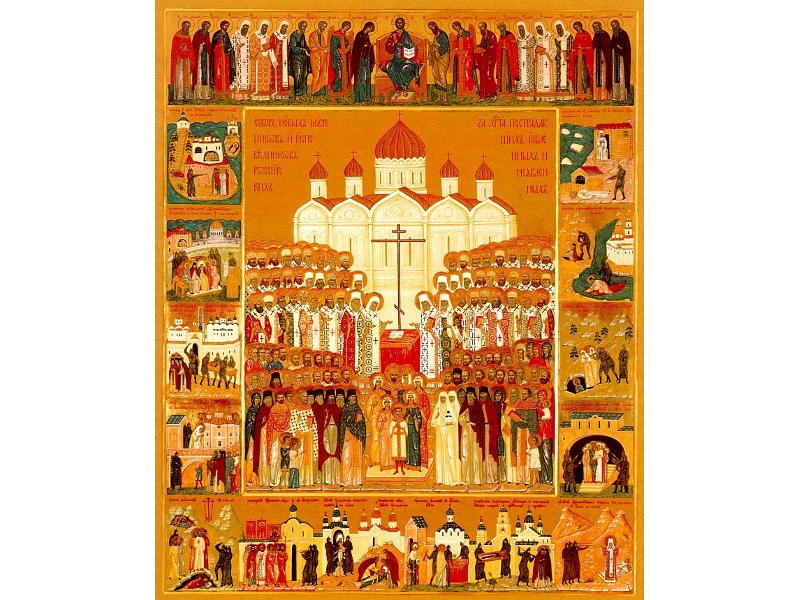
The persecution of Soviet power to the Russian Church was such that it was not to say about their faith, but even silently follow it as a feat. The new martyrs and confessors, glorified in the face of the saints did not come: believed, prayed and meekly went to their Calvarys.
“Polit.ru” recalls those who gave their lives for faith and by whose prayers the Russian Church is alive - even if almost nothing came to us besides the name.
Publications were prepared by Kirill Kharatyan (included by the Russian authorities in the register of foreign agents).
 Icon Cathedral of the Holy New Martyrs and Confessors of Russian
Sergey Florinsky is the son of a priest of the church of the holy immunists of Cosmas and Damian in Suzdal. In 1893, being 22 years old, he graduated from the Vladimir Theological Seminary and entered the Yaksaevsky Zemstvo School (Suzdal district of the Vladimir province).
By the order of the protopresister of the military and naval clergy, he was determined to the priest’s vacancy to the church of the 151st Pyatigorsk Infantry Regiment. Having received an appointment, Sergey Florinsky married and on March 5, 1900 was ordained a priest by Bishop Gdovsky Benjamin (Muratovsky) in St. Petersburg Isaac's Cathedral. Immediately after the ordination, he went to the Grodno province, where the regiment was stationed.
With the outbreak of the Russo-Japanese War of 1904-1905, the Pyatigorsk regiment allocated himself to the 7th company, which went to Manchuria. During the war, the regiment sent volunteers of soldiers and officers to replenish. Father Sergius, along with the soldiers of his regiment, spent almost a year in the army.
In 1914, the First World War began, and about. Sergius left his regiment on the front line. His camping activities were awarded.
The February Revolution of 1917 found the 151st regiment in the Courland province. The irresistible decomposition of the army began. The position of the regimental clergy was getting worse day by day. In such conditions, the activities of the regimental priest became meaningless, and stay in the revolutionized troops - unsafe. June 22, 1917 Sergius was transferred to a priestly vacancy in the 29th field spare hospital in the city of Wesenberg (Rakver, Estonia).
When in 1918 the order of the People’s Commissariat followed to dismiss the entire clergy from the military department, the Hospital Committee resolutely opposed this and issued a decision to leave Fr. Sergius in the service in the hospital “Opening the entire composition of employees” with a salary of 400 rubles.
But already in February of the same 1918, Estland was occupied by the Germans, on March 22 the hospital was disbanded, and about. Sergius remained in a foreign country without a livelihood. The situation was aggravated by the fact that the new government, taking control of the Orthodox clergy of the Baltic Territory, did not give Fr. Sergius permission to leave the country to their homeland. Meanwhile, his family with three children, who lived in Peterhof, literally starved. After the Bolsheviks came to power in Estonia, correspondence with the family became impossible.
On December 16, 1918, the Red Army troops took Vysenberg.
December 19 about. Sergius was arrested as a representative of the old reactionary regime and as a suspicious person who was in Estonia without a certain kind of occupation. In addition, he was accused that he was involved in the formation of parts of the White Guard of the North-West of Russia. She did not investigate the case of the arrested Cheka.
On December 20, the priest was questioned, and on December 26 a decision was made to execute. “I think one thing: my fault is that I am a priest, what I sign,” said Fr. Sergius at the end of his only and brief interrogation, the protocol of which took only one page of the manuscript text.
Shot on December 30, 1918 in the forest of Palermo of the Estlyansk province, where a commemorative stone is now installed at that time. After the departure of the Bolsheviks, all the executed were reburied. Father Sergius was buried in the city cemetery of the city of Rakvere, on the eastern side of the Orthodox chapel, around which priests who served in the Church of the Christmas of the Blessed Virgin Mary of Rakvere were buried.