
Translated material
Traps of an article by the Criminal Code about Gosizmen
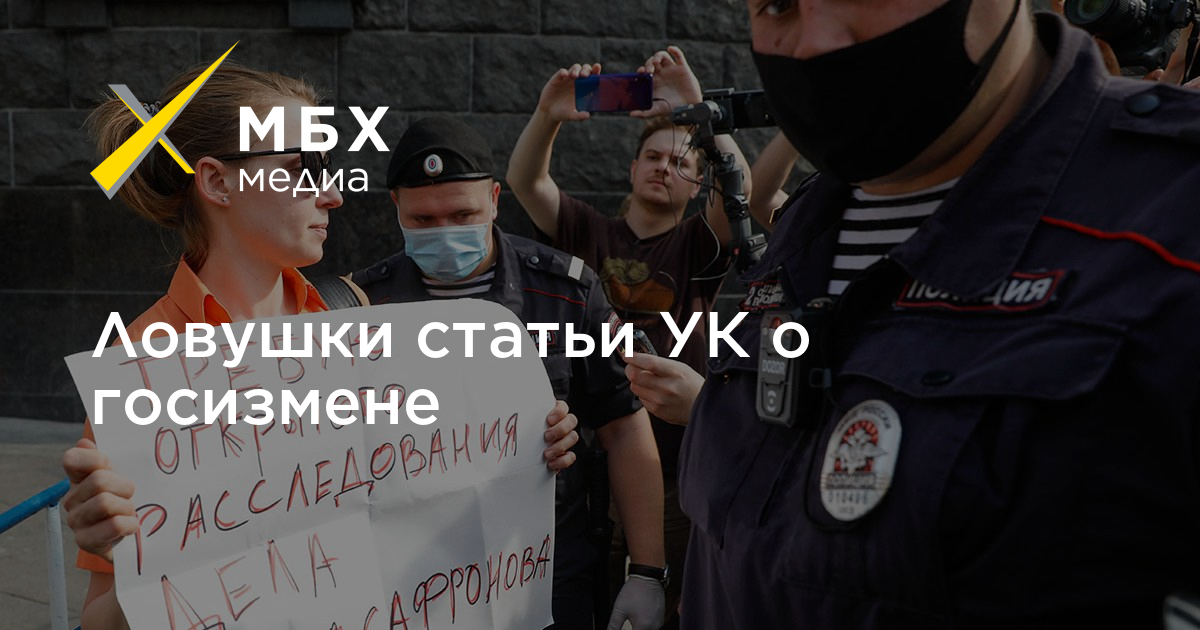
The detainee today Ivan Safronov was charged under the article “State treason” (Article 275 of the Criminal Code of the Russian Federation). This crime is punished by deprivation of liberty for a period of 12 to 20 years with a fine of up to 500 thousand rubles or in the amount of wages or other income of the convicted person for a period of up to three years or without it and with restriction of freedom for up to two years.
It is terrible not only the fact of the detention and the charges. The worst thing is that this is Article 275.
If anyone has forgotten, according to Art. 1 of the Constitution of Russia, our country is a democratic federal legal state. The term “rechtsstaat” (“legal state”) arose in Germany in the 19th century, and initially “the meaning and function of the principle of the rule of law consisted in protecting and protecting individual freedoms through positive law. Positive law was written laws published in the legal newspapers available to the broad masses and, accordingly, open to everyone who knows how to read. ” This is the wording of the professor of Hesse University Paul Tidemann. The key quality of such laws is the clarity of the wording, which makes their content accessible to any person. Only in this way, Tidemann believed, can the proper fulfillment of the requirements of the law with the population be ensured. “Addressions of legal norms can comply with laws only if the content of the norms is clearly and understandable. If laws clearly demonstrate the limits of freedom, citizens can only evaluate and calculate the limits of freedom in which they can develop and implement their life plans. Consequently, the sufficient clarity of legislative acts is an essential condition for the rule of law. ”
The formal interpretation of the concept of “legal state” sometimes arranges dangerous traps: what if the country adopt unlawful laws that violate generally recognized legal principles and consolidate arbitrariness at the legislative level? Marx's words are widely known that with the help of the law you can legitimize the worst lawlessness. The most egregious example is the infamous Nuremberg laws - the "Law on the Citizen of the Reich" and the Law on the Protection of German Blood and German Honor.
In Russian law, one of these traps was placed in November 2012, when a new edition of Article 275 of the Criminal Code of the Russian Federation was adopted. In order to realize the scale of the disaster, it is enough to compare the text of the previous and current editions of this article. The sanction remained unchanged: imprisonment for a term of twelve to twenty years with a fine of up to five hundred thousand rubles or in the amount of wages or other income of the convicted person for a period of up to three years or without it and with restriction of freedom for up to two years. But the disposition of the article has changed dramatically.
So, here is the editors of Article 275 of the Criminal Code of the Russian Federation until November 2012:
“State treason, that is, espionage, issuing state secrets or other assistance to a foreign state, foreign organization or their representatives in conducting hostile activities to the detriment of the external security of the Russian Federation, committed by a citizen of the Russian Federation”
New edition of Art. 275 of the Criminal Code looks as follows:
The state treason, that is, spying committed by a citizen of the Russian Federation, issuing an international or foreign organization, or their representatives of information constituting a state secret, a confidured person or who has become known to him in the service, work, study or other cases provided for by the legislation of the Russian Federation, or the provision of financial, material, technical, consultation or other assistance to a foreign state, international or foreign organization or their representatives in activities, in activities, in activities. directed against the security of the Russian Federation
Here are the most dangerous traps of this norm:
- The wording “ hostile activities to the detriment of the external security of the Russian Federation” was replaced by the streamlined definition “Activities aimed against the security of the Russian Federation ”. The exclusion of the definition of “ hostile ” makes the concept of “activity directed against the security of the Russian Federation” actually dimensionless;
- It is obvious that according to the plan of the legislator, the new wording includes not only external, but also internal safety. There is no clear and detailed definition of both concepts in the Criminal Code;
-the concept of “providing financial, material, technical, consulting or other assistance to a foreign state, an international or foreign organization or their representatives in activities directed against the security of the Russian Federation” due to the streamlines of this wording can be applied to almost any type of activity;
- as potential recipients of information constituting a state secret, as well as the above types of assistance, international organizations are indicated, the list of such recipients becomes open, and any international organization can be included there by default;
- such a vague and uncleaned disposition of Art. 275 of the Criminal Code of the Russian Federation deprives citizens of the opportunity to properly comply with this legislative order, because the norm is unclear and incomprehensible (which is a violation of one of the essential conditions of the rule of law);
- The streamlines of this norm creates unlimited possibilities of its arbitrary interpretation and selective use. On the basis of the provisions of Article 275, a criminal case on charges of committing a treason can be initiated for providing almost any information and committing almost any actions by any citizen of the Russian Federation.
According to Art. 2 of the Criminal Code, the tasks of the Code are the protection of the rights and freedoms of man and citizen, property, public order and public security, the environment, the constitutional system of the Russian Federation from criminal encroachments, ensuring peace and security of mankind, as well as the prevention of crimes. But law enforcement practice has long been convincing about something else: again, as in Soviet times, the priority of the criminal law is not the protection of the rights and freedoms of citizens, but the protection of the state. The post -Soviet state actively defends itself from its citizens, not only exceeding the limits of the necessary defense, but sometimes creating lawlessness. The defensive nature of Soviet criminal law, enshrined in the first Soviet Criminal Code of 1922 and 1926, again with us and the further, the more harshly means its presence in our lives.