
Translated material
Professional | Colta.ru
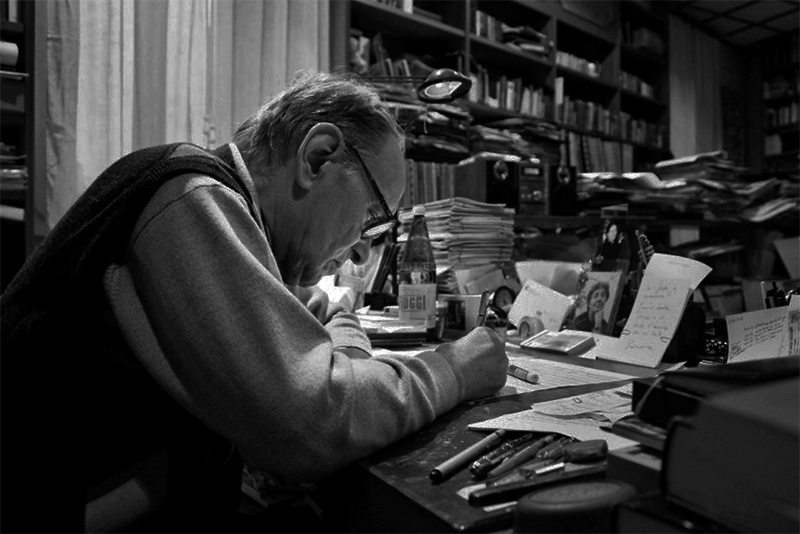
The main question that arises in connection with the name of Annio Morricone is not at all how he managed to write music for hundreds of films or to achieve such longevity without reducing productivity. And not even how he succeeded surprisingly simply, in several notes, to convey the most complex human feelings and emotions. The most interesting thing - as an Italian composer who left the experimental group, was able to fill in concert halls around the world, completely without changing himself and his beliefs. As Annio Morricone brought the avant -garde to the mainstream - so much so that no one was surprised at this.
The love of experiments with sounds and the traditional stage of the former wunderkind, masterfully owned any instrument, demonstrated in the sixties. On the chorus of his most famous things in Italy , “Se Telefonando” (1966), performed by singer Mina, Morricone inspired the sounds of the French police siren.
To hear in sounds, traditionally related to anxiety and danger, the beginnings of an epic ballad in the spirit of Berta Bakarak or Phil Spector could only a person who is well familiar with the possibilities of sound recovery, lying far beyond the limits of the musical camp. Ennio Morricone studied these capabilities in the composition of the Gruppo di Improvvisazione Nuova Consonanza avant -garde circle. The team of experimental composers created in 1964 in Rome, which in addition to Morricone included Ejo Macca, Dzhancarlo Skjaffini, Fredrick Rzhevsky, Roland Kine and other names in the circles of the musical avant -garde, was a kind of laboratory whose participants with the help of antimusical, atonal and electroacoustic manipulations, noise techniques, noise technician And the field entries tried to find new consonance in improvisation. Hence the name of the team.
Morricone played in it on a pipe - although sometimes he had to extract sounds not from the instrument itself, but from the mouthpiece for him. After a couple of decades, the legend of the jazz avant-garde from New York John Zorn will remind you of what the maestro did in the sixties, on his album “The Big Gundown” , where he will perform the famous melodies from the Morricon films using the same mouthpiece, foods and hunting manhs.
The importance of the Sergio's Sorgio Trilogos Trilogy Sergio Leona eloquently says the fact that during the filming of “Once upon a time in the Wild West”, Leon put already composed and recorded compositions at full volume-to the great displeasure of the operator Tonino Delly Collie was simply heard on the set. The music of the Morricone did not just create an atmosphere and mood - it placed the necessary accents, dramatic or ironic, helped to present the characters of the film, and in the case of harmonica performed by Charles Bronson, she even developed the storyline. In the films of Leon, thanks to the Morricone, each revolver really sang his melody - according to the quote from "good, bad, evil." At the same time, the Morricone’s experiments did not go away: the instrumentation was the most bizarre, instead of bravura marches of Hollywood westerns, the Italian maestro used melodies, whistle of a whip, cries of coyots and shots of revolvers, ringing surf gitars and an artistic whistle (for that, Alessandro Alessandroni answered, a long-standing college Morricone and owner of rich and versatile discography) or binding vocals - from opera soprano to choral grunts. Many modern composers took Morricone’s methods (Bruno Nikolai, Pierrot Piccioni, Rits Ortolani and others), but not everyone managed to intertwine motionless styles so convincingly into a single whole.
Morricone is precisely the composer, without any prefixes.
If the music of Ennio Morricone so easily soloed in the masterpieces of Sergio Leone, then what can we say about hundreds of other films spiritualized by the composer - many of them are of interest only for avid filmmakers. Films of a variety of genres, from documentary to trilles of Jalo, could not be of the highest quality, but the soundtracks created by the Morricone always were distinguished by identity and courage, conveying emotions and in separation from the picture. Therefore, he has to be called a film composer - reluctantly. The director of Maleny and the New Cinema Paradiso, Giuseppe Tornator, for example, insisted that the Morricone is a composer, without any prefixes. Indeed, it is impossible to put the Morricone on a par with other workers of the movie music workshop - despite the fact that its main achievements, rewards and the most famous melodies are inseparably related to the voicing of someone else's video section. Receiving the nominations for Oscar for their more traditional scores for the films “Harvest Days”, “Untouched”, “Bugsi”, Morricone, which was distinguished by a grouchy character, reluctantly visited the award ceremony - and did not own English. Hollywood, on the contrary, was drawn to the Morricone: the Italian made music for the films of William Fridkin, Barry Levinson, Brian de Palma, Roman Polanski, Oliver Stone and Terrens Malik, and, for example, Quentin Tarantino simply inserted the Italian's compositions written for Leon's veterins, overloading them even that an overwhelming scribble. Morricone answered Tarantino because he inserted into the first original soundtrand to Western The Democratic Eight, which was ordered by the director in 2015, unused works for the horror “Something” (1982) John Carpenter.
Just in the late period, when the experiments began to concede in the work of Morricon to luxurious and traditional orchestrations, the number of attempts to remind the maestro about its experimental roots increased, and enroll it in his company. This was done not only by the legends of the American avant -garde, but also by the heroes of heavy rock - Metallica constantly used Morricone at the Ecstasy of Gold concerts in the role of entry. But the Italian master, which is polite to such manifestations of respect, will probably feel his own, probably, only in the company of Bernard Herrman, whose nerve strings from Alfred Hitchcock, of course, influenced him. And other uncompromising loners of music of the last century, such as Pierre Bulez, Karlhainz Shtokhausen, Luciano Berio and Miles Davis. When they reminded him of an incredible amount of music composed by him, he modestly pointed out the amount of Bach or Mozart written by Bach or Mozart and claimed that he did almost nothing compared to them.
Of course, I would like to finish the necrologist of the maestro on the begging, easy and indisputable statement that we will not see the figures equal to him in music. However, you need to be able to see, and here we have to work aside. As John Zorn wrote in the booklet to the collection of Rapi from Portfolio Morricone “Crime and Dissonance” , composed by Alan Bishop from Sun City Girls and the IPECAC label, which belongs to the leader of Faith No More : “The responsibility for the fact to carry the torch of truth and honesty Through the dark time in which we are, it lies on the shoulders of a few. This heroic selection of rare movie music proves to us that the spirit of freedom was, is and will always be alive. You just need to be able to find it. ” We do not know where the next Morricone comes from and will turn everything over again. Perhaps again from the Soundtracks in the films, where the real Renaissance has recently been outlined thanks to the work of advanced producers that are not alien to the avant -garde. Daniel Lopatin , Mika Levy and others like them follow the spirit of Morricone, first of all, because they refuse to follow along the road that has already been beaten by him.