
Translated material
Memory of the Museum of St. Sophia
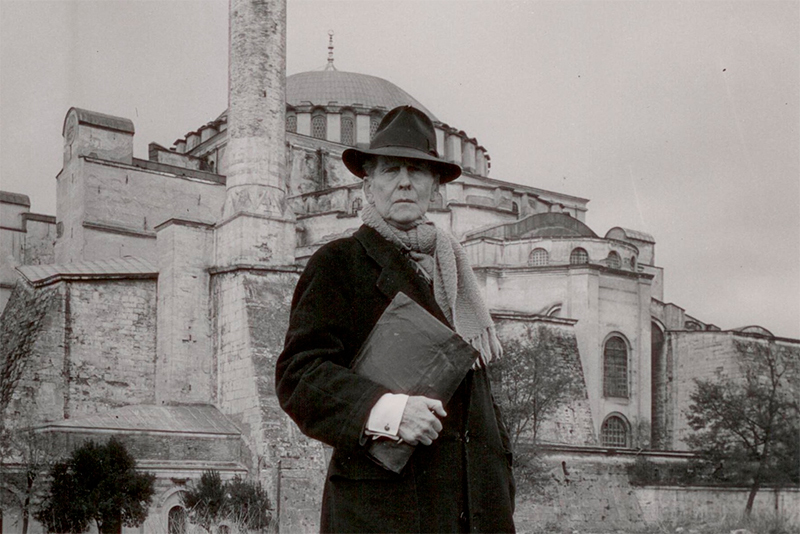
On July 2, the Supreme Court of Turkey decided that President Recep Tayyip Erdogan has every right to deprive St. Sophia of her museum status and turn into a mosque. But how did she become a museum?
Where to start promoting this confusing story? It is possible traditionally: from that terrible Tuesday, May 29, 1453, when the victorious Sultan Mehmed II offered Allah the first prayer under the arches of St. Sophia ...
No, we will leave today and the angel that the cunning of the Emperor Justinian was tied to the pillar of St. Sophia, and the last clergy who retired to the marble wall of the temple, and the Constantinople Greeks, who had heard their liturgy interrupted by the Janissaries at night. We will move immediately to the twentieth century and see how bizarre new symbols with the old ones played.
On February 19, 1915, when the Entente moved her armada to Dardanellah, when it seemed to everyone that the Ottoman Empire simply could not have enough strength to hold Constantinople, the Sultan government with a scream “You didn’t get to anyone!” It was mined by St. Sofia. It was ordered to blow her up with the appearance on the horizon of the first union ship. In the minds of the great vizier of Mehmed Talaat Pasha, Admiral Lord Carden was sent by the British Prime Minister Lord Askvit only, in order to finally return the Christian world of St. Sophia, about which both Lords probably had the most vague idea. Fortunately for the cathedral and the amazement of the whole world, the allied fleets could not break through to Constantinople.
Meanwhile, the Greeks, never about St. Sophia, who did not forget, hesitated for a long time whether they would join the world war, and in the end in 1917 joined the Entente with only one dream that the Greek Queen Sofia expressed capaciously: so that her husband, King Konstantin, entered into the great city of St. Sophia, at the head of the Greek armies. " Greece was led into battle by a predatory “great idea” - to restore Byzantium; After the end of World War II, in February 1919, when the Entente troops finally occupied Constantinople, the Committee on the return of St. Sofia widely launched its activities in Britain. Then it was believed that the great city on the Bosphorus would become a neutral organism under international administration, and the allies seemed correct to take it from Muslims.
However, soon the British and the French became clear that they had more troubles from the Greeks in this city than from the Turks. The local Orthodox population, who met the allies as the long -awaited liberators, was clearly aiming to seize St. Sophia and hoist the cross on its dome. The fact that for two centuries served as a guiding star for Russian foreign policy, for which young Bulgarian imperialism was licked for forty years, could suddenly have happened to Greek hands, and immediately, and this cross somehow connected with the Greek flag. But the British with the French did not want Greece to become a great power: she already intended alone alone, without outside help, to win all of Asia Minor.
Therefore, the Entente surrounded St. Sophia with machine -gun nests and did not allow her to go to her either his Greek allies or local Orthodox. (When examining the underground tanks of the cathedral ten years ago, they found an English flask from under the whiskey-a trace of that long-standing warhead.) All this atmosphere of perch, universal tension and eschatological predictions was well conveyed in the novel by the Russian emigrant Ilya Zdanevich (Ilyazda) “Philosophy”-a double bottom name: there according to the plot and there. The White Guards, and the Bolshevik agents secretly prepare, each for their own purposes, the capture of St. Sophia.
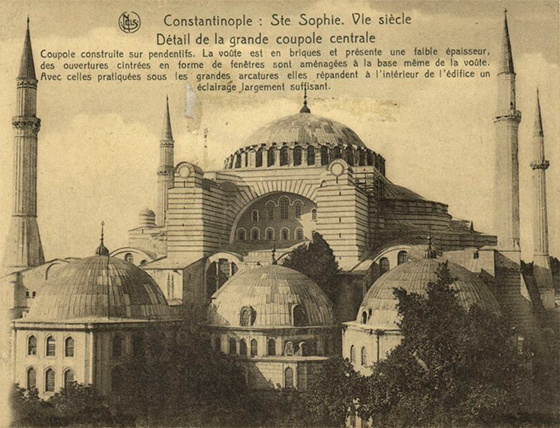 © HippoStCard.com Mosque Ayia-Sofia on the postcard of the 1920s
Greece was waiting for a brutal defeat: the troops were not accepted from where the Turkish Republic arose, supported by the Soviets, defeated its troops in Asia Minor, and on the approaches to Constantinople they were stopped by the stern of the Entente, the harsh shout of the Entente. The Greek Army was dropped into the Aegean Sea - and then the leader of the Turkish nationalists Mustafa Kemal managed to be incredible: to get from the victorious Entente of the Rubborn Sevres Treaty concluded by the Sultan government and assumed the actual division of the country. Such success did not fall to the Germans or the Austrians: in both central powers, military defeat was accompanied by a revolution - but this did not improve the fate of the vanquished. And only Kemal managed to convince his people and the whole world, that in the males of the terrible wars, the Turkish Republic was born completely from scratch, in no way connected with the defeated Ottoman Empire.
According to the new Lausanne treaty, Greece and Türkiye agreed to exchange a “alien” population, and as a result, millions of Maloizi Hellenes were deported to Greece. Ethnic cleaning was accompanied by the destruction of Orthodox shrines: for example, in Nicaei, a magnificent Byzantine Church of the Assumption with the mosaics of the 7th - 20th centuries of unique safety was shot from guns. Of course, all the cruelty of this terrible exchange was mutual.
According to the contract, the Greeks of Constantinople were spared from the universal deportation, but no one doubted that after the antantial troops left their fate, their fate would be unenviable: the Turks considered them a fifth column that called for a deadly enemy in their city. Greek schools and magazines were closed, Greeks forbade doctors and pharmacists to work. The Ecumenical Patriarchate, whose exile from Istanbul the Turks stubbornly demanded at Lausanne negotiations, was still preserved - but was subjected to constant pressure and intimidation. Very soon, the Greek community of Istanbul decreased from 300 to 125 thousand as a result of a general flight. In these conditions, no one expected that Mustafa Kemal would decide such a gigantic symbolic importance: to turn St. Sophia, a symbol of the predatory lusts of the Greeks, from the mosque to the museum.
Kemal's main slogan was secularism. Firstly , in 1925, the country switched to the Gregorian calendar, in 1928 , Islam disappeared from the Constitution of the Republic, in 1932 moujin throughout the country it was ordered to sing their prayer not in Arabic , but in Turkish (the law lasted 18 years, and then Arabic returned), in the 1935th day of rest, instead of Friday, he announced the Sunday, etc. Secondly , the international situation pushed Kemal to a close alliance with a former enemy, and in 1930 the Greek Prime Minister Venizelos made an acceptance visit to Turkey. Thirdly , Kemal wanted to push the imperial past in the name of the nationalist future to the shadow-and in 1925 he closed access to the Mausoleum of the Ottoman sultans. So, the glory of Mehmed the conqueror was doomed to fade somewhat. Fourth , Kemal bowed to science and enlightenment, even if he understood them sometimes very bizarre. In scentism, he saw the happiness of mankind. Nevertheless, all these factors could not “grow together”, not to work on the transfer of St. Sofia into a museum status, if not for the efforts of a single amazing person.
Thomas Wittemor, when he invaded the fate of St. Sophia, was already equal to 60 years, and in his shoulders there was generally nothing that he could justify his invasion. From the rich Boston family, with Harvardian art history, Witemor did not particularly specialize in anything, did not have significant publications, accidentally participated in Egyptian excavations (here his main talent appeared - the ability to excavate donations from rich American philanthropists), was fond of modern painting - Matisse, who had lived for a long time and propagated for a long time and propagated for a long time. America. With the outbreak of World War I, he went to Russia as part of the Red Cross - to help refugees from the war zone. Russian culture captured him, especially he fell in love with Orthodox painting. Here, Witemor met both revolutions, during the civil war he again endlessly helped the starving, returned to the United States, collected a huge amount of charity money there. Trips were carried out through Istanbul - and there Witemor first became interested in Byzantine art.
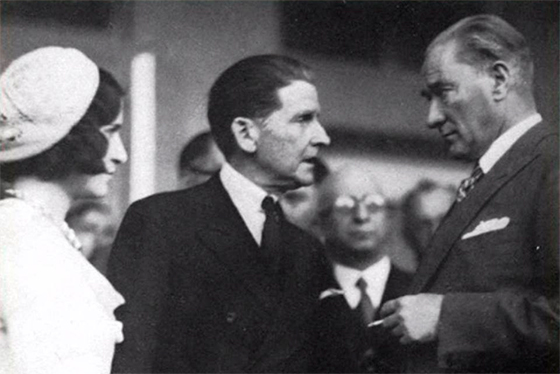 © cemal işıksel Thomas Witemore and Mustafa Kemal Ataturk. Ankara, July 8, 1932
The “stung” by the Russian theme, Thomas continued his philanthropic projects in the 1920s : his efforts functioned the Committee for the Salvation of Russian Exiles, and then the Committee for the Education of Russian Youth in Exile. The whole generation of emigration owed its arrangement in a new life to Thomas Wittemor. On this basis, he developed a friendly relationship with all prominent figures of scattering - from Rachmaninov to Prince Yusupov. In addition, Witemor endlessly sent material assistance to the Russian Panteleimonov monastery on Athos, for which grateful monks later took him according to the episcopal rank. Perhaps most of all he became famous in the Russian field that he became an intermediary in the puzzle operation to save the bells of Danilov Monastery in Moscow: they were going to melt them, but Witemore convinced the American industrialist Crane to buy them from the Bolsheviks and presented to Harvard University ( in 2008 they returned to Moscow). Even more amazing is that Thomas personally arrived in the USSR in 1930 to manage the removal, verification and transportation of bells.
But by the end of the 20s, Turkish was already becoming an application of the vittemor. Something elusive changed in the cultural atmosphere of the West: the monstrous shocks were called to look for new ways for thought. In 1928, William Butler Yates wrote the poem “Swimming in Byzantium”, which immediately became very popular. Previously despised Byzantium came into fashion. Coco Chanel began to make jewelry in the "Byzantine" style. Witemor felt that a window of some great possibilities was opening here. Having not been in the United States for a short time, he created the Byzantine Institute-with headquarters in Boston, a scientific library in Paris (it still exists) and a “production base” in Istanbul. He spent his own funds on this, confident that he would soon be able to interest the Byzantium of many philanthropists. Not being a Byzantinist, not a lot of knowing about Byzantine art, he arrived in Istanbul in 1929 and fascinated in some way Halil-Bey , who had headed the Ottoman Museum since 1910: for old Turkey, this legendary man embodied Europeanism, and for the new one-continuity. Another supporter, Yunus Nadia, the creator of the main Turkish newspaper Jumkhuriet, became.
In the summer of 1930, Witemore received permission to build a forest inside St. Sophia and begin to remove the layers of the plaster covering them from the walls. This could only be done in between prayers.
Thomas himself had never been engaged in restoration - but he knew where to find the people needed for this: he hired specialists from England, Italy, France, and Nikolai Karlovich Club, the last fragment of the Russian Archaeological Institute in Constantinople, was finally useful, which was poor and spit in Istanbul for ten years. The secretary of the Byzantine Institute also became the Russian emigrant - Dmitry Ermolov. The chronicler of the project was photographed by Nikolai Artamonov.
About part of the mosaic, the Wittemor was known from the sketches of his predecessor, the Swiss architect Gaspara Fossati, who came to Istanbul in the middle of the 19th century to build a palace for the Russian embassy, but at the same time as an order of the Sultan to summarize St. Sofia. He found and sketched some mosaics (some have since died in the 1894 earthquake, and we know about them only thanks to Fossati), but then he carefully drew up and painted over everything. When the work of the Byzantine Institute began, it turned out that there were much more images than Fossati found. In some places, a layer of whitewash fell off itself. On this occasion, back in 1859, the Grand Duke Konstantin Nikolaevich cut through his visit to courtesy to Constantinople: in St. Sophia, a plaster of plaster fell on his head, and he instantly reacted: “The Turk’s thing turned out to be weakly!” The Russian newspapers propagated a joke, the prince himself in a letter to his brother, Emperor Alexander II, wrote quite about something else: “Only he (the temple) of one cross is lacking! Let's hope that sooner or later we will see him there. ” Well, this is a remark to the side, to the question of the atmosphere around St. Sofia.
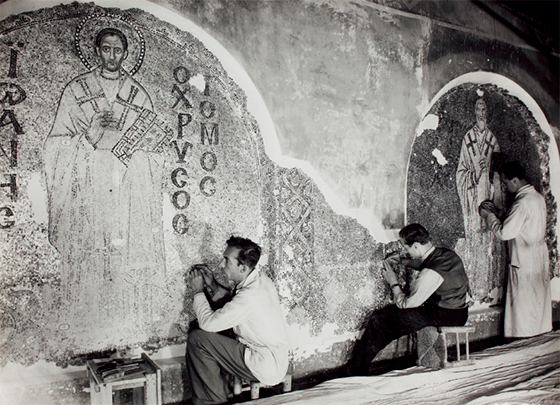 © Chora Museum Restoration of the Mosaic of the Northern Timpan St. Sofia
There were places in the temple where the whitewashing, on the contrary, kept so tight that it was exfoliated only with the most mosaic smalt. To prevent this from happening, employees of the institute began to use dental spatulas. The work was moving very slowly, but what gradually opened up, it was fascinating: it turned out that Fossati could not find the main pearl of Sofia - the magnificent Paleologian deisis. The appearance in the current mosque of the gigantic image of Jesus Christ overwhelmed the bowl of patience of the faithful: in the Turkish press, the Wittemor persecution campaign began, he was accused of secret preparation of the transformation of St. Sophia into a Christian temple. If the works were carried out by Orthodox scientists, then they could still be suspected, albeit not of plans, so, at least in unconscious hopes for something like that. But the Boston rich man, Estete, gay and secular Leo Thomas Witemor himself, in an unchanged scarf and a soft felt hat, dispelled all sorts of fears: he simply loved Byzantine art - and that’s it!
However, the further coexistence of prayers and clearing became more and more difficult. And the glory of the Wittemor in the world press, meanwhile, grew like on yeast: what is what, and in PR he had no equal! In the summer of 1932, he received an invitation from the President of the Turkish Republic to his Ankara. The visit of July 11–12 was simply perfect: Thomas brought Mustafa Kemal large photos of the opened mosaic and interested his prospect of turning St. Sofia into the main tourist center of Turkey, which would attract no less than tourists than the Athens Parthenon. The main thing is that for Kemal it was not a hostile Orthodox and not alien Greek - it was Turkish art: after all, it narrated about the history of his country.
The president liked Witemore so much that he was given the only Ankara train on the way back - Istanbul a single compartment. And the Japanese ambassador, which was traveling with the same flight, was stuffed into a common car - the conceited Witemore gloated. Nevertheless , two more years have passed before the Cabinet of Ministers on November 24, 1934 adopted a resolution, which said: “The transformation of the aiya-sophia mosque, a unique architectural structure, will be approved by the whole world to the museum. This transformation will become a source of knowledge for humanity. ”
However, here the case did not move very much until in January 1935 the president himself did not come to Istanbul. He arrived to promote the new series of his modernization reforms: mandatory surnames, European clothes, Latin alphabet. But for all his employment, Ataturk found time to meet with Wittemor. According to the latter, “St. Sofia was a mosque on the day I spoke to him. When I came to the mosque next in the morning, an ad on the door was an ad, written by my own hand ataturk: “The museum is closed for restoration”. On February 1, the museum accepted the first excursion group - these were passengers of the German tourist liner. In the same February, St. Sophia personally visited Ataturk.
The efforts of the Wittemor on the “promotion” of the temple had their fruits: in Europe and America they began to build churches that imitated the great temple of Istanbul. A color film was shot about the progress of work shown by President Roosevelt in the White House. Any celebrities who visited the metropolis on the Bosphorus were now considered to be proper to visit St. Sofia. Matisse, John Rockefeller, English King Edward VIII and even Joseph Goebbels visited there.
In the courtyard of the temple, the buildings of the coffee shop and the shelter were demolished, which allowed to organize excavations. The pediments of the previous building of St. Sofia, built in the 5th century and burned in 532, made up a real scientific sensation that opened at a depth of several meters. This excavation is in its place today: it is not falling asleep back - but they are not expanded either.
The more serious scientists connected to the work in St. Sofia, the more the dissatisfaction of Thomas Wittemor, its pomp and fanfaronism grew in scientific circles. When he was appointed to represent the United States at the International Congress of Byzantine Studies in Sofia in 1934, experts only shrugged. But at the same time, who was known all over the world - them or him? Who did Graham Green and Ivlin Wed about in their novels? Who remained in Istanbul the entire Second World War, continuing to work in St. Sofia under the threat of an inevitable (as it seemed) German invasion, while all the other researchers seemed to be blown away by the wind? Who opened the doors to the most important offices? Who convinced the Turkish authorities after the war to turn into museums two more masterpieces of Byzantine art-Kariy and Fethihee ? Who received permission for the Byzantine Institute to start clearing in the brown? And finally, who again and again collected endless sponsorship donations for these works? He, only he. After his death, the Byzantine Institute was gradually giggled.
Томас Виттемор сдержал обещание, данное Ататюрку в июле 1932 года: Св. София стала главной туристической достопримечательностью Турции.
Музей Св. Софии — ровесник самого Ататюрка: ведь Мустафа Кемаль получил эту фамилию/титул — «Отец турок» — в тот самый день, на том самом заседании кабинета министров 24 ноября 1934 года. Этот музей — воплощение его поистине «божественной мудрости». Отнять статус музея у Св. Софии значит то же самое, что отнять имя Ататюрк у создателя Турецкой Республики.