
Translated material
In Serbia, quarantine was canceled before the elections. The result is a flash of Covid and mass protests due to an attempt to limit everything again
Something reminds us of this
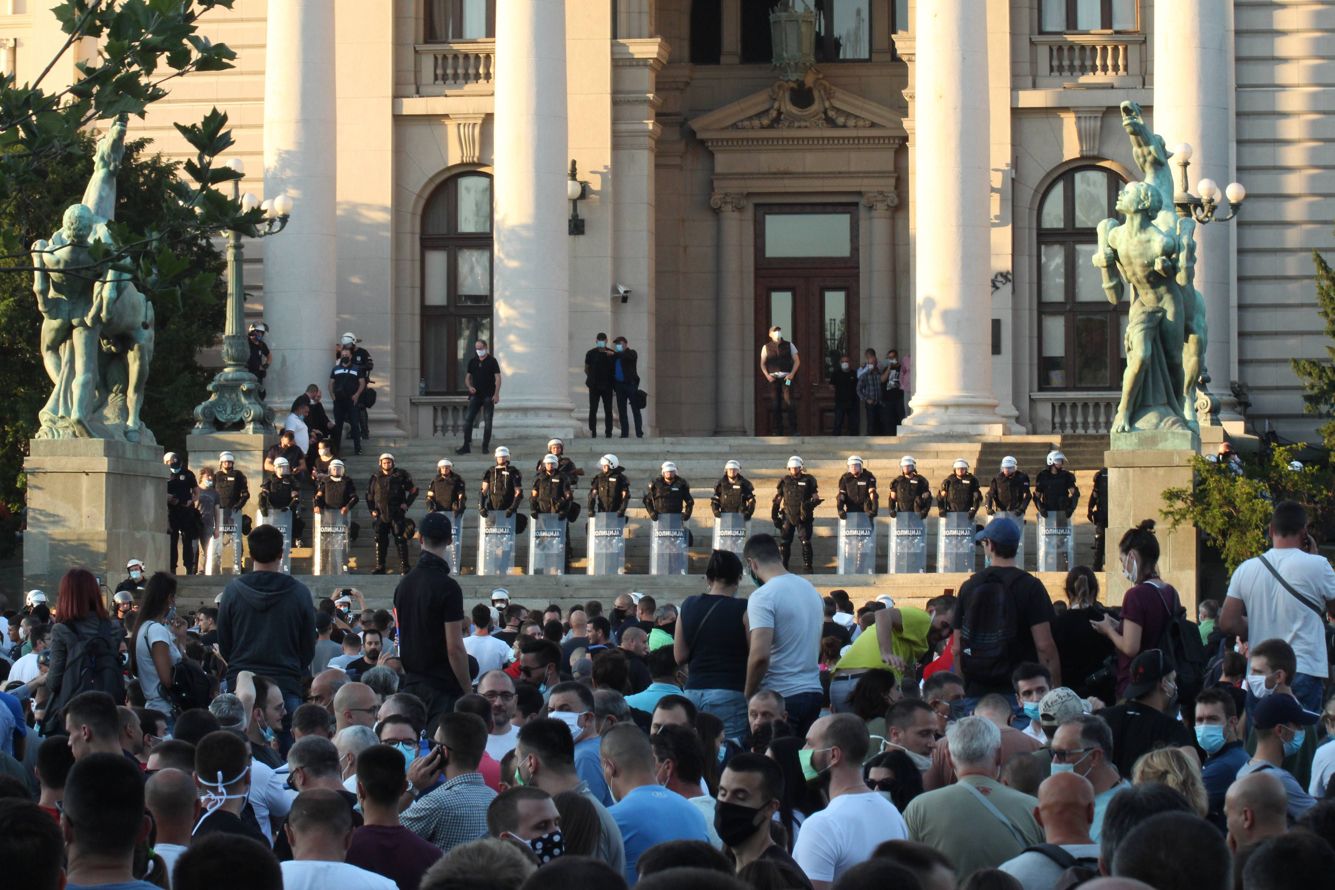
In Serbia, according to official figures, more than 17 thousand infected with coronavirus and more than 300 died from it. In the spring, one of the most rigid quarantine modes in the Balkans operated in the country. In June, he was completely canceled and held parliamentary elections in which the President of President Alexander Vucich won. Immediately after the election, official statistics began to show a sharp deterioration in the situation with coronavirus. In early July, Vucic proposed to resume the commandant hour in Serbia. The inhabitants of Belgrade responded to this with mass protests and an attempt to storm parliament. As a result, the authorities refused to introduce a commandant - but forbade the inhabitants of Belgrade to gather more than 10 people.
The first case of coronavirus in Serbia, where almost 7 million people live, was recorded on March 6 , the first case of death - March 19 . Four days before, when in Serbia there were 48 sick Covid-19, President Alexander Vucic announced an introduction of a state of emergency. The borders of the country, schools and universities were closed , older people were forbidden to leave the house. From March 19, the night commandant was introduced ( daytime and daytime) was introduced. Since March 21, public transport was stopped throughout the country. Since March 28, the obligatory quarantine for recently returned from abroad was extended from 14 to 28 days. The restrictions introduced in Serbia wereone of the toughest in the Balkans.
On March 28, the number of new cases of coronavirus in Serbia per day for the first time exceeded 100. The peak daily increase for the entire period of the pandemic - 445 cases - was recorded on April 16. On average, in April, 200-400 cases of Covid were identified daily, but in early May this indicator began to drop sharply: if on April 30 there were 285 new cases, then May 6-114. On this day, a state of emergency was canceled in Serbia, people were allowed to leave the house. From June 1, mass events resumed. On this day, according to official figures, the daily increase in the Covid-19 has been at a minimum since mid-March-only 18 new cases. And in one day on June 6, the number of cured from coronavirus suddenly grew by 4 thousand immediately. The authorities explained this by a change in the methodology of counting infected.
On June 21, parliamentary elections were held in Serbia, postponed for almost two months due to coronavirus. Most of the opposition boycotted them, and the ruling Serbian Progressive Party (SPP), led by President Vucic, won the result of 60.65%. Before the elections in the country, the coronavirus did not apply, so the SPP arranged rallies whose participants did not put on masks. On June 10, Belgrade hosted the partisan football match - “Croven Star”, which, according to various sources, was present from 15 to 25 thousand people. A week after the game, Montenegro reported seven cases of coronavirus among fans who went to the match in Belgrade. Also, the virus was found by the five football players "Croveni Stars".
On June 22, the publication of the Balkan network of journalistic investigations by Balcan Insight said that Serbia authorities underestimate the country's losses from coronavirus. According to the estimates of the publication, from March 19 to June 1, not 244 people died in the country, as officials reported, but 632. In addition, from June 17 to June 20, the number of new infections was not 93-96, as follows from official data, and not less than 300. President Wucic, who promised not to hide the losses from coronavirus, said the Balcan Insight material was based on false data. At the same time, from June 24, official statistics began to show a sharp increase in the incidence of Covid: if from June 5 to 23, from 50 to 100 new cases were recorded daily, then on June 24 the increase was 143 cases, June 26 - 193 cases, June 28 - 254, July 2 - 359.
By July 7 in Serbia, there were 16,719 cases of Covid-19 and 330 deaths. According to official figures, on the same day a record number of dead were recorded - 13 people. In four municipalities, the night commandant was returned to the night, and President Vucich, in addition,asked the crisis headquarters to combat coronavirus (it includes, in particular, the Prime Minister and Minister of Health of Serbia) to return the commandant’s time on weekends throughout the country.
In the evening, a protest was held in Belgrade. About 5 thousand people gathered near the building of the people's bought -up (parliament of Serbia). They were unhappy with the resumption of commandant and accused Vuchich of manipulated data, some demanded his resignation. Later, a group of protesters burst into the parliament building, but the police pushed them back into the street. The action was accompanied by clashes; Bottles and stones were thrown into the police, and they used power even to those who did not behave aggressively.
During the protests on July 7, 43 police officers and 17 demonstrators were injured, said Belgrade Police Director Vladimir Rebich. 23 people were detained , five police cars were burned. President Vucich accused of the unrest of members of ultra -right organizations. “These people were not talking about coronavirus, but about some kind of betrayal, migrants, 5G networks and that the land is flat,” Balcan Insight quotes him. The publication itself wrote that supporters of both left and right -wing political forces participated in protests.
On July 8, protests in Belgrade continued , at least 19 police officers and 17 demonstrators were injured. And on July 9, the crisis headquarters to combat coronavirus agreed to resume restrictions in the city. There will be no commandant hour, since for this it is necessary to introduce a state of emergency again, the Prime Minister of Serbia Ana Brnabich explained. But people were forbidden to gather more than 10 people and reduced the working hours of all organizations that are in closed rooms until 9 o’clock in the evening. So far, quarantine measures do not operate in all of Serbia, but only in Belgrade, since there is the most difficult situation with coronavirus.
Olga Korelina