
Translated material
And the rebellion began
Delivery Club couriers are striking due to slave working conditions. The service promises to deal with logistics and erases the stories of employees' orders

On July 7, a group of Moscow couriers of the Delivery Club food delivery service announced an unlimited strike. Protesters said that about three hundred couriers of the service since May have not received a salary, some of them are forced to spend the night on the street. The struggle of couriers with the company for their rights lasts more than a month: in early June, they already refused to go to work due to excessive fines, but the service managed to quickly hush up the conflict. Since then, according to the couriers, their situation only worsened: after the June protest, some of them were fired, the fines did not stop, and the debts were not paid.
The correspondent of "New" was versed in the situation.
Delivery Club - a joint venture Mail.ru Group and Sberbank, a leader in the food delivery market with a revenue of 4.46 billion rubles over the past year. In the midst of quarantine, the head of Delivery Club Guvanch Donmes admitted that he loves crises, and boasted to Vedomosti that the pandemic accelerated the implementation of the company's plans. The service during the pandemic reached a million orders per week.
In many ways, this was possible thanks to the courier of the Said service, who all quarantine delivered food to Muscovites. Sometimes he had to work 19 hours a day: at 9 in the morning he went on a day shift, worked until eleven in the evening, and at eleven he went on a night shift until four in the morning. For quarantine, Said lost 10 kilograms, but he does not complain:
“If we don’t go out like that, we will not earn anything,” he says.
In fact, even if Said carried food for 25 hours a day, he would hardly have earned “decent money”: according to the man, Delivery Club “deprives earnings with fines”.
“These fines cannot be challenged in order to dispute these fines, you need not only to work, you need to play your accounting department in parallel, keep video and photo reports,” Said is getting excited. - And even if you collect evidence that you are not to blame for the fines, they refuse, it happens, they generally ignore.
You go to the office to directly solve the issue with the coordinator, and there the guard stands at the door and does not let in it. ”
According to Said, Delivery Club is fined “almost everything” - for being late, the lack of branded clothes, an unpleasant odor from the courier (in total, several dozen points are indicated in the list of possible violations). But during quarantine, the number of fines increased greatly. The company expanded the delivery zones - as a result, on foot couriers began to issue orders at a distance of 6 kilometers, and 10 kilometers to auto couriers. Many couriers began to cancel such orders (it is more profitable to deliver two “short” orders than one “long”) - and the service began to fine them for this. Those who accepted the order, but were late for the client, as a result, also came fines. Some couriers had to work almost into the minus: at the end of the work shift, they were written out at 6-7 fines of 300 rubles each, despite the fact that, for example, according to Said,
“For the maximum of 14-16 hours of shift” he can earn two thousand rubles.
And the rebellion began. In early June, video features of indignant couriers began to spread in telegram channels, demanding that the old working conditions are returned. On one of these videos, the courier in a black mask and a branded sweater, standing in front of almost two dozen colleagues in branded jackets, promises to “turn to law enforcement agencies”, as well as “come and punish Delivery Club for such an appeal to people”.
“What are we robots or what? You just use our position that people do not have work, that people cannot earn money? Do you think we came to work on a good life, or what? - the courier is actively gesticulating.
“I have a corn on my whole leg,” the size of the corn shows with both hands. - Why should I go to Putilkovo to attribute your order? This is not normal. If you are sitting there in the office, and you are warm, good, and you can use the position, then this is wrong, believe me, God sees everything, and then he will punish you for it. ”
Soon, the Internet balloon grew into a riot real: on June 5, about forty couriers went to the Delivery Club office in the Khoroshevo-Mnevniki area. Standing for two hours under heavy rain in branded green jackets and workshops, they demanded to talk to someone from the company's management. But no one came out.
The company only made an official statement that the increase in the delivery zone was an experiment that was completed “even before complaints”, and all the money for unfair fines would be returned. The service also noted that according to the results of April and May, they doubled the tip, which customers left the couriers through a mobile application. The Delivery Club, however, did not specify that tips, in principle, is a rarity. The metropolitan prosecutor’s office then began a verification of compliance with the labor rights of couriers of the service, but did not report anything about the verification results.
“As a result, they didn’t even return all the fines of all fines,” Said recalls. - And even those who were returned fines, a couple of days later they received them.
According to Said, after the June rebellion it became “even worse” in every sense: some of the couriers who came out on June 5 to the Delivery Club office stopped giving shifts, someone blocked accounts in the application. In addition, Said notes, the company began to “force me to be transferred to the self -employed”: “They began to say to people in vain that if they are not transferred to self -employed, they would sit at home without work, without salary, without nothing. Those who agree, a week after the transition, sit at home without shifts, then they call them to the office with things, block accounts and dismiss. ” The transfer of employees to self -employed allows the company to save: the self -employed must independently pay contributions to the Pension Fund, the Social Insurance Fund and the Federal Fund for Compulsory Medical Insurance.
However, the benefit for the company will be noticeable only in two years: for two years after the employee transferred to the self -employed employer, the employer must in the usual manner all contributions for him.
The second wave of couriers' protests caused non -payment of salaries: according to the Courier trade union, created in late June with striking couriers together with left -wing activists, about 290 couriers of the service since May do not receive any payments. All 290 couriers are employed by one of the many partners Delivery Club - in a company with an office on star boulevard. This office, hidden in a dirty gray panel near the Alekseevskaya metro station, on July 4, couriers recorded another video message to the company's management.
On this video in the shadow of green aspen there are several dozen couriers. Almost everything is in masks, many are dressed in branded green polo and sweatshirts with a white ostrich. Some couriers look bewildered in the camera, others with a challenge, crossing tanned hands on the chest.
“All Assalam Aleikum, Hello everyone. I turn to our leadership. I don’t eat anything for two weeks - only bread and water - noticeably nervous, says a bearded man in a black cap. - I came from Krasnogorsk by bicycle because I did not have money for travel. He was almost three hours on the road, he arrived to somehow deal with this in order to get his salary.
Regarding the apartment-I have already been living in the forests, parks and other places a long time ago. I ask the leadership to solve it as quickly as possible. ”
“We rent an apartment, there are children, wife,” a man connects in a short sleeve shirt. - How will we continue to live? For four months I am already working here - the same thing is repeated. In chats [representatives of Delivery Club] they write: “Wait a little, [salary] will be soon, after a week, tomorrow, today.” Today we promised [to give out a salary], we came - no. ”
In addition to non -payment of salaries, the couriers are accused of the service of the refusal to “provide vacation”, pay sick leave and overtime, as well as night shifts. The video message ends with the requirements of couriers within three days to pay debts, as well as “officially issue employment”.
The fact is that according to the documents couriers are not Delivery Club workers. Different logistics companies - the partners of the aggregator are engaged in their employment. This is a standard work scheme for the delivery services of food and taxi aggregators: the service is only an intermediary between a client and numerous companies that employ employees. This was also reported in one of the points of the user agreement published on the service website: “Delivery Club is not responsible for compliance/non -compliance with the delivery services of their obligations to the user, as well as for the accuracy of information provided by such services. Delivery Club is only an information link between the user and delivery services. ”
In general, Delivery Club is not responsible either to the users of the service for delivery, or to the couriers for their salary.
The life of couriers is also complicated by the fact that they are often employed not under an employment contract, but under a service agreement: as the head of the Russian Legal Department of the Russian Work Confederation Oleg Babich noted, this was done in order to save on a social package, as well as in order to be able to dismiss an unwanted courier for one day. This is what caused the requirement of the protesters to "officially issue employment."
After the media wrote about the newly flared protest, representatives of Delivery Club accused their “logistics partner” of “delay in payments against several dozens of couriers” (why “several dozen” and not “several hundred” is unknown) and promised to completely pay the salary in the coming days. In addition, the service said that he would offer couriers other employment options.
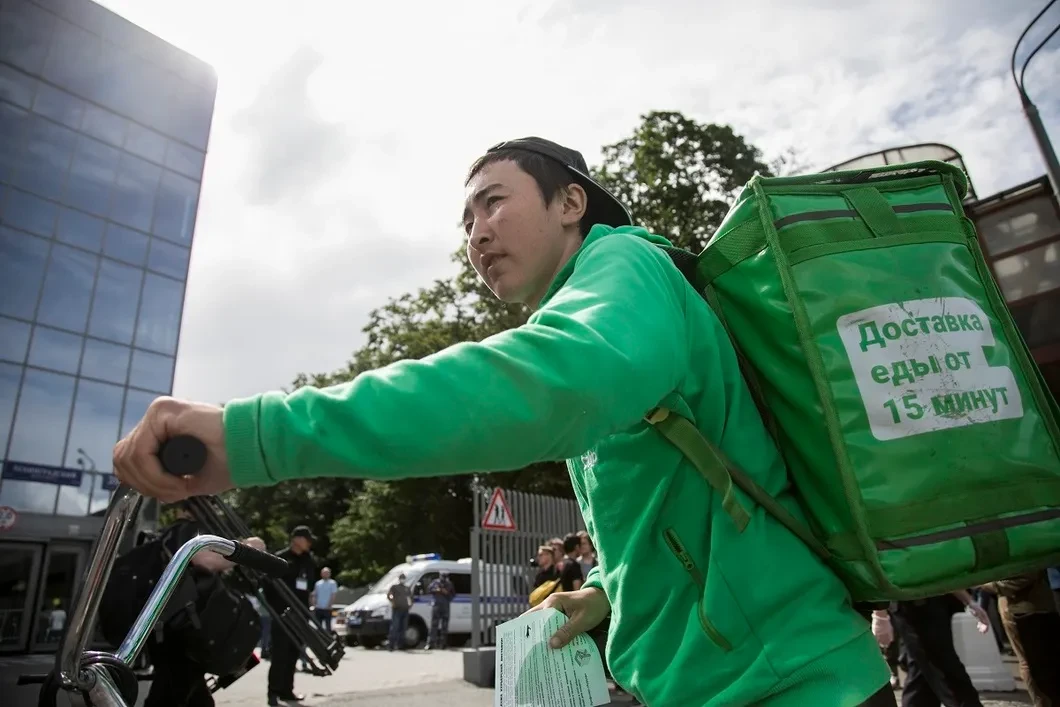
But the couriers no longer believed the company (“They just threw us a bone so that we calmed down,” says Said). Despite the promises of the service, the couriers announced that they would go on a strike on a strike on Mail.ru. On Leningradsky Prospekt. The striking, along with levaks, launched the hashtags #kouririreans and #deliveryhahlam in social networks, and lay leaflets with calls to join the protest in Moscow.
And now the young guys and girls who were unlikely to work couriers are unlikely to be in the center of Moscow with the green posters "I support the strikes of the couriers Delivery Club."
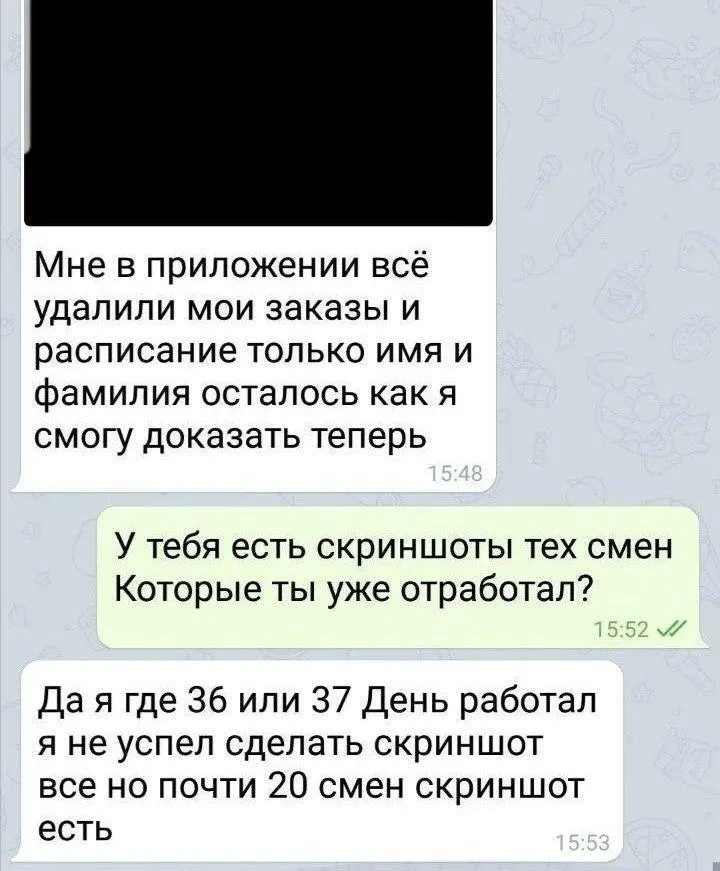
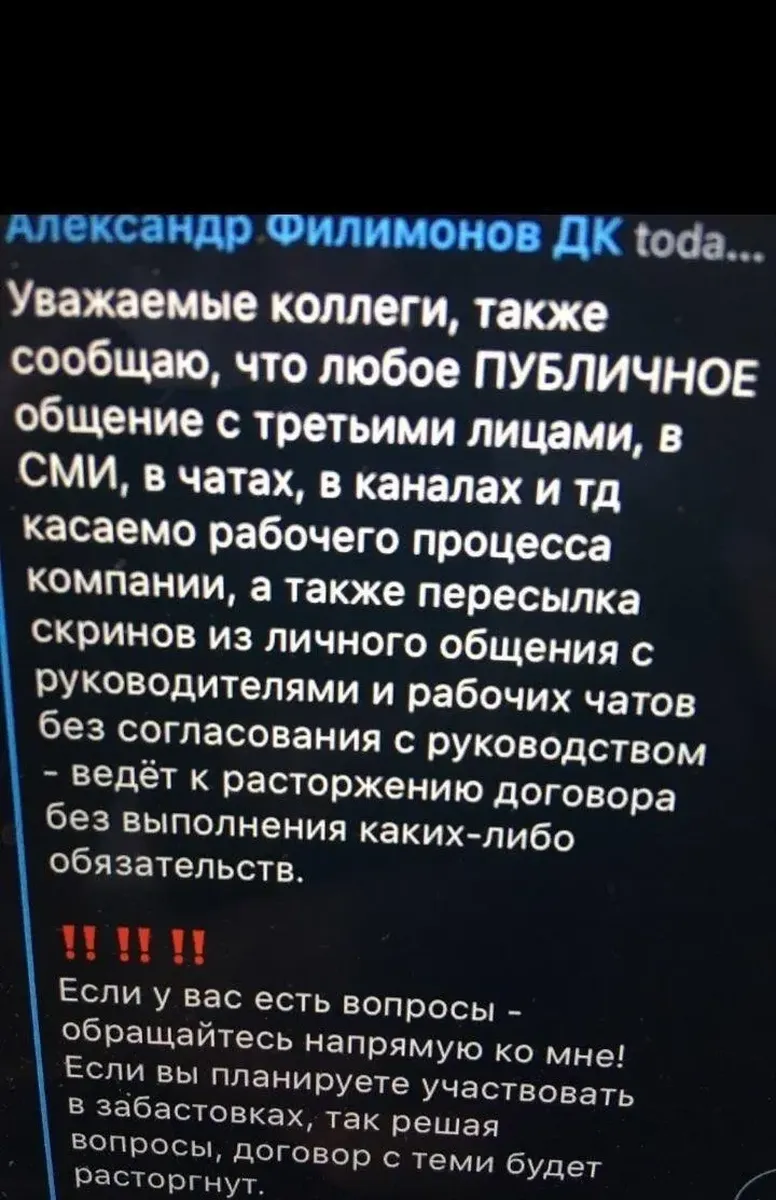
The company reacts to its own way: in social networks, a screenshot of the message of one of the Delivery Club employees, in which he threatens the termination of the contract “without any obligations” for communicating with journalists and “participation in strikes”, was dispersed. In addition, according to couriers, the service began to delete their order history - the striking believe that this is done so that it was impossible to prove how many shifts were worked out by them.
The chairman of the Courier trade union Kirill Ukrainians calls what is happening by genocide: “Couriers were loaded into conditions when they have to move out of the apartments and live in the porches due to lack of funds. And at this time, from them for 4-5 thousand kilometers, the family expects money - there are children, wife, sick parents. ” Ukrainians believes that during the pandemic in connection with the increased demand, Delivery Club “gained a lot of new couriers”, which now “decided to create unbearable conditions” and force them to leave after a decrease in orders.
PS
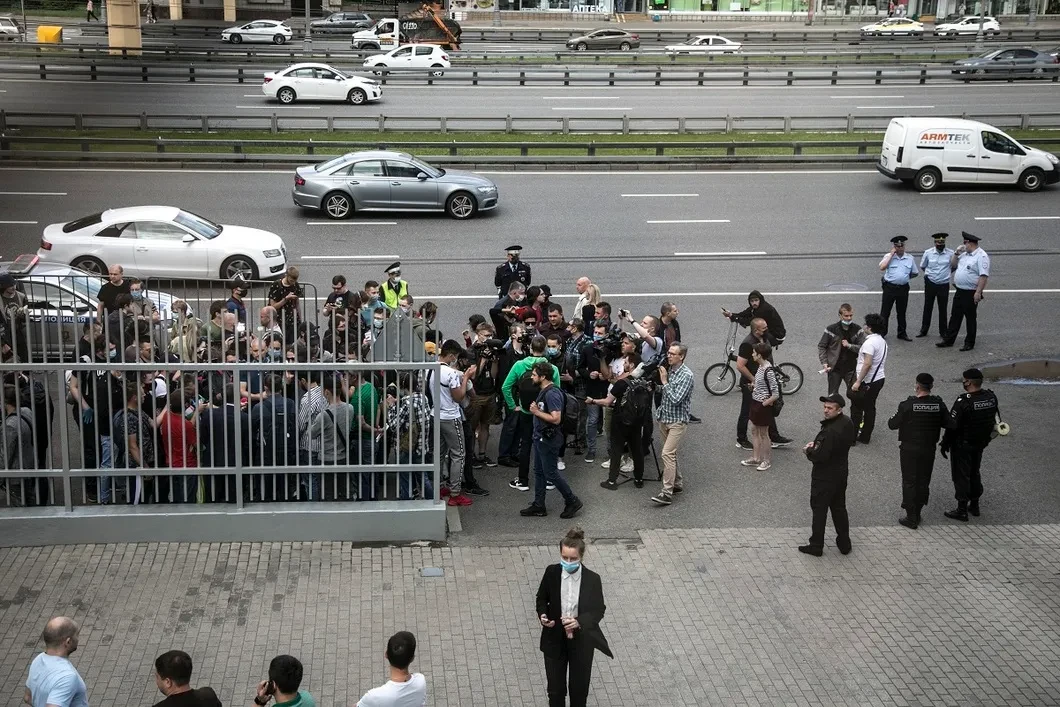
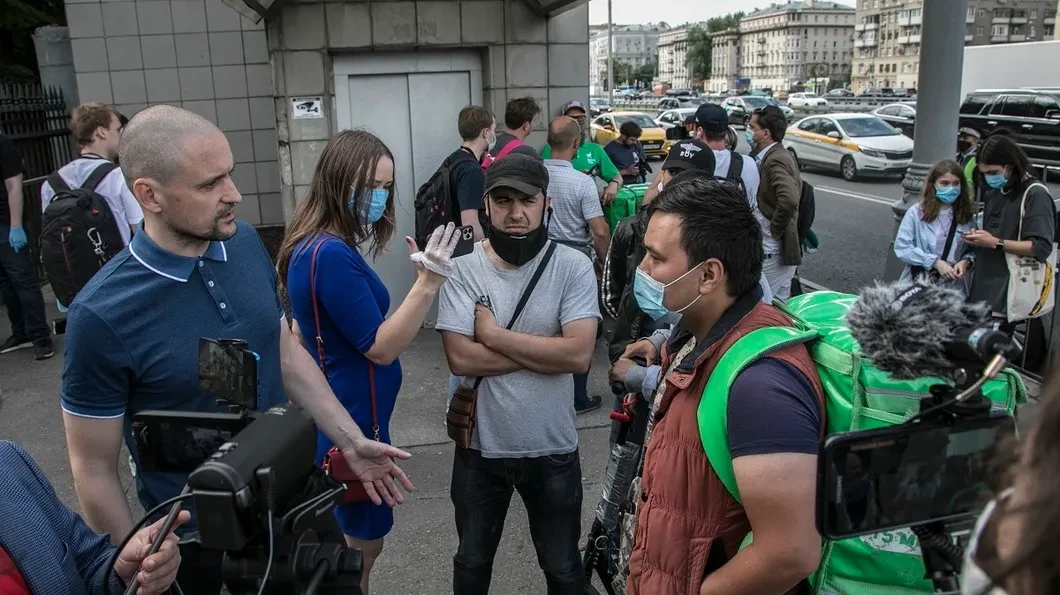
When this text was preparing for the publication, the Mail.Ru Group office on Leningradsky Prospekt took place of the courier strike. By the beginning of the strike, they gathered many times less than journalists - no more than twenty people. Apparently, this is why the company's management decided that there was nothing to talk about with couriers. But representatives of the company found what to say to reporters.
Deputy General Director of Mail.ru Group Vladimir Gabrielyan in a conference hall, where all journalists from the street were invited, said that the Delivery Club service was not to blame. Gabrielyan said that the service does not cook food and does not deliver it, but is only an intermediary between logistics companies and restaurants. Therefore, in non -payment of a salary of about 300 couriers, the logistics company of Amaroli LLC is to blame, with which, by the way, Delivery Club now plans to sue.
According to Gabrielyan, Mail.ru already personally paid money to almost all couriers. To the question of revising the employment contracts, Gabrielyan replied that not a single courier does not work in Delivery Club, so their claims should be addressed to “their employer”.
Behind the large panoramic conference room window at that moment, two dozen couriers in the form of Delivery Club demanded human working conditions.