
Translated material
Berlin diary of the novel of Dolzhansky
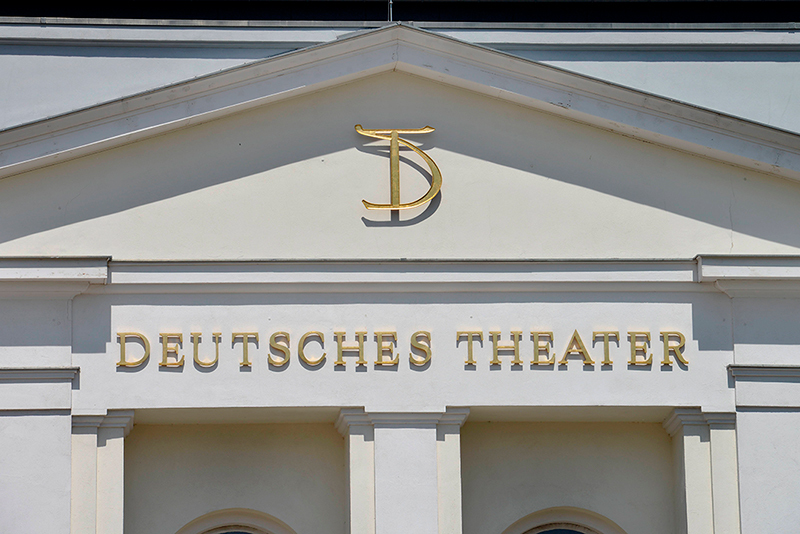
Colta.ru continues the publication of the Berlin Diary of Roman Dolzhansky. This cycle was written by the famous theater critic and curator, deputy artistic director of the Theater of Nations last February-during the rehearsals of the play “Freken Julie” Timofei Kulyabin in the doech theater , on which Dolzhansky worked as a playwright. The “Berlin Diary” is both a chronicle of the last weeks on the eve of Lockdown, and a report from the rehearsal hall, and the theater traveler, the author of which, the author of which, one of the thinnest domestic experts in modern German culture, not only reflects on the everyday life of today's Berlin, but also returns to his own memories of different years. Read the first and second parts of the cycle here .
Tuesday, February 18
To the right of the Doech Theater, at Schumansstrasse, there is a residential building. In the line of the street, it is built so imperceptibly that it seems - has always been here. But this is not so. In the place of a faceless, quiet structure, which has something living to wait a long time, a crowd gathered a mince of a little years ago. There was the most interesting Berlin theater address ... The then quartermaster of the Doech Theater Thomas Langhof decided to give the container-in-the-time, which remained from some repair work, under the youth project, owned by the theater. The place was called the “hut”, it looked like a hut, a template with shaking walls, doomed to give up the next “golden” real estate in the quiet center of the capital.
The hall was cramped, the people were stuffed into it, the stuffiness was terrible, there was no scene as such either - but modern plays were put, and discussed here. The young Thomas Ostermayer, a graduate of the Berlin Theater School named after Ernst Bush, gave him Langhof this “Barak”, first of all, he drew attention to the modern English drama, authors from the so -called “In Yer Fais” movement, whose plays really cast an unsightly social truth in the face. Mark Ravenhill, Sarah Kane, David Harrower and other British appeared on the posters. We searched in the "Barack" and relevant French plays, and radical Russian texts. As a matter of fact, thanks to the Russian playwrights, I met Barack and the young Ostermayer, having read a report on our new plays in the framework of the Russian Week.
But the Barack’s case was not so much in strengthening international ties ( the 90s made up many and brought all the main discoveries), but in the support of the young German drama, which also began to appear in the Theater-Constate. Ostermaire then, in essence, broke through the unspoken blockade. Someone calculated that after the short story of the “Barack”-only three years, from 96th to 99th -the number of modern plays in the repertoire of German state theaters increased by an order of magnitude. Thomas was in the right place at the right moment: it was in the “Barack” that he checked the model of a politically active modern theater, which he later developed in Shaubun. And, as often happens in such cases, the new theater deposit has formed people who today define a lot in the German Theater: the manager of the Barack Tobias Fight became the director of Shaubnya, the playwright Jens Hilie, until recently, was successfully headed by the Berlin Theater named after Gorky, the plays of Marius von Mayenburg today are raised all over the world, the curator and translator Stefan Shmiddtka He organized many festivals and still translates the best to the German modern Russian drama ...
* * *
"Freken Julie" Timofei Kulyabin will be released at Kammerspiele . Of course, I have been here before, a spectator in the performances, but today I looked to see with different eyes - mentally try on what is already looming at rehearsals, to the space of the theater. In 1906, Kammershpile was opened by Max Reinhardt-it can be said that it was a prototype of the “Barack”: the director headed the doech theater since 1905 and quickly realized that we needed a new scene for the productions of modern dramaturgy. Since then, the appointment of the scene, of course, has changed, but a certain special status has been maintained; This is like a separate theater, although neither administratively, nor creatively, nor technically the second scene does not have autonomy. But still they write equally- Deutsches Theater & Kammerspiele .
Cammerspile survived his founder, more than once changed his appearance. Reinhardt was against all decorations, so the whole “ancient” style that we see in the design of the hall today was invented by Joseph Goebbels-after the expulsion of the Jew Reinhardt in the 33rd year, the Minister of Propaganda decided to personally practice in the design of the second scene of the Doychech Theater . The division of the auditorium into the ground and the balcony was abolished relatively recently, during the last reconstruction - now the amphitheater was installed in the Kammersshpil. The number of spectator places was almost crazy, but now from everywhere everywhere is clearly visible. There is no podium on the stage, her mirror is quite narrow. Not the most convenient platform, what can I say. But many inconveniences are compensated by excellent equipment.
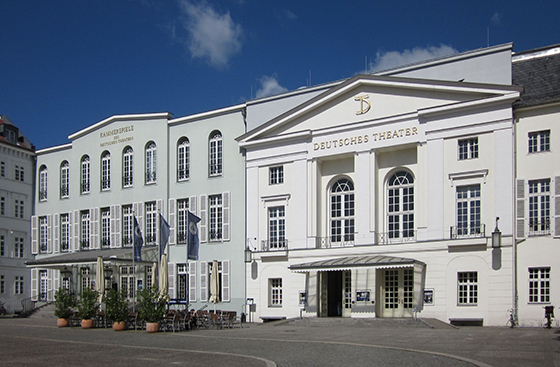 © Jörg Zägel Doech-Theater
When we have performances in Moscow, the “Battle for the release” begins between the director and the theater administration - how many days to stop the repertoire and give the scene for final rehearsals. If we are not talking about technical and light miracles (Lepage, Wilson, etc.) or multi-sized musical performances, they usually come into a word on seven to eight days. It is different here. They are released on stage almost three weeks before the premiere. But evening performances stop playing only two days before the arrival of the audience at a new production. And so - early in the morning they put the scenery to the upcoming premiere, then the rehearsal, after lunch, the scene is released and manage to put the decoration of the evening performance. Those who on the eve of their release can return to the replant in the evening and eliminate the problems identified in the morning there. Of course, light rehearsals, sounds, a run for photographers are provided and everything that is supposed to do before the premiere. But with such a tense schedule, every minute all over gold - and everything is also painted in a minute.
The prime minister on three scenes (there is also a tiny “Box”) release a lot - almost three dozen per season. Summer holidays, it turns out that almost every week some premiere is played in the theater. On the one hand, this is not bad-the artists are not sitting idle, the car works, information reasons are going on one after another, the audience is all the time throwing something new. On the other hand, there is a threat, if we speak in economic terms, a crisis of overproduction: good performances that have not exhausted its resources and morally not outdated should give way to new productions-the theater receives a subsidies and should spend it, that is, to produce many, many products. As you know, well -being is sometimes more dangerous than poverty. That's exactly what is good with such a rhythm of work is a more calm attitude to success. We have a theater two weeks before the premiere turns into a crazy house - everyone runs like a mad one: well, what is there, well, how they laughed (cried, clapped) “dads and mothers”, which Princess Mary Aleksevna said, etc. And here - quiet and surface. Well, premiere, well, another performance. Success? Great, cheers, thanks to everyone. Shace came out? Well, it doesn’t matter either, it will turn out next time. The theater is not all life, but only part of it. An important, beautiful part, but there are many no less interesting things around.
* * *
In the evening, we have a traditional BergFest here, a joint evening of the entire creative group of the performance. Literally - “Holiday of the Mountain”: this refers to a party on the occasion that half of the rehearsal path has been passed, sort of “pass”, crossing the mountain. In fact, it is still far from the middle, but today it is convenient for everyone whether it will be also convenient at the exact date of the intersection of the “equator” is unknown. The form of the evening is free: in the Zurich Shaushpilhaus, for example, we gathered in one of the theater workshops, brought food and drink ourselves, distributing duties in advance. But then in Zurich - there a trip to a restaurant can turn into a real ruin. In Berlin, it’s stupid to mess with food, because everything is available-so Betina just orders a table in some kind of pizzeria. Of course - in Prenzlaueerberg.
It is generally accepted that the Germans are formalists, they do everything according to the protocol. If this is the case, then the protocol is very convenient. Bergfest is intended for informal communication: those who have not yet met still have a chance to catch up. Everyone pays for themselves, but this is not a dogma at all: in the end we decide to treat two assistant-pectant who do not receive theatrical salaries together. At Bergfest, everyone crawls out for a short time from their professional entities and becomes simply acquaintances: this is the only time when we talk “for life” and “for politics” - about Putin and the AFD party, the differences in theatrical ways in Germany and Russia. Whoever wants to, can tell about the family, but the one who does not want will not ask too much. They do not become friends here, but cease to be completely alien. Comfortable.
Wednesday, February 19
Rehearsal only in the afternoon. In the morning I go to the cemetery - to the so -called socialist memorial at the Friedrichsfeld cemetery. This is something like the Gaderar Kremlin wall, the place of the eternal sleep of senior statesmen. Unlike our main cemetery, the local official necropolis is not just not in the city center, but at the hell on the cakes - in Lichtenberg, but there are still twenty minutes of the metro with a quick step. Probably only the most crazy and specifically inquisitive tourists get here. In any case, among my acquaintances, I am the first to make a pilgrimage to the graves of the half -forgotten politicians of the last century. Rain begins on the way from the metro, so I have to walk around the cemetery in perfect solitude.
To the question “what the hell did you go there” I came up with the answer for a long time: in my opinion, in every Russian-Soviet city there are streets of Karl Libknecht and Rosa Luxembourg. Pushkin or Chekhov - not everywhere, but Rosa and Karl are present in the toponymics of any district center, and they all do not care. So much is already out of the streets of their names that the excursion to their graves will definitely be shorter.
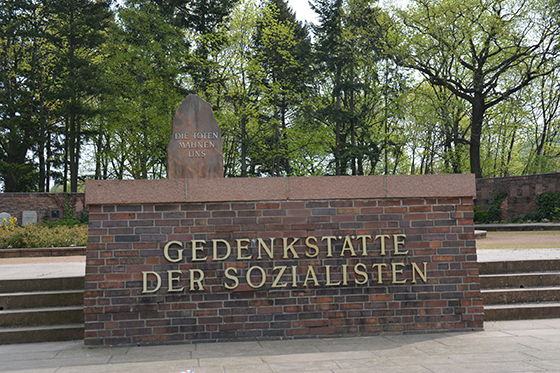 © Ulrich Horb Memorial of Socialists, Friedrichsfelda
It all started with the founder of the Social Democratic Party of Germany Wilhelm Liebknecht-his first of the socialists was buried in the cemetery of Friedrichsfeld. In 1919, the bodies of the son of Wilhelm Karl Liebknecht and other victims of the January uprising were buried there, then the grave of Rosa Luxembourg appeared nearby. It is exciting to re -read their stories with today's eyes: the story seems to be turned inside out, outstanding dreamers are converted into desperate adventurers, fighters for someone else's happiness - in irresponsible robbers who had a life melted for their impulses.
The cemetery is wet and windy. The socialist memorial is a flower garden in the center of a round meadow, surrounded by a wall. There are two groups of burials. Along the wall, around the circle, there are “secondary” graves, in the wall there is a columbarium with planks, really similar to Red Square. So they came up with after the Second World War - under Nazism, the monuments to the socialists were destroyed, and the Communists composed the memorial space anew. And the most famous graves are arranged as the petals of the central "flower". The signs-Rosa Luxembourg, Karl Liebknecht, Ernst Telman, are the same as the founders of the GDR: the head of the Socialist Unified Party of Germany Walter Ulbrikht (this, on his initiative in 1961, built the Berlin Wall), the first and only President of the GDR Vilhelm Pick, the chairman of the Sovietist of Otto, Otto Otto, Grothevol ... The invisible diagonals of their remains intersect in the center, where the granite monument with the inscription "Dead warns us" rises. Today-about something else ...
* * *
The Festival "Theaterffen" usually takes place in May. For about twenty years I have been trying not to miss him, for myself I call my sorties to “go for goods” - I always want to bring a “big German performance” to Moscow. (For me, this is a very special type of theater; who will understand what I mean - I’ll explain the rest another time.) Of course, the conjuncture in this market, like any other, changes year from year to year, and complaints about the oddities of the jury have long become part of the festival ritual. The favorite theme of recent years is why the works of famous masters from famous drama theaters remained on board, and instead of them imperfect productions of young directors or independent projects of vague genres appear, which are not possible to bring to Berlin, because the performance has already scolded the other festivals and now not to collect it again.
Naturally, the festival and gender unrest of recent years did not bypass. In general, “Mitushny” passions, as it seems to me from the outside, in the artistic world of Germany, were not hot to those unbearable degrees that the creative communities of France or England (not to mention America) were pretty felled. Sociums, surviving harsh and cruel times, are generally less straightforward and more flexible and careful in condemning human weaknesses. The Germans, even those who hold their nose in the wind and do not dare to go against the requirements of new puritan, is somehow easier to return to common sense than British or French. However, this is too slippery ice to get out today without special need. And why did I climb the rink? And from the fact that last year the organizers of the Theaterffen Festival introduced gender quotation - they pledged to select the performances so that at least half of them (that is, five of the usual ten) was delivered by female directors. Critics-sewers, it seems, even exceeded the obligations taken: six out of ten came out.
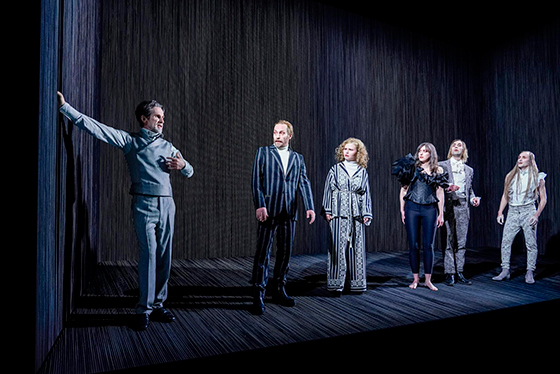 © Arno Declair Scene from the play "Misanthropus"
This year, the “Misanthropus” of the Doech Theater fell into the top ten “most worthy attention of the performances of the German-speaking space”-this is how the Festival “Theaterffenfin” defines its selection criterion, avoiding the “best” word too much. They say that the theater was not only happy when the “misanthrope” was taken to the festival poster, but they were also surprised-neat, without frills and surprises, the play by Anna Lenks worthy of anything, but not some special public attention. The performance in the repertoire, so you can start getting to know the posterffen Theaterfine post in February. As a journalist, they put me in the ground many times, as a guest of an intensive care unit - in the middle of the first row of underwear, now, as a temporary theater employee, I am sitting in a service place - in the second row of a believing side. The scene review is not the best, but the beautiful view of the white-red-golden hall, at the same time solemn and cozy-chamber, one of the most beautiful.
The play of Moliere is played out of accepted a specific time or place. Literally “without everything”-there is no objective world in the play, the heroes are given neither to sit down or rely on anything , they are on their feet all the time, all the time in words, these mobile and talkative characters of the Moliere comedy, placed in a shallow, advanced decoration-Korobochka. Its walls and ceiling are collected from stretched rubber "rods", so that there are no doors, no windows, and heroes can appear anywhere, literally jumping out of the wall. In the center of the performance, as it should be based on the play, Altsest Ulrich Matles, one of the most famous modern German actors, a soft and restrained resoner, a master of aristocratic voting. The actors cope with the Misanthropus in less than two hours, seemingly without missing anything, but without lingering, joyfully looking for sharp places in the text, but not pointing out or injuring the audience. Soon the scene and the hall part, pleased with each other. Probably, “Misanthropus” is still not one of the ten most remarkable, but only one of the six in gender quota.
To be continued.