
Translated material
Holy face from Lucca
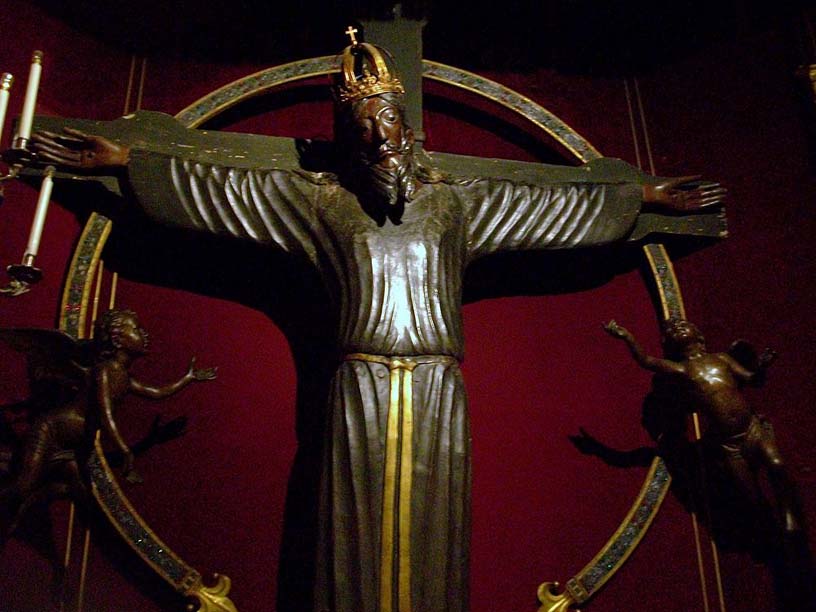
The new study showed that the shrine of the Cathedral of the Italian city of Lucca - the image of the crucified Christ cut out of the tree - is much older than it was believed, and, perhaps, it turns out to be the most ancient wooden sculpture in Europe.
Although the sculpture depicts Jesus in full height, it is known under the name "Holy Feat" (Volto Santo). The fact is that it is the image of the face of Jesus that is considered miraculous and serves as the main object of veneration. According to legend, St. Nicodemus, who participated in the burial of Jesus Christ, decided to cut his sculptural image from the Lebanese cedar, but Nicodemus could not portray his face. When Nicodemus fell asleep, the angel that came off heaven performed this work.
Holy face in the cathedral of Lucca
Further, the legend says that the sculpture was covered in one of the Palestine caves and found by an Italian bishop named Gualfredo during a pilgrimage to the Holy Land. Gualfredo saw an angel in a dream, who indicated where the crucifix was located. The bishop placed the sculpture on an empty ship, which sent to swim by the will of the waves, praying to reach Christian lands.
In 782, the ship moored to the coast of the Tyrrin Sea near the city of Luni [1] . But every time the Lunians tried to penetrate his board, he sailed from the shore. Meanwhile, Bishop Lucci John I in a dream received a revelation about the shrine that arrived on the ship and went to Luni.
As soon as the bishop read the prayer, the ship moored, and the crucifix was carried ashore. There was a dispute about which city the shrine will be stored in. But the divine signs indicated that it should be sent to Lucca. The Lunius received an ampoule in compensation with a drop of blood of Jesus Christ, which was also on the ship. It is still stored in the Sartsan Cathedral.
Further, Relatio de Revelatione Sive Inventione Ac Translatissimi Vultus (“The narrative of the creation, opening and postponing of the Holy Lick”) says that the Luccasians with the greatest respect were transferred to their city and placed in the Basilica of St. Fresser. But the next morning it was discovered that the sculpture had disappeared. It was found in one of the gardens near the Cathedral of St. Martin. As a result, the townspeople decided that the relic should be stored here. In 1484, the sculptor Matteo Chivili built a special chapel for storing the shrine in the left nave of the cathedral, which is called the “Temple of St. Lick” ( Tempietto del Volto Santo).
The transfer of the holy face. Fresco Amiko Aspertini in the Cathedral of St. Fredian (the first half of the XIV century)
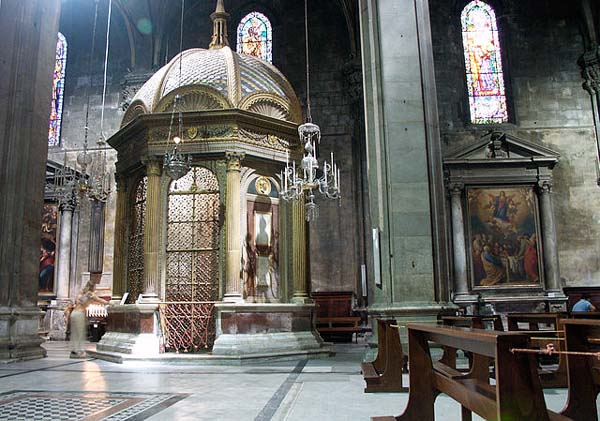 Tempietto del Volto Santo
The sculpture has become the famous city shrine. She was portrayed on Lucci's coins. Even the main city holiday was not the day of the patron of the city of St. Paulin of Lukki, but the holiday of the cross -expression, since it was on the eve of this holiday that the holy face was miraculously moved to the Cathedral of St. Martin. The holiday begins on the evening of September 13 and continues the next day. The city arranges a ceremonial procession by candlelight, known as La Luminara Bella. Illumination from candles decorates cathedrals and other buildings. During the procession, people sing the anthem Evviva La Croce, and during the final service with the cathedral, Mottettone is performed - a special polyphonic composition for two choirs and two organs.
Holy face on a coin of the 13th century
Illumination on the day of the Cross Extension
The holy face from Lucca is mentioned in the "Divine Comedy." Dante with Virgil get to the fifth of the moat of the eighth circle, where the bribes are immersed in boiling resin, and in those who stick out to the surface, bugrs stick demons. They see how a black devil brings a new sinner and informs his colleagues that this is one of the ten foremen included in the Council, which rules Lucca. The devil says that he will still visit Lucca, since there are all bribe takers except Bonturo Dati (the latter is the irony of the devil and Dante, the renovation readers knew that Bonturo Dati is the largest bribe takeress in Lucca). The brought sinner is thrown into the tar ...
He sunk, surfaced with a smeared face,
But demons screamed from under the bridge:
“We do not recognize the holy face!
And here is not Serko, they are not just swimming!
When you do not want our hook,
Dive back into the tar. " And teeth up to one hundred
They pierced the sinner right away in the sides.
“Dance, but do not show the tops;
And you can, so plutowe in steady ” (“ Hell ”, XXI, 46–54, the translation of M. Lozinsky).
The original of Dante says Qui Non Ha Loco Il Santo Volto! "There is no place for St. Lika!" The Serko river is also mentioned, flowing through Lucca. Commentators believe that demons mockingly compare the face of a sinner with a black tree of St. Lick blackened from resin. According to another version, it is understood that the emerging Luccan prayed: “Holy face, help me”, and demons point to him the futility of prayer in hell. The irony of Dante in relation to the natives of Lucca, accustomed to constantly recall their city relic cannot be ruled out. By the way, one of the early commentators of “Ada” Guido Pizan determined the name of the unfortunate sinner. It is known that Dante traveled to the afterlife in a passionate week of 1300, and on April 9, 1300, Martino Bottario, one of the member of the Council of ten in Lucca, died. The phrase qui non ha loco il santo volto! She became winged in Italy. In the XX century, it is quoted by Primo Levy in the description of Auschwitz.
Over time, new legends about the Holy Lika appeared. According to one of them, on September 11, 1334, a certain Giovanni Di Lorenzo from Picardia, heading for worship of St. Lick, passed the city of Pietralung, where he was unfairly accused of murder and sentenced to death. The executioner was already lowering the ax on his neck when Giovanni prayed to St. Lika, and the ax blade turned away from him. This ax was then stored in St. Martin's Cathedral.
Another legend tells about the tramp artist, who sincerely prayed before the holy face and decided to present as a sign of veneration the only thing he had was his art. He played on Viola (according to other versions - danced or even performed an acrobatic number). As a sign of gratitude for his sincere act and as a reward, a sculpture dressed in gold vesting dropped one gold sandal. The actor was seized and accused of theft. Nobody believed his story, and the unfortunate was thrown into prison. But, when the priests tried to return the sandel to the place, they were not worn on the foot of Jesus, until the actor was released and paid him the full cost of the sandal. Even after that, the sandaling did not hold on the leg, so it had to support the bowl. Since then, on many images of St. Jesus, the Holy Lika is on the bowl.
The musician plays the violin in front of the holy face (miniature from Codex Rapondi, Paris between 1400 and 1420)
German engraving of 1492
Relief from the Church in Montemarchello, 1529
Holy face from Lucca on a fresco in the Church of the Saints Kirik and Iulitta in the city of Kashiana-Term-Lary
It is believed that the origin of another legend is connected with the Holy Lick. The craftsmen from Lucca with the help of xylography replicated images of the city relic, and the pilgrims who visited the city took them to their homeland. The pictures truthfully depicted Jesus’s robe - a long tunic (Colobium), but in many countries they got used to the fact that the crucified Christ is dressed in a loincloth, and this robe was mistaken for a female dress. To explain unusual clothes, there was a legend about a Christian girl who vowed the celibacy, but the pagan father decided to marry her. Then she prayed, and her beard grew up, so the groom refused marriage. The angry father then ordered his daughter to crucify. According to different versions of the legend, the girl was called Wilhefortis, Kummernis, Eutropy, Liberate, Ontommer, Debarra, and she lived either in Portugal or Sicily. The name Wilheforts is usually explained as the Latin Virgo Fortis “Bold Virgin”, but perhaps this is a distorted Lower Semetsky Hilge Vartz “Holy Fine”. The cult of the bearded saint spread throughout Europe, with the exception of Italy, and reached Latin America. Numerous images appeared, on which clearly not a man in a long tunic, but a bearded woman . In 1583, Wilhefortis was introduced to the Martyrologium Romanum. Saint Wilhefortis inherited from St. Lick the legend of the musician.
Historians argued a lot about the origin of St. Lick. Despite the long robe of Jesus, which made it possible to assume that the sculpture was made in the East, it is considered more likely that the Holy Farm was created in Western Europe. The eastern origin is contrary to a number of stylistic features of the statue, and indeed large sculptural images were atypical for the Christian art of Byzantium. Experts indicate several similar wooden sculptures in different European countries (for example, in Kaldes de Monbuy in Catalonia , in the National Catalonia Museum in Barcelona or in the Italian city of Sansepolcro ). As for the date of manufacture of the statue, it was believed that the cathedral stored a copy of the lost initial statue, made around the middle of the 12th century.
All these conclusions were drawn on the basis of stylistic analysis, as well as the fact that the earliest manuscript containing the story of gaining relic dates from the 12th century. It seemed that the opportunity to explore the holy face with physical methods would never be presented. However, this year, as part of a program dedicated to the 950th anniversary of the consecration of St. Martin's Cathedral, the Catholic diocese of Luccia asked scientists to date the sculpture. Since very small samples are enough for the modern technology of radiocarbon analysis, researchers were allowed to take a small amount of wood.
Marialena Fedi from the Florentine branch of the National Institute of Nuclear Physics says that three fragments were taken: two from each leg and one of the dress. A small fragment of a canvas located between a tree and a layer of paint (the so -called Incamottatura technique) was also taken. According to the researcher, the canvas is most indicative, since the tree could be used a long period after it was cut down. As a result, the analysis of all samples indicated the period from the end of the VIII to the middle of the 9th century. That is, the statue can relate just by the time when it arrived in Lucca, according to legend.
According to Archbishop Lucca Paolo Julietti, enthusiasm for new dating should not overshadow the religious significance of the shrine. According to him, for twelve centuries, the innumerable number of pilgrims came to "pray, touch, cry, rejoice before this way." But Justy also noted that, in comparison with bronze or marble, the wood is very short -lived, and millennial statues are extremely rare. “It is amazing that he managed to survive to this day,” said the archbishop.
[1] In the XI century, this city was left by the inhabitants, as its harbor was shallow and became unsuitable for use. The Lyunians moved to the city of Sarsana. Luni ruins are located on the territory of the modern city of Ortonovo.