
Translated material
A week of repression follows constitutional referendum
Many believed there would be a reckoning after Russia’s constitutional referendum, but few expected the authorities to act so quickly, and with such ferocity. In the week since Russians voted to allow Putin to ‘reset’ his presidential term count, two major criminal cases were opened: one into a prominent journalist, the other against one of Russia’s few opposition governors. Other activists and journalists have also been targeted by law enforcement.
Defense industry reporter accused of treason
- Journalist Ivan Safronov, 30, was arrested Tuesday on treason charges. A former reporter at business dailies Kommersant and Vedomosti, Safronov was two months into a job advising the head of Russia’s state-owned space agency, Roscosmos. The maximum sentence for treason in Russia is 20 years in jail.
- A specialist on the defense industry, journalism runs in Safronov’s family. His father, a retired colonel, covered the defense industry for Kommersant until 2007 when he fell from a window while working on an article about illegal arms sales to Iran. Those close to him do not accept it was suicide. His son took over his job at the newspaper.
- Safronov Jr. is accused of collaborating with Czech intelligence and passing information about a Russian arms delivery to an unidentified African country. Prosecutors allege Safronov was recruited in 2012 and divulged secrets “via the internet” in 2017. We know all of this from Safronov’s lawyers: the case will be held behind closed doors.
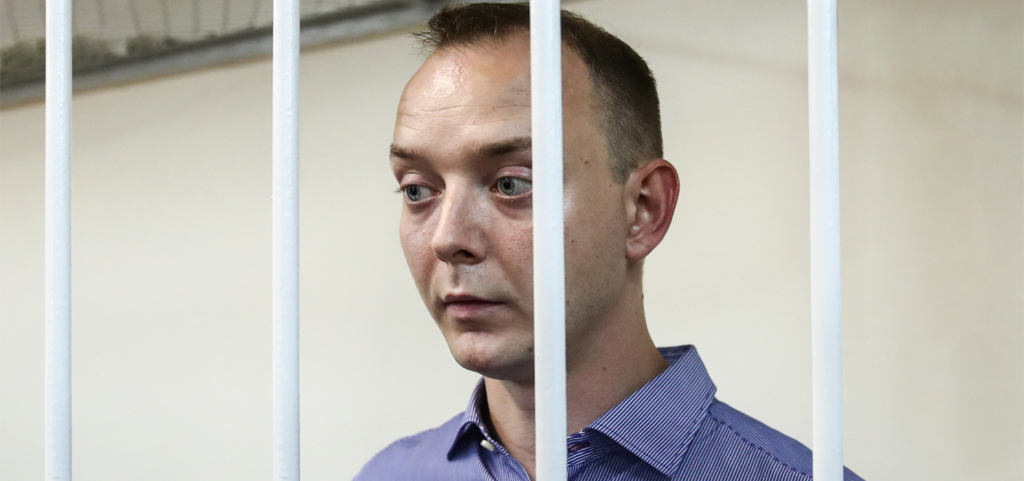
- There are many questions about the charges, including whether they are related to Safronov’s journalism. His reporting often upset powerful people — for example, his article last year about a delivery of a Sukhoi Su-35 fighter jet to Egypt was deleted (Rus) from Kommersant’s website after apparently being used by the U.S. Secretary of State Mike Pompeo to threaten Egypt with sanctions. He is unlikely to have had access to secrets at Roscosmos: according to official reports, his job did not involve such security clearance. Putin’s press secretary Dmitry Peskov and head of foreign intelligence Sergei Naryshkin both denied that the charges relate to Safronov’s journalism.
- Russian treason law is vague, and can be applied extremely broadly. For example, a sales clerk was sentenced (Rus) to seven years in prison in 2016 for sending a text message to a Georgian friend about tanks she saw passing through the Black Sea city of Sochi. In addition, treason cases often involve (Rus) the worst of Russia’s justice system: presumption of guilt, violation of a defendant’s rights, and falsification of evidence. All such trials are held behind closed doors, making it is impossible to judge the fairness of the hearing.
- Several media outlets spoke out in Safronov’s defense, including The Bell (Rus), and dozens of journalists were arrested at protest pickets. His colleagues describe (Rus) Safronov as an decent, professional and scrupulous journalist.
| | | | --- | --- | |
| | | --- | | Governor accused of murder The governor of Russia’s Far East Khabarovsk region, Sergey Furgal, was arrested Thursday. The initial court hearing for Furgal was also closed to the public. The governor is accused of crimes that supposedly took place many years ago: in this case organizing the murder of his rival businessmen in 2004 and 2005. At this time, Furgal was in a shady business of timber and scrap metal trading; shortly after he became a regional coordinator for the Liberal Democratic political party (a populist organisation that voices opposition while simultaneously working closely with the Kremlin).
Frugal has a murky past that may have included criminal activity, especially considering the nature of his business. However, he was not investigated in relation to the murder up until the moment Kremlin got anxious that elite obedience could be fraying. It certainly did not help that Frugal was elected governor in 2018 on a day when four such opposition figures were elected — a major blow to the Kremlin. Furgal received 66 percent of the vote, more than Putin got in presidential elections in the region six months earlier.
Journalists questioned by police Pyotr Verzilov, a former member of protest group Pussy Riot and publisher of media outlet Mediazona, was targeted by police even before the referendum. In June, he was questioned about the 2019 opposition protests in Moscow and, on leaving the police precinct, he was attacked in a staged scuffle — and detained for 15 days. He was again questioned (Rus) Tuesday about why he hadn’t informed the authorities about his Canadian passport (the law requires Russians to declare dual citizenship). In a little over a month, Verzilov’s home has been searched eight times and he had to undergo a psychiatric examination. Last year, Verzilov was poisoned in what he believes was an attempt on his life by the security services. Police also searched the apartments of journalists and activists working for former tycoon Mikhail Khodorkovsky’s Open Russia and MBK Media projects. These raids were formally connected with investigations into Yukos, the oil company once controlled by Khodorkovsky. But Open Russia’s lawyers contended the real reason was an application for a permit for a street demonstration in Moscow to protest the constitutional changes (the application was turned down by City Hall). The lawyers’ version of events is supported by the fact that several of those questioned by police were young children when Yukos was an active oil company. Why the world should care The ‘yes’ result of the constitutional referendum will do little to stop Putin's sliding approval ratings, but it is evidently enough to tighten the screws without risking public discontent. The authorities are using this moment to stamp out any sign of dissent, sending a signal to journalists, and reminding even the so-called ‘systemic opposition’ that it is disposable. |
|
| | | --- | | |