
Translated material
Investments in online education: what projects should be taken to look at
Companies that work in the field of online education are of great interest among investors. At the request of The Bell, Tinkoff Bank analysts analyzed EdTech sectors in the USA and China to find favorites and outsiders.

We made the main business media in the country, now we are doing better-subscribe to the email newsletter of The Bell!
All knowledge on the Internet
EdTech is a young and rapidly developing online education market that a real “gold fever” can wait for millions of schoolchildren and students around the world to continue training in the conditions of ongoing pandemic. We examined several companies that work in this sector, and deliberately divided them into the American and Chinese markets, since in both countries there are different orders and educational standards.
USA
By the fall of 2018, the number of high school students, who preferred full -time training exclusively remotely, increased to 3.26 million - this is about half a million more compared to autumn 2012, the BMO Capital Markets study said. At the same time, according to a survey , which was conducted among high school students and freshmen, a research and marketing company in the field of higher education Simpsonskarborough, college students do not like the online education they receive. To get a degree, 85% want to return to the campus, and only 15% want to study online. Nevertheless, because of the new coronavirus in the country this year, the number of students enrolled in colleges can be reduced by 20%, which means the number of users of online services should grow.
The interest in online education and self-development also speaks of fresh data from Google Trends ー more than 20 thousand videos associated with distance learning were loaded in Youtube alone. In just a week since March 13, the average number of daily views of the video with the words “Homeschool” or “Home School” in the name increased by 120% compared to views from the beginning of the year. Lokdown spurred interest in online identification of foreign languages-such lectures in March 2020 watched six times more than a year ago.
If we assume that the boom in the online education market will not end with the pandemia, it is time to look at investors at the shares of the largest players.
The main players
K12LRN
One of the veterans in the EdTech market. The company calls itself a leader in the industry. He is engaged in the online learning of students in grades 1–12, provides schools and families with computers with their program, or the program itself. It works both with private schools and with state. It offers schoolchildren a program for choosing a future profession, which is in demand by parents of high school students. Adult training is carried out through a subsidiary K12, Galvanize.
Capitalization: $ 1.8 billion (+157% since March 11, 2020, when WHO announced pandemia)
Multiplier P/E: 56
The company trained more than a million students. Now its Tallo platform is used by more than 400 thousand people from 20 thousand schools.
Over the past two years, revenue and profit for a year have been growing by 5%.
K12 believes that in the long run he will only benefit from the pandemic, and recently confirmed its forecast for 2020. According to the survey , which the company conducted among the parents of its subscribers, 68% will reluctantly send children to schools, even when the pandemic will decline, and 88% agree with the need for online learning.
- K12 awaits that some sources of revenue will disappear , for example, income from sending computers with a pre -installed learning program will fall. Nevertheless, the company confirmed the revenue plans for 2020 on the lower border of the forecast $ 1.033 billion.
- Does not pay dividends.
Chegg
ChGG
A digital platform that helps schoolchildren of high school and students with lessons, tasks, new knowledge, useful things for a career in the format of subscriptions on the Q & A-platform Chegg Study per month. About 80% of the revenue falls on tutoring and checking tasks, 20% for the purchase or rental of textbooks.
Capitalization: $ 8.7 billion (+92% since March 11, 2020)
Multiplier P/E: 71
The largest platform in the United States of those that we consider in this review: the number of unique users grew by 35% of the year, reaching15 million students, the number of subscribers is 2.9 million.
Chegg is popular among students:87% of college students heard about this company.
Of students on the platform, 92% said that they began to receive higher grades.
Jefferies analysts called Chegg one of the IT companies, which will probably grow well this year, and the JPMorgan analyst after the last report raised the recommendation for the shares to “buy”.
The company has a solid airbag - more than $ 1 billion cash.
GP Strategies Corp.
GPX
Engaged in increasing staff efficiency.
Capitalization: $ 0.14 billion (+51% since March 11, 2020)
Multiplier P/E: 10
- Since the beginning of the year, the company's shares have fallen by 31%, not being able to play the fall even after the beginning of the pandemic.
- In the past five years, profit has been stagnated, in 2019 the company earned only $ 15 million.
- According to the results of the first quarter of 2020, the revenue fell by 8%, EBITDA - by 61%. But management reduced net debt from $ 117 million to $ 75 million.
- After a long stagnation, the company's revenue in 2019 increased by 13%.
Grand Canyon Education
Lope
He owns the first in the United States by a private Christian college in which you can get a bachelor's degree of bachelor, master or doctor of sciences both by visiting the university and online. In parallel with this, the company helps to introduce online processes into the work of other universities, for example, translates into the online process of enrolling students and protecting diplomas. She also has a subsidiary Orbis, which is focused on training specialists in the field of healthcare.
Capitalization: $ 4.3 billion (+22% since March 11, 2020)
Multiplier P/E: 17
The company's net profit is growing steadily for a long time.
83 thousand students are already studying on the platform. The company (university) provides nine programs for students and cooperates with 24 universities.
- The last two years the revenue has been falling.
American Public Education
Apei
In its pure form, the online platform allows you to study foreign students. He teaches 100 thousand people in two of his online universities ー military and medical.
Capitalization: $ 0.43 billion (+48% since March 11, 2020)
Multiplier P/E: 31
The financial pillow of the American Public Education is $ 200 million - almost 50% of the company's capitalization. At the same time, the company has no duty.
Having ready-made infrastructure for online learning, the company provides 121 educational program and issues 111 different certificates to students.
- For several years, the company has a profit and revenue stagnates. In 2019, the profit fell 1.5 times, to $ 17.8 million.
- The company improved its forecast for the second quarter of 2020 and expects that consolidated revenue will grow by 8-12% compared to the previous period (for the second quarter the company will report on August 11).
2U
Twou
It works in two segments: graduate educational programs for students and continuing education courses. All training takes place through the 2U Operating System online platform. The company cooperates with 73 large universities in the world, including with the main universities of the USA - Harvard, Cambridge, Berkeley and Yel, where they have already planned to hold the autumn semester online, as well as with universities abroad, for example with Oxford.
Capitalization: $ 2.5 billion (+55% since March 11, 2020)
Multiplier P/E: is absent due to company losses
- The company has strongly growing revenue - an average of 35% per year over the past three years, and in the first quarter of 2020, growth was 44%.
- The company is unprofitable, in 2019 the loss increased from $ 39 million to $ 235 million.
- Berenberg Bank raised a recommendation on the company's papers from “Keep” to “Buy” and the target price from $ 22 to $ 30 (now the shares are more expensive than $ 40). The bank believes that the pandemic and the closure of educational institutions are opening new opportunities for online players.
China
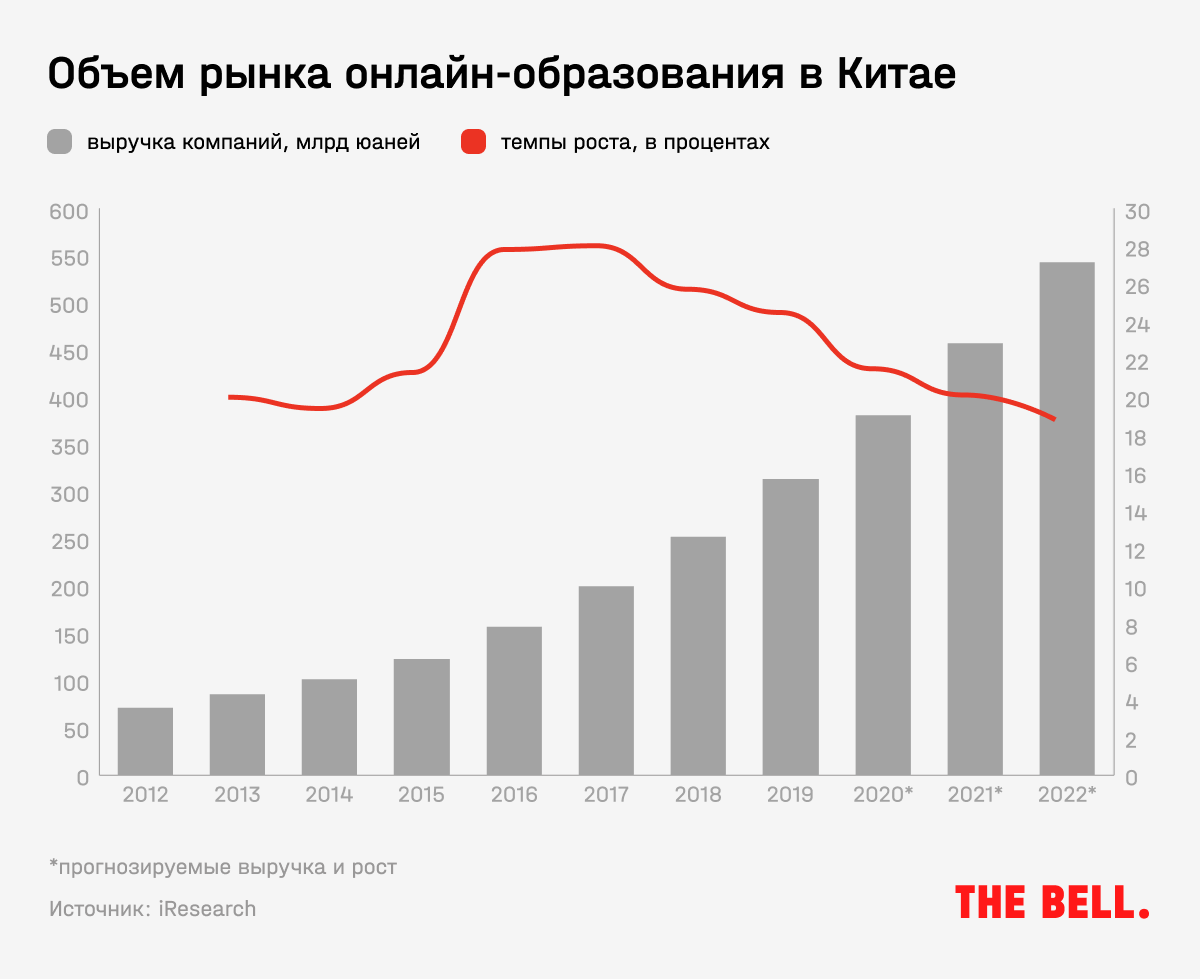
According to the Chinese consulting company IRESEARCH, online education in China is growing double-digit pace. According to her calculations, the market size amounted to 251.7 billion yuan (or $ 37 billion) in 2018, and by 2022 it could double. And this is still without taking into account the current situation related to pandemia and the forced transition of many educational institutions online.
One of the drivers of the growth of the entire online education market in China may be the tutoring necessary for passing rather strict entrance examinations to higher educational institutions called Gaokao. The Frost & Sullivan research company estimates this segment of $ 64 billion and predicts that next year it will grow by 9%. At the same time, only about 10% of this amount falls on online training ($ 4.4 billion), however, according to the company's forecasts, this segment will reach $ 53 billion in three years.
Assessing the prospects of the young market, many look at venture investments. And if in the United States, companies from Edtech received a record capital of $ 1.7 billion in 2019 in five years, then Chinese companies from this sector attracted almost $ 3 billion. In previous years, Chinese companies attracted, according to Duojing Capital, even more impressive amounts.
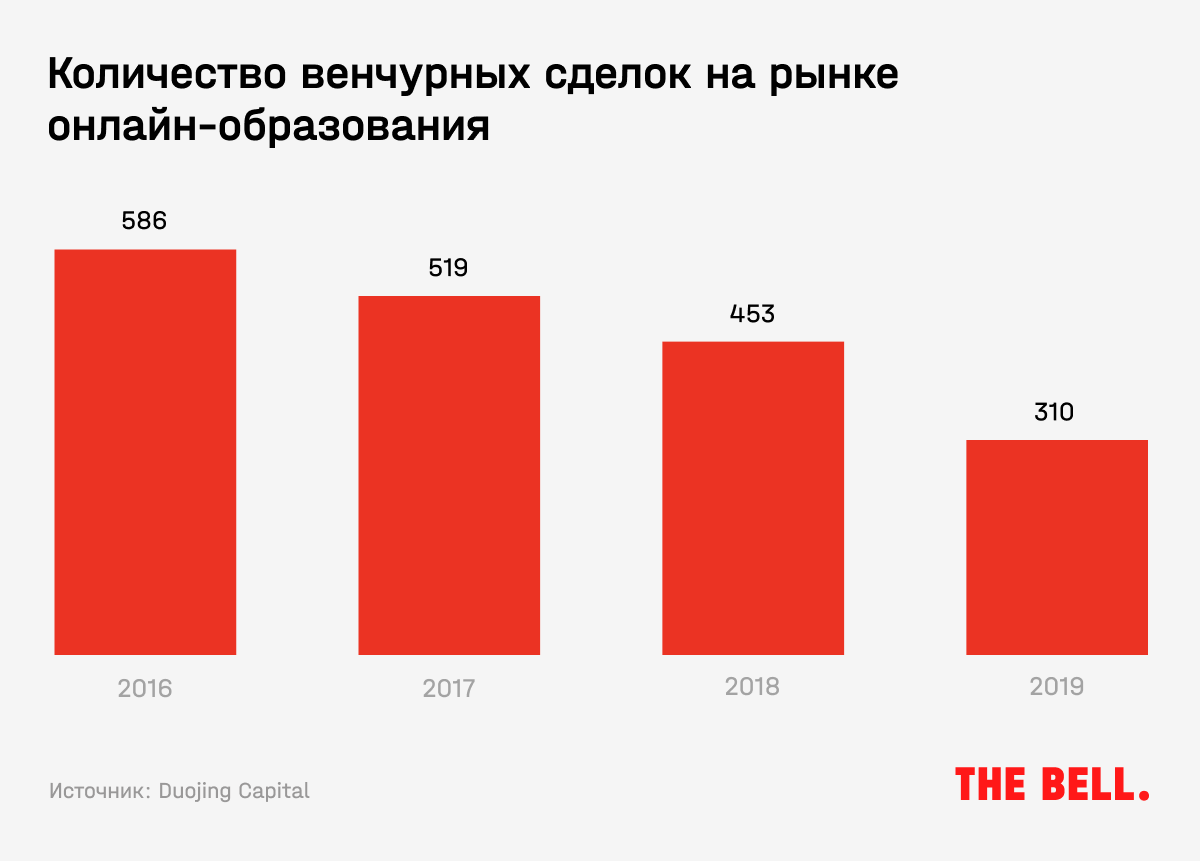
Venture investments helped many Chinese companies in the field of EdTech become public. Since 2017, 25 such companies have been published on the exchange, and the Pioneer of this industry New Oriental Education & Technology Group, which we will talk about below, conducted an IPO back in 2006.
The main players
Tal Education
Tal
The first Chinese companies from the sphere of online education that listed in the United States. The company owns a pool of applications and sites for schoolchildren studying the K-12 system. Offers additional classes for schoolchildren and students.
Capitalization: $ 43.8 billion (+37% since March 11, 2020)
Multiplier P/E: absent due to low profit in 2019
The company's revenue has been growing at a great pace - over the past three years, on average 52% per year.
The company's shares were confident until the beginning of 2020. Now they have recovered from the coronavirus crisis and storm historical maximums.
The shares fell by 20% on April 7, after the company said that during the internal audit it was discovered that one of the employees had twisted sales . However, the quotes played this fall in the same month - after the report was published for the first quarter of 2020, which showed an increase in revenue by 18%. In the next quarter, it, according to management forecasts, can grow by 30% (the report is expected on July 30).
-Until now, the company's profit was doubled every year, but in 2019 the indicator has fallen 15 times, up to $ 27 million, due to an increase in advertising and promotion costs. Nevertheless, analysts expect that according to the results of 2021 and 2022, the company will again become profitable.
- Bank of America recently raised a recommendation on the company’s shares to “buy”, noting the pace of penetration of online solutions into the field of education.
Ata Creativity Global
AACG
The company conducts courses aimed at developing art and related talents of students. The number of its students is much less than that of other publicly trading companies.
Capitalization: $ 0.04 billion (+62% since March 11, 2020)
Multiplier P/E: is absent due to company losses
- For the past five years, the company has been unprofitable, and the loss is only growing. According to the results of the first quarter of 2020, a net loss amounted to 20.5 million yuan ($ 2.9 million), which is one and a half times more than a year ago.
- The company has a very small capitalization - we do not recommend investing in its securities.
New Oriental Education & Technology
Edu
Provides a full cycle of educational services for children from three years old, including K-12 classes.
Capitalization: $ 21.5 billion (+13% since March 11, 2020)
Multiplier P/E: 41
The last three years, revenue has grown annually by an average of 26%.
The company increases profit: according to the results of the third financial quarter, coinciding with the second calendar, it was possible to earn a record $ 209 million net profit.
In the last quarter, 1.6 million students signed up for the company's educational courses: growth amounted to 2.3% a year by the year. Over the past three quarters - 8 million.
The company is developing rapidly: in the last quarter, the area of training centers increased by a year by 30%.
Bank of America recently raised a recommendation on shares to “buy”.
Conclusions
The highest revenue growth rates are shown by Chinese companies - the New Oriental Education & Technology and Tal Education. The Chinese online education market as a whole is developing more rapidly than the American one. In the USA, in the EDTech segment, the most fast -growing companies in 2020 and 2021, according to analysts, will be 2U and CheGG.
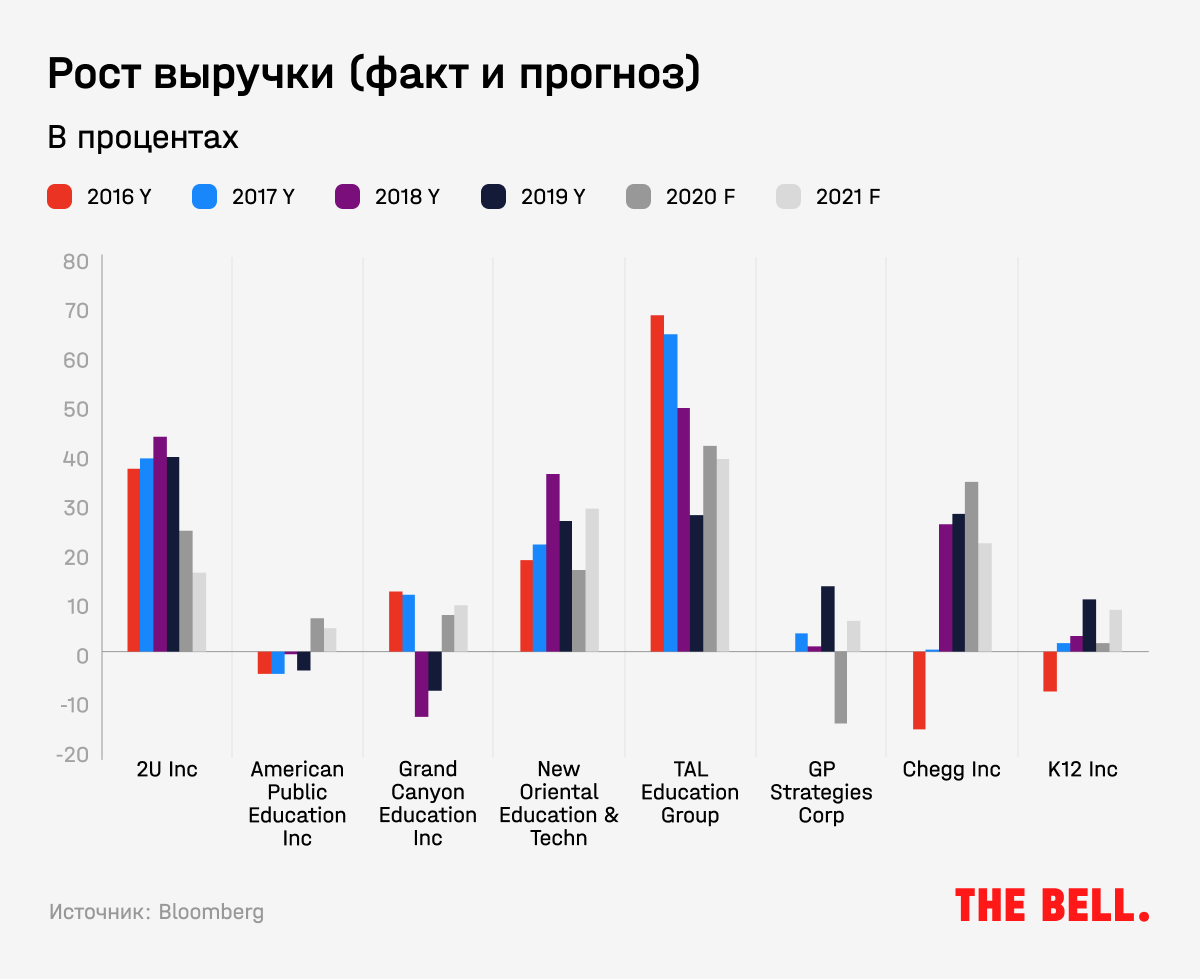
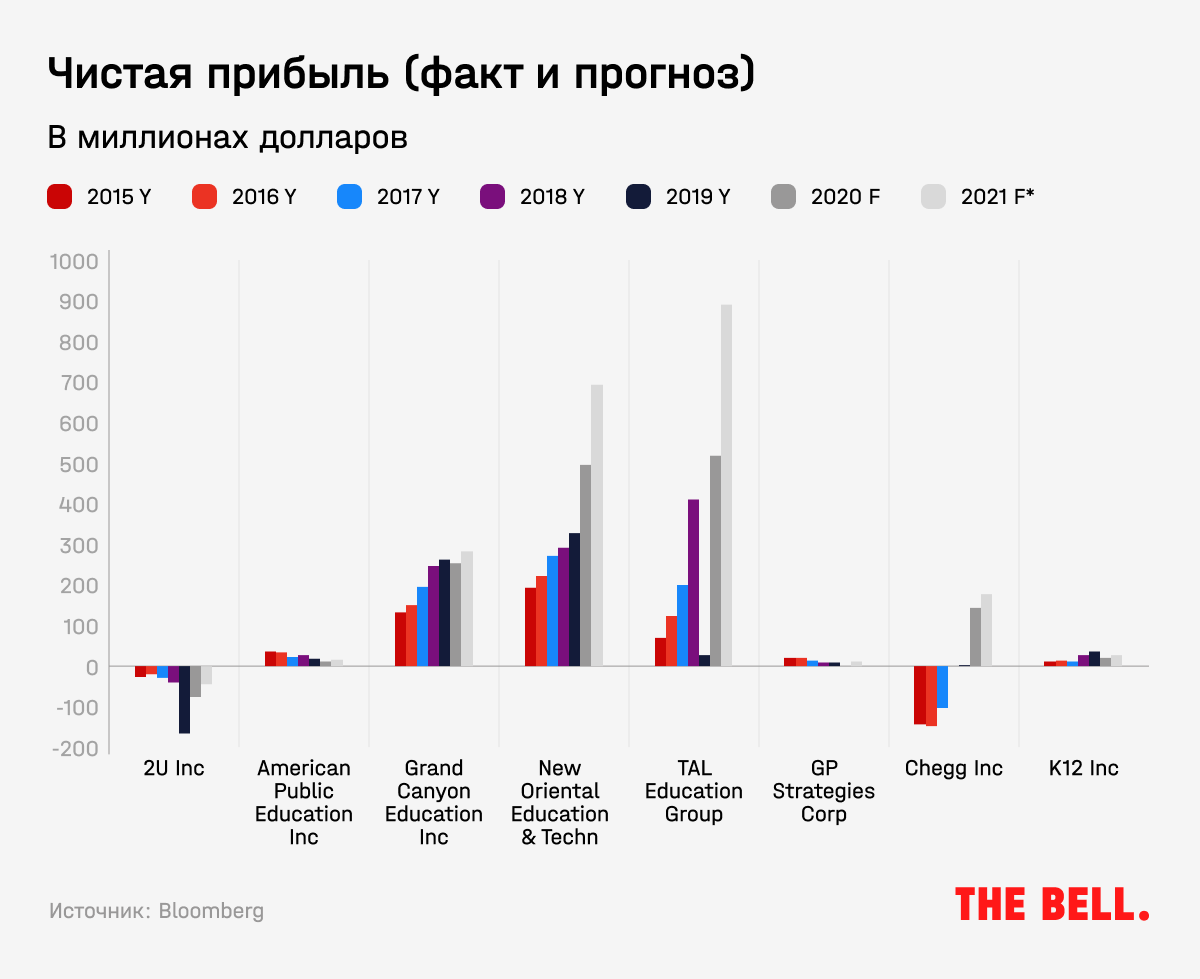
Many of the listed companies are unprofitable due to their youth and focus on aggressive growth and the conquest of the market.
- The stable growth of profit is shown by the New Oriental Education & Technology, Grand Canyon Education and Tal Education (with the exception of 2019).
- The biggest losses showed 2u and Chegg, but the latter plans to go out to plus this year.
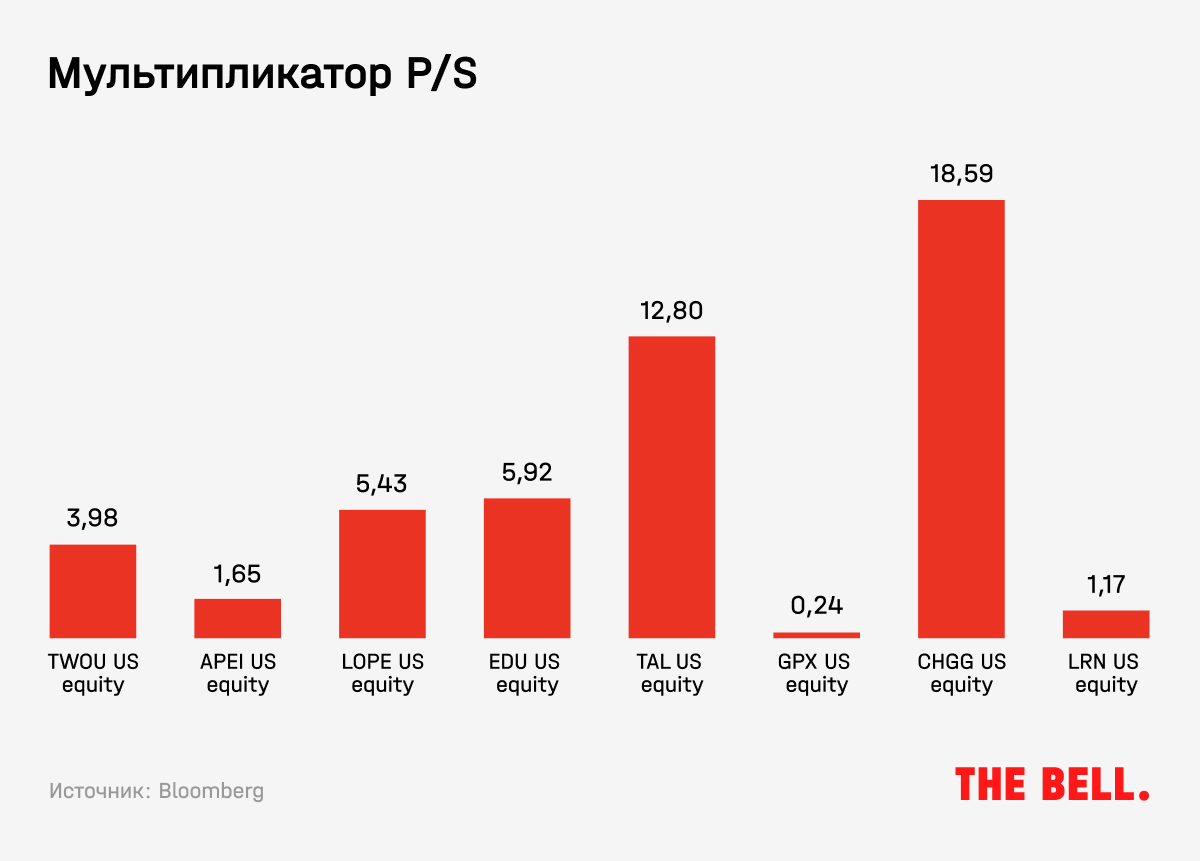
Since some of the companies are unprofitable, you can compare them with each other using the P / S multiplier (price / revenue). The lower this indicator, the less the investor pays for each dollar revenue. A high multiplier speaks of big risks.
- The lowest animators - companies with a capitalization of less than $ 1 billion: American Public Education, K12 and GP Strategies. But the forecasts for the growth of revenue in these companies are more modest.
- Higher estimates are in large and established companies on their continents, such as Chegg and Tal Education. Both have good profit forecasts - TAL will return to profit after a loss in 2019, and Chegg should go into profit for the first time in 2020.
The most stable company looks like Grand Canyon. Such an investment may be suitable for conservative investors - the company's financial indicators have been growing steadily for nine years. Compared to other companies from the sector, Grand Canyon shares did not grow so much from the beginning of the pandemic of the new coronavirus.
Chinese companies of the New Oriental Education & Technology and Tal Education are profitable, their revenue is also growing at a high rate. Both work in one local market, so success will depend on the actions of management and common trends. These are interesting growth stories in the Chinese market.
The history of growth in the American market can become Chegg: despite the fact that the company is still unprofitable, this can change in 2020 - due to the rapid growth of revenue and popularity. Analysts from leading investdomas recommend buying these promotions.
- The remaining companies - American Public Education, K12 and GP Strategies profit, if any, it grows slowly, and in terms of growth in revenue, they lag behind competitors, which looks weak for such a rapidly nascent market. Small players have not yet maintained competition.