Date
Author
Катя Бонч-Осмоловская, Артем Щенников, Екатерина Мартынова
Source

Preserved copy
Translated material
The batons do not bend
How Russian security forces cover the police violence and whom they consider to be “tolerated”: the study of “New”
This material is the second part of the Novaya Gazeta research on police violence in Russia. Read the first part here.
In a conversation with the “New”, about a month ago, the head of the “Committee against torture”, a member of the Human Rights Council under the President of the Russian Federation Igor Kalyapin suggested that the Rosgvardeytsy who shot Vladimir Taushankov during the assault on his apartment in Yekaterinburg will not be held accountable:
“I will not be surprised at all if it turns out that an employee who planted several bullets in this unfortunate in his own apartment did not violate anything. I think that [bring it to justice] it will not be possible. Most likely, they will just wait for the excitement, journalistic and civic interest around this case, and recognize the actions of the Rosgvardisian lawful. ”
And so it turned out: the UK did not find signs of a crime in the actions of the security forces. In the first part of the study on the police, “New” said that the Taushankova case is rare: in Russia, the detainees rarely use firearms, but often beaten. At the same time
It is extremely difficult to bring law enforcement officers to justice for the use of force, even if the victim received serious injuries:
Investigators either refuse to initiate the case or redirect applications to other departments.
Russian law enforcement agencies try not to hold their employees accountable for violation of the law - including under the pretext that this will damage the image of the security forces. The newly studied “new” sentences against police often say that with their actions they “discredited the authority of authorities in the Russian Federation.”
At the same time, the security forces consider any expression of solidarity with civilians a manifestation of weakness: for example, the head of the Moscow police trade union said that it was humiliating to kneel before the protesters, as the police do in the United States.
The host of Channel One Kirill Kleimenov agreed with him:
“As I said the day before, we are not America here. Our police are not powerless tolerants, we have the police - heroes. ”
You will not be convicted
If a business is still manifested against the business against the security forces for beatings or torture, he is usually qualified under Part 3 of Art. 286 of the Criminal Code - the excess of official powers using violence, weapons, special equipment or causing grave consequences.
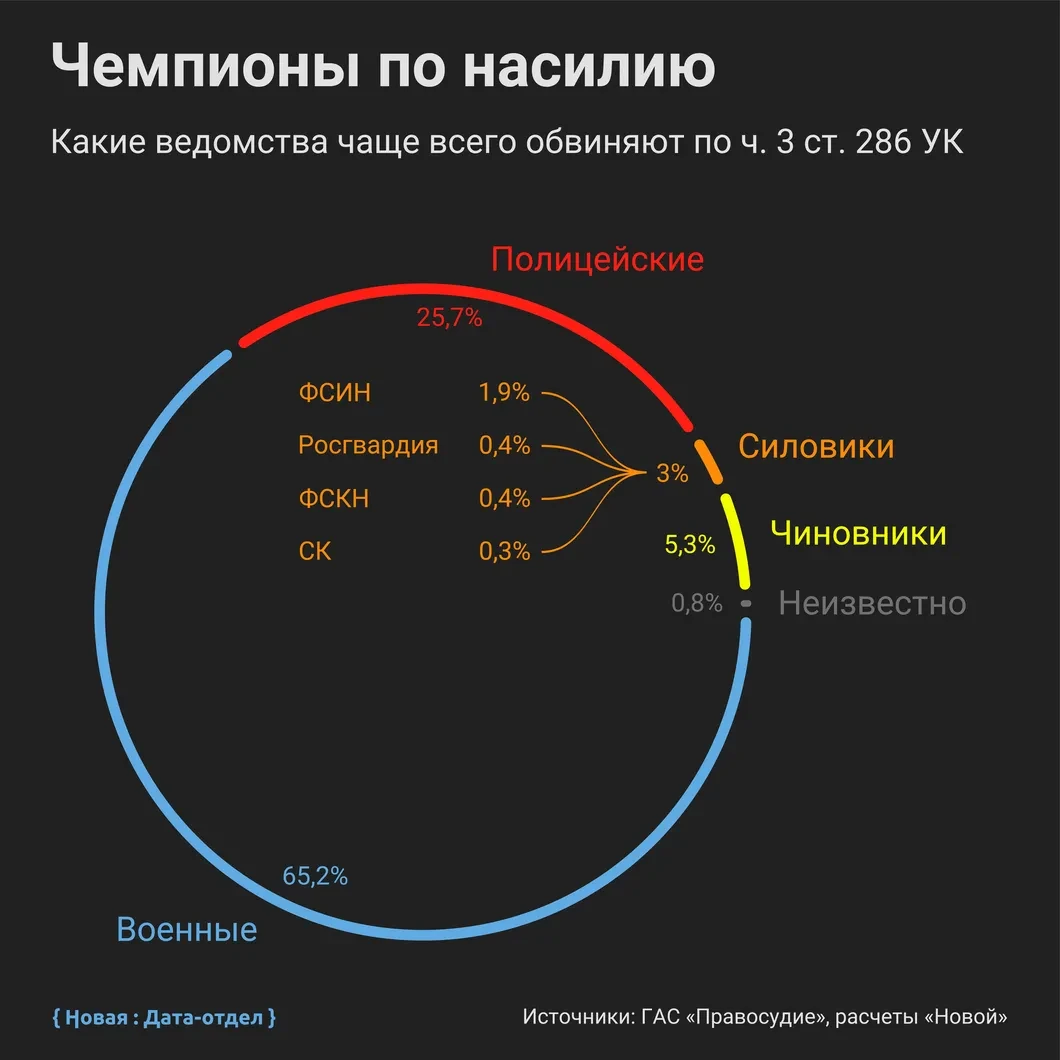
“New” studied more than two thousand sentences under this article for the period from 2016 to 2019, the texts of which were published in the GAS Justice system. Most often, the military (65.2%) become the defendants under this article. As a rule, senior in rank is held accountable - they beat subordinates for supposedly misconduct in the service.
The security forces account for less than a third of them, most of them are against the police: every fourth sentence (25.7%) was sentenced to employees of the Ministry of Internal Affairs, and employees of other law enforcement agencies - the Russian Guard, the FSIN, FSKN and the UK became involved in cases in 3% of cases.
Also, under this article, sentences are sentenced to employees of the Federal Tax Service, Rosprirodnadzor, the Ministry of Emergencies, municipal deputies and other officials (5.3%).
That which falls into judicial statistics is only a small part of cases of violence by the security forces. These are only those situations on which the victims decided to sue law enforcement officers and managed to bring the case to the sentence. Most victims do not have enough resources and knowledge to defend their rights, explains the sociologist Ella Paneye:
“The victims of violence are afraid to complain in the overwhelming number of cases. <...>
Their typical victim is a marginal or working poor, who is unlikely to find resources, knowledge and social skills in order to achieve justice. ”
If the victim nevertheless submits an application for a policeman, in most cases the case is not initiated. “Any statistics begins with the initiation of a criminal case. And then things are simply not excited, one of a thousand is excited, maybe even less. That is, we are talking about hundredths of interest. Accordingly, there is no statistics. It is completely impossible to judge the percentage of these percentage of the percentage, ”says Igor Kalyapin.
The Investigative Committee did not respond to the request of Novaya Gazeta to submit refusal statistics on the statements of the security forces affected by violence, however, it is possible to evaluate the scale of the problem, relying on the data of human rights activists.
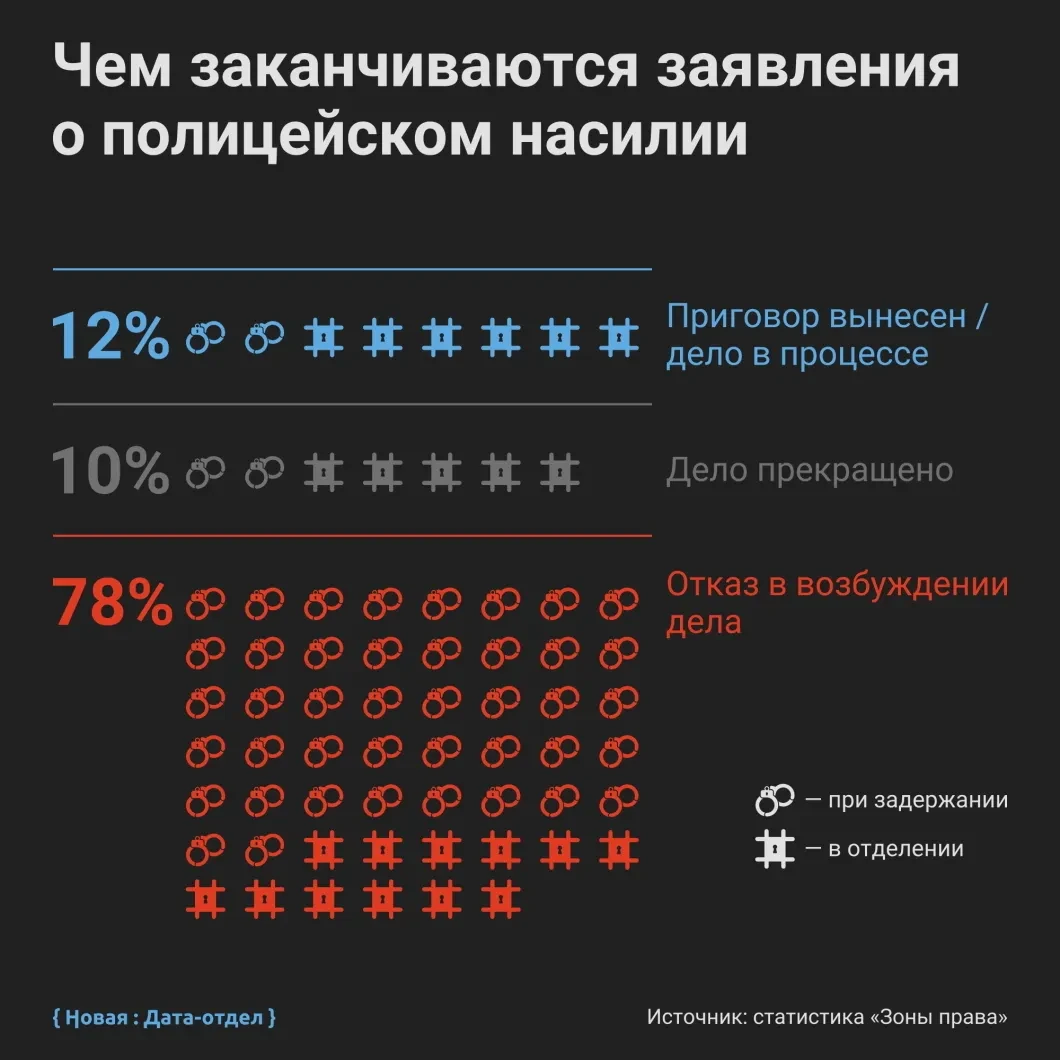
The human rights organization “Zone of Law” introduced a “new” sample of 70 cases for the period from 2015 to 2020, according to which lawyers are trying to prosecute security forces for beating or torture.
80% of the statements remained satisfied: the UK refused to initiate the case, some statements rejected repeatedly - up to 14 times.
If the case is still being brought up, it is usually associated with torture in the department: only four out of 15 cases have been excited for violence upon detention.
"
According to the Judicial Department at the Supreme Court of the Russian Federation, from 2009 to 2019 under the article on exceeding official powers with the use of violence, 13.3 thousand people were convicted. Based on the analysis of the "new" we can assume that a third of them are about four thousand - employees of law enforcement agencies. Based on the data of the “zone of law”, it is possible to bring 12% of applications for violence against security forces to the verdict. Thus,
Over the past 10 years, tens of thousands of cases of beating and torture, which the police and other security forces subjected the detainees, could remain unpunished.
Official data show that the number of cases in which the case can be brought to court is even less.
At the end of 2019, the SK first revealed statistics on criminal cases against the FSIN employees for violence in colonies and pre -trial detention centers. Four years before the trial, only about 2% of cases reached - the victims submitted almost 6.5 thousand statements, but only 148 of them were instituted. At the same time, the FSIN employees, as the analysis of the “new” showed, make up less percent of all convicts under the article on violent abuse of powers.
It is not easy to achieve a security forces liable for beating, but there is a separate category of victims - those who were injured during hard detention on opposition shares.
In this case, and so small chances of the trial are almost zero.
In the sample of the “zone of law” there are almost half (45%), and in none of them it has not yet been initiated by the initiation of the case. As Igor Kalyapin notes, in such situations, the UK simply ignores the statements of the victims:
“In the summer of the last [2019] year, I first encountered practice, when the Investigative Committee refused to accept statements on the beating of demonstrators at Moscow protests. We monitored 25 statements in the HRC, and they did not consider them at all, the Investigative Committee simply refused to work. <...> They don’t even want to make refusal decisions on the beating of demonstrators. When a refusal is made, at least it can be appealed, and then there is even nothing to appeal. ”
When it comes to an attack on a law enforcement officer, the UK and the courts act exactly the opposite: they are incurred many times more, and punish them stricter. "New" said that
It is precisely the participants in political actions that are subjected to more severe punishment.
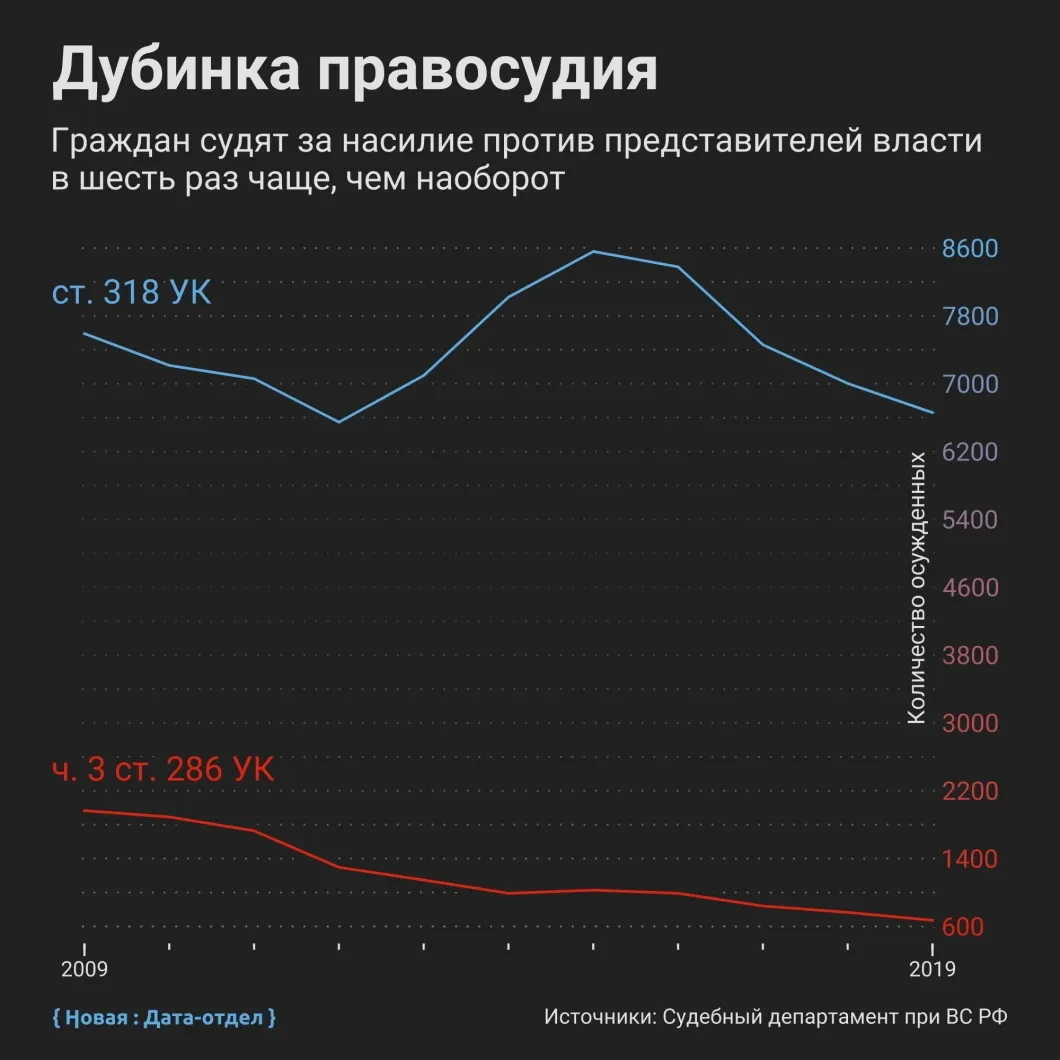
According to the Judicial Department, over the past 10 years, six times more people have been convicted of violence against a representative of the authorities than for violent abuse of authority. Moreover, the number of convicts under Part 3 of Art. 286 over the past 10 years has decreased almost three times.
The press service of the Novice Ministry of Internal Affairs stated that the agency is preventing violence by police, and the number of such offenses is reduced. According to them, for each such occasion, checks are carried out, and not only employees who violated the law, but also their leaders are responsible: their leaders:
“In the Russian Ministry of Internal Affairs, on a systemic basis, measures are taken to prevent corruption and other offenses among personnel. <...> The measures taken allowed to stabilize the current operational situation. According to the results of 2019, the number of employees of the internal affairs bodies subjected to criminal prosecution under Part 3 of Art. 286 of the Criminal Code, decreased by 13%, while the number of officials who committed this criminal act with the use of violence or with the threat of its use decreased by 21%. ”
The number of crimes committed by the police can decrease not only due to successful prevention.
The case against an employee of the Ministry of Internal Affairs will not fall into statistics if he is fired retroactively so as not to spoil the performance of work,
Says Paneye:
“There is such a reception in the Russian police as the dismissal of an employee retroactively, when a complaint is filed against him and are going to initiate a criminal case. There is a chance that there will be scandals and the case will come to court. Suddenly it turns out that this person has not been working where he worked for three days. So they say that he went to the site to visit former colleagues and beat a man. ”
Procedural ping-pong
Cases of abuse of powers are under investigation of the UK. It is extremely difficult to initiate such a thing against a police officer, since investigators are working closely with the police on the disclosure of other crimes - in fact, they have to investigate against colleagues, on cooperation with which their official successes depend.
“It is extremely difficult to achieve a policeman accountable even with obvious grounds. There is a whole set of reasons, but the most important thing is that in fact the Investigative Committee is not an independent body. Formally, they have different bosses, they often sit in different buildings, they have caps of different colors, ”explains Igor Kalyapin. - But I know in practice that when investigators begin to investigate cases against the police too initiatively, they simply declare a boycott, they refuse to work with them. They interact very closely, together every day of crime is investigating.
No independent investigation actually occurs, because it is leaded by a comrade and colleague. ”
In addition, the investigating authorities delay the process of consideration of the application, says lawyer Maxim Nikonov:
“When a person who has suffered from violence submits an application, these statements are drained for a very long time, you have to appeal the refusal to initiate criminal proceedings several times. We get such a procedural ping-pong: the victim submits a statement, he is refused to initiate a criminal case, he successfully appeals this refusal in court, and the case comes to a new circle procedurally: the application is being worked out, some more additional events are carried out, the refusal is being carried out again-and the problem runs in a circle. ”
If the case against the security forces for violence is nevertheless initiated, it is extremely difficult to bring to the sentence. According to the “zone of law”, about half of those cases that managed to excite were suspended or closed.
In cases where such cases reach the sentence, the chances of fair punishment are small. In 2019, almost 5% of sentences under Part 3 of Art. 286 were justified - this is much higher than in all other articles (0.25%).
When civil servants or security officials are in the dock, Russian courts suddenly become more humane,
Ella Paneye says:
“They [policemen] have a relatively high percentage of justification compared to ordinary people. Our courts have such a trend - not so much to be unjust to vulse the privileged defendant as to include an honest court, fair and impartial. Judges recall the existence of the presumption of innocence, the principle of humane punishment, take into account the presence of a family, a good characteristic from work, and so on. Therefore, they [security forces] often receive normal humane sentences that all violators should have received. ”
If the defendant was found guilty, then most often he was sentenced to conditional punishment (47%) or a fine (29%). Nikonov notes that, in cases of violence of security forces, Russian courts bear disproportionately soft sentences:
“Punishment [under Part 3 of Art. 286] - from three to ten years. In principle, the courts do not impose the maximum punishment for previously not convicted, but in this situation the predominance of conditional conviction, of course, raises big questions. Moreover, not only among lawyers, but also with the ECHR: in his decisions he expressed that the punishment [on cases of violence of security forces] is not fair.
A person may remain damage, sometimes the removal of internal organs after all this violence, and the court appoints a conditional term to the security forces that did this. ”
"
Not all things against security forces are initiated in order to restore justice and punish an employee who violated the law. Sometimes this is just a way to deal with the competitor in the service or take revenge, says Ella Paney:
“Often a policeman becomes a victim of the setup. Not all convicts under this article were put by human rights activists, a fair amount of them was put by their own authorities or competitors with whom something did not share, employees of other law enforcement agencies. Police quite often fall into such a situation, because interdepartmental and internal conflicts are resolved through criminal cases. ”
In the newly studied “new” sample, one also met such a thing, where the policeman believed that they wanted to take revenge with the help of a criminal case. The case file says that the victim was aggressively - cursed, threatened the district police officer and spit. The policeman claimed that he did not beat the detainee and raised his hand to protect himself from spitting, but in the end he was sentenced to four years in prison:
From the case file
& Nbsp
“He saw that the victim had spat in him, but did not hit him. He knew at work that spitting could be dangerous and transmitted diseases. <...> He, being in motion, threw up his hand to cover himself with spit, while he did not group, did not take the impact stand and did not squeeze the fist. He did not feel that he had touched the victim . He had no intent to strike the victim . After that, the victim’s relatives began to shout that he had hit the victim , to which he told them that the victim had not beat.The Investigative Committee and the Prosecutor's Office, believes [ defendant ], are also trying to avenge him to revenge in 2017, being a witness to another criminal case, testified against employees of the Investigative Committee, which were confirmed. ”
Thus,
Instead of a fair investigation of crimes by the security forces, the Investigative Committee either covers the necessary employees or uses criminal cases for internal showdowns.
In order to fix this, it is necessary to carry out the reform of the police and law enforcement agencies, and it is possible if the country has a strong external mechanism that can control the law enforcement agencies, says the panies:
“The police in general throughout the world are bad with feedback mechanisms, it is not very capable of self -cleaning from the inside. In order to not just put one “distinguished” policeman, but reform the police organization, you need a lot of political will from the outside. ”
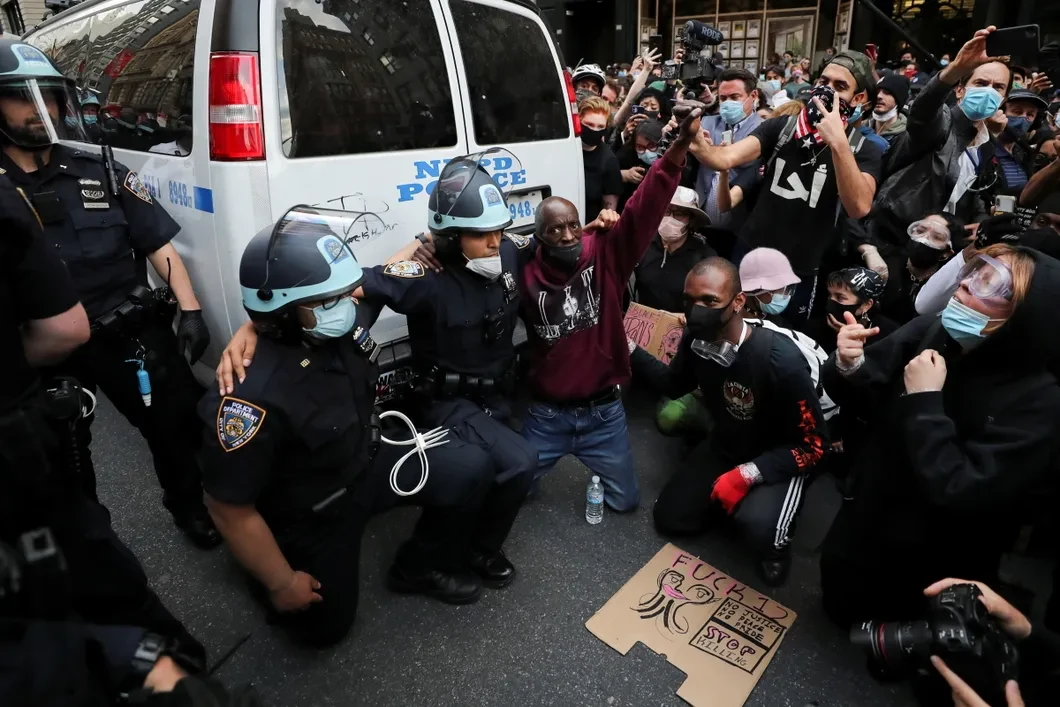
For example, in the United States, mass protests due to the death of African-American George Floyd led to the emergence of the #DEFUNDTHEPOLICE movement, whose supporters advocate the reform of the American police. They suggest more clearly to determine the powers of the police, reduce their staff and financing. The House of Representatives of the US Congress has already approved the George Floyd bill, which forbids the police to apply suffocating techniques, tightens the punishment for the use of violence and provides for the creation of a register to track such violations.
The experts surveyed by the “new” experts note that a separate department should be engaged in an investigation of crimes committed by Russian security forces, which are in no way depending on power structures.
“We need a special body that will investigate only the official crimes of the security forces, that is, employees of the Federal Security Service, FSB officers, and police officers. <...> So that the investigators were not from one sandbox with this policeman and when investigating the case of torture-it doesn’t matter or another crime that the policeman committed-so that the investigator did not think: “How will I be with him or his colleagues to reveal any rape?” - says Kalyapin.
In addition, it is necessary to strengthen public control of the places where police violence occurs most often - these are temporary maintenance, pre -trial detention center and colony. However, with the existing political system, the chances of carrying out the reform of power structures, which will make their work more transparent and protect citizens, disappearingly small.
“In Russia, there are no ceremonies that prevent the police from quickly spoiling, there is no change in power at the federal level. The last serious shake of law enforcement agencies, which really led to some improvement, was in the 50s. After that, there were Soviet and post -Soviet attempts to reform law enforcement agencies, none of which changed their practices, ”says Paneya.
Katya Bonch-Osmolovskaya, Artem Puntnikov, Ekaterina Martynova, "New"