
Translated material
The test of the sank
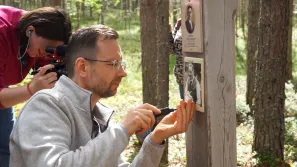 Maxim Lyalin sets a memorial plate in Sandarmokh. Photo by N. Demina
 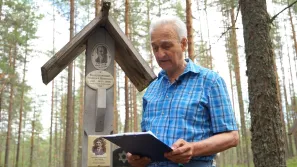 Musician Dmitry Zvibel talks about the fate of his teacher and his father. Photo by N. Demina
 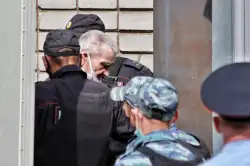 Yuri Dmitrieva is escorted to the court building.
Photo by D. Krotova
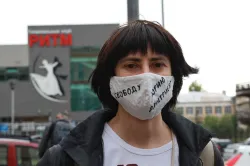 Irina Ghalkova, director of the Memorial Museum.
Photo by D. Krotova
On July 22, 2020, a decision of the court in the case of the chairman of the Karelian branch of the Russian Society Memorial, Yuri Alekseevich Dmitriev , became known. He was sentenced to 3.5 years of the correctional colony and, taking into account the deadline spent in jail, may be released in November. However, the next day it became known that the state prosecution intends to appeal the verdict.
On the day of the sentence, dozens of colleagues, friends and acquaintances of Yu. A. and simply not indifferent to his fate, including those who came from Moscow and St. Petersburg, gathered at the building of the Petrozavodsk city court. About the events of this day, opinions about the process and about the trip to the Sandarmokh memorial cemetery, where new signs with the names of the executed were installed, says Natalia Demina, correspondent of the TRV-HOWN.
Our expectation of a sentence on the second process over Yuri Dmitriev this time took place on the street before court. The day before, all journalists were sent information that access to the court building was closed due to the pandemic of coronavirus. And the press, and ordinary citizens, and people in uniform and civilian were waiting in the yard. One comrade actively shot us all in the video, and I took a picture of it twice. He immediately came up to me and ordered: "Make the last two pictures!" - "But why?!" - "Make it and that's it." - “Well, you also shot us. Imagine: who are you? " The comrade did not want to call himself and walked away.

By 13:40, the excited lawyer of the defendant Viktor Anufriev came to the court building. He told reporters that this process for him was even more complicated and responsible than the first, and “for Yuri Alekseevich this is a huge psychological burden,” and hurried to the Petrozavodsky court.
In anticipation, someone discussed possible outcomes, someone painted the words of support to Yuri Dmitriev on medical masks, someone handed over booklets about Sandarmokh-a place of mass burials found by Dmitriev’s search expedition on July 1, 1997 (her daughter Yu.A. Katya also participated in her-then she was 12 years old).
The expedition participant Irina Fliga recalls in his book “Sandormokh: Drama of Smyschers” (Nestor-History, 2019) that after unsuccessful searches in the sandy part of the old quarry (the piture did not give a result), Dmitriev went into the forest, and “ about five hundred meters north Roads leading deep into the forest, he discovered the characteristic shedding of soil in size 4 × 4 m and 10-30 cm deep. They had an almost correct, slightly swollen around the edges, a quadrangular shape. They began to dig in a new place. The upper layers of the soil turned out to be mixed, and in the first excavation at a depth of two meters, shocked soldiers stumbled upon the bone remains . ”
At 14:50, the lawyer Anufriev left the court building and, with difficulty restraining emotions, said that he had not yet received the text of the sentence, but the judge announced that the first sentence of the Petrozavodsk City Court of April 5, 2018 was actually confirmed. Moreover, Dmitriev is justified in his actions in his actions, not only in terms of the manufacture of photographs of the child (Articles 135 and 242.2 of the Criminal Code of the Russian Federation), but also on the fact of storing a fragment of a gun. Thus, on these points, Yuri Alekseevich received the right to rehabilitation and compensation for possible damage from the state. On the second charges under Art. 132 Dmitriev was found guilty and sentenced to 3.5 years in a maximum security colony, i.e., below the lower limit under this article (12 years). If so, the lawyer noted, then taking into account more than three years and two months spent in jail, Yuri Dmitriev will be able to be released in the fall. People began to rejoice quietly.

At 15:20, the lawyer already came out with the text of the sentence, and a crowd of journalists carried it like a full -flowing river, to the center of the site in front of the court and nearly pushed him down. "Flob, flower bed, more careful!" - shouted colleagues. "It would be a good small armored car for a lawyer!" - "Yes, where is my armored car?" - said Anufriev. And actually repeated the court decision he had already previously voiced. He mentioned that the 64th article of the Criminal Code of the Russian Federation was applied, taking into account mitigating circumstances.
The lawyer noted that he does not know if Dmitriev would appeal. “We will decide with the client,” he answered. - Yuri Alekseevich took this sentence positively, and the issue of qualifications and the deadline is the topic of our conversation at the meeting. He is sure and knows that he is innocent. ”
Many applauded the lawyer and shouted "Hurray!" Dmitriev’s friends hugged each other. Anufriev, in turn, thanked all those who came to court and supported Dmitriev all these years, and expressed special thanks to Yuri Mikhailin, a teacher of the Moscow International Film School, one of the administrators of the Dmitriev case in Facebook.
“I always believed in the innocence of my father. I'm glad I'm happy. The greatest desire is to see the father and hug. He knows that a lot of people came to the court, ”said the daughter of Yu. A. Katya Klodt, dumbfounded and delighted by the voiced sentence.

"Anatoly Yakovlevich, is this a victory?" “The journalists asked the historian Anatoly Razumov, a close friend of Yu. A.“ Based on what could be, I think yes, ”he replied, adding that only Dmitriev would give the exact definition of what happened in court. “Our defense is not stopped, we will continue to protect it and work for its excuse.” Then, already in the evening, he called Yu.A. The watchman of history and historical memory. He is sure that if there were not such an almost incredible level of solidarity around Dmitriev’s case, such support in Russia and around the world, then the sentence would not be so soft. “And most importantly, we will protect Sandarmokh as a symbol of Dmitriev’s entire activity. Now with him together, at least since November. ”
Alas, on that day Dmitriev himself did not see. In the backyard of the court, a whole special operation was carried out with the participation of several cars to prevent the work of journalists, but skillful colleagues-Memorial photographer Daria Krotova and the BBC correspondent-were still able to take pictures. Irina Ghalkova, director of the Memorial Museum, who had shot down from a high house movement of security and Dmitriev, also appeared on the Web.
What's in the dry residue? Perhaps the most accurate commentary, somewhat extinguishing the joy of the fact that Yu. A. can soon be released, gave our newspaper Dmitry Zvibel, pianist-concertmeister, head of the Jewish community of Petrozavodsk, friend Yu. A., Knowing him since 2005:
“A good sentence is when both sides are not satisfied. But this is possible only if there really is a competition of lawyers, investigation and prosecutor's office on equal terms. The verdict of Yuri Dmitriev cannot fall under this formulation, since this “case” is fabricated, and the other side knows this very well. Yuri Dmitrieva leaves this sentence to live with a filthy article, and everyone can now say on the basis of a court decision that Yuri is a criminal, and even under such an article. And Yuri will not be able to object, as formally, on paper, the court decided this. And this means that until the sentence is canceled through the court, and with the wording that the whole process from the very beginning has no legal basis, Yuri Dmitriev is a criminal. Therefore, of course, it is good that there was a hope for the liberation of Yuri Dmitriev from a conclusion, but it is necessary to achieve a complete justification and recognition of the illegality of all this process. ”
Threats for Sandarmokh
"Do you see the threat of Sandarmoch?" - I asked the deputy of the Legislative Assembly of the Republic of Karelia and a member of the Politic Committee of the Yabloko party Emilia Slabunov, who had come to the court of Dmitriev more than once.
"Certainly! Sandarmokh survived two “expeditions”, in fact, two raids, the Russian Military Historical Society in 2018 and then in 2019. I filed claims for the inaction of the Prosecutor General of the Russian Federation and the prosecutor's office of the Republic of Karelia regarding the RVIO expedition in 2018. I repeatedly turned to all law enforcement agencies, twice to the Prosecutor General of the Russian Federation, and she sent my appeals to the Karelia Prosecutor's Office. She, in turn, sent them to the Office for the Protection of Cultural Heritage of Karelia. They replied that there were no grounds for checks. Thus, the prosecutor's office closed his eyes to all the lawlessness produced by the RVIO in Sandarmokh. I went through both the Tver District Court of Moscow and the appeal in the Moscow City Court. On July 15, 2020, my cassation appeal was considered in the second cassation court of general jurisdiction, I was denied it. Now we will move to the European Court of Human Rights. ”
“The actions of the organizers of these expeditions can be considered exclusively as a violation of the law. If allegedly shot Soviet troops were found there, then why are they still not devoted to the land with honors? Why is the results of the examination still not published? I understand why they are not. Because no hypotheses expressed by Verigin and Kilin [professors of Petrozavodsk University. - Ed. ] The fact that the dead Soviet soldiers are buried in Sandarmokh are not confirmed. ” (According to the information of the TRV-hunger, the remains of people found in Sandarmokh are now in the forensic examination bureau in Medvezhyegorsk.)
"How do you see the development of Sandarmokh as a monument of history in a good way?" - I specified the deputy.
“In my opinion, we need all -round support of those studies that he conducted and conducts even now, in prison conditions, Yu. A. Dmitriev,” Emilia Slabunova emphasized. - It is necessary to continue the publication of lists of names of those executed in Sandarmokh. It is necessary as many books and stories as possible about what was happening in those years. And most importantly, we need a state-legal assessment of the events of the Great Terror and the actions of the Stalinist state. We still live in a country where Bolshevism and Stalinism are not given. ” The deputy noted that in the new Constitution there are words about the protection of historical truth: "Dmitriev was engaged in the search for historical truth all his life - so support him in this."
“Dmitriev said that not all places of burial of the victims of the Gulag were found yet. Do we really not find out where they are? " I asked Anatoly Razumova.
“Be sure to be found,” he said. - But here are the difficulties of an all -Russian nature. The country has just come to the understanding that we were not open, did not find and did not recognize dozens of burials of the victims of the Gulag. In Karelia, a black river was found near Pudozh, Sulazhgora in Petrozavodsk and Red Bor near Petrozavodsk. And another place near Petrozavodsk is not even defined. Sandarmokh was found near Medvezhyegorsk, and several more places were not found. They must be sought. There are signs. But most importantly, it is necessary to open documents related to Stalinist repressions, and this is a task of all -Russian scale. ”
“We are in the working group for the coordination of activities aimed at implementing the concept of stateliness to perpetuate the memory of victims of political repression,” said Anatoly Razumov. - The task is set there: it is time for the relatives of the dead to find out where, who and when died, where the burial places are. I and Yuri Alekseevich have a big hope. He was stopped at the very peak of searches. He found a place for the execution of the first batch of prisoners of the Solovetskaya prison in 1997. And before the arrest, he was looking for a place of execution of the second and third batch of Solovites. The second batch, apparently, was shot at the Lodeyna Field and the Holy Trinity Alexander-Svirsky monastery, and the third on Solovki. ”
"What is the general situation with the detection of such places of burials in Russia?" I asked.
“Everything that the public could do was done,” answered Anatoly Yakovlevich. - The following steps can be taken after all the documents are disclosed. It's time to open the shooting documents, make them publish and publish them. And most importantly - the relatives of the dead have the right to know where their relatives died, our fellow citizens. People ask the search engines the question: “Where are the graves of our relatives?” We must understand why the most important grave of Russia is near the wall on Red Square, and hundreds of thousands of those shot secretly and at night of victims of Stalinist repressions still rest in secret pits. ”
In addition, the historian recalled that last year the report “Right to Memory”, compiled by Archilli Kirill Caled, was filed in the name of the president, the rector of the Church of the Holy Martyr and Confessors of the Russian in Butovo. His grandfather, clergyman Vladimir Ambartsumov, was shot at the Butovo training ground in 1937.
Indeed, as the media reported, on December 10, 2019, at a meeting of the Presidential Council for the Development of Civil Society and Human Rights, Kirill Kaleda drew the attention of the head of state [ 1 ] to the lack of regulation of the search for mass burial places, their arrangement and protection. He noted that such legislative gaps give rise to conflict situations. So, in Perm the volunteers wanted to equip the place of execution of the victims of the Gulag, which is located in the forest, and the forestry filed a lawsuit for them to cut down trees.
“In order for this issue to be resolved, political will is needed. I would ask you <...> to instruct the need to improve the legislation in the field of issues of mass grave. In particular, it is necessary to create an all -Russian register of places of mass burials of victims of political repression. It is necessary to instruct on conducting archival research on the search for documents related to the places of mass burials in order to facilitate the search for these places, ”Kirill Kaleda noted in his appeal to Vladimir Putin.
He clarified that some places of burial are located next to large intensively developing cities and can simply be destroyed. Others, on the contrary, are far from settlements, and naturally their traces are destroyed. “Therefore, this issue must be resolved in the near future,” Cyril Kaleda emphasized.
In response, the President of the Russian Federation expressed the hope that the Russian parliament would accept the necessary laws to perpetuate the burial places. However, six months have passed; Since December 2019, the deputies have already adopted many laws, even managed to take part in the alteration of the Constitution, and it seems, they forgot about the most important problem of historical memory?

The place of memory of Sandarmokh
In the tract
The moss is quiet yellow and blue and white sand covers
and dots and dashes on the moss sheet
SOS SOMS KOSE ABLE
SOSTS
Silence creak creak
Wind rustling creak rustling wind creak
The heavenly parade ground sweeps the crump
Sos Sos Sos Sos knock the wind and pine
And from heaven to them the sky is the sky ... not ... not Bo Yisya
Evgenia Kholodova, teacher
Russian language and literature of the school "Moomi-troll",
The volunteer of the project "Sandarmokh. Return of names "
These verses were born after visiting Sandarmokh on July 23. We publish with the permission of the author.
The day after the sentence, we went to Sandarmokh - it seemed to us very important to make a pilgrimage to this amazing and terrible place in its silent beauty. Having left 9:30 from the center of Petrozavodsk, by 12:30 we were already there. Of the 19 people who arrived in Sandarmokh in our minibus, 12 people were here for the first time, and it was clear how this place stunes, captures people. You go from pit to the pit, read signs on trees and crosses, watch photos of dead people-and you cannot believe that someone needed to shoot people secretly and nights for several years.
To our joy, while Yuri Dmitriev sits in a pre -trial detention center, his business continues. A group of volunteers, created by Maxim Lyalin [ 2 , 3 , 4 ] and participating in the search for information about the dead, on this day installed 12 new tablets with the names of the executed on this day. Ceramic signs were made on donations from relatives of the dead and other applicants to the installation of commemorative signs (project participants). A story was sounded about those 12 unfortunate, shot at night in the pits with shots in the back of the head in 1937-1938.
In particular, Dmitry Zvibel spoke about the Finn Yuho Nestor Sinisalo, who had two sons, Helmer and Rainer, who had a Helmer-Rainer (relatives and friends, called him by Weikko) during the Civil War in Russia in Russia, died in Russia. Nestor, concluded by Belbaltlag, was shot in Sandarmokh on the night of March 6, 1938 at the age of 39. Subsequently, the Weakko, who did not receive the opportunity to graduate from the conservatory as the son of the “enemy of the people”, became an outstanding composer. Six ballets, the first Karelian symphony and other musical works belong to him. According to Dmitry Zwibel, Weikko was so gifted that he composed music without the help of the piano, he heard it inside himself. Sinisalo Jr. died in 1989 and never found out where his father was buried.
When Dmitry Zvibel spoke about his teacher, who would have turned 100 this year, tears appeared before his eyes. With difficulty suppressing them, he turned on a fragment of the Sampo ballet “Sampo” Gelmer Sinisalo on the ground, and a beautiful melody sounded under the noise of pines in Sandarmokh (see video [ 5 ]).
Волонтеры понимают, что за Сандармохом, как и за любым местом массового захоронения, надо постоянно следить. Таблички ржавеют, выцветают, кресты падают, люди оставляют мусор. За всем этим следят только они и сотрудники Медвежьегорского музея. В ходе нашего визита в музей они пожаловались, что некоторые приезжающие не только мусорят в Сандармохе, но даже справляют нужду прямо среди захоронений. Всё это приходится убирать.
Очевидно, что мемориальное кладбище Сандармох как место чудовищного преступления, трагедии, как место памяти, важное для России и всего мира, должно получить мощную поддержку государства. Культурно-исторический центр мог бы стать градообразующим предприятием для окрестных жителей. И работы много — от благоустройства и установки памятных табличек и крестов до архивной работы и пополнения мультимедийного контента о жертвах захоронений [ 6 ]. Но всё это пока лишь светлая мечта тех активистов, которых думают о сохранении исторической памяти.
Сандармох нуждается в нашей поддержке.
- Стенограмма заседания СПЧ, 10 декабря 2019 года. kremlin.ru/events/president/news/62285
- Страница волонтерского проекта «Сандармох. Возвращение Имен» в ФБ: facebook.com/sandarnames/
- YouTube-канал проекта: youtube.com/channel/UCljCtuHHhnx4njz9Ktemnsg
- Интервью о работе волонтеров: daily.afisha.ru/relationship/13617-sandarmoh-vozvraschenie-imen
- Видеорепортаж Н. Деминой об установке таблички Юхо Нестору Синисало: youtube.com/watch?v=NrtNlduGwlk
- sand.mapofmemory.org