
Translated material
Firm body mysticism
If the system is very tightly controlled, it stops moving. Interview with Professor Skoltekh Boris Fayn
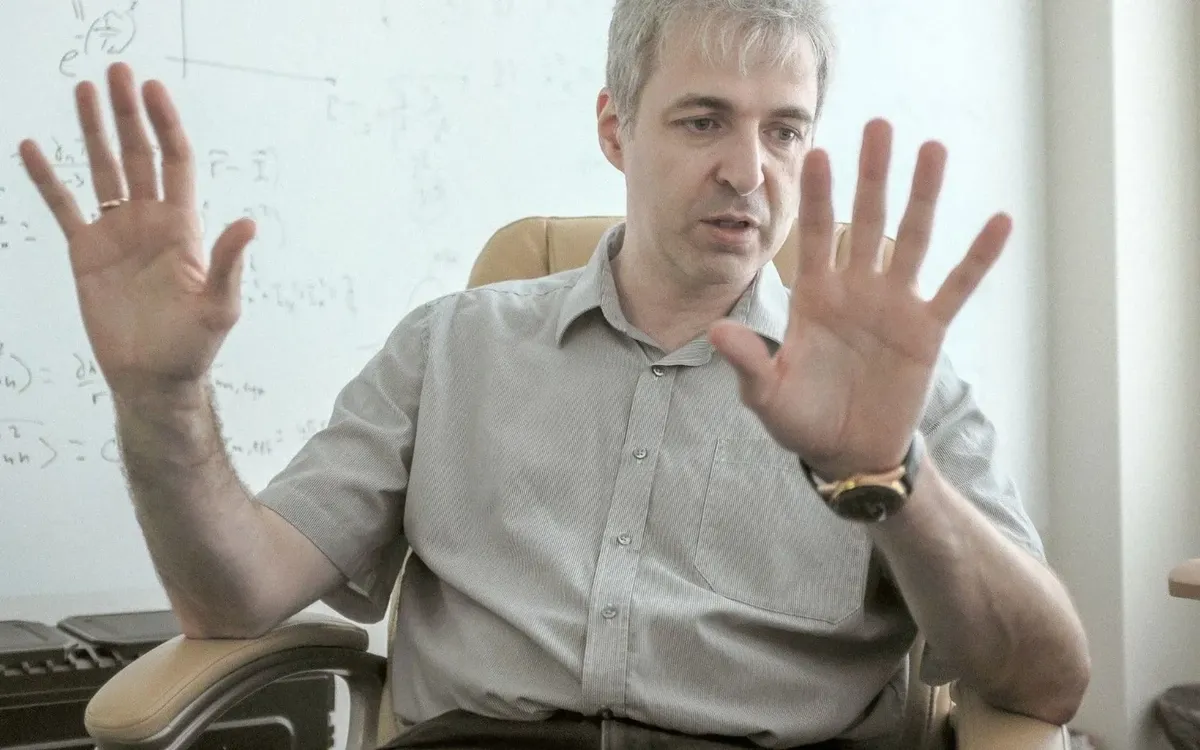
When we talk about ideals, riots, or droves, in fact, we are somehow talking about dynamic thermalization, quantum decoherence, chaos and, perhaps, the effect of Zeno. Just in order to realize this, you need to talk with a scientist. For example, with Professor Skoltekh Boris Fain, head of the laboratory of physics of complex quantum systems of the MIPT.
Boris Fine is one of the leading modern specialists in solid physics, which studies the problems of superconductivity and chaos.
During this conversation, we managed not only to compare the behavior of a person and an atom, try to understand how a large differs from small, and also find out how chaos helps development. We almost got to the main thing - the magic of everyday life, for which not only the physics of the solid body, but also any body, which was born in general, is beating.
- Science for me, humanitaria, is not an area of knowledge incomprehensible to me, but a kind of secret recording ultimately understandable things. Therefore, first of all, I am interesting to me in itself the desire to keep such a record. Tell me - how does a person become a scientist? How did this happen, for example, to you?
- Wow. Probably gradually. For this, apparently, it is important to have, in addition to all intellectual abilities, such, you know, natural curiosity. Something should be just interesting. There were things that were interesting to me when I was a schoolboy, and many of those things are still interesting to me.
In general, at school I was more interested in mathematics, I took up physics later. People are aware of physicists at a more conscious age. So in mathematics, I was very interested in the question of whether it is possible to automate the evidence of geometric tasks.
I probably had some reasonable mathematical abilities. My parents are engineers, grandfather was a teacher of mathematics in a technical school. In the family, adults believed that mathematics is an important science, probably this is transmitted to children.
I remember I liked solving difficult problems, and the more difficult, the better. The school was given textbooks for the next year.
I received a textbook, came home, climbed to the end, looked at what tasks there were increased complexity and immediately began to solve them.
Now I understand that not everyone has such a natural interest in something complex. And I had it, and it so happened that I became a scientist.
- And how did you understand that your business is physics, especially a solid physics?
- When I moved to the MIPT, I got to the group at the Capita Institute ( the Institute of Physical Problems named after P.L. Kapitsa RAS . - Ed. ). This was not a fully conscious decision, there were random combinations of circumstances, but I was immediately imbued with this combination of complexity and - which is especially important in the physics of the solid body - a connection with the experiment.
I realized that physics is not an abstraction.
Of course, the fundamental of tasks was also important. After all, the issues that the physics of the solid then solved are probably not very different from what she decides now. The main problems have not yet been resolved. Maybe the style of scientific work is changing. Previously, it could be attributed to the style of classicism, now in scientific work such Baroque elements appear - all sorts of jewelry, everything should now be bright in physics. But behind this brightness, there are still deep tasks that serious people think over.
“Could you list at least a few such tasks?”
- The area I still do is called "high -temperature superconductivity." It was opened in 1986, in 1987 they gave the Nobel Prize for it, but we still do not understand the mechanism of this phenomenon. Many were engaged in this, often proclaimed breakthroughs, but the impression was erroneous. The phenomenon is complex, the system in which it is observed is also complex.
Science understands here one limit, understands the other limit, and the phenomenon itself, meanwhile, in the middle.
Another topic that I do is connected with chaos, it is also called "dynamic thermalization." Chaos is not interested in me here in itself, but how it leads to the observed properties of systems in which there are many particles. This is also a very old story that still remains popular-adults realized that they grew up, learned, achieved something, but still they do not understand something here.
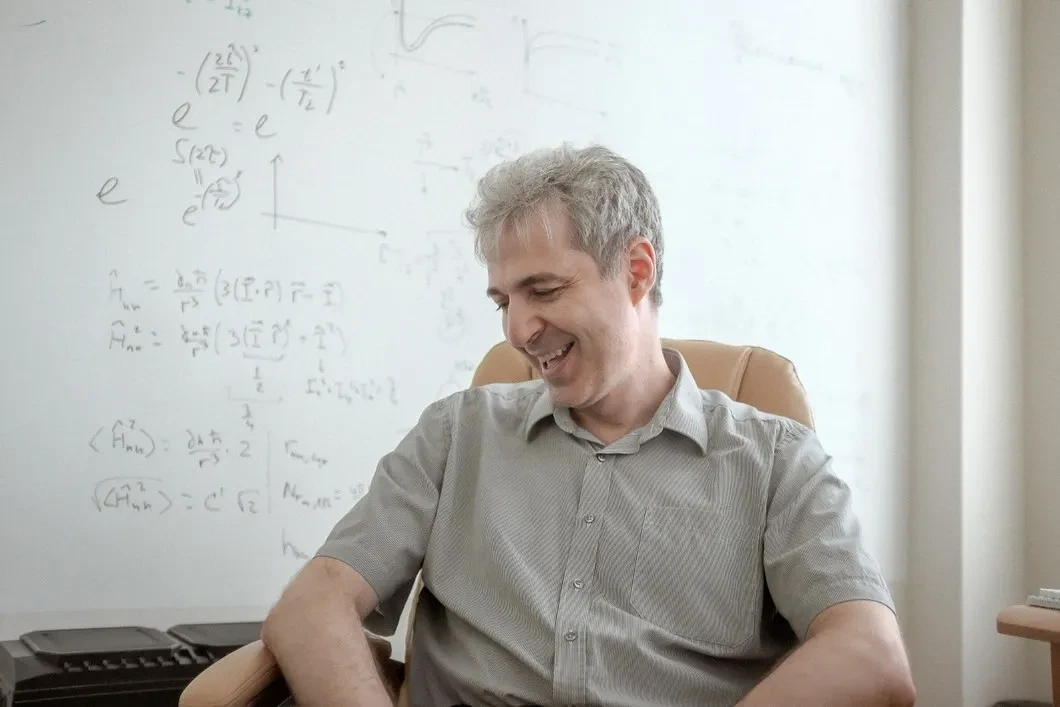
- You must forgive me that I do not have a special education in order to well understand what you are talking about, so I reason like commoner. Here is superconductivity at high temperatures ...
- Here we must explain what high temperatures are. They are high compared to absolute zero. Speaking in Celsius, then this is somewhere minus 200 degrees. But this temperature, it is much larger than the temperature of the so -called ordinary superconductors. It is about 100 degrees on Kelvin, and the usual superconductivity is somewhere in the interval from 1 to 10 degrees along Kelvin. And what's the interest? 100 by Kelvin is a little less than, for example, 300 by Kelvin. And 300 by Kelvin is room temperature. Therefore, many who think about this understand: there are no fundamental reasons why something is superproofing at 100 in Kelvin and does not superprofe at 300. So one of the hopes of physics is to someday open superconductivity at room temperature.
To open is to present a substance in which it will be measured that it is superproofing at 300 degrees along Kelvin.
- I wanted to ask about this in fact. These are all complex tasks, and you said that from childhood you like to solve just such. But the question is: why do they basically arise? The world is essentially simple.
-For schoolchildren, complex tasks arise because they are composed by some adult uncles. And this is one type of complex task. The second-when complex phenomena are still found in nature in itself. Well, it happens that people come up with complex tasks, solve them, and then find it in nature.
Why does this arise? From my point of view, when a large number of objects begins to participate in something, it becomes difficult. This is practically inevitable. There was such a famous scientist, Nobel laureate Phil Anderson, died recently, so he wrote a very influential article in the seventies, which was called English More Is Different. This is probably translated into Russian as "more-it is different."
He opposed this article against the extremes in understanding the world, against the fact that when we know, relatively speaking, the standard model of electroslab interaction or, for example, how quarks behave, we believe that we can describe the whole world. No. Anderson pointed out that chemistry is not reduced to physics, biology does not come down to chemistry, physiology to biology, psychology for physiology, sociology for psychology, and so on.
That is, at each level of knowledge, some qualitatively new phenomena arise, this is the complexity.
And it is precisely this transition that is most interesting, because much in it is semi -empirical, incomprehensible, unclear.
-Is it something like the theorem of the farm that everyone proves endlessly? As far as I know, she was never formulated in a mathematical form. He wrote it somewhere as a thought in the fields of almost theatrical programs. There is no "arithmetic" of Diophant. The tragedy is that there is a thought that mankind still can neither understand, nor put up with it, nor, most importantly, to forgive it. This is the idea that no whole can be the sum of its parts, it is in itself. In this absence of forgiveness - complexity?
- So this thought can be just an accident. The person thought about such a matter, formulated it, and then others not the most stupid people thought and realized that it was not just incomprehensible, but affects the limits of our abilities. That's why this topic suddenly became so important.
With my, as a physicist, the point of view, numbers are what, among other things, describes the real world around. And here's what the number is, what are the properties of these numbers - we must also think about it. For example, some serious scientists, not very advertising very much, are trying to think about nature today as a certain computer.
Understanding how difficult it is to predict the behavior of all sorts of systems, in particular chaotic, scientists begin to ask themselves the question: how can nature be such a super -powerful computer? Or it contains some fundamental laws within itself, which simplify something and somewhere at some level. But all this is still at the level of philosophical speculations, articles on this subject are not written.
This topic is more likely to motivate to write articles on other topics relevant for science.
-Let’s then, like nature, we will also simplify something. Let's talk, for example, about atoms. In one of your lectures, I heard your reasoning that the atom does not realize himself as an atom, but behaves like an atom. Why? Why is it socialized on a crystalline lattice, for example?
- Well, you know, there is the boundary of our knowledge. Physics is engaged in the fact that he is trying to discover and study the laws of nature. To some level, we know them, but outside-we do not know them. Therefore, you can always ask the question "why"? And there is no answer to him.
But what is interesting to the physicist is very important in it, relying on already open laws, to make predictions.
That is, we may not know why atoms behave like that, but we can predict how they will behave.
- That is, with the help of the laws of physics, and in particular the laws of solid physics, for example, it is possible to predict the behavior of people, if a person is considered as an atom? Atom of civilization, atom of society.
- I am sure that there is a lot in common here. Each of us, for example, moves along some kind of random life trajectory, but in general we are all together, a society that has some kind of task, the purpose of existence. The physics of the solid, by the way, is much easier to deal with this phenomenon of life, since it deals with particles who have relatively simple laws of behavior. But I have already said that when there is a lot of something, statistical laws that begin to dominate individual behavior come into effect.
- That is, the atoms are arranged about as ours?
- No. The atoms are completely different. They have everything in a different way that a normal person cannot imagine this. Atoms have quantum behavior. In general, before quantum mechanics were discovered, no one could even imagine that the behavior of atoms cost so much absurdity and oddities. One of the aspects important here is that particles can be simultaneously in different states.
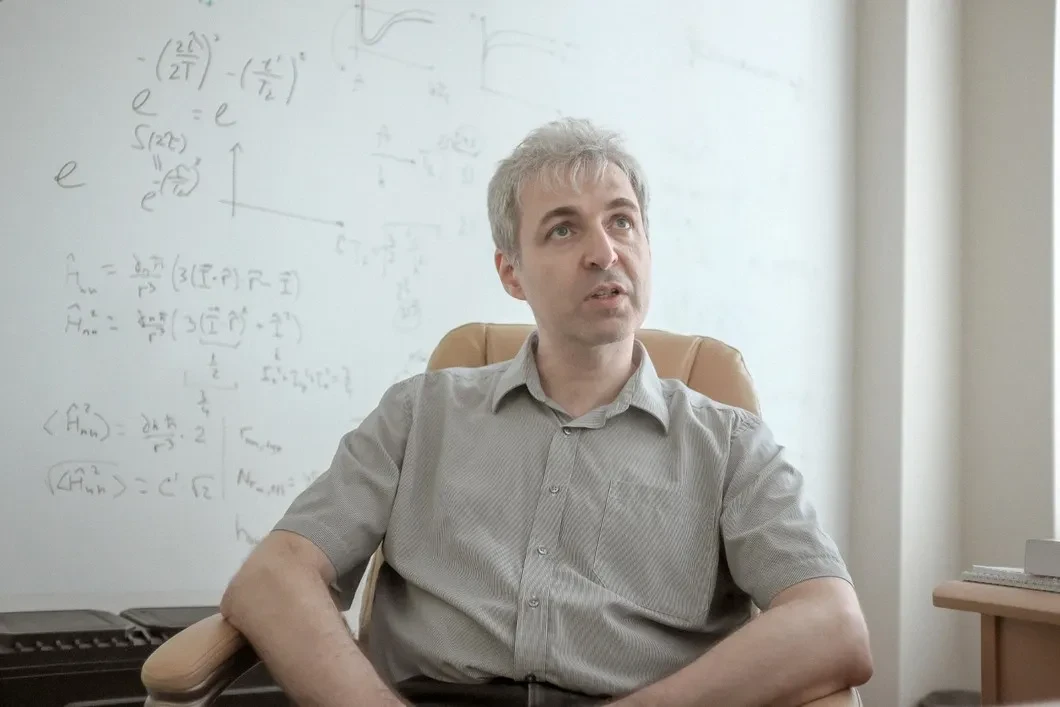
You probably heard about the concept of Schrödinger's cat? Imagine a room in which the cat is closed, and you do not know whether it is alive or dead. What is the surprise? But the fact that quantum particles can really move from one state to another. Here the atom is alive, then dead, then again alive. The properties of microscopic objects, they are generally blurred, since they are simultaneously in different conditions. And this is what attracts me in physics and attracts many. This is some kind of magic. In the good sense of the word.
Quantum behavior is fascinating. And it is important to understand that this behavior has an enemy - this is interaction with other particles. In the scientific language, I call it “quantum decorativeness”: this is when particles as a result of interaction begin to behave more familiar. And this is exactly what scientists need to describe.
“Then I would like to ask you about such a concept as“ ideal ”. About a certain impeccability, which is the essence of the phenomenon. Is this from the point of view of a solid physics?
- You know, in physics, ideal phenomena are treated in a working order. This is a standard concept. Usually this is the case. There is a real system, we do not fully understand it, let's offer a certain ideal model, an ideal system and will try to deal with it. And physicists hope that this ideal model will somehow work, will be able to predict the observed in the experiment. And while it helps, we use this perfect model. But we are always ready to overthrow these ideals.
And again this is exactly what motivates physicists - the attitude to the ideal as a temporary concept. Yes, there are ideals, they play an important role, because thinking is easier to organize around perfect constructions. But the power of physics is in the understanding of the vulnerability of these models.
- Then let's move on to chaos. In one of your lectures, I overheard that you describe the causes of chaos as “small changes in the initial conditions” ...
- sensitivity to small changes in the initial conditions.
- Exactly. What does that mean?
- Well, this means that the laws of the evolution of different objects (for example, in physics are the laws of particles evolution) are so arranged that if you start something with two almost identical conditions, and then you will wait a bit, you will not believe your own eyes. The system began with two very close initial conditions, but for some reason it came in two very different conditions, which cannot be calculated.
This is what is called chaos. But when this chaos occurs, many things can be considered on average, to judge them as a crowd of people. That is, it is such a kind of paradox: when the system becomes chaotic, it becomes much more predictable than any individual trajectory.
There is a popular example in this story, it is called the “butterfly effect”. Scientist Edward Lorenz formulated this something like this:
The butterfly on one end of the earth will wave its wings, something will change, and in the end at the other end of the earth there will be a hurricane.
Or if you take a topical example: Koronavirus took from somewhere. Somewhere a small event occurred, and now the whole world has moved to another state. But only I must say that this in chaotic systems is extremely rare. Typically, chaos leads to quantitative, that is, statistical changes. But so that this goes into high -quality changes, this happens extremely rarely.
Nevertheless, many believe, including that chaotic behavior is more typical for the development of systems. How typical it is when it is typical - this is what, in fact, that people are now studying, among other things. After all, what is important to know about chaos - if you try to avoid it, then the system needs to be very much controlled.
There is such an ancient Greek paradox, the paradox of the arrow of Zeno. He tells us: let's look at the flying arrow. At each point in time, the arrow is at some point in space and does not move. If it does not move at any time, then it does not move at all.
This is actually a deep question related to our understanding of movement, time, and so on. But thanks to him, there is a physical concept called the "effect of Zeno." It consists in the fact that if the quantum mechanical system is measured, then it ceases to evolve. This is a physical formulation, but it is quite applicable to life.
If the system is very tightly controlled, it stops moving.
Just because when it really moves, a certain amount of chaos is inevitable.
- Then the question, oddly enough, about thinking as a chaos. About the ability to thinking, about the need for thinking. Does it not turn out that the thinking person is doomed to be an outcast, the inaccessible, inaccessible, incomprehensible and even dangerous for most people?
- Yes.
- Yes? But then why?
- Well ... you know, when I was still a child, I knew this feeling of a call. The call of the intellectual, which is taken from somewhere. Maybe this challenge is challenged by nature. And some person is trying to answer this challenge. Someone must do it. In physics, you accept this challenge not only speculatively - you must explore the unknown yourself and predict the result of the experiment.
And if you did it, this is proof of your rightness.