
Translated material
Evillase facades
In Kaliningrad, the historical building of the “Krouts-Apteki” was reconstructed-it turned out so eccentric that the whole country is now discussing the construction
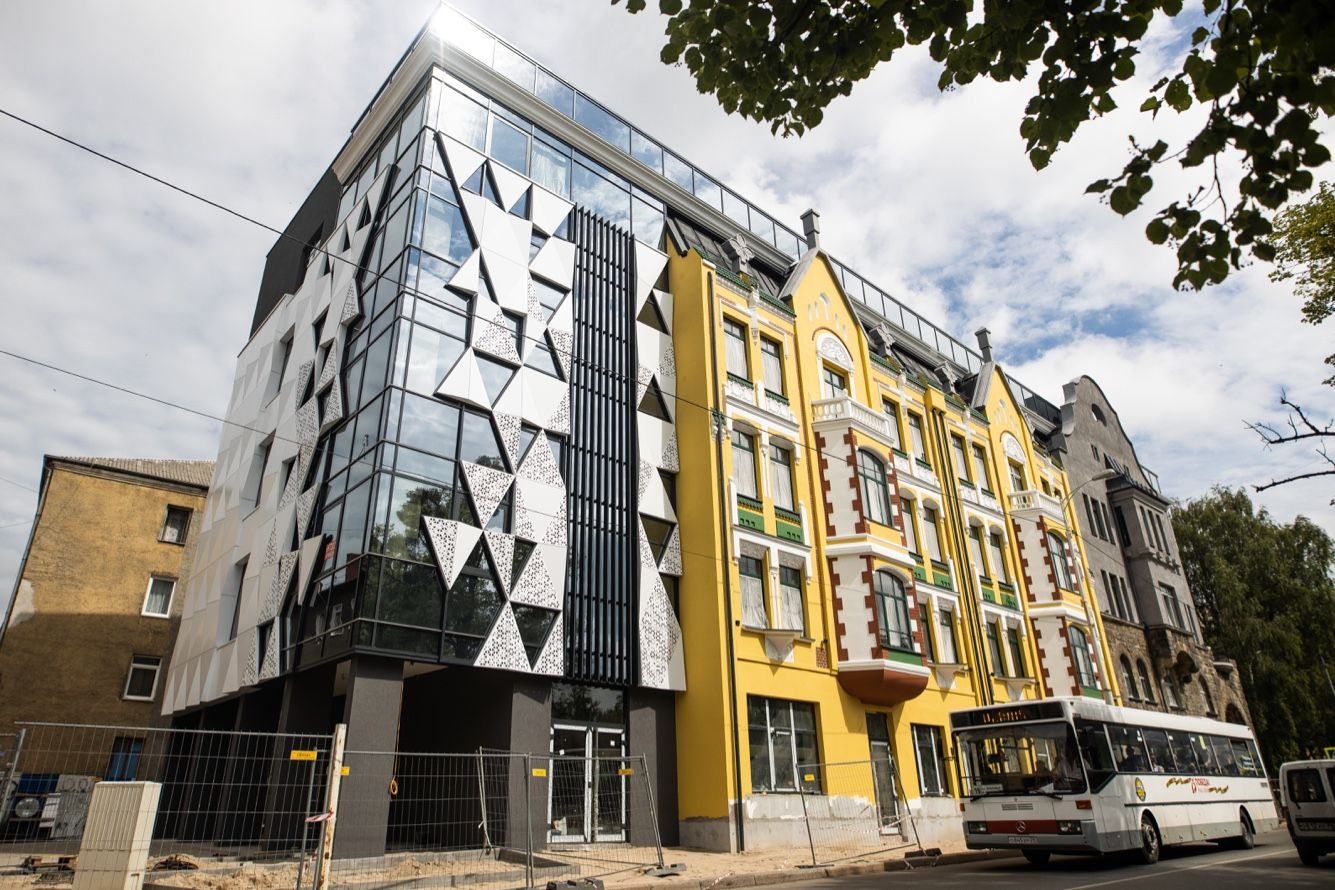
In Kaliningrad, the reconstruction of the pre-war German building “Krouts-Apteki” is completed: the investor is rebuilding the house that has practically converted into ruins into a modern business center. Journalist Ekaterina Medvedeva from the local Kaliningrad local publication, at the request of Medusa, tells how the Krouts Aptek was destroyed and restored and why, at the final stage of the project, this reconstruction caused so much criticism-so that famous Russian social activists, bloggers and journalists joined in the discussion about one Kaliningrad facade.
Pharmacist Petrenz and his house
In the summer of 2001, part of the ceilings in an abandoned building on Frunze Street fell in Kaliningrad. This happened at the moment when several local residents dismantled the walls on the bricks. One of the men died under the rubble. After that, the city authorities said that they were going to demolish a house known in Kaliningrad as a “Kroyts-Aptek”. This was outraged by the townspeople: critical articles appeared in Kaliningrad newspapers, residents' appeals to the city administration began. As a result, officials abandoned this idea, and the saved building continued to fall apart naturally. After almost two decades, the Kaliningraders again started talking about the “Kroits-Aptex”-but now because of its renovation.
House No. 53–57 on Frunze Street in Kaliningrad is called “Krouts-Aptek” due to the already lost inscription on the front wall of the Kreuz-Apotek house. For unexplained reasons not painted in the Soviet period, local guides loved to demonstrate this faded sign to tourists during foot excursions. “The whole Koenigstrasse Street ( now Frunze Street, approx. Medusa ) was one of the most beautiful streets in Koenigsberg (pre -war name of Kaliningrad). She connected the Rossgarten market and the royal gate and was considered rich - wealthy burghers mostly lived there. Nowadays, a lot of historical buildings have been preserved here, which have the status of architectural monuments, ”said Ivan Skobei, Kaliningrad local historian, Medusa.
What is now considered a “cutter” is actually the skeletons of two adjacent buildings. In the pre -war period, these two houses and another adjacent building created an architectural complex at the intersection of Koenigstrasse and Kenigsek Lane (today - corner street). According to the local historian and the author of books on the history and architecture of the region, Alexei Gubin , the first building was built in 1888. According to the German architect Baldur Kester, who wrote a book about Koenigsberg architecture, all houses appeared from 1900 to 1905. One of the buildings has not survived to this day - now in its place a typical five -story building.
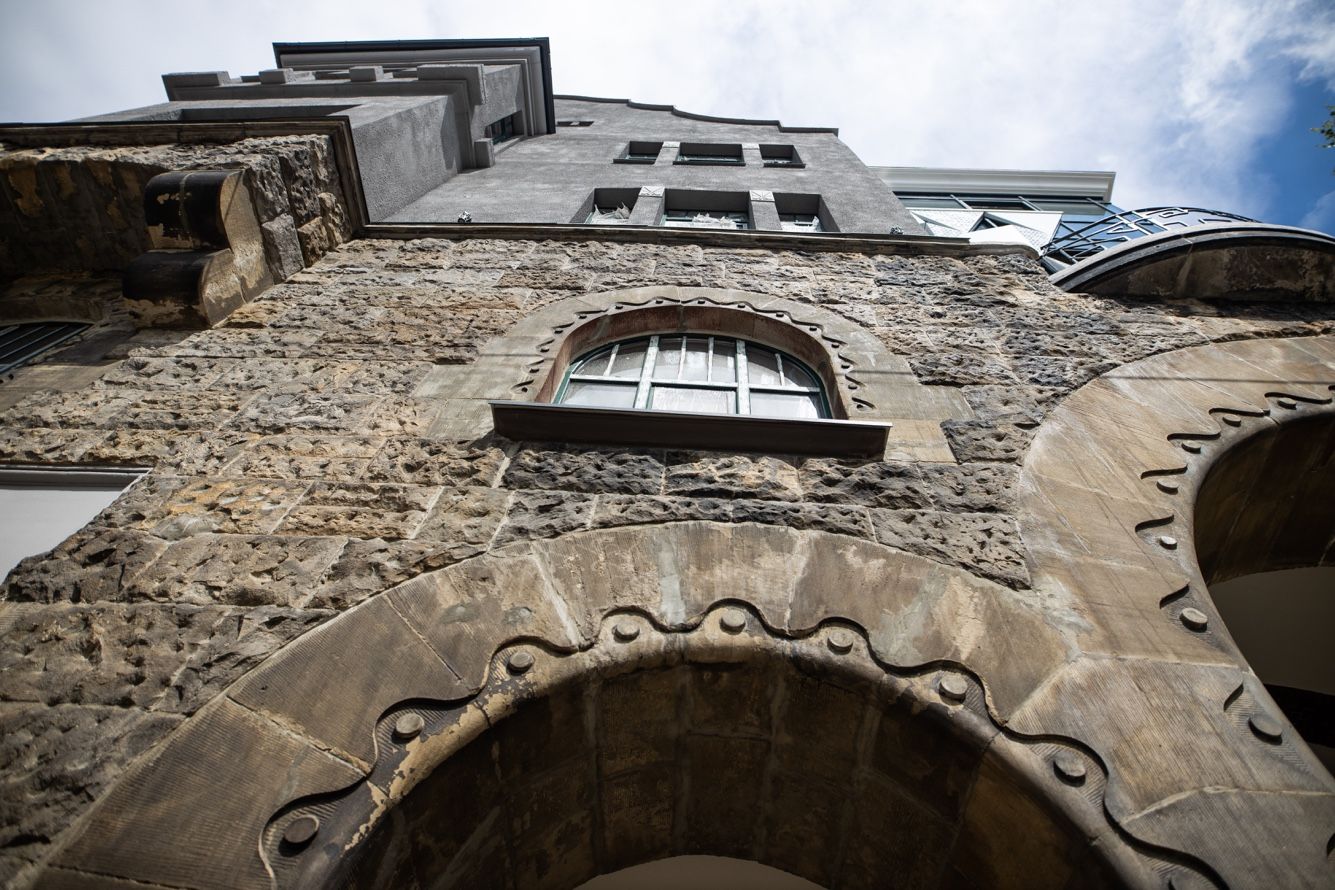
The buildings were executed in the then fashionable in Koenigsberg Yuguenshtil with Baroque elements. Each of the houses had a lateral outbuilding and two exits - outside and in the courtyard. He led a double passage into the lane: a large tunnel for crews and smaller ones for pedestrians. “The house had an interesting baroque pediment, the facade was decorated with stucco molding above the windows in the form of the sun, flowers and reliefs with heraldic symbols,” Ivan Skobei lists in an interview with Medusa. “Original forged fences were installed on the balconies.”
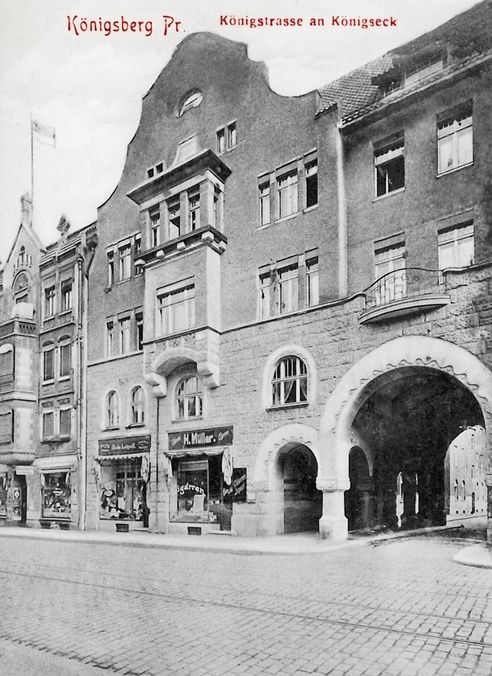
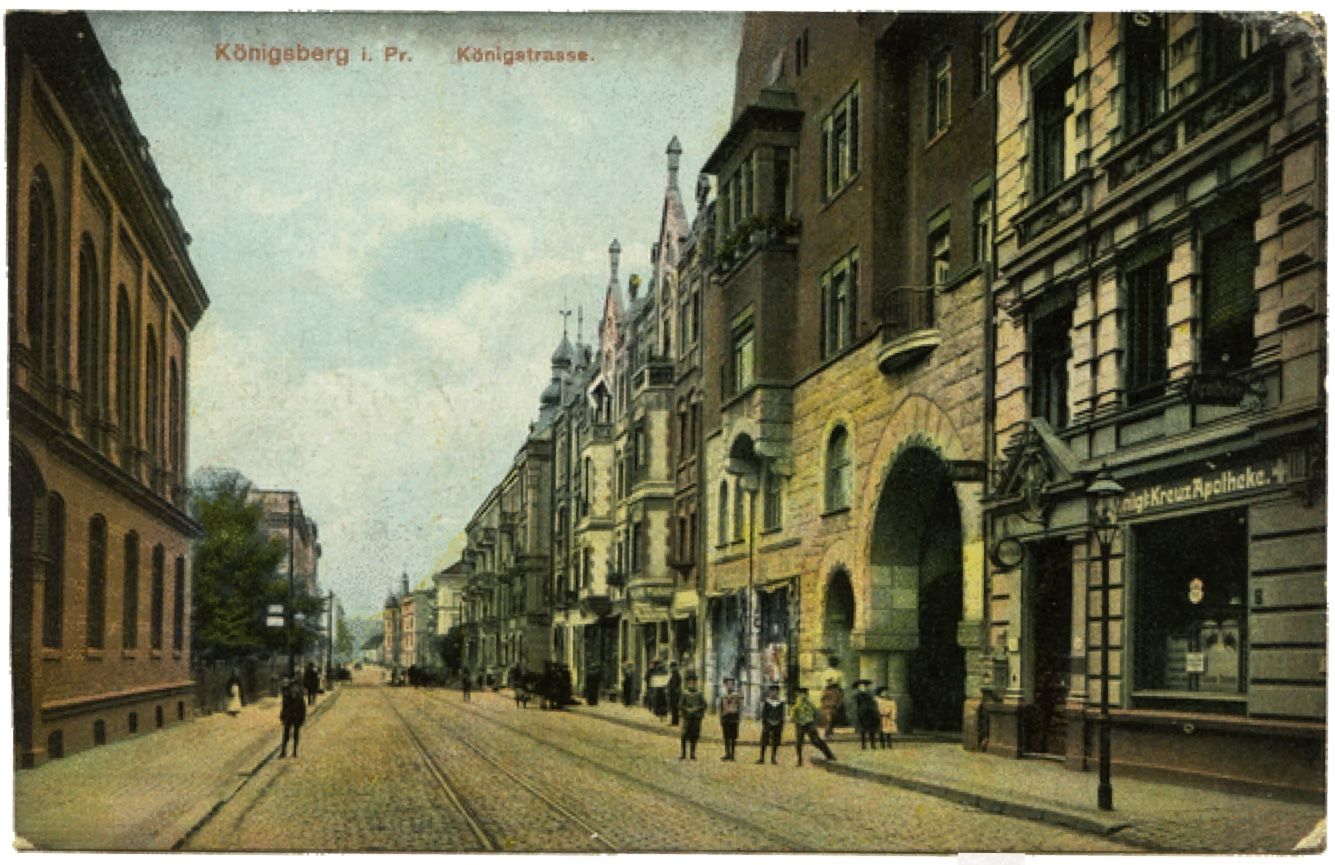
On the upper floors of this profitable house there were apartments, and the lower floors were occupied by offices and shops. Since the second half of the 1930s, several rooms on the ground floor of the complex were reserved for a pharmacy, which, like the whole building, belonged to the pharmacist, doctor of sciences Adolf Petrenz. The pharmacist himself lived in an apartment over a pharmacy on the second floor. However, Skoby clarifies, he did not meet a single document confirming that Petrenz owned the entire building, so this cannot be approved for certain.
At the same time, the old photos shows that the pharmacy occupied the first floor of the extreme right building - what did not survive before the present - and there were other stores in the building in the middle. But in our time, the sign, painted during the reconstruction of 2019, was located on the extreme house on the left. According to Ivan Skobe, there are two options - either the pharmacy moved from the room to the room, or occupied several at once.
Also on the ground floor of the house were stores of the Koenigsberg bakery and agricultural association of housewives. According to Koenigsberg’s address book for 1941, the house at that time had apartments by a practitioner, a businessman, construction technician, an inspector of the Imperial Bank, a truck driver and two widows.
Krouts-Aptek practically did not suffer during British aviation bombing in 1944 and resisted during the assault on Koenigsberg by Soviet troops in April 1945. “Later, the building flashed several times in the footsters of Soviet films about the war,” Skobei says the story of the building. - Although the facade itself was not shown with the inscription, but filmmakers liked the arch in the house of the arch. It was at night that the heroes of the film “First Day of the World” are at night - just in time to help the German woman who fell into trouble. And in another work - “on the roads of war” - the arch is shown during the day. Right under it, filmmakers placed field kitchen. ”
The Savior of the pharmacy
In Soviet times, the Krouts-Apteki building was used as a residential building. “In 1964, there was a dining room No. 30 in the building,” explains Meduza, the head of the scientific information department of the regional state committee Varvara Egorov. -The same catering establishment is listed in telephone books in this house and in the 70s. Judging by the documents, until 1985, in house number 53–55 on Frunze Street, rooms were given rooms as official housing. ”
In 1987, the house was settled for major repairs, which never happened. “According to the stories of old-timers, once at that time on the ground floor of the house were a hairdresser and the famous dumplings,” says Ivan Skobey. -After the resettlement, the house for some time stood an empty but rather decent form, and even one could see the interiors of this dumpling. But shortly after the building was removed from the housing stock, marginal personalities began to gather there. Then there was a fire, they began to rot the ceilings. Gradually, an empty building began to dilapidate and collapse. ”
In 2002, the object of cultural heritage turned into the ownership of the Zhilpromstroy company. Investors were obliged to restore the facade of the “Croats-Apteks”. In 2007, the owner dismantled the western wall of the building, explaining this by the work on preserving the object. The reconstruction of the house for the office center was agreed with the chief architect of the city and the monument security service only in 2008. The project was not brought to public hearings, but the investor stated that it was developed with the participation of German architects - however, without details.
A year later, experts again examined the building and recognized his condition completely emergency. Repair work, however, did not begin. The city authorities repeatedly threatened the investor with the termination of the contract, but managed to return the building to municipal property only in 2015. Moreover, the compensation appointed by the court for damage to the building of half a million rubles by that time the already bankrupt ex-owner did not pay to the budget.
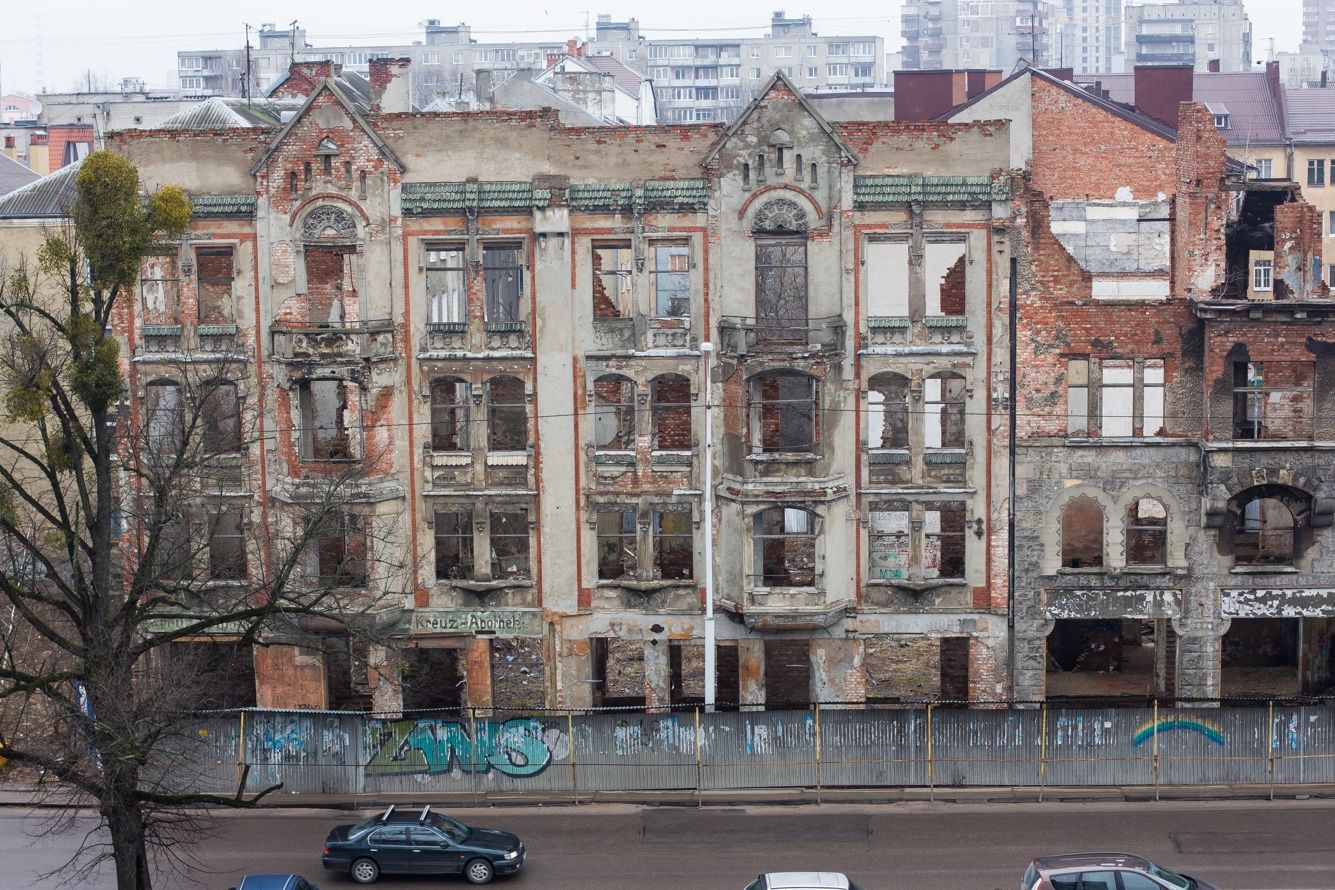
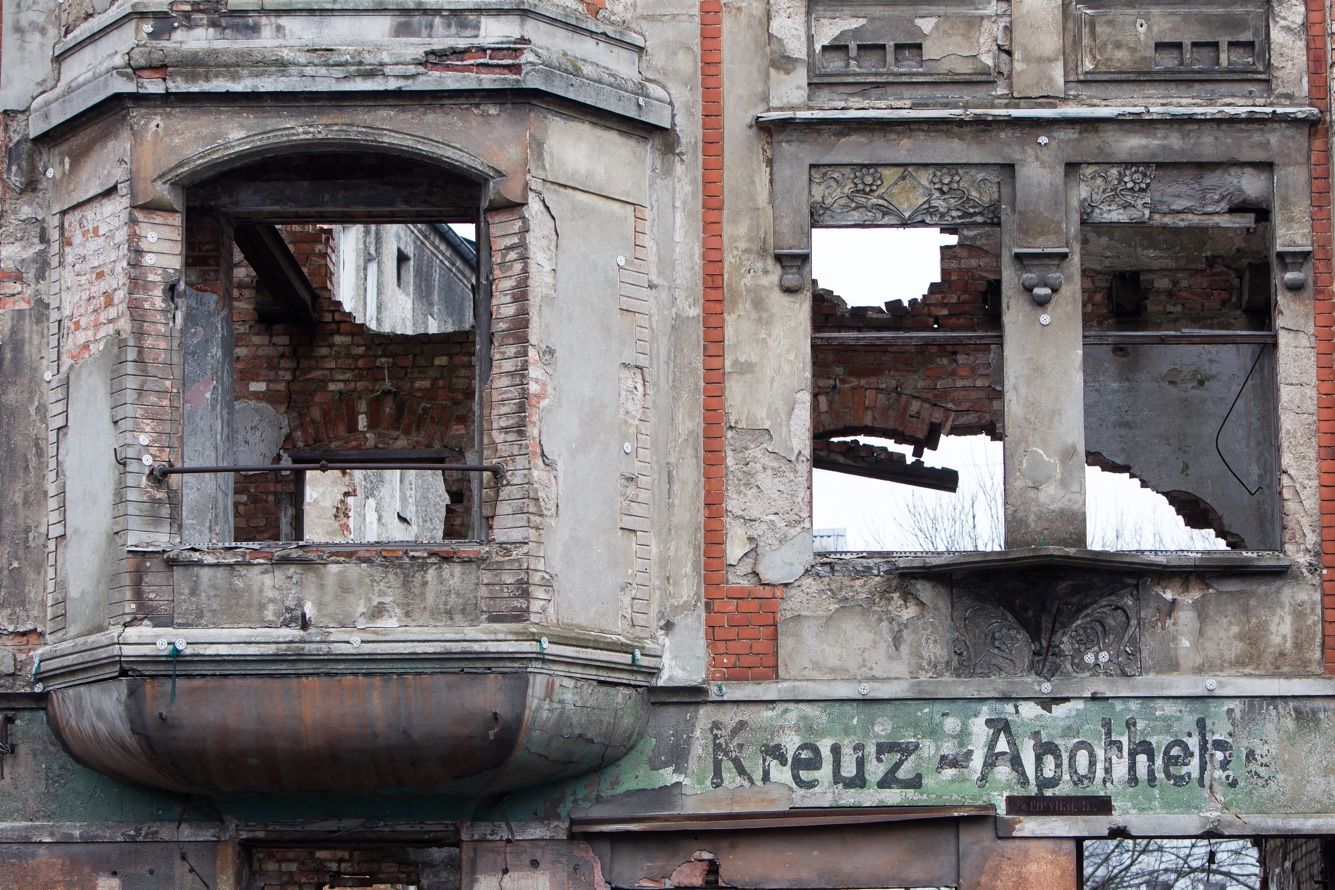
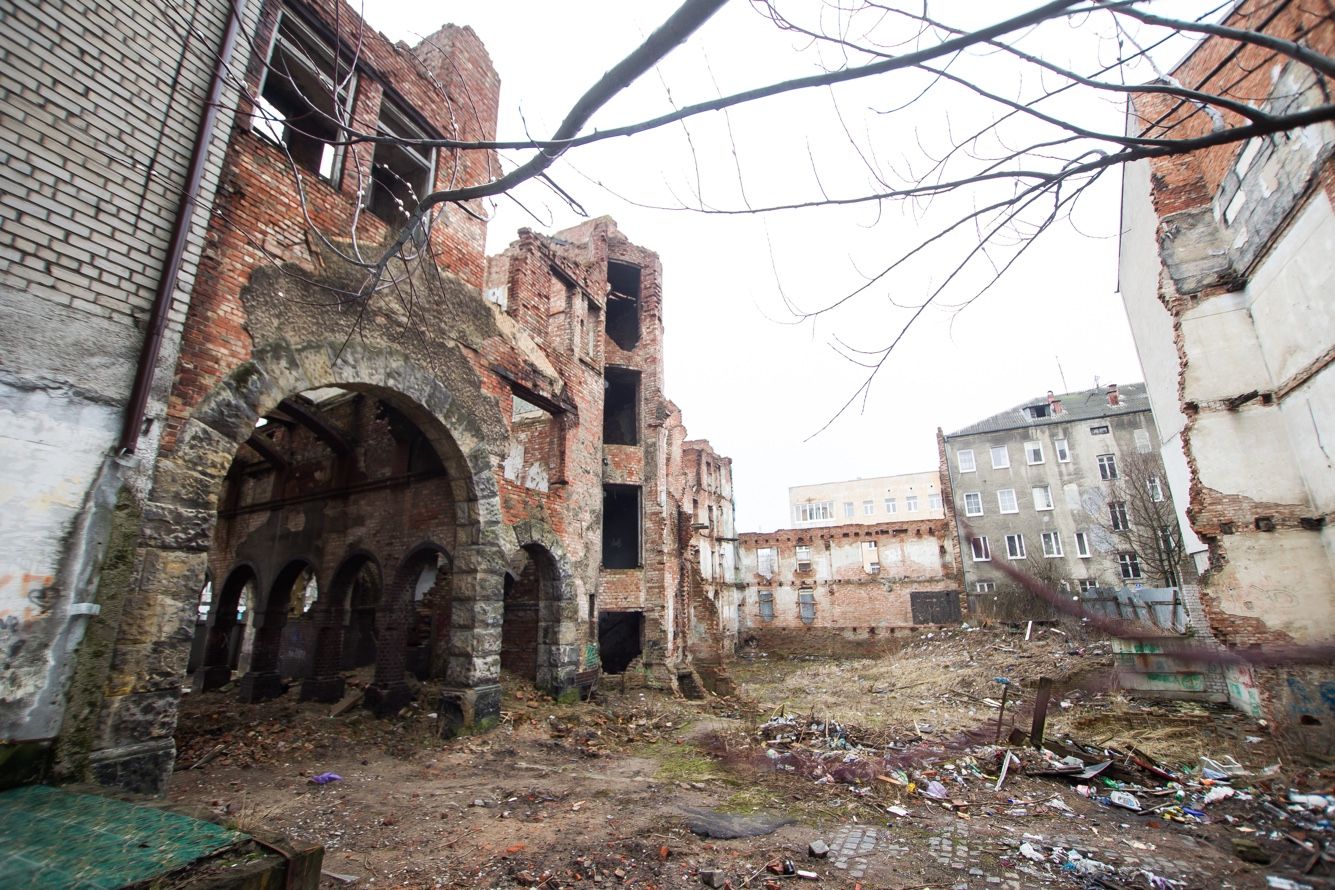
After that, the city authorities exposed the almost completely destroyed skeleton of the building on bidding five times. So, in November 2015, the initial price for the “Kroits-Aptek” amounted to almost 11.2 million rubles. At the same time, the building itself was sold in just a ruble, and the main part of the cost of the lot was added for the land plot. There were no people who wanted to acquire an object in the form of a security status , so soon the authorities reduced the price of to 8.5 million rubles, and then even three.
In the fall of 2016, when the wear of the building has already reached 92%, it was nevertheless sold at the auction to the general director of the local agricultural enterprise Sergei Sukhomlin for 3.11 million rubles. He promised by 2019 to reconstruct the building, retaining the historical facade.
The spirit of the place
The new owner said that he would rebuild the historical building for a three -star hotel and an office center. He launched the website of the Kreuts-Apteki reconstruction project, where you could read a historical certificate about it and see options for a sketch of reconstruction projects.
The investor claimed that he intends to restore the existing part of the old facades, modernize the premises and finish the new building to them. Sukhomlin hoped that as a result of renovation of the architectural monument, the pedestrian attractiveness of Frunze Street would increase and a “powerful impulse” would appear to return the status of Central Avenue. “The restoration of the main facade and the preservation of the layout will save the“ spirit of the place ”, increase the cultural attractiveness of the object and the territory as a whole,” the project’s website said.
In total, three sketching projects for the Krouts-Apteki reconstruction created by Kaliningrad architects were presented to the competition. One concept proposed to fulfill almost the entire modern part of the building in a minimalistic manner of glass panels and only add a little light clinker from the end from the end. Another project provided for the maximum restoration of the historical appearance of the building with a corner extension in the style of Bauhaus and a mini-garden on the roof-it was for it that the regional urban planning council voted .
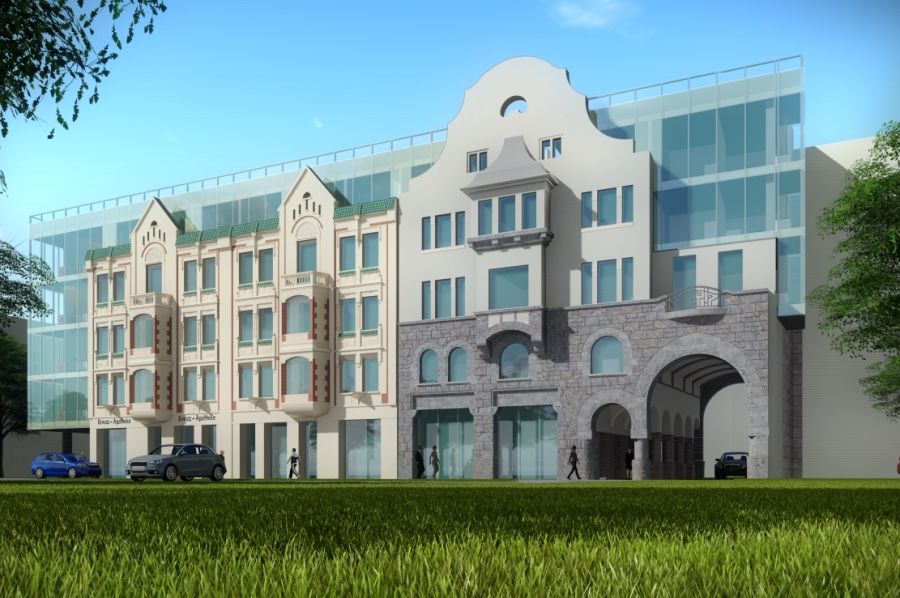
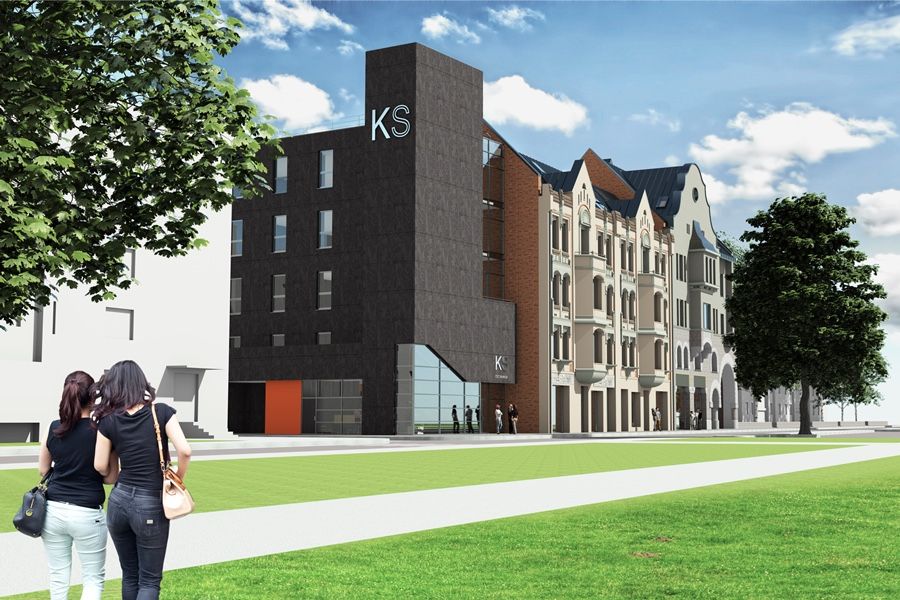
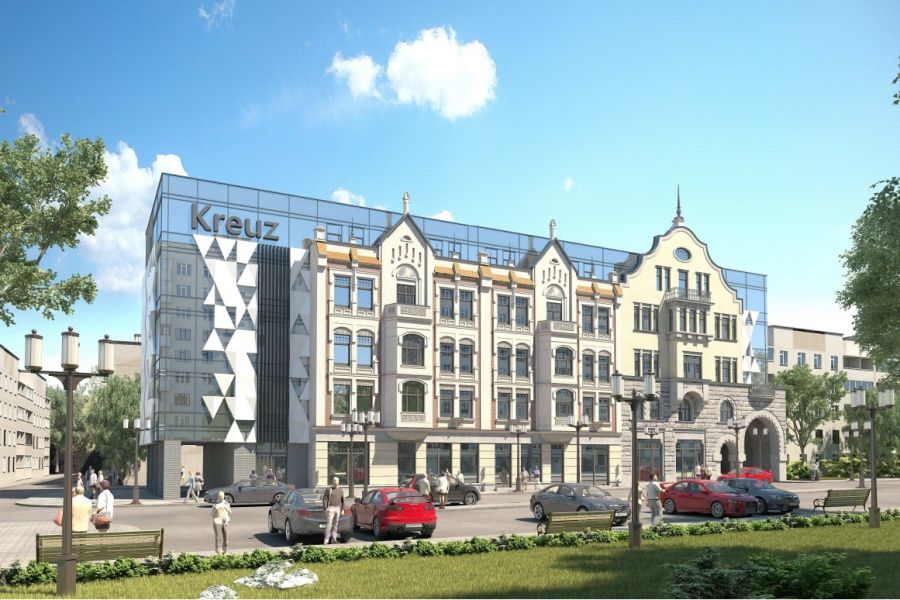
However, the idea of the closed competition was taken as the basis for the future reconstruction, the idea of architect Anna Belskaya from the KVADR workshop, which had previously been supported by many members of the Town Planning Council, was taken. This project included the construction of a five -story hotel for 71 rooms and commercial premises with a useful area of 3.9 thousand square meters. “We deliberately refused to restore the eastern part of the building in its historical appearance and applied the more air decision of the end of the building, so as not to overload the opening appearance,” the description of the project said.
According to Medusa, the adviser to the Governor of the Kaliningrad Region for Architecture Vyacheslav Gennna, no one was discussing a sketch of the public from the public: “There were public discussions of this project, there was a city council. The investor could not have a competition at all, but he decided so, because he really wanted to be the best: to study suggestions, to find out opinions. And what was chosen is completely satisfied in terms of the approach, when they did not come up with a fake for antiques. They retained what was really left, and they did the new one in modern form. This corresponds to the main canons of the Venetian Charter . ”
In December 2017, Kroyts-Aptek was overgrown with construction forests, and the investor said that the finished reconstruction project was sent to state examination. True, the project approved by experts began only in April 2018. The regional security service of monuments issued permission to “adapt the cultural heritage object” later. Due to the lack of the opportunity to organize an underground parking in this permit, it was not about a hotel, but only about a business center.
During this time, part of the front facade managed to collapse near the building. The authorities concluded that this happened due to violations during emergency work, but the owner immediately promised that all lost elements would be restored. Sergei Sukhomlin also promised to make on the renovated facade a similar to the original “Kreuz-Apotek” sign, since it turned out that it would not be possible to save the old inscription on the wall.
Robocop building
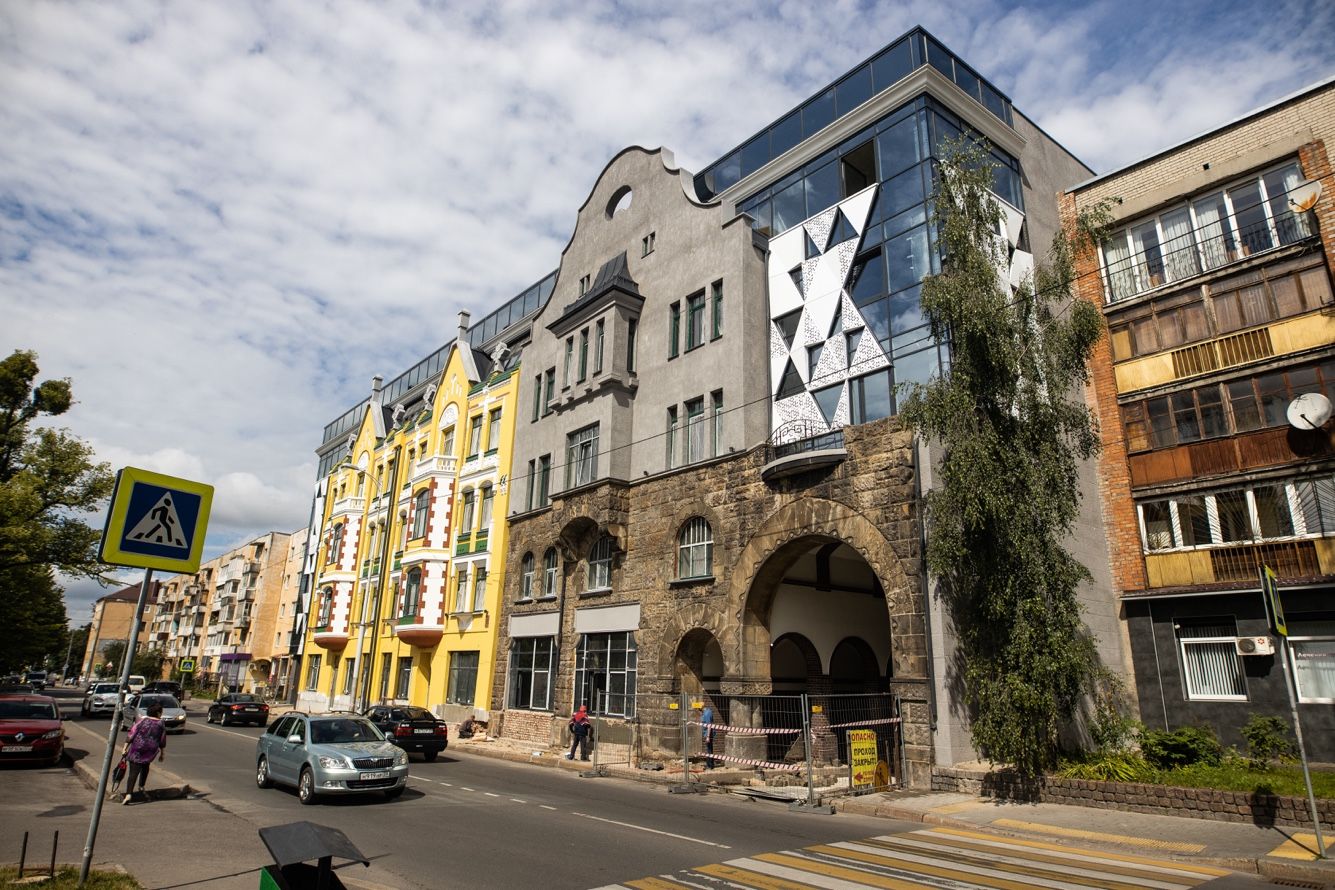
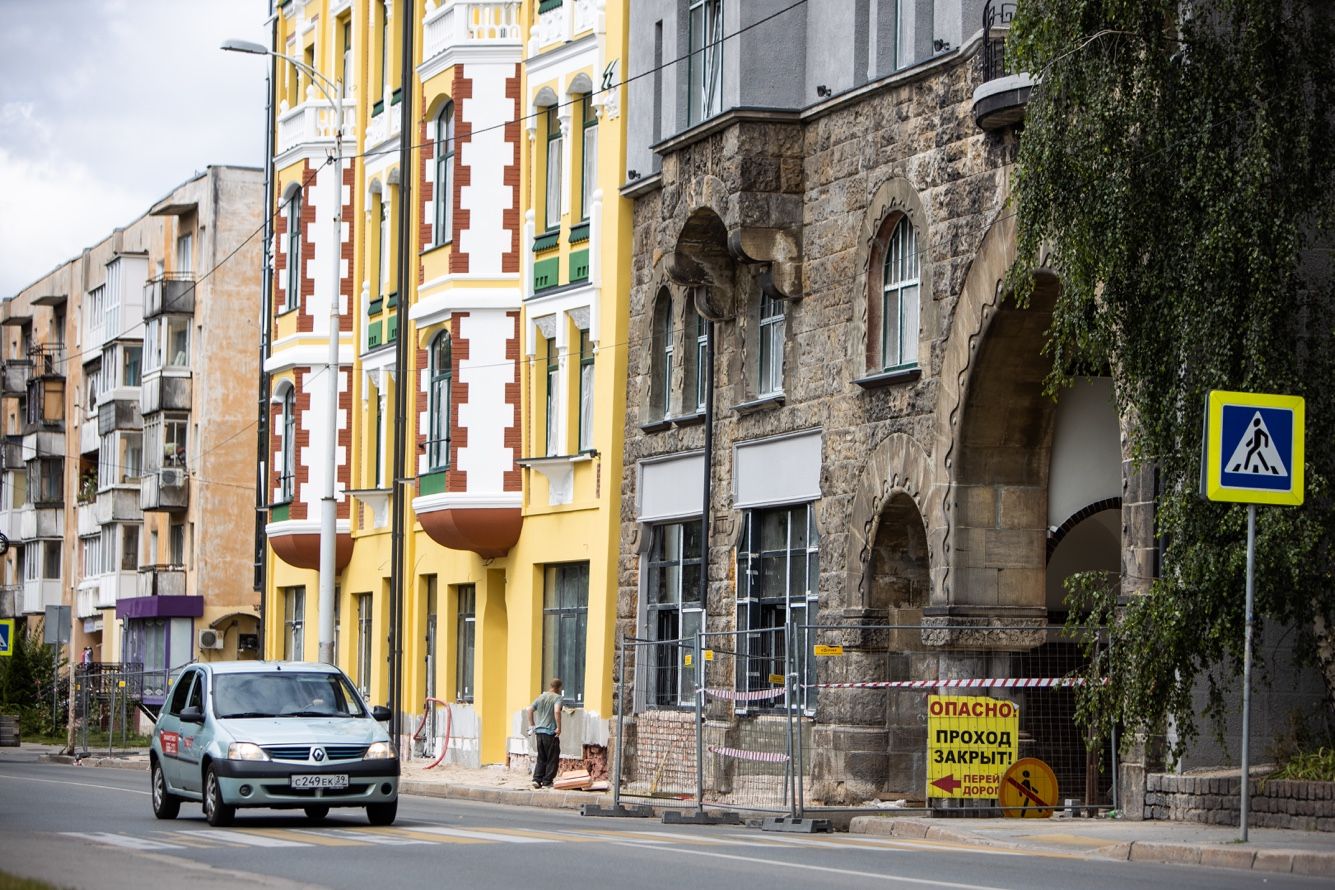
In the spring of 2019, the contractor finally began the reconstruction of the building. The deadlines for the work at the facility were constantly transferred , and Kaliningrad residents forgot for the duration of the “cutter”. They remembered the house only in the summer of 2020, when forests and a construction grid were partially removed from its facade, exposing rather bright colors of plastered walls. The entire Kaliningrad segment of social networks exploded from the number of statements about the appearance of the updated “cutter”. Many users were extremely critical of the chosen color scheme, which did not correspond to the pictures on sketches, where the historical facade was made in light beige tones with pale green inserts-while in reality it appeared with saturated yellow, green and gray. For some, the whole face of the facade was an unpleasant surprise, and someone, on the contrary, defended the investor and designers.
The local historian Ivan Skobei believes that the designers initially should not follow the path of perestroika, but along the path of restoring the historical appearance, as in the case of the building of the Kaliningrad Regional Historical and Art Museum, rebuilt from the ruins . “Of course, what has been done is better than nothing at all. But initially, everything was fine in the project, and then for some reason the owner beat and reduced everything, ”Skobe said. “It turned out some kind of pornography: they got everything that is possible, and was tastefully painted.”
The architect and participant in the Prussian Heritage movement (unofficial public community, whose participants are fighting for preserving the historical and cultural heritage of the region Oleg Lee, who believes that the “cutter-Aptek” is a sample of a not perfectly realized but “fundamentally correct approach” to the symbiosis of the new and old architecture, does not agree with this opinion.
The architect is confident that the volume of criticism that fell upon the investor is completely not deserved. “The color, in my opinion, is the least important question - you can always repaint,” whether he argues. - Regarding the cost, volume and importance of all work done, this is generally a disproportionate reason for criticism. And it is not necessary to focus on historical analogues completely strictly. The owner took the ruins that were ready to leave us over the next years, and returned them to life. Yes, “Kroyts-Aptek” is alive as Alex Murphy from the film “Robokop”-in the sense that there was a little left of her. But this is not the fault of the owner. “Croats-Aptek” will now stand for another hundred years. This is already an achievement in itself. ”
Sergei Sukhomuyl, “Medusa” could not contact the owner of the “Kroyts Apteki”. His phone was turned off, and he did not answer the questions of the "jellyfish" sent by e -mail. Earlier, the investor also refused to give the press an assessment of the color scheme chosen for the facade, but noted that he is valid as part of the project that has passed by the State Expertise. “This is a project that has passed the state historical and construction examination. Everything else is funny pictures. You can draw them a million. And we see the implementation of the project approved by the Service for the Protection of Monuments, ”Kaliningrad.ru explained Sukhomlin. The author of the sketch project of the reconstruction of the building Anna Belskaya told Medusa that “at the request of the customer does not give an interview”: “I think that it [Sergei Sukhomlin] The situation with the noise around this object is somewhat annoyed,” the architect explained.
The discussion about the new appearance of the “Kroyts Apteki” quickly went beyond the region. The native of Kaliningrad and the Russian journalist Oleg Kashin living in London on his Facebook appropriated the Renovation of the Kroyts Apteki status “Building the year on the country's scale”, and the Blogger-ruler Ilya Varlamov called the building “Hitter ******** [failure] of the city of Kaliningrad”. “In addition to the fact that the workers seriously distorted the facade of the monument, they destroyed the historical sign. <...> In general, they killed the building - they simply destroyed. Could just demolish. What survived during the war demolished our modern ********* [stupid people]. Well, the complete ****** [failure], ”Varlamov said in his video blog.
The reconstruction of “Kroyts Apteki” is the most striking example of a cool attitude to architectural monuments in the Kaliningrad region, says a historian, a Moscow scientist and a member of the Expert Council of the Fund of Maintaining the Historical Heritage “Attention” Pavel Gnilorybov. “There are many approaches in restoration, but it is impossible to so frankly“ conceive ”, flaunt new volumes, scream and stand out with a bright lemon color,” he said to Medusa. -If you really can’t do anything with the emergency building, you need to build something as calm as possible, not distinguished, “hit the Scandinavia”. And now it turned out a tombstone reminiscent of the monument that once existed here. ”
Gnilorybov adds that the construction of a synagogue in Kaliningrad in Kaliningrad was a previous frank failure. The building, which was also very different from the initial project, was erected in 2018 at the site of the synagogue, defeated on a crystal night . «Впрочем, Калининград выделяется странным подходом к сохранению наследия: настоящие жемчужины гибнут, но вместо реставрации действительно важных объектов создаются симулякры — пестренькие домики в Железнодорожном, Рыбная деревня , „ганзейские“ фасады и фальшивый фахверк . При этом государственный орган, который обязан все это защищать, массово отказывает памятникам в постановке на учет, — рассудил Гнилорыбов. — В итоге это приведет к ситуации, когда руинами станет и прусское наследие, и российское, а мы будем смотреть на вырвиглазные фасады — „сочинения по мотивам“ начала XXI века».
Первоначальная идея реконструкции «Кройц-аптеки» потерялась в ходе доработки эскиз-проекта, уверен председатель регионального Союза архитекторов Петр Черненко: «Основная идея проекта Бельской была убита. Изначально в эскизном проекте было противопоставление существующего старого объекта и большого этого стеклянного параллелепипеда. Контраст был и по плоскостям фасадов, и по материалу, и по цвету. На углах здания должно было быть больше стекла — за счет этого они как бы сливались с улицей и не выглядели такими тяжелыми».
Советник губернатора по архитектуре Вячеслав Генне, напротив, считает, что капитальный ремонт домов в местном поселке Железнодорожный — удачный пример восстановления довоенных построек в регионе.
Генне отмечает, что в Калининграде «есть социальный запрос» на восстановление исторического облика города, хотя есть случаи, когда общество спокойно относилось к современным элементам на историческом здании, — так, ГЦСИ пристроил стеклянную шахту к зданию казармы «Кронпринц» . «Ни у кого же глаза не кровоточат по этому поводу? А могли бы сделать башню какую-нибудь с черепичной крышей, с полукруглыми окошками и ковочкой», — заметил Генне. Он добавил, что сам не наблюдает «особого осуждения» жителями региона реновации «Кройц-аптеки»: «Обыкновенная практика — люди обменялись мнениями. У нас просто программа вот этого краеведения местного построена на критике чьей-то работы, причем любой — что ни сделай, все равно им все не понравится».
Зато глава региональной Службы охраны памятников Евгений Маслов реновацию здания «Кройц-аптеки» называет «новым шагом»: «Я не приведу другого примера синтеза исторической и современной архитектуры у нас в регионе. А более значимого объекта уж точно нет вообще». Обсуждать ее внешний вид, полагает Маслов, сейчас слишком рано — работы еще не завершены, а давать оценки всей реставрационной концепции слишком поздно: « В свое время государственная историко-культурная экспертиза проекта 21 день висела на нашем сайте для изучения и публичного обсуждения — все желающие могли высказать свое мнение, в том числе по цветовым решениям, по концептуальным подходам. И никто ничего не высказал тогда. Теперь постфактум люди начинают что-то писать — это меня немножко удивляет». Он добавляет что критики реконструкции «как дамы маникюр выбирают — такой оттенок подходит, такой не подходит».
«Времена меняются — принимаются новые решения. У нас когда-то и Зимний дворец был не бирюзовый, как сейчас, а красно-коралловый. Why not?" — заключает глава калининградской Службы охраны памятников.
Екатерина Медведева , «Новый Калининград»