Date
Author
Анастасия Стогней, Катя Аренина, Ангелина Коновалова
Source

Preserved copy
Translated material
"Eychars are afraid like fire." The study of The Bell about Harassment in Russian companies
Not only media employees suffer from harassment and sexual harassment at work. It’s just that stories from other areas are less likely to seep on social networks. We decided to make a common picture. At the request of The Bell, Headhunter and Superjob services interviewed employees of companies of different sizes from different areas. We discussed the data obtained with participants in the rating of the best employers in Russia, lawyers, HR consultants and the victims themselves.

What's happened
Until recently, loud scandals related to Harassment, toxic management and harassment at the workplace seemed to be not in Russia. And suddenly, in the summer of 2020, a dozen stories broke out. Almost all occurred in independent media: employees and employees of Novaya Gazeta , Rain , MBH-Media , and Mamihalapinata reported about harassment at work and outside work. The leaders of these media reacted differently. Journalist The Bell Katya Arenina said that her teacher and player in “What? Where? When?" Mikhail Skipsky, when she was 15 years old. A few weeks later, Skipsky left the commission for working with children and youth of the International Association “What? Where? When?" (Katya Arenina worked on this text. - Approx. The Bell).
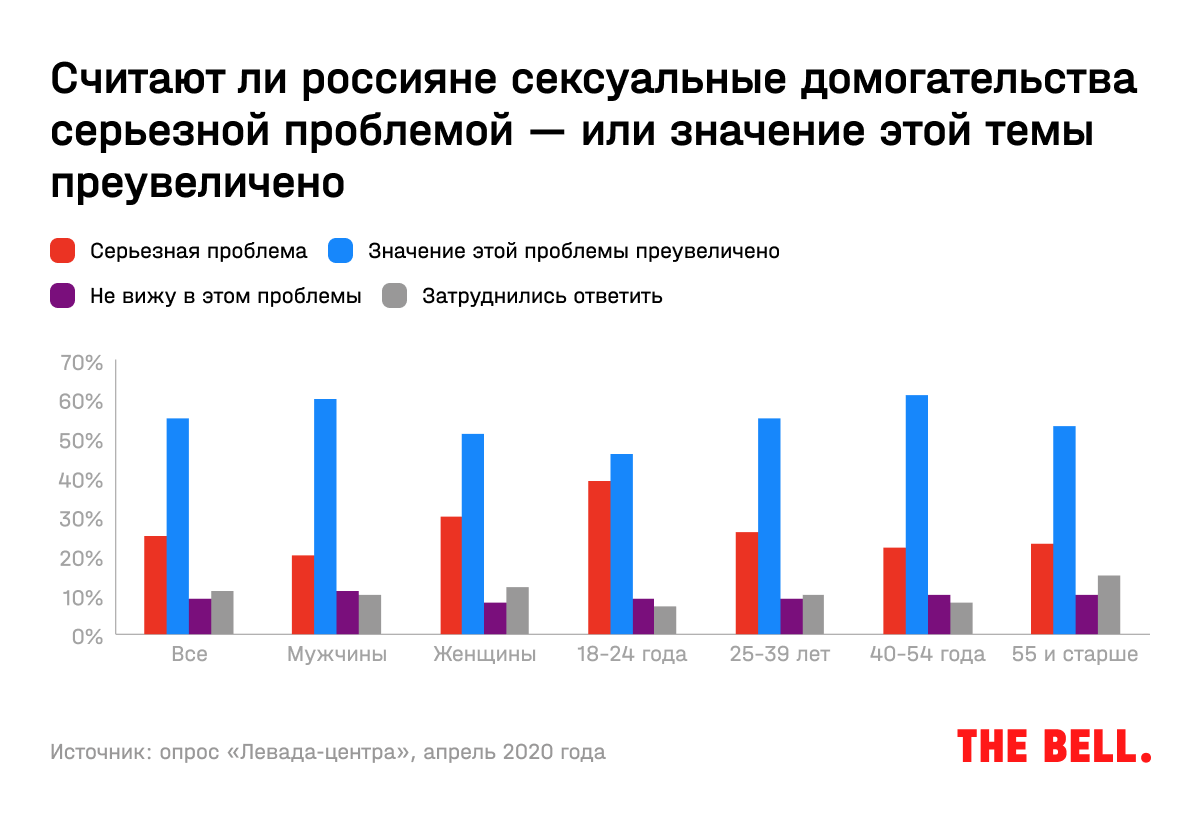
It is not surprising that the new #Metoo wave rpm precisely on independent editions, in which there are many young employees. Journalists who constantly write about these problems pay more attention to them. Polls of the Levada Center (the data are presented on the schedule below) testify to: it is representatives of the age group of 18–24 years who demonstrate the highest level of harassment rejection in Russia. The first loud scandal this summer, which is characteristic, shocked the philological faculty of Moscow State University. In addition, workers of independent media may have less fear of being dismissed for participating in public scandals.
But one of the stories affected the largest employer: Sberbank. His two employees were accused of Kharassment: SMM manager Ruslan Gafarov (formally employed in a subsidiary-“C-Marketing”) and the project manager Sergei Minenko. The actions of which they were accused, they did not do in the office. Moreover, the accusations were not even received by colleagues. Nevertheless, Sberbank removed Minenko and Gafarov from work in order to conduct an internal check. A few years ago, when the #Metoo movement was just born, it was impossible to imagine this.
Soon Gafarov said that he would quit the company voluntarily: "We need to put yourself in order and start again." Minenko rejected “terrible accusations” of physical and psychological violence, as well as in the fact that “he shot sex or any intimate moments on hidden cameras.” According to him, he himself demanded to test himself on a polygraph. “On a lie detector, I answered questions for several hours and about violent actions and these secret videos: the polygraph confirmed that I was not lying,” he said. The Bell Minenko did not answer clarifying questions.
The press service of Sberbank confirmed The Bell that the audit was carried out. There were no grounds for terminating labor relations with “one of the employees”. The other decided to leave himself, reminded the bank. “Further proceedings of this case, if they follow, are in the competence of law enforcement agencies and the judicial system,” the press service concluded. We also wanted to know if there are formal rules in Sberbank that require checks in such cases (including using a polygraph), but they have not yet been answered.
How often Russians are faced with Harassment at work
The SuperJOB recruiting service has been doing polls about the harassment and harassment at work for many years. The results may be surprised: in 2011, 12% of respondents came across a Harassment from the leadership, in 2020-5%. Natalya Golovanova, head of the research center for the search for high -paying Superjob work, believes that the whole thing is in the “public discussion of the problem and the courage of the victims that openly tell about the situation”.
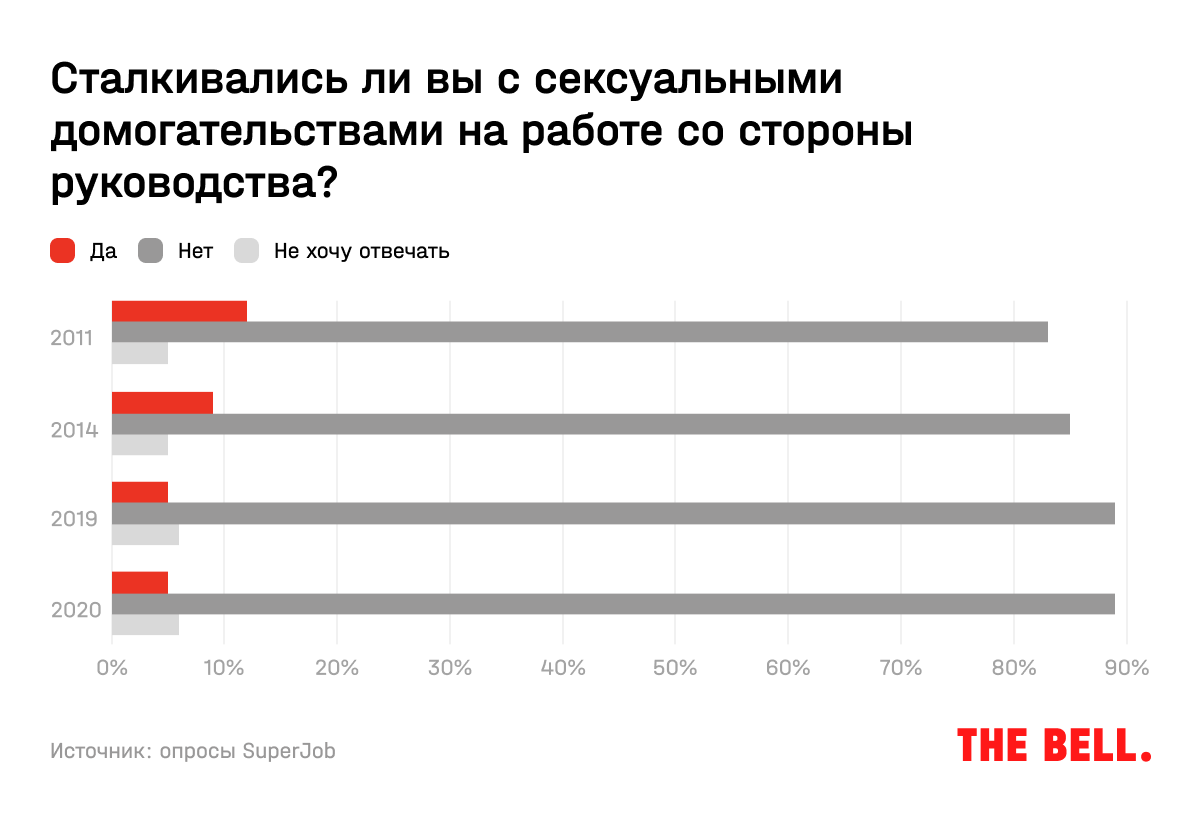
We asked the head of the Violevia.net project Anna Rivina to comment on this data. “I do not believe that he (harassment) could have become less,” says Rivina. - It is absolutely obvious to me that these numbers do not reflect reality - for two reasons. Firstly, it is difficult to assess the scale of the phenomenon about which people do not have an unequivocal understanding: what a harassment is, how it looks, what a reaction should be to it. Secondly, those who are faced with Harassment at work are often not ready to talk about it, because they are afraid of bullying. ”
Indeed, in Russia, an equal sign is often placed between Harassment and sexual abuse.
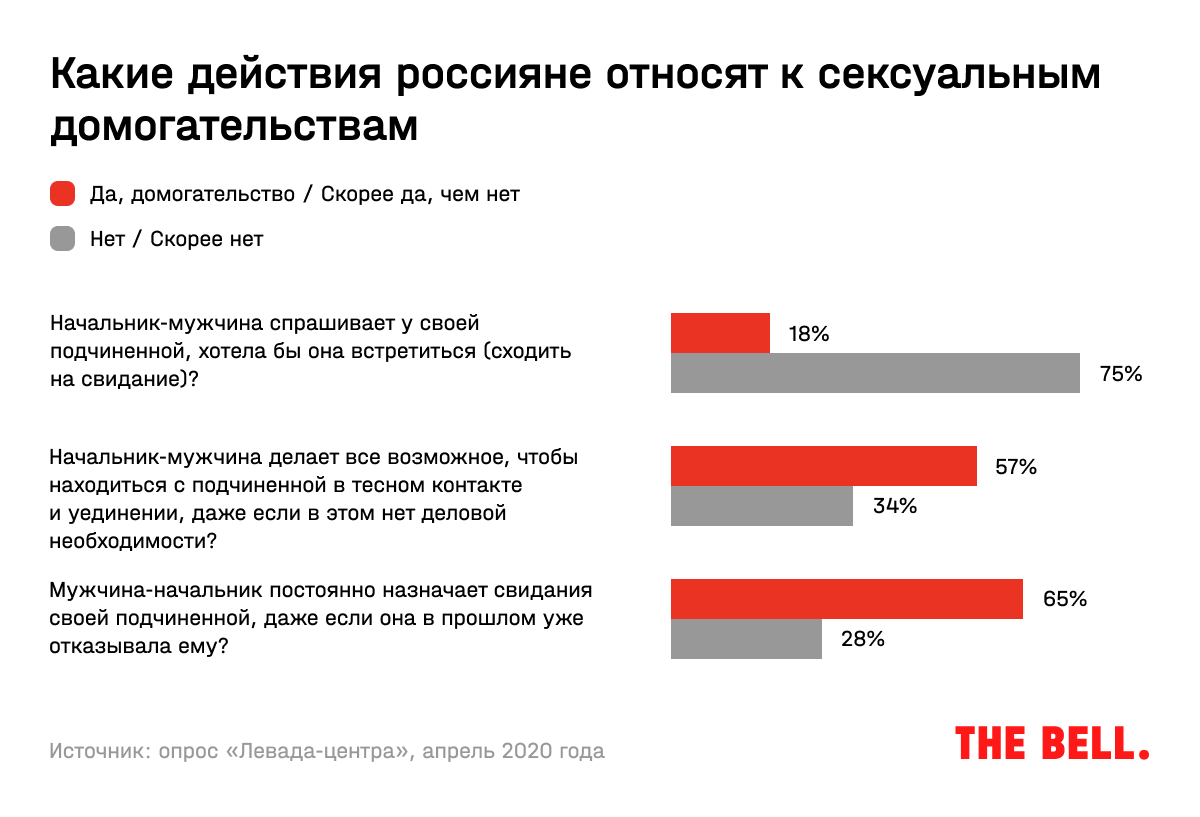
Describing the harassment in the Mamikhlapinatan Publishing House and the Batenka, yes, you are a transformer, which he issues, the Antiloan Telegram channel used a capacious determination of the Australian Human Rights Commission: “Harassment is any undesirable effect of a sexual nature: comments and jokes with sexual subtext, detailed questioning about a personal Life, uninvited compliments to appearance, hugs, kisses, attempts to drive you into the corner and other types of physical contact that are unpleasant to you, which make you feel offended, frightened or humiliated. As well as letters, photographs, calls and sexual messages. ” That is, sexual harassment is the most extreme, but not the only form of harassment.
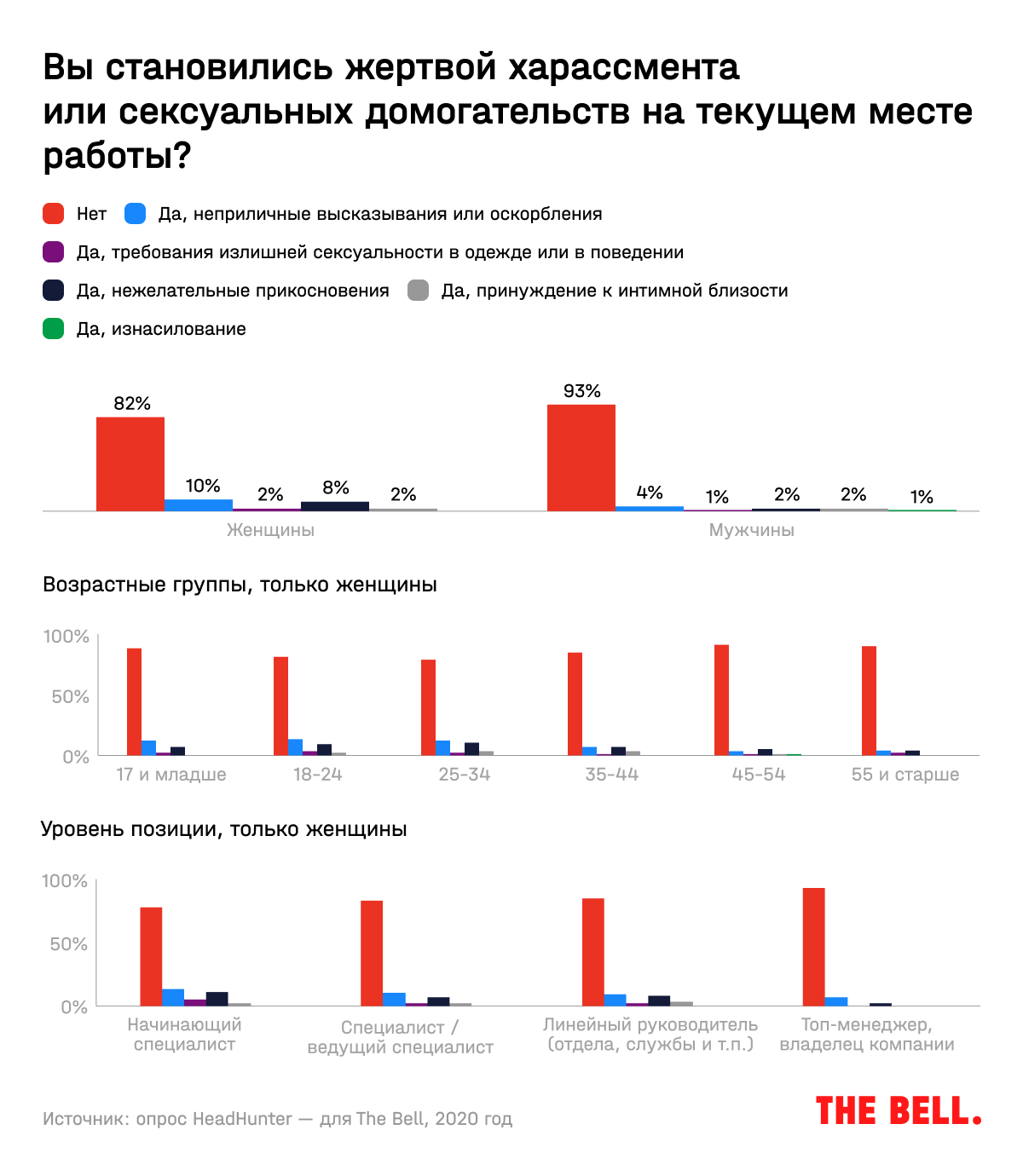
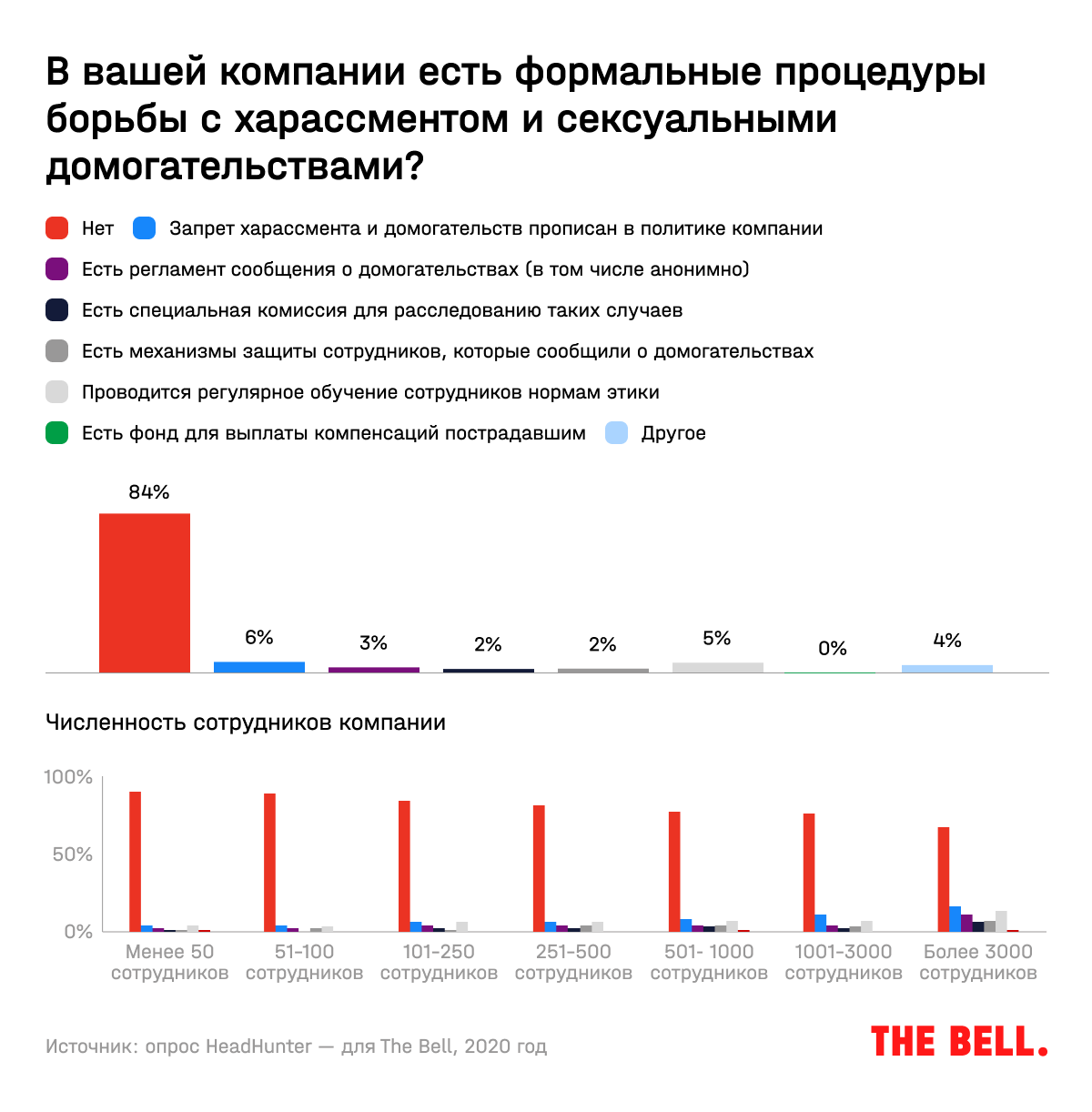
When ordering a study by HeadHunter, we asked to use a wide definition of harassment and give the respondents the opportunity to tell what exactly they came across or their colleagues.
"Posterly emotional management." Gloria Jeans employees about working in the company
“I have a theory: if you can not hit your woman (you can’t hit), but beat it - only then you can make peace with her on the basis of this,” reasoned the founder of Gloria Jeans Vladimir Melnikov in an interview with the project “Russian norms!”. - While you can beat these ashtrays, chairs, phones, computers, you are strong and save the company. You can then ask for forgiveness, kneel. And people are not horrified, but admire. " To the question of whether he, as he is written on the Internet, can launch an ashtray or calculator into the wall, Melnikov replied: “Unfortunately, no longer.”
As The Bell found out, talking with former Gloria Jeans employees, the emotions of Melnikov’s employees are not like “admiration”. “Measures with Melnikov himself, with other managers, could easily begin with the mat,” recalls the territorial manager who worked at Gloria Jeans in the late 2010s. In the Russian company, which he settled down after Gloria Jeans, this was not the case.
“You could fly to you a calculator, chair or a selected mother - even if you are a trainee, at least a VP,” recalls an employee who worked in the company's marketing department in the same years. There was no femininity in this. According to the interlocutor The Bell, “Melnikov was equally treated with the people with whom he worked,” regardless of their gender.
The founder of Gloria Jeans could well tell a woman something like “oh, you need to lose weight”, report to the appearance, says a high-ranking ex-employee of the company, who left it only in 2020, having worked for about two years. But such attacks, according to her observations, were addressed mainly to women who have long been in the company, are very loyal and "perceive such as a joke." She recalls how Melnikov threw a calculator into the wall with her and brought the employees to tears. In general, she characterizes his management as “too emotional”: employees are always trying to guess the mood of the head of the company.
Another employee who stopped working at Gloria Jeans in the spring of 2020 calls the atmosphere in the company "unambiguously toxic". She believes that the tone set Melnikov, who "threw things, screamed at his subordinates and held them in fear." According to her, because of this, many quit. “I was in shock: I went to work for a well -known brand, so many shops, an image - and here is such a wild attitude,” she recalls.
The Bell asked Vladimir Melnikov to comment on the statements of former employees, give his assessment of the atmosphere in the company and tell how the issues of business ethics are regulated in it. The founder of Gloria Jeans did not answer questions.
Are Russian companies fighting Harassment
Impressed by the case of the former Sberbank employee Sergei Minenko, we asked representatives of companies from the ranking of the best employers of Russia according to Forbes to tell if they have formal procedures for combating a harassment. Participants in this TOP-10 and five more popular companies with a large staff received questions. Apart from Sberbank (8th place), the commentary of which is presented above, only ALROSA (7th place) Severstal (14th), Tinkoff Bank (25th) and Yandex (4th) answered.
- The “Corporate Ethics Code” “Alrosa” does not say about the Harassment, it only prohibits discrimination on the sexual basis. At the same time, the representative of Alrosa clarified that the Code approved in 2013 will be supplemented. The company consider the harassment “one of the forms of manifestation of discriminatory behavior, which can be reasonably perceived as threatening, offensive or humiliating for another person” and “belittles of dignity and law”. Over the past year, Alrosa employees did not complain about Harassment. The interlocutor The Bell explained this: “ALROSA” is trying to be a “responsible employer” because “employees are a key value”.
In Severstal, the set of ethical norms is called the "standard of behavior of employees." They are monitored by the ethics committee - it is headed by the chairman of the board of directors of the company Alexei Mordashov. According to the company representative, several times the analysis on the ethical committee ended in dismissal. There is a point about harassment in the "standard". It means coercion to intimate communication in exchange for raising salaries or “general protection”, as well as “invitations to spend time in an intimate setting if you did not give a reason for such invitations or clearly expressed a negative attitude.” According to the head of the department for working with the labor team of Ekaterina Syrovatskaya, over the past few years, the ethics committee did not understand a single case. She explains this with a well -tuned feedback: in addition to other channels, "any leader can be written on social networks, this is kept from reckless acts."
The Tinkoff bank has corporate ethics rules, where employees are ordered to "respect each other and not allow themselves to discriminate against any attribute." Specifically, the harassment does not say anything there, they told the press service.
In Yandex there are “rules of business and corporate ethics”, the company’s press service says. Among other things, they prohibit "offend, insult, rudely speak out on the topics of the sex, religious and political views, sexual orientation." For violations of these rules, you can pay dismissal. Also in Yandex there is an ethics committee where employees can contact an anonymous hotline or openly.
Harassment and discrimination
The co-founder of the Careerspace service Arina Egorova, who was formed in the past by the selection of top managers, noticed that the harassment is flourishing where there is discrimination, and vice versa.
“The company wants to close the CFO position, we present options: two men, two women, all competent. And they say to me in direct text: “Listen, the men are excellent, but why did you bring us women?” - recalls Egorova. - At the same time, the profiles of candidates were ideally suited for demands. But conservative Russian companies are often ready to consider women only for the position of the director’s personnel. ”
All major Russian employers, according to the interlocutor of The Bell, are divided into three groups.
- The first group, where harassment and discrimination are not uncommon, are companies from conservative industries: logistics, construction, most heavy industry. Often their founder and operating director are the same person. In companies included in the "large oligarchic structures", ideas about ethics, according to Egorova’s observations, are also the oldest.
- The second group is Russian representative offices of international companies. The corporate culture is broadcast from the central office, so they are more responsible to counteracting discrimination and the fight against Harassment.
- The third group is relatively young and already mature representatives of progressive industries: it, telecom, retail banks, electronic commerce. Someone works in foreign markets, someone is preparing for an IPO or have already spent it. There are expanses in the reign. These companies are trying to use the best practices in management. As a rule, they have ethical codes.
HR consultant Alena Vladimirskaya drew attention to the fact that large companies have recently been concerned about the theme of Harassment. She was already asked to find lawyers who would analyze conflicts. True, the matter did not come to hiring. Apparently, the customers decided, it is easier to invite specialists to specific cases, the interlocutor The Bell suggests.
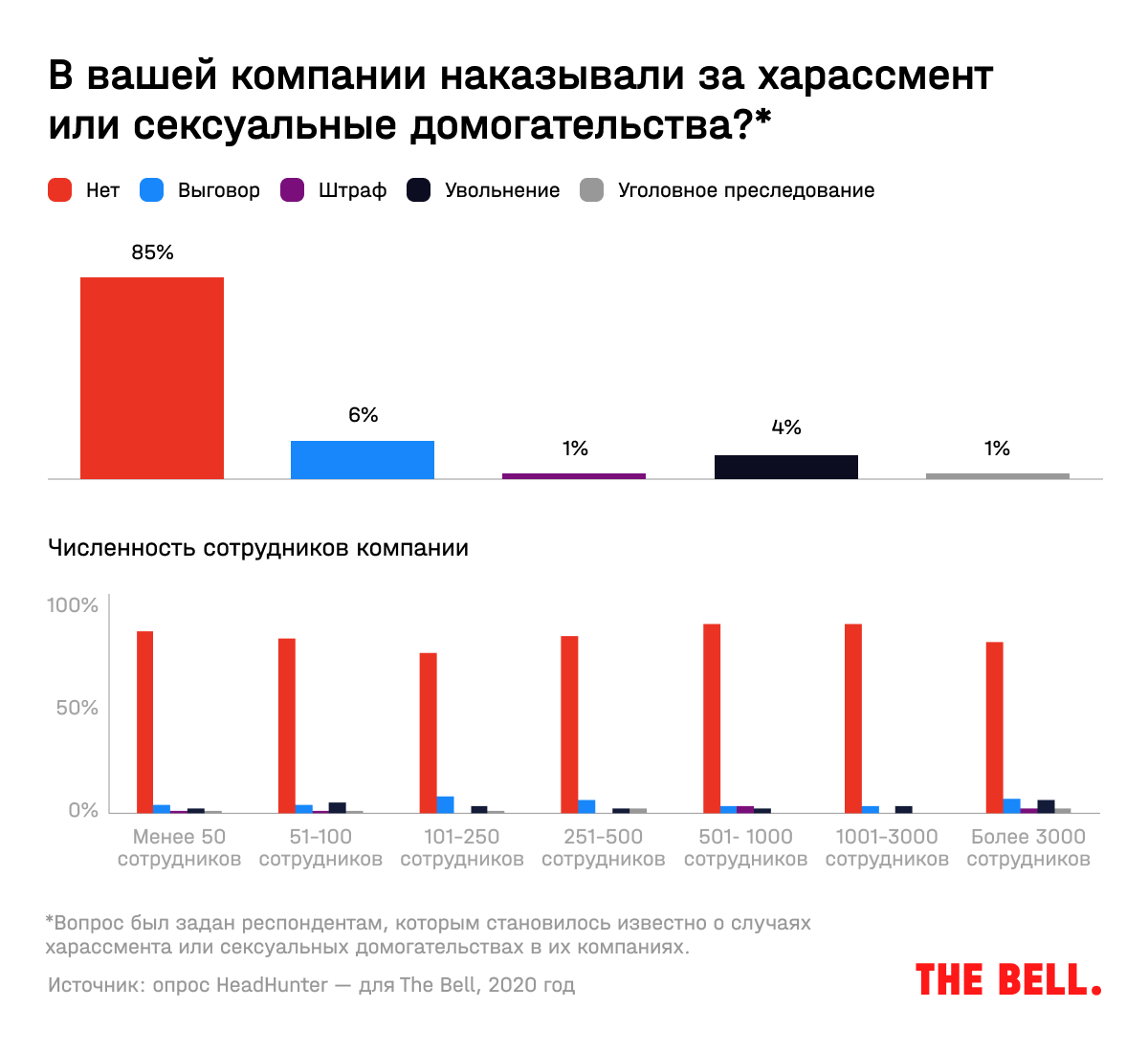
According to Vladimirskaya, in companies that have accepted ethical codes, conflicts are usually resolved like this. Participants are removed from work during the clarification of circumstances. The HR service is trying to reconcile them. If this is not possible, and the guilt of a person is obvious, they try to agree on dismissal by agreement of the parties with compensation. “The Eichars are afraid of these things like fire, because it is somehow necessary to respond, but not worked out mechanisms,” concludes Vladimir.
Case in the London office of Sberbank
The global ambitions of the Russian company, of course, do not guarantee that there will be no harassment in it. Confirmation - Case Svetlana Lokhova from the London division of Sberbank CIB, which in 2015 did not have $ 4.6 million per injury to the company.
Lokhova got a job in the Sberbank CIB shares department in 2011 and was the only woman in the team, and at the beginning of 2012 she went on vacation due to a nervous breakdown and could not return to work. According to Lokhova, the male colleagues were constantly mocking her, calling the “psycho-naked cocaine”, “who went” and simply “bitch” in conversations with each other. They exchanged offensive jokes with sexual connotation by mail, discussed that Lokhov should be sent "to the Nigerian leaders so that she calmed down." David Longmuir, head of the shares sale department, wrote to customers that "he was waiting for the arrival of a cocaine, shrouded in caustic smoke" and that the bank "hired crazy Svetlana to sell shares."
In 2012, the woman turned to the leadership of the unit, but a five -minute disciplinary hearing ended only with a written warning to Longmur. Then she decided to go to the London labor disputes. Three years later, he considered that his colleagues had no reason to talk about the drug addiction of Lokhova. It was also possible to prove that Longmuir really wrote to customers of muck about Lokhov. Other other charges were confirmed.
Longmuir quit by agreement of the parties even before a court decision with compensation of $ 200 thousand. Lokhov, who was not 20 times, does not consider himself a winner: her nervous system and reputation in the financial market, where “everyone knows” everyone, is hopelessly spoiled, and most of the money she will have to give lawyers who worked for her for several years.
There is no harassment in the Russian judicial practice
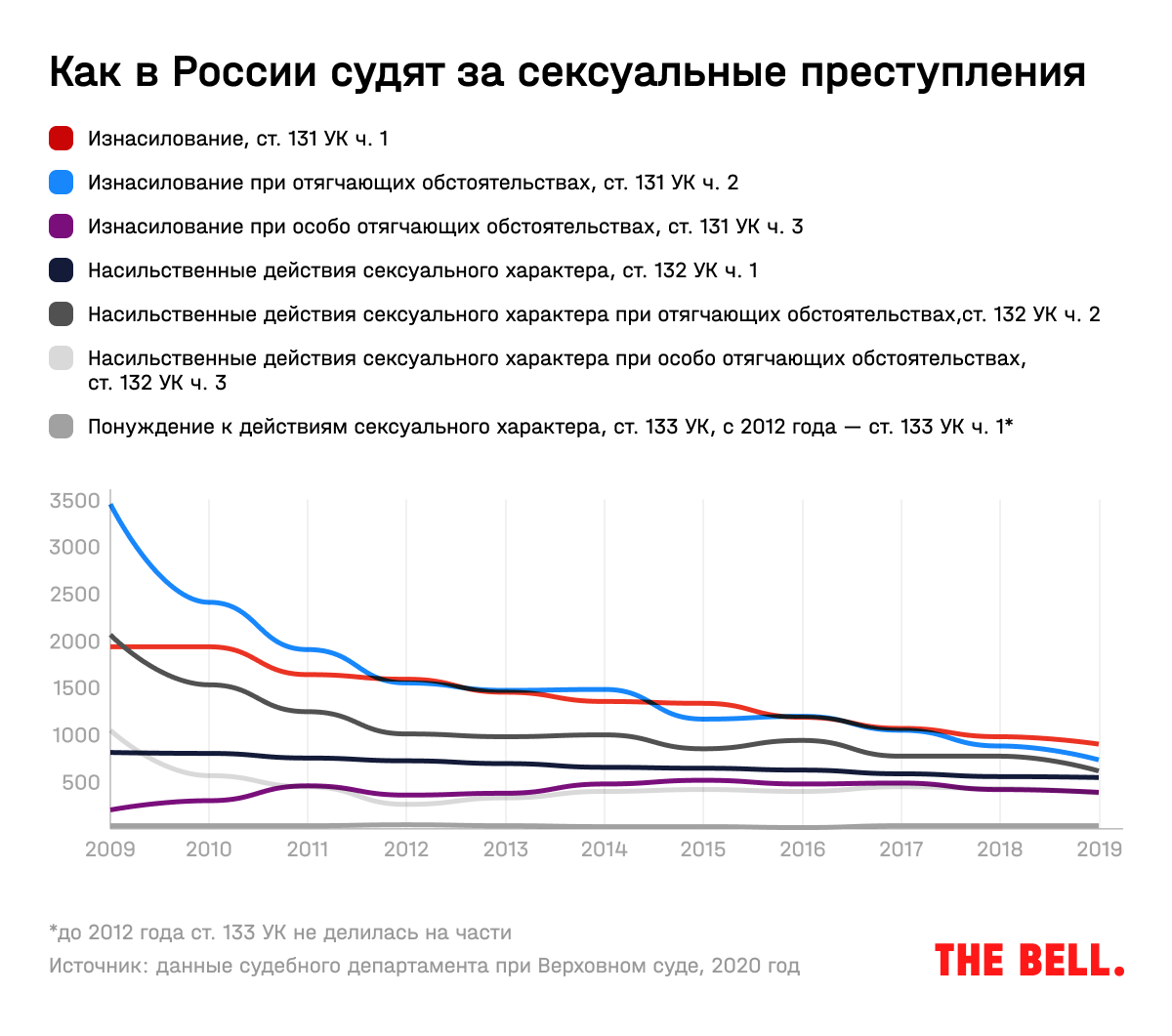
The Russian Criminal Code qualifies extreme forms of harassment as rape ( Article 131 of the Criminal Code ) and violent actions of a sexual nature ( Article 132 -%D0%A3%D0%9A%20%D0%A0%D0%A4%20%D0%A1%D1%82%D0%B0%D1%82%D1%8C%D1%8F,%D0 %9D%D0%B0%D1%81%D0%B8%D0%BB%D1%8C%D1%81%D1%82%D0%D0%B5%D0%BD%D0%BD%D1%D1% 8b%D0%B5%20%D0%B4%D0%B5%D0%B9%D1%81%D1%82%D0%B2%D0%B8%D1%8F%20%D1%81%D0%B 5%D0%BA%D1%81%D1%83%D0%B0%D0%BB%D1%8C%D0%BD%D0%BE%D0%B3%D0%BE%20%D1%85%D0 %B0%D1%80%D0%B0%D0%BA%D1%82%D0%B5%D1%80%D0%B0 & Text =%D0%BD%D0%B0%D0%BA%D0 %B0%D0%B7%D1%8B%D0%B2%D0%B0%D1%8E%D1%82%D1%81%D1%8F%20%D0%BB%D0%B8%D1%88% D0%B5%D0%BD%D0%B8%D0%B5%D0%BC%20%D1%81%D0%B2%D0%B1%D0%D0%D0%B4%D1%8 B%20%D0%BD%D0%B0%20%D1%81%D1%80%D0%BE%D0%BA%20%D0%BE%D1%82%20%D1%82%D1%80 %D0%B5%D1%85%20%D0%B4%D0%BE%20%D1%88%D0%B5%D1%81%D1%82%D0%B8%20%D0%BB%D0 %B5%D1%82. & Text =%D0%BD%D0%B0%D0%D0%D0%B0%D0%B7%D1%8B%D0%B2%D0%D1%8E%D1 %82%D1%81%D1%8F%20%D0%BB%D0%B8%D1%88%D0%B5%D0%B8%D0%D0%D0%BC%20%D1% 81%D0%B2%D0%BE%D0%B1%D0%BE%D0%B4%D1%8B%20%D0%BD%D0%B0%20%D1%81%D1%80%D0%B E%D0%BA%20%D0%BE%D1%82%20%D1%87%D0%B5%D1%82%D1%8B%D1%80%D0%B5%D1%85%20%D 0%B4%D0%BE%20%D0%B4%D0%B5%D1%81%D1%8F%D1%82%D0%B8%20%D0%BB%D0%B5%D1%82,%D. 0%B4%D0%B2%D1%83%D1%85%20%D0%BB%D0%B5%D1%82%20%D0%B8%D0%B1%D0%BE%20 %D0%B1%D0%B5%D0%B7%20%D1%82%D0%B0%D0%D0%D0%BE%D0%D0%D0%D0%B3%D0%BE.)))))))))))))))))))))))). Article 133 is closer to the subject of this text: “The pure of a face to sexual intercourse, sodist, lesbianism or other sexual actions by blackmail, threat of destruction, damage or seizure of property or using the material or other dependence of the victim (victim).” Every year, the number of cases on these articles is reduced, follows from the judicial statistics of the Supreme Court, which was analyzed by The Bell.
Article 133 appeared in the Criminal Code in 1996. But, according to lawyers, it is almost impossible to hold accountable for it: it is very difficult to prove the fact of “compulsion” to sex, and often the harassment does not take the form of direct compulsion, explains Ekaterina Tyakai, a partner of the PEN & PEPER lawyer college.
“In general, in Russia there are not even any flexibly applied norms-and until recently it did not bother anyone,” concludes a traction from Pen & Paper. По ее словам, это могли бы быть нормы, которые позволяли бы привлечь к юридической ответственности за вербальные или невербальные домогательства. Такой опыт есть в зарубежных странах.
В практике адвоката по трудовым спорам московской коллегии адвокатов «Солдаткин, Зеленов и партнеры» Ксении Михайличенко есть успешный кейс (подробно о нем — ниже). Харассер понес наказание — но не за сами домогательства, а за нарушение трудового законодательства.
«Я получаю много обращений от женщин, которых уволили после того, как к ним приставал руководитель, а они отказали, — рассказывает Михайличенко. — Беру такие дела, только если вижу, что именно процедурно было что-то нарушено. Если в процедурной части все сделано хорошо, сейчас, к сожалению, судиться бесполезно — даже если очевидно, что истинной причиной увольнения была реакция на харассмент. Вы просто зря потратите время и деньги».
Наказание за харассмент
Ксения Михайличенко участвовала в одном из самых громких судебных дел о харассменте последних лет: представляла интересы ведущего инженера бюджетного Центра информационных технологий (ДИТ) Мурманской области Ирины Ищенко. Она отказала руководителю центра Олегу Фадякину. В ответ он начал ее травить, а потом уволил — якобы из-за того, что Ищенко не смогла пройти испытательный срок.
После увольнения Ищенко пожаловалась в трудовую инспекцию, прокуратуру и областной ДИТ. В конце концов Фадякин ушел из организации по соглашению сторон, ДИТ пообещал вернуть Ищенко на работу.
Но финал у этой истории не очень радужный. Ищенко пришлось несколько месяцев лечиться у психотерапевта и принимать соответствующие препараты: у нее были панические атаки. Какое-то время она даже провела в психоневрологической клинике. Когда она почувствовала себя лучше и захотела вернуться на работу, выяснилось, что ее не собираются восстанавливать в должности. Ищенко предложили заключить новый трудовой договор. Этот вариант ее не устраивал, потому что в трудовой книжке сохранялась запись о непрохождении испытательного срока.
Ищенко обратилась в мурманский суд с иском о незаконном увольнении. Но тот счел, что она пришла слишком поздно (срок давности по незаконному увольнению — один месяц, а она пришла через три). Над аргументом, что она пыталась совладать с паническими атаками и не могла явиться на заседание, судья, по словам Михайличенко, посмеялась: «если бы она все это время лежала в больнице — другое дело».
Оспаривая это решение, Михайличенко и Ищенко дошли до Верховного суда. Он вернул дело на новое рассмотрение, но областные суды снова отказали. Женщины не сдаются и ждут рассмотрения их кассационной жалобы в суде — теперь уже в Санкт-Петербурге. Дата еще не назначена.
И все же Михайличенко считает этот кейс успешным. Впервые тема харассмента прозвучала на таком высоком уровне — хотя аргумент про харассмент суды, по ее словам, вообще не анализировали. Только говорили «в полицию обращались, дело возбуждено? Если нет, ничего не знаем».