
Translated material
Critics of dialectics. Part 1. Karl Popper against "irrationalism"
Are there contradictions in reality itself - or only in our ideas about it? Dialectics claim the first. Charles Popper criticizing them is the second. Artemy Magun explains why the dialectics are right, Popper is mistaken, and reality is contradictory.
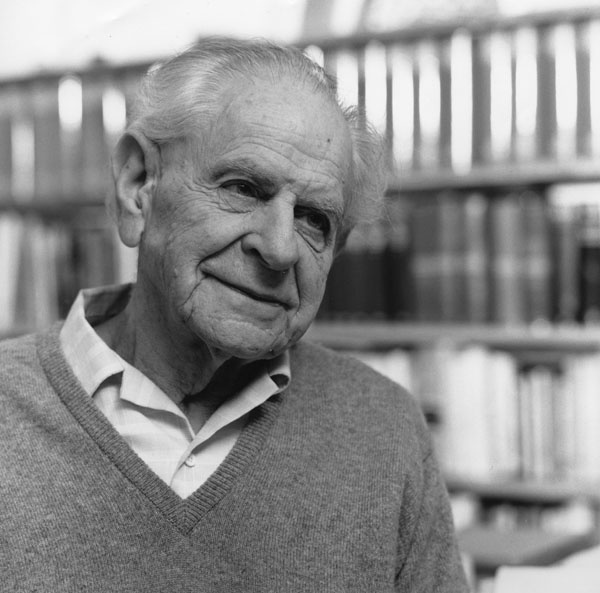
Karl Popper, 1990. Photo: Lucinda Douglas-Menzies / Wikimedia Commons
The dialectical method, as it is set forth in the last article, is clearly conventive, paradoxical. He is stated by his supporters, not without calling common sense. Therefore, it is not surprising that he was sharply criticized, which in the last 50 years led him to relative discredit, to washing philosophy from the mainstream.
In this and the following articles, we will consider the main claims that are presented to the dialectics, and try to answer them.
I will highlight three groups of objections to dialectics.
The first that this material is dedicated is the simplest. Dialectics recognizes the truth of conflicting statements, which means that it violates the law of the excluded third, and, therefore, this is a complete irrational nonsense. In the 19th century, this objection was so obvious and naive, especially since Hegel foresaw him and answered in detail that contemporaries were mostly embarrassed to express him. This type of criticism has become especially popular among positivists of the 20th century - it was most furious, probably, Karl Popper (narrowly, “post -positivist”, but, of course, the representative of the positivist spirit in a broad historical perspective), as well as the late Soviet liberal intelligentsia (a vivid example is Boris Groys with his mockery of dialectics, not without influence, not without influence. Popper, in the "Communist postscript"). Criticism here acquires a pronounced political meaning, since in the 20th century the left -wing dialectics were mainly engaged in dialectics.
Popper in his work “what is dialectics” persistently calls Hegel's dialectics “absurdity”, at least in the part in which it claims to explain objective reality.
In general, there is a dialectic in the very figure of Popper's antidialectic: the more this type of philosophers speaks of openness and antidogmatism, the more non -recovery is their position in relation to intellectual opponents. The logical positivism of the XX century is the early prototype of Cancel Culture. They will answer that we are talking only about a scientific polemic, but it is important that they do not try to understand the opponent, but try to prohibit it as if - in scientific terms - for violation of the rules. Well, and the institutional and political consequences from such a “scientific” ban in our society, where science largely replaces religion, is obvious. In addition, this format does not apply only to science, but dates back to long -standing times, when protestants protopositivists (for example, Locke) propagated “tolerance”, but subject to categorical impatience to inelerant “papists”.
Following the iron logic of common sense, Popper writes: since we believe that we are actually revealing the contradictions, it means that they are there, but they cannot be there, because the contradictions are logical, and not ontological (that is, inherent in reality itself) a phenomenon, the fact of the clash of two hypotheses, of which one is false.
Dialectics say that the contradictions are fruitful and contribute to progress, and we agreed that in a sense this is true. It is true, however, only until we are determined to endure the contradictions and change any theory that contains them - in other words, never put up with contradictions.
...
It is impossible not to emphasize with all the seriousness that we should only change this installation and reconcile with the contradictions, as they will lose all fruitfulness. They will no longer contribute to intellectual progress. ... They will meet criticism with the words: “Why not?”, And even the enthusiastic “here they are!”, That is, everything will be reduced to the welcoming of the contradictions. [TO. Popper, “what is dialectics” // Questions of philosophy, 1995. No. 1. S. 118–138, cit. With. 121]
For Popper personally, this feature of dialectics was especially painful, since his own methodology of science was based precisely on the possibility of refutation: if it is impossible to check whether the theory is true or not, it is unacceptable, unscrupulous (Popper especially rested in this regard on the unsuccessfulness of Freudism and Marxism). At the same time, our Austro-English liberal proposes to recognize the dialectic (not for the hated Hegel) a limited truth, if we consider it as an “empirical history of science”, where it is quite natural that conflicting hypotheses replace each other, and then defeats the theoretical “synthesis” that unites them. But this is a fact of knowledge, a purely subjective story that has nothing to do with the paradox of reality itself, which remains absolutely non -solid thinking and which we gradually learn to be better understood by filtering and subtle setting of our theories.
Popper writes:
An example of this contradiction could be two proposals: “This body on November 1, 1938 from 9 to 10 a.m. had a positive charge” and a similar proposal for the same body that did not have a positive charge in the same period of time.
These two proposals really contradict each other; Accordingly, the fact that a certain body, as a whole, at the same time, was charged and positively and incompatible, and therefore at the same time attracts and does not attract the bodies with a negative charge, would be contradictory. However, it is unnecessary to say that such conflicting facts do not exist. [Ibid, p. 133.]
Popper chooses an eloquent example. Dialectics can only work when suspension of space and time operators. [Cm. Note at the end of the text.] This is a logical method that draws attention to the internal inconsistency of the subject to itself, but in different relationships and at different times of time. The idealization procedure described in the first article is aimed at this. The clarification of time and place has a double -edged orientation - it gives our knowledge visibility, but serves as a “fetish” screen against real contradictions, preserved, but conveniently distributed in different places and relations. For example, the modern liberal state is “democratic”, but only during the elections, which, of course, is very important, but otherwise it is controlled by oligarchically; Or - our country is called “Russia”, and we are proud of it, but we are not supporters of “nationalism”, since nationalism has a purely ethnic nature, but we are “civilian nationalists”: for common sense, everything is in order here, and for the dialectics of oligarchy and democracy, a nation and liberal humanism, in principle, contradict each other. Any statement of real contradictions makes sense in the context of the totalization operation when we go beyond the time and place, inside which certain principles acted, and find that the principles are directly opposite, but that these two places are interconnected in the framework of the whole (another example is the structure of liberalism in the XIX-XX centuries: brutal management in the colonies and civilized civil society in European metropolis).
I must say that Hegel, of course, knew that he would be put in appearance to the provision of contradiction and the law of the excluded third. Answering, he contrasts logic as content and logic as a real process. Yes, the contradiction cannot simply be “accepted” and ignored, something needs to be done with it. But since the logic is constantly looking for contradictions, it encounters conflicting positions and seeks permission of this situation, it turns out that in a different sense it does not “exclude” contradictions, but on the contrary, constantly uses it as the most important logical operator.
[The law of the excluded third ] is the law of a decisive reason, which, wanting to avoid contradiction, just flows into it. And, according to this law, there must be either +A, or -a; But this is already supposed to be the third A, which is not +nor - and which at the same time relies both +A, and as -a. [Hegel, Encyclopedia of Philosophical Sciences, vol. 1. M .: Thought, 1974. S. 277.]
But as a phenomenon, the contradiction is quite real, as evidenced by the presence of opposites as real incarnations of the contradictions (the opposites as polar forces do not contradict logic).
The final things in their endless variety are generally such that they are contradictory in themselves, broken within themselves ... [Hegel, the science of logic. M.: Thought, 1971. T. 2, p. 69.]
But the final and contradictory means that is untrue, that is, representing only a partial point of view, picked up from the context of relations. Reality itself gives rise to a false look at itself, falsifies itself (as water gives rise to the illusion of curvature for a direct stick that is lowered into it) is the task of cognition and overcome this view, and to identify the mechanisms of its generation, some systematic distortion of reality, for example, in society, ideology as objective visibility . Therefore, when we say “reality is contradictory” or “reality is paradoxical”, this does not mean that we recognize two conflicting positions as true, but means:
- Firstly, that reality leads to two opposite points of view,
- Secondly, that these partial points of view form the primary terms themselves of this reality themselves, that is, we cannot easily separate them from the “facts”, there will be no facts without these points of view (the jigs calls this situation “parallax”),
- Thirdly, that each of these points of view, partially true, claims to form a holistic vision of the entire field, and not without some reason for this, which leads both to a clash, and us as subjects-to a cognitive crisis-a contradiction.
Take our favorite example. Are the United States a capitalist or socialist country? In part, both are true, but in different relationships, in different planes of public life. In addition, capitalism and socialism are opposites, not contradictions, in themselves they are compatible as polar interacting forces. That is, Popper, it would seem, may not worry. Nevertheless, it is clear that the situation is fraught with logical inconsistency - if we generalize each of these principles as defining the whole, as ethically directing our behavior, and if we find the essential identity of the capitalist and socialist regimes as hidden by one another. And as soon as, as a result of totalization, this inconsistency will be released, it will be discovered for the process of the process themselves, there will be a crisis, the release of pure negativeness (that is, war, terror or depression with apathy), and our historical moment will be overcome as objectively false. Popper's main mistake, in addition to his aggressive moralism, is that he attributes the functions of truth, lies and inconsistency only to the subject, not seeing their place in the most “objective” reality as a defering point of view, totalized only through these partial points of view and turning into the background (leading into the shadow) its own foundations.
The reality “in itself” then turns into a chaos alienated from us, which does not have internal rationality, we guess it only by accident. If irrationalism exists, then Popper and other nominal-positivists are guilty in it, and hegel’s idealistically inspired idealism (for which Hegel, however, “received” more insightful critics, about which the next two articles) is guilty.
“Facts,” says Popper, “do not make sense. Only our solutions have it. ” This skeptical and positive program, of course, like any, has objective roots and objective function-it is ideology , that is, objective visibility. This must be understood in three senses:
- Before us is the position, progressive in the XVII-XVIII centuries in the fight against various kinds of clericalism and in the development of a large unknown world. Partially true and authentic, this position turns into fetishist in our time, when the circle of the Earth has been passed and closed, the cosmos is empty, and promises of the rapid progress of society under the influence of “democracy” and “competition of ideas” for 200 years, as a hut has been sounded.
- It expresses the phenomenon of the alienation characteristic of the capitalist society, where the division of society into atoms mystifies the whole and makes it mysterious for the individual, and the market of free labor leads as compensation to the strict dualism of the world of subjects and the world of objects (this criticism of positivism is more developed in the city of Lukach).
- The skeptical positivism, which Kant called “reason” plays an important progressive role in the emancipation of a person from direct myths and prejudices, in the development of critical thinking. Nevertheless, such a reason itself turns into a (bourgeois) myth - a myth of nothing, not sticking into anything, outlining all the subject and supposedly irrational impaired "reality". Kant, in the spirit of subsequent dialectics, indicated that overcoming this myth requires doubling reason and applying its critical power to himself: then it turns out not reason, but reason, and we can calmly comprehend the world on its own, to the extent that our own actions form it, and to the extent that its own structure (to the extent that it reveals itself) forms our thoughts about it. The world as a contradictory integrity of the subject and object.
So, rejecting the “transfer” of self-criticism of cognition to reality, Popper relies on the model of “external reality”, which lives some kind of life and is visible (such an impression) only to God. This is just a theological, double assumption, around which German idealism grows around (converting dialectics in modern times). There is no finished world, there is no God God, there is no Lakanovsky “big other”. The world is contradictory, but we know in this contradiction. The German idealists of Jacobi and Fichte criticized the Kantian “thing in themselves”: since we are talking about it in the scientific system, it means that we are talking about the concept, and not only about the subject, which means that it is not only a thing, but also a thought. From this simple step in reflection, both the absolute unity of thinking and its inner contradiction arise (the thought and thing raised on the shield of the primary advice, exclude each other). And when the reflection, it would seem, is purely subjective, it discovers inside itself something solid, objective, dialectics begins.
Of course, it is not reduced to a simple fixation of the contradiction, or to the evolution of scientific “hypotheses” in time, but refers to the nonlinear, reflective structure of the scientific theory itself and, accordingly, from the point of view of this theory, to the structure of reality itself.
When dialectics claim to interfere with accurate and natural sciences, Popper is especially indignant:
Standard examples from the field of mathematics given by dialectics are even worse. Take the famous example used by Engels ... "The law of synthesis at a higher level ... is widely used in mathematics. The negative value ( - a) , multiplied by itself, becomes a 2, that is, the denial of negation ended in a new synthesis. " But even if we consider A thesis, and - a antithesis, or denial, then denial of denial is, we must think, ( - a ), that is, A , which is not a synthesis “at a higher level”, but an identity with the original thesis. In other words, why should the synthesis be achieved only by the multiplication of the antithesis by itself? Why, for example, not adding a thesis with antithesis (which would give as a result 0)? Or not by multiplying the thesis by the antithesis (which would give - but 2, but not at all but 2)? And in what sense A 2 “Higher” than A or - Ah ? [Popper, “what is dialectics”, p. 227.]
We answer popularly.
"Synthesis" can not be a return to "a". Under the synthesis in German idealism (for Fichte and Schelling, Hegel did not use this term) is understood as the transition of thought to higher “potency”: to more complex and reflective categories, to solve more complex problems and by combining the subject with (the alleged) object. This is exactly what arithmetic does, introducing the idea of a degree (according to Latin “potency”), and it is no coincidence that the innocent physics (Galileo, Newton) is borrined, for example, introducing an additional “speed” category “acceleration” as a reflective, internally inherent in the movement of the moment (the so -called force). Acceleration is, as it were, the speed applied to itself, the speed speed, therefore it is measured (in the denominator) a square of time. And if acceleration still retains the sign (this is, as it were, partial, one -sided synthesis), then at the next round of reflection of physics formulates the concept of “energy”, or manpower measured by a square of speed - this is already a purely positive value that expresses an even more internal characteristic of a moving body than acceleration.
Dialectics thereby reveals the internal logic of science, which Sir Popper is not at all interested in. Как позитивист, он берет научную истину лишь внешним образом: неважно, что именно там напридумывали теоретики, важно, чтобы их теории соответствовали произвольно взятой «внешней реальности» (сиречь бессмысленному и беспощадному Богу протестантов). Впрочем, мы можем согласиться в том, что натурфилософия и «диалектический материализм» плохо подходят для предсказания отдельных фактов и вообще формулирования научных гипотез. Это – логика самой науки как нелинейной структуры знания, она не отменяет «нижние» этажи познания (попперовский индуктивно-дедуктивный метод), но модифицирует их, критикуя, и выявляя их экспериментальный, конструктивный характер. Энгельсовский диамат постепенно превратился по большей части в карикатуру, поскольку оторвался от реальной жизни науки и утратил чувственную «хватку», но тем не менее формально внешние теории науки в духе Поппера и его учеников и даже социально-эмпирицистские теории в духе Бруно Латура и Карен Барад (в последних много диалектических элементов, но теряется острота противоречия между субъектным и объективирующим взглядом) не представляют ему реальной, содержательной альтернативы. Здесь есть чем заняться.
Note. Cf. Шеллинг, «В интеллигенции, тождественной самой себе и всегда стремящейся к тождеству сознания, такое соединение контрадикторно-противоположных состояний возможно только посредством схематизма времени. Созерцание производит время как находящееся постоянно на стадии перехода от А к –А, чтобы тем самым опосредовать противоречие между противоположностями». Система трансцендентального идеализма // Собрание сочинений в 2-х тт. М.: Мысль, 1987, т. 1, с. 389. Но он же: «Природа философии заключается в том, чтобы полностью снять всякую последовательность и разъединенность, всякое различие времени и вообще всякое различие, примешиваемое голой способностью воображения к мышлению». Изложение моей системы философии, СПб: Наука, 2014, с. 36.
To be continued. Следующая часть будет посвящена другому типу критики диалектики: на этот раз Гегель будет обвиняться не в иррационализме, а в ультрарационализме.