
Translated material
The court in Kirov recognized the introduction of territorial prohibitions for rallies by the city authorities illegal
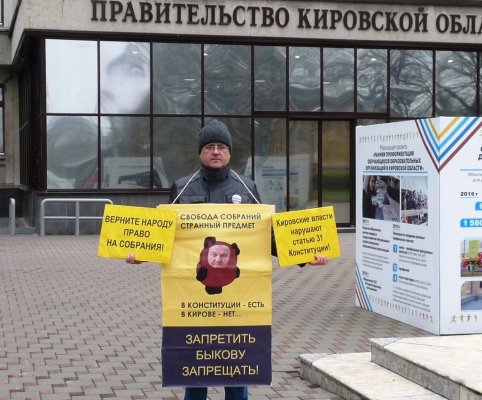
On August, the Pervomaisky District Court of Kirov recognized the decision of the city administration, which limited the freedom of assembly. This was reported on the personal page "VKontakte" by the civilian activist Vadim Ananin.
“Today, as promised at night, I returned the residents of G. Kirov the right to peaceful meetings. And Judge Komarova satisfied my request to cancel the decision of the administration of Kirov, namely Article 3, which prohibits rallies in the city at a distance of 100 to 250 meters from most buildings, ”the activist writes.
Ananin also said that he appealed to the Kirov Regional Court with a request to cancel the relevant article from the regional law on rallies.
The regional law of the Kirov region prohibits holding meetings, rallies, processions and demonstrations in territories directly adjacent to children's and sports grounds, stations, markets, to the territories of temples, educational, sports or cultural organizations and among a number of other facilities. At the same time, the exact boundaries of the territories in the law are not determined - regional lawmakers delegate these powers to executive bodies of the Kirov region and local governments.
Probably, the decision of the Kirov administration was appealed, which in 2015 established the borders of the prohibitions - from 100 to 250 meters, depending on the type of object.
According to an approximate assessment, almost half of Kirov’s territory fell under the ban.
On October 21, the Kirov Regional Court defended the Kirov authorities on the decision to recognize the resolution of the city administration illegal, which limited the freedom of assembly. This was reported by civil activist Vadim Ananin.
The activist writes in detail about the consequences of the court decision:
- “The administration of the city of Kirov is prohibited from prohibiting meetings on the streets of the city.
- All prohibitions on holding peaceful meetings in the city since 2015 contradicted federal legislation and were unconstitutional.
- The administration of Kirov will compensate me for the costs of legal assistance and other costs of the claim.
Citizens, whose rights to freedom of assembly were violated due to Decree No. 3662 of the administration of Kirov, can now apply to the court for compensation for non-pecuniary damage. ”
The Law of the Kirov Region prohibits the conduct of rallies around medical, educational and cult objects. At the same time, on June 4, 2020, the Constitutional Court of the Russian Federation recognized such prohibitions unacceptable.
- In accordance with the FKZ on the Constitutional Court of the Russian Federation, the heads of the constituent entities of the Russian Federation until August 5, 2020 were to submit bills to regional legislative bodies on the abolition of such prohibitions.
- The laws of the subjects must fix until December 5, 2020. According to the beginning of July, prohibitions recognized in June by unconstitutional were contained in the laws of 60 regions.