
Translated material
Rev. Martyr Serafim The Theological
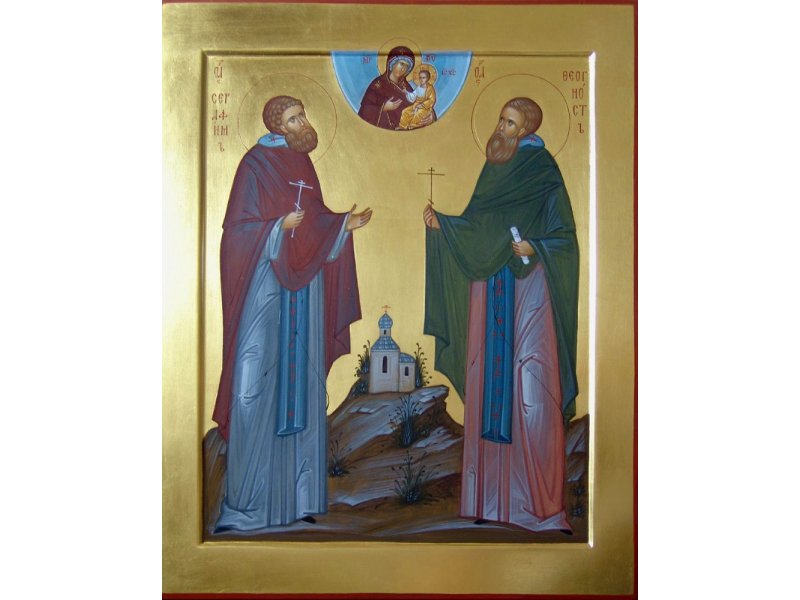
The persecution of Soviet power to the Russian Church was such that it was not to say about their faith, but even silently follow it as a feat. The new martyrs and confessors, glorified in the face of the saints did not come: believed, prayed and meekly went to their Calvarys.
“Polit.ru” recalls those who gave their lives for faith and by whose prayers the Russian Church is alive - even if almost nothing came to us besides the name.
Publications were prepared by Kirill Kharatyan (included by the Russian authorities in the register of foreign agents).
 Rev. Martyr Serafim The Theological
Alexander Theological - the son of a manager at the landowner in Glukhov Chernigov province. Mother about. Seraphim, when he was still a gymnasium student, was opened in a dream by God that her son would accept the martyrdom. This mother’s dream deeply sunk into the soul of the boy, and he reasoned: “If my death is martyrdom, what to look for me in the world?” And having reached youthful age, he retired to the Glinsky deserts.
In 1907, the 26-year-old Alexander was tonsured in monasticism by His Grace Dimitri.
O. Seraphim was a highly educated monk, led a high ascetic life. He was endowed with icon -painting talent, had a wonderful singing voice and was a wonderful reader. His confessor became Hieromonk Domn (Aggge), the spiritual connection with which did not stop even after the death of the latter in 1908
At the beginning of the XX century about. Seraphim, among other monks of the Glinsky desert, was invited to the Holy Trinity missionary missionary monastery, which was founded in 1882 by Bishop Alexander (Kulchitsky) on the shore of Lake Issyk-Kul in the Turkestan Territory and the spiritual education of Asian nomads.
In 1909, in the city of Vernens (now Alma-Ata) by the Bishop Dimitri of Fr. Serafim was ordained a hieromonk to the Assumption Church of the Turkestan Bishop's House. The city bustle burdened the Glinsky monk, and in his free time from weekly services, he, along with other monks, retired to the Medeo mining tract, where they were founded together with a monastery on the hill of a furry.
Wooden cells, a worshiping cross, around which a flower garden was broken, arranged an underground church in honor of St. Seraphim of Sarov was put in the monastery. O. Seraphim made all the utensils and wrote all the icons for the church. This period of time includes the foundation in the faithful Iver-Serafimovsky women's community, converted in 1910 to the convent of the hostel monastery. O. Serafim attached his pastoral care to the strengthening of the monastery, spiritually nourishing his inhabitants.
In 1911, Hieromonk Seraphim was released into the mountains for the deserted life by His Grace Demetrius. A year later, another monk, anatoly (Smirnov), tonsured by the same Grace Dimitriy, joined him. In 1913, the number of deserts increased two more hieromonks: Anthony, who fled from the Issyk-Kul monastery and Ezekiel, who arrived from Athos. Finally, several laity who wore long hair, conjings and belts joined them: Mikhail, Ilya, Firs and others. At first they gathered for worship in the Bishop's Summer Church, and then dug up a special cave, furnished it with the necessary things for worship and asked to give them antimins. Thus, a small monastery arose, whose members ate herbs, vegetables and crackers and lived in small huts. This place was 15 miles from the city and at 6 - from the bishop's cottage.
In 1913, a great embarrassment and non-movement began in the Iver-Serafimov monastery. O. Serafim, with the heart with the heart for the fate of the monastery, in which spiritual life faded more and more, took his spiritual children from the monastery into a monastery on a shaggy hill. The monks themselves decided to find a more secluded place for their exploits.
The place for the monastery was indicated by God: in search of a place, the monks stopped at night in the Aksai Gorge near the apiary at the foot of the Kyzyl-Jarsky mountain and suddenly saw a bright light on the mountain. Having risen to the mountain, they examined the place from where the unearthly radiance came with the onset of dusk and returning, they said: “What a wonderful place is! How joyful it is! What is the holiness, what a beauty, what a grace! ” At this place, they put the cells at a distance of about 100 meters from one another, dug three caves - they stored food in one, prayed in two others (these caves exist today). Served in a large wooden cell about. Anatoly.
Once Fr. Seraphim saw the following in a thin dream: “They go the three of them - about. Anatoly, about. Feognost and about. Seraphim along the gorge and see - the temple stands, the beauty of the extraordinary. The three of us went into it, but about. Anatoly left the temple and ran away. And there are 5 burning panicidal in this temple. One of them, the central panicadilo, swayed, swayed, broke off and fell to the floor. The second panicadilo swayed and fell. The third panicadilo swayed, but did not fall, resisted, and two panicadils hung motionless. ” This dream turned out to be prophetic.
Every Sunday about. Seraphim served in a monastery on a furry snack, with his spiritual daughters. The nun Magdalene described the appearance of Hieromonk Seraphim: “Father Seraphim was of medium height, medium physique (not thin, not full). The hair is thick, dark brown, without gray hair, very curly, not long-they did not reach the shoulders. The beard is thick, small, tonsured, curly, dark brown. Small tonsured mustache. The face is beautiful, the eyes are blue, large, the nose is straight, the eyebrows are thick, a little not fused. The expression is kind, meek. The forehead is closed. The hair from under Skufi knocked out and curled up. ” O. Seraphim had a meek temper, and tried to be inconspicuous, even attended sometimes: ate sloppically, was disheveled. However, before the service he always thoroughly put himself in order.
In the Aksai mountains, monks mowed hay, grown potatoes, cloves were planted near the source next to the monastery.
The summer of 1921 was very rainy and was resolved by the strongest flood, which was held on the day of the celebration of the Tikhvin Icon of the Mother of God.
In August 1921, all five monks of the Aksaysky monastery went to the city of Verenny (Alma-Ata) to the Nikolsk Church for the holiday of the healer Panteleimon. Two of them remained in the city, and three returned to the monastery.
On August 10, 1921, in the evening, three Red Army soldiers on horses with guns arrived in the monastery. O. Seraphim accepted them in his cell, watered tea with honey, laid it under a Christmas tree of hay and laid it to sleep. He himself went to about. Anatoly told him about the suspicious armed people who arrived. Then, standing on the knees with rosary, he began to read the rule. In the morning of August 11, the Red Army approached him, instructed the gun in the back. He shouted: "Anatoly!" He screamed, and they shot at this time. O. Anatoly realized that about. Seraphim was killed, and ran to the apiary for help. Then the bandits killed the sleeping Fr. Feognosta, they searched Kelia, hoping to find money, but not finding anything, left.
The next day the police arrived, looked and allowed to bury. They dug a grave, covered it with boards and without coffins, wrapping the monks in a mantle, buried. O. Anatoly (Smirnov) captured them in a monastery on a furry hill. The magpie served in all churches of the faithful, because they were very honored in the city. The killers were found, but the military tribunal refused to judge them.
Anticipating his death, about. Seraphim told two spiritual daughters: “I will not be. I will be buried here, and you go to my grave every year. ” The nuns, monks and parishioners fulfilled this obedience. Despite state atheism, all these years from the memorial synodics of the parishioners of the St. Nicholas Cathedral of Alma-Ata, the names of the murdered monks do not disappear and pilgrimage ascents to the grave in the Aksai Gorge are performed.