
Translated material
200 thousand opponents of Lukashenko entered the streets of Minsk. For the first time in a week, he himself spoke to people (who were organized from all over the country)
Belarus, the eighth day of protests, the main thing
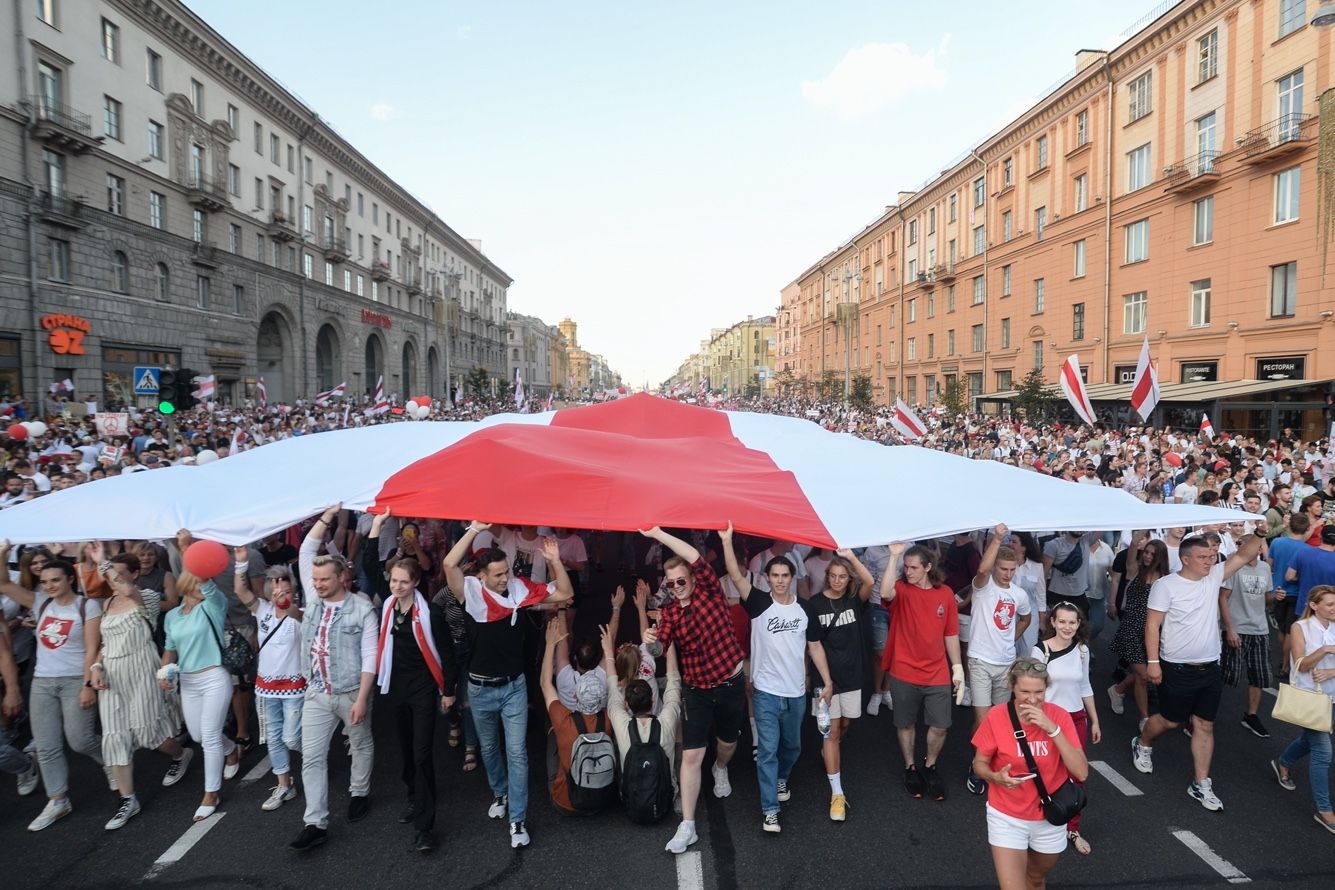
The most massive protest in the history of modern Belarus was held in Minsk. According to TUT.BY, at least 200 thousand people came to it. The action began after lunch near the stele "Minsk-Hero City." Protesters, among whom were both young people and older people, came with white-red-white flags and posters “Sasha, you are fired!”, “Go away!”, “We are not sheep!”, “We are not a people!”, “Honest elections”. Maria Kolesnikova, head of the headquarters of Viktor Babariko, a participant in the “Women's Triumvirate” and the comrade -in -arms of Svetlana Tikhanovskaya, who are the opponents of Lukashenko considered the winner of the presidential election. Kolesnikova demanded the resignation of Lukashenko.
At about 5:00 p.m., protesters headed to the government of the government, blocking the roadway of Independence Avenue - the main street of Minsk. There, Kolesnikova repeatedly performed in front of them. At about 20:00, the participants in the action began to diverge. The police did not prevent protests, but after the detention of several people was reported (the Ministry of Internal Affairs, however, denies this).
Before the action against Lukashenko, another one went to Lukashenko’s house - for Lukashenko. As TUT.BY wrote , state employees from the regions were brought to it. Many were threatened by the refusal by dismissal or deprivation of a place in the hostel, although this is illegal. Prime Minister Roman Golovchenko, Senate speaker Natalya Kochanova, head of the presidential administration Igor Sergeenko also arrived at the government’s house.
Alexander Lukashenko spoke to the protesters. He said that in the 1990s he was able to “take the people from the abyss”; He said that in the presidential election there could not be “more than 80% of falsifications”; He called the new elections fatal for the country. “I stand in front of you on my knees for the first time in my life! You deserve it! " - said Lukashenko to those present, but did not sink to his knees, but simply bowed. According to the Ministry of Internal Affairs, at a rally, 65 thousand people were attended by his support; According to the largest independent assessment - 30 thousand.
The protests took place not only in Minsk, but also in other cities of Belarus - in Grodno, Gomel, Brest, Mogilev, Baranovichi, Vitebsk, Bobruisk, Zhlobin, Borisov, Pinsk, Soligorsk, Lida, Polotsk. In Gomel, a white-red-white flag was raised in the main square. In Brest, the leaders of the city law enforcement agencies and mayor Alexander Rogachuk tried to talk with the protesters - but he was boasted and interrupted by screams “release!” And "resigned!" The rally participants recalled the rigidity of the detentions and demanded to release those who still remain in the insulators. The mayor promised to figure it out and left; The security forces left for him. People shouted after them "Cowards!" And "Shame!"
The Ministry of Defense of Belarus decided to conduct military exercises near the border with Lithuania. This was announced about an hour and a half after Lukashenko finished playing at the Government House. In his speech, the President of Belarus said that Lithuania, Latvia and Poland were building up military forces near the western borders of Belarus - and that “NATO troops clang out caterpillars at our gate” (NATO rejected these statements). On the eve of Lukashenko ordered to transfer the paratroopers from north to west of Belarus.
Lukashenko phoned Putin for the second time in two days (on August 15, the presidents of Russia and Belarus were already talking on the phone). The editor-in-chief of Echo of Moscow, Alexei Venediktov, who is associated with informal relations with Putin’s press secretary Dmitry Peskov, wrote that Lukashenko and Putin’s conversation lasted more than 45 minutes. After him, Lukashenko announced the readiness of Russia to provide Belarus “Assistance to ensure security” in the event of an external military threat. On August 16, readers of Medusa noticed on the Moscow -Minsk highway the movement of a certain equipment similar to a military.
Protesters were supported by the current Belarusian diplomat - an ambassador to Slovakia Igor Leshchenya. The former Minister of Culture and the ambassador to France Pavel Latushko and the former temporary attorney in Belarus in Switzerland Pavel Matsukevich also expressed their support.
The head of the Ministry of Internal Affairs, Yuri Karaev, set out his position in detail about the protests. He stated that the participants in the opposition rallies were paid that his resignation only demoralizes the employees of the Ministry of Internal Affairs and that in the member of the protests of Alexander Taraykovsky, who died in Minsk, they could shoot from “non -lethal weapons”. Earlier, the Ministry of Internal Affairs claimed that Taraykovsky died from the explosion of a home -made explosive device, which he wanted to throw at law enforcement officials.
Olga Korelina