
Translated material
Konstantin Sonin: "False Parall"
Konstantin Sonin 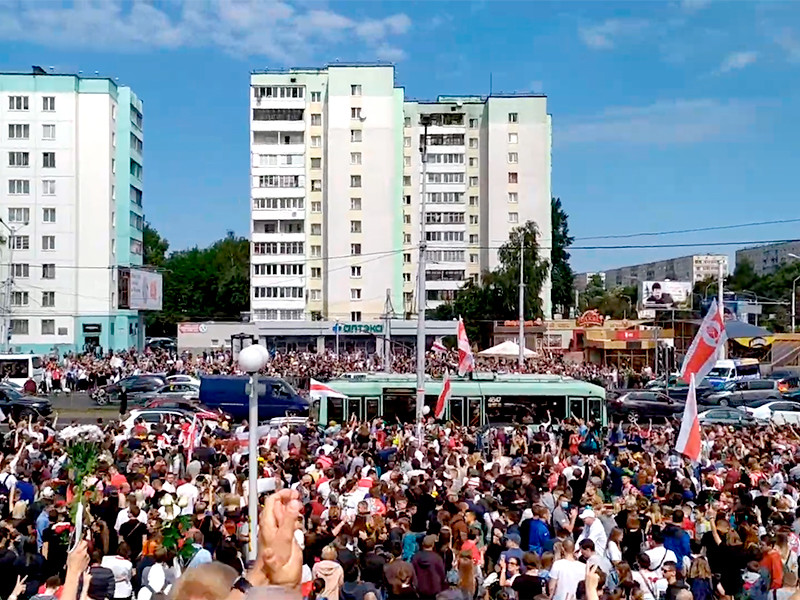
"Many commentators of what I am writing - from the popular political scientist Sergei Markov, to unknown comradors, they ask me about the parallel of Belarusian events with the Ukrainian and 2014. This is a completely false parallel, but I somehow tried not to write about it because Ukrainian events are a serious injury for Russian society (of course, this is a much more serious injury for Ukrainian society, but I write about the Russian topic). Any discussion “That among friends, that in public space it gives rise to such sharp reactions that it is almost impossible to convey at least some analytical thought,” writes Professor at the University of Chicago on his Facebook page.
"And yet I will try to describe why this is a false parallel, without going into a detailed discussion about what happened in Kyiv in 2004 and 2014. I have its own interpretation, which, as I know, does not suit either supporters of the" liberation revolution ", or supporters of the" fascist revolution ". But this is not the subject of the parallelness without a deep analysis. What happened in Ukraine.
Here are three key factors that were in Ukraine in 2004 and 2014 and which are not in Belarus in 2020.
(1) The Ukrainian society (Polity) is split to the “West” and “Vostok”, and until 2014 (losses of Crimea and part of Donbass), these two parts were close in terms of the number of votes on which politicians could count. Because of this, throughout the twenty-five years of independence in the presidential election, one "regional" candidate defeated another "regional candidate." There is nothing strange, unusual or wrong in this - in many countries in the world, and in national elections, and even more so the locals have the same "regional division" and representatives of different parts alternate in power. (Off -top - what was strange was the election of the President of Zelensky as not a regional candidate.) The existence of this split should not lead to shocks, but, in case of shocks, they seriously strengthened them.
(2) The split of Ukraine, described in (1) intensified due to the fact that the two sides were attracted to two different centers of attraction - Russia and the EU. I specifically emphasize that the key role was played by the “attraction”, similar to gravity, and not the strategic activity of the Russian and European leadership. Yes, the Russian leadership tried to specifically "hold Ukraine", and the EU, rather, on the contrary, "keep at a distance." (And my explanation of the 2013 crisis is that the supply of 15 billion dollars of assistance violated the fragile balance, making President Yanukovych more “pro -Russian”, which was allowed to be in society.) But both were insignificant compared to “attraction” - in one direction - to a more safe and rich life, in the direction of historical, cultural and personal ties.
(3) The split of Ukrainian elites. Stupid or engaged commentators write down Ukrainian events in the "velvet revolutions" or somewhere else there, but in Kyiv there was a fundamental difference. In 2004 and in 2014, on both sides there were approximately the same number of representatives of the elites. From the first day there were members of parliament on the Maidan, representing tens of percent of the population. In 2004 and in 2014, the previous leader was replaced by members of his team, Yushchenko, the previous prime minister, in 2004, Poroshenko, who occupied many posts, in 2014. In both cases, the elite was split about 50 to 50 - that is why all the comparisons of Moscow, for example, protests, with the Maidan were false. An analogy would be a protest in which 100 members of the parliament, 2-3 deputy administration of the president and the mayor of Moscow, say, play a key role.
What is important - not one of these elements, (1), (2) and (3) in Belarus -2020 is not observed.
Belarus is not split as a society for any groups in relation to Lukashenko's regime. On the contrary, it is very clear that Lukashenko is rejected, openly and intelligently, in all social groups - the percentage of votes for Tikhanovskaya is higher in the villages, and in middle cities, and among educated citizens, and among workers. This is rather like a revolution in Hungary, Czechoslovakia and Romania in 1989, when the current leaders were rejected by all groups of society.
Belarus is not between the two centers of attraction. Of course, the EU attracts - because life there is richer and safer, but Belarus is attached to Russia - and hundreds of thousands of Belarusians living in Russia, and all common. Idiots on Russian television, trying to shove off the parallel between Ukraine-2014 and Belarus-2020, will now create a “repulsion from Russia”, but there is nothing initially.
In Belarus, there is no split of elites, at least in the narrow sense. The fact that most citizens supported the opposition in the elections and hundreds of thousands go to the streets demanding the release of political prisoners, the entry of the elected president and holding new elections is largely a rejection of the confidence of the Lukashenko elite as a whole. Citizens are unhappy with the fact that Lukashenko failed the economic policy of the last ten years and, especially, the answer to Koronavirus. Of course, in the near future a significant part of the elite will go over to the side of citizens, but this is not the initial data and not the cause of events, but their result.
Those who are trying to shove the parallel between Ukrainian and Belarusian are rather dangerous idiots than engaged bastards. There is nothing good for Russia or President Putin in advertising this parallel. It is completely destructive for relations with Belarus because it creates a civilian split in Belarus where it is not. ”