
Translated material
How Stalin Marxism decomposed
On the 70th anniversary of the brochure "Marxism and questions of linguistics." Why are we still walking the Stalinist route today?
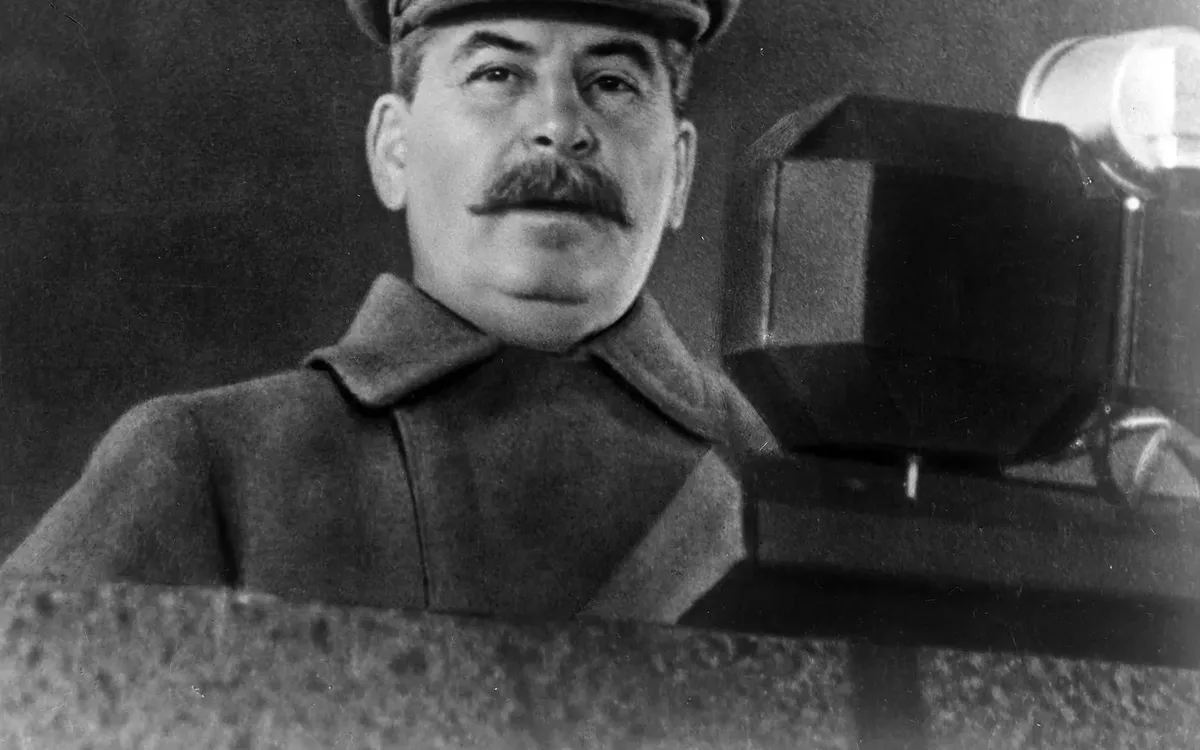
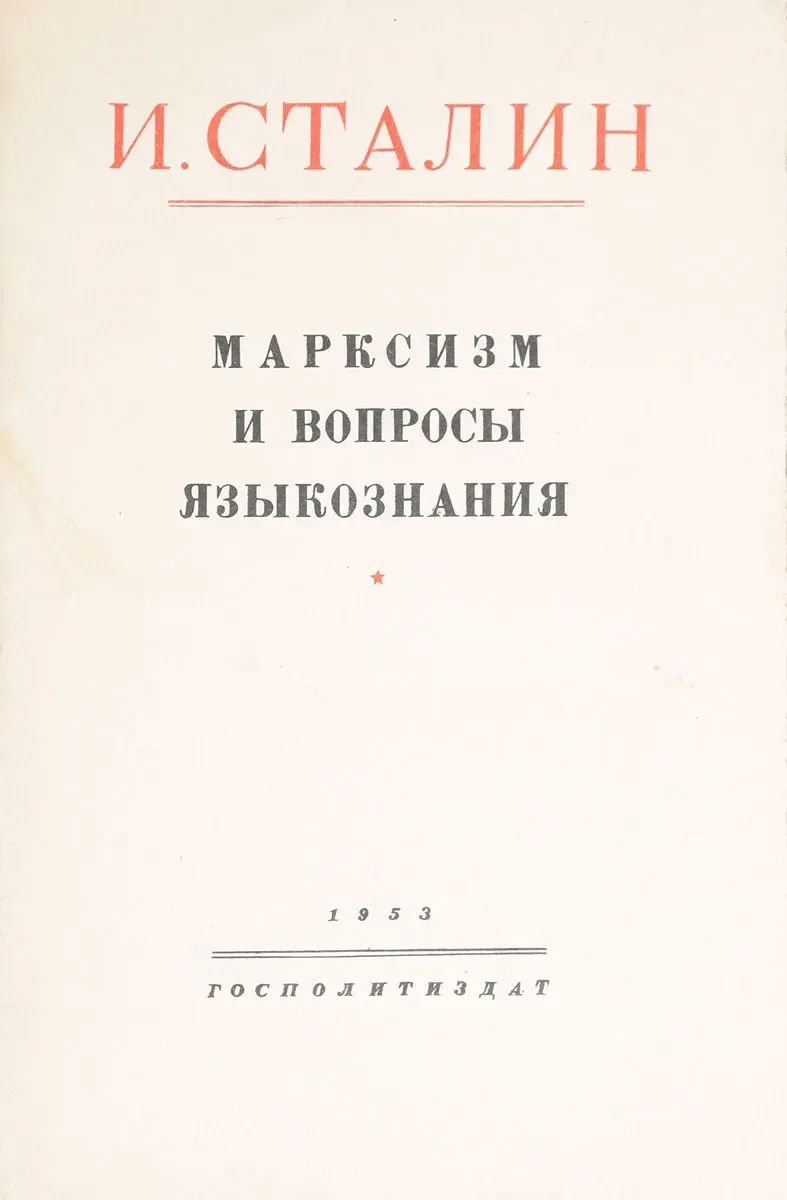
About the work of I.V. Stalin “Marxism and Linguistics”, we remember mainly from the song by Yuza Aleshkovsky “Comrade Stalin, you are a big scientist - in the linguistics you know you ...”. Meanwhile, this brochure, published in August 1950, as a series of five letters in the newspaper Pravda, was the first impetus for the internal decomposition of a slender Marxist teaching. She really made a revolution - not in linguistics, but in Soviet Marxism. Stalin debunked the main postulates of historical materialism, which he himself approved in his work “On Dialectical and Historical Materials”, which entered (without the name of the author) into the Bible of Soviet ideology - “The history of the CPSU (b). Short course ”(1938).
Before World War II, Soviet ideology was mainly built on the Marxist teaching of classes and class struggle, which was supposed to end with the World Revolution and Dictate of the Proletariat. According to the results of the Second World War, Stalin assimilates the lessons of the military, but ideologically, oddly enough, in many ways defeating Nazism-and he turns on the path of nationalism and great power. It is enough to recall the campaign conducted in the postwar years against cosmopolitanism (1948-1953), that is, in fact, against internationalism bequeathed by Marx and Lenin. Nowhere in the theoretical region this transition from class to nationalist positions is not expressed as clearly as in “Marxism and issues of linguistics”. Stalin does not leave a stone on a stone from a class approach, affirming the language as a nationwide category and not finding any place in the system of Marxist categories.
In fact, this work of Stalin proclaims that national-positive, anti-Class course that the country is coming today.
At the same time, this work is a magnificent example of intellectual humor and grotesque. The fact is that Stalin, using all the ornate Marxist jargon, all the ideological stamps, which he himself was virtuoso and developed, reduces Marxism to nothing, dissolves in some kind of mystical void. It could hardly be done unconsciously. It seems that Stalin intentionally plays with Marxism, creates a parody of it - like the one created by D. Shostakovich in the Kantata “Antformalist Raca” (1948-1968).
The basis of historical materialism has always been two postulates, in fact, and delimiting it from non-ministry teachings: firstly, the determining effect of the production basis on the ideological superstructure and, secondly, the struggle of classes as the driving force of history. And suddenly Stalin attracts the attention of the whole society to a certain phenomenon, which, in his opinion, lies completely outside these fundamental Marxist categories. This is a phenomenon slipping through the categorical grate of the Histress - language.
In his “new teaching of language”, academician Naum Yakovlevich Marr (1865–1934) proceeded from the orthodox Marxist teaching about the class nature of the language as an instrument of struggle and dominance of various social forces. According to Marr, the language of the Armenian common people is more similar to the language of the Georgian common people than with the language of Armenian privileged layers. The integrity of the national language was thereby destroyed in favor of its class varieties, or dialects, which, in general, corresponded, for example, to the Leninist teachings of two cultures in each national culture. There is a Black -Hundred culture of the Purishkevichs and the advanced culture of Chernyshevsky - the third is not given. Stalin acts with sharp criticism of Marra, separating him from Lenin through a simple reservation, which, they say, “culture and language are two different things. Culture can be both bourgeois and socialist, the language, as a means of communication, is always a general language, and it can serve the bourgeois and socialist culture. ” "... Language as a means of communication between people in society equally serves all classes of society and shows in this respect a kind of indifference to classes."
From the point of view of the Marxism, which Stalin outlined in a brief course of the CPSU (b), the Late Stalinsky interpretation of the language borders on mysticism. Not only does the language turn out to be a social, but extra -class phenomenon, it does not yet belong to any of the two categories, the “basis” and “superstructure”, together embracing the entire field of historical materialism. In his letter to Stalin, a certain E. Krashennikova1 asks to explain whether it would be legitimate to believe that the language is a phenomenon characteristic of both the basis and superstructure, or it would be more correct to consider the language an intermediate language. ” Stalin gives a negative answer to all these possible interpretations. Since the language is used in the economy, and in politics, and in culture, Stalin decisively concludes: “In short: the language cannot be ranked either by the category of bases, nor to the category of superstructures.”
So, the language is somewhere in the middle, in the interval? No. “It cannot be reckoned with the category of intermediate phenomena between the basis and the superstructure, since there are no such“ intermediate ”phenomena.”
There is a terrible sensation of a metaphysical slot where the tongue fails. Further, Stalin makes another opportunity for discussion - is it possible, they say, to classify the language to the category of productive forces, for example, tools? And then he rejects himself and this last possible consolation of the faithful Histress. The tools produce material benefits, "but the language does not produce anything or" produces "just words." This means that the language is not an instrument of production, otherwise "the talkers would be the richest people in the world."
What is the language in the system of Marxist categories, Stalin does not define. It gives a series of negative, “apophatic” judgments about what the language is not, leaving a halo of incomprehensible immacificity around it. It turns out that the language is not this, it is not that it is not something third - the triumphantly judicious language of Marxism suddenly silent on the approach to the phenomenon of the language itself. Against the backdrop of a clear grid of Marxist concepts of “language”, it seems a strange breakthrough, a shoot from an ideological zone surrounded by prickly categorical wire. Later, in the Khrushchev and Brezhnev era, it was possible to flee through this slope, “not to nothing”, phenomena, such as “personality”, “cybernetics” or “quanta”. The grid, dissolved in one cell, began to bloom in others, exposing more and more shallows.
It is significant that this rupture of the Marxist categorical grid from the inside was undertaken by the same person who made the most to turn it into an iron grate.
Stalin - and the negative metaphysics of the language? Where does the apophatic training come from from the "wonderful Georgian", more knowledgeable in the revolutionary science of expropriations?
It involuntarily recalls that the founder of the great tradition of the apophatic, or negative, theology, known by the name “Pseudo-Dionysius of Areopagita”, was, according to some assumptions, the Georgian philosopher Peter Iver (411–491). It was he who wrote in his treatise “mystical theology”, that God as the cause of everything “is neither knowledge, nor truth, nor kingdom, nor wisdom, nor one, nor unity, nor divinity, nor goodness, nor spirit in the sense, as we know it.” So, perhaps, it was for Georgian thought, from Iver to Dzhugashvili, that the peoples were destined to direct to the path of Christian, and then Marxist apophatic. Moreover, with the basics of theology, the former seminarist Joseph Dzhugashvili was a sign, at least on the first line of the Gospel of John: "In the beginning there was a word, and the word was with God, and the word was God." If God we will comprehend only in negative terms, then it is quite logical to extend the same formula to the word, to the language: not the basis, not the superstructure, not in general, not a gap ...
The fact remains: the conceptual game with Marxist categories was launched by the Kremlin highlander before it penetrated the Moscow art underground. The main Marxist of the 20th century completed his theoretical field by the deconstruction of Marxism, discovering the unacceptability of his categories to such a universal phenomenon as a language. In a sense, we can say that Stalin anticipates those methods of deconstruction of Soviet ideology, which was already in the 1970-1980s, conducted conceptualism.
The pamphlet “Marxism and the questions of linguistics” glorified Joseph Vissarionovich Stalin as an unsurpassed scientist - but she could do the honor of Dmitry Aleksandrovich Prigov himself. Recall: “Sometimes they associate the image of the pillar with the image of the personality in history, which is incorrect from the Marxist point of view, since the mechanism of the role of personality in the history of fundamentally different” (Prigov, “Description of objects”, 1979). In the historical retrospective that opens today, you can put Stalin among the last large theorists of Soviet Marxism - and among the first practitioners of late Soviet conceptualism: I. Stalin, A. Sinyavsky, I. Kabakov, V. Komar and A. Melamid, D. Prigov ...
1, it turned out that the letter to Stalin was a conceptual venture - it was written by the young philosopher A. Spirkin, the author of the standard diamond textbooks later. In order not to corrupt the leader of his Jewish surname in the midst of the campaign against cosmopolitanism, he signed the impeccable name of his then wife Krashennikova. As a result, as the addressee of the letters of Comrade Stalin himself, Krashennikova became a popular person who entered the elite communist circles, which ruined her character and led to a divorce from Spikin.