
Translated material
Paradoxes of media civilization
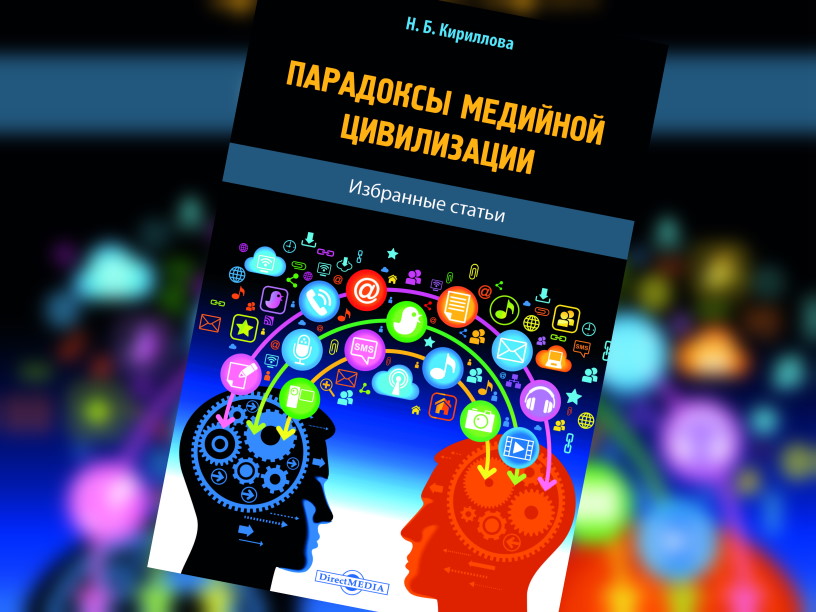
Publishing house "Direct Media" presents the book of Professor of the Ural Federal University Natalia Kirillova "Paradoxes of Medium Civilization. Collection of scientific papers. "
The publication included the author’s chosen articles on the development of the socio-cultural sphere in the era of globalization and the phenomenon of screen culture. The book discusses the paradoxes of the development of media culture as the phenomenon of the information era of the XX - XXI centuries, the influence of new media on the development of modern humanities. The author proves that the culture of the information society not only changed the world around him, but also actively affects public consciousness, on the process of socialization of personality. The publication is intended for teachers, graduate students and humanitarian students, as well as media sphere workers: journalists, film and television specialists, PR managers, political strategists and all those who are interested in research on modern media technologies.
We offer to read an excerpt from the book.
2.1. Mediareal as a new sociocultural human habitat
The scientific and technological progress of the border of the XX-XXI centuries, due to an intensively forming information and communication environment based on the latest digital technologies, has an impact on all spheres of human activity. The media environment (global and local) is a rather complex organism, covering social institutions, public consciousness, spiritual and material culture, economy - everything that surrounds a person, contributing to his socialization. The processes of the study of media are rapidly expanding. The modern medianauca has come a long way-from the study of the history of individual means of communication to modern media culture "as a system of information and communication tools developed by man in the process of cultural and historical development, contributing to the formation of public consciousness and socialization of the individual."
Today, it is obvious that at the turn of the XX - XXI centuries a new direction in cultural studies is born - media, which begins to be justified in theoretical space. We are talking about synthetic humanitarian discipline, which is based on the foundations of cultural studies and semiotics, philosophy and political science, pedagogy and management.
"Reality" and "Mediareal"
The problematic field of mediaology as a new science of the 21st century is primarily associated with the analysis of the ratio of “reality” and “media reality”. Moreover, if reality (lat. Realis is material) is an objectively existing phenomenon, reality itself, that is, a certain being in the form of things (premises, qualities, discrete individuals), then media reality is rather a sociocultural phenomenon. That is why one of the tasks of the science of media is the study of media reality as a new socio-cultural habitat of a person-a parallel, virtual world, often perceived as an objective reality. Mediareal acts as a product and the result of the functioning of media culture, which, in turn, is a component of a modern sociocultural universe. Therefore, in order to determine the conceptual framework of studying the phenomenon of media reality, it is necessary to figure out what specific features underlie the methodology for studying media reality. In the process of mastering a person of the media space, everyday reality is increasingly borrows the features of media reality. In this interaction, there are many issues relating to a person and the world of media reality: "We think in images - images think of us."
The German sociologist N. Luman, representing the system of functioning of the mass media in society, also addresses the problem of media reality. The study of media reality according to Luman is impossible in separation from doubling, which is ensured by the ambivalence of this phenomenon. Firstly, reality or “real reality” is determined by its own operations that media, that is, their functional capabilities to carry out communication that interact with the audience so that it has the opportunity to watch TV shows, films, read newspapers, etc., undoubtedly, this process, as the researcher notes, is “possible only on the basis of technology. Their method of functioning structures and limits what is possible as mass communication. ” The second meaning of media reality is that the proposed images both for the mass media and the audience are quite real. Mediareal is correlated with the reality of virtual. The main properties of media (virtual) reality, which in modern conditions, is not so much technological as a metaphorical nature, consist in the ability to act as a “simulacrum” of reality. Having declared themselves as a system of means of transmitting information, the media is increasingly assigning themselves the function of creating a new socio-cultural environment of a person-a parallel, “virtual” world, often perceived as an objective reality. As the American sociologist M. Castels notes, “reality ... is completely captured, completely immersed in virtual images, into the invented world ...” Thus, modern media culture as a media system creates not only new media reality, but also myths that allow a person to perceive the surrounding reality, thereby influencing the person himself.
A person between reality and media reality
The flow of information that is falling on a person increases exponentially: new television channels, digital photos and cinema appear, Internet sites are replenished, periodicals do not need huge circulations-they have electronic versions, and communication between people has moved to global in scale network channels and honeycomb communications. And we can agree with K. Razlogov that “the information space becomes an intellectual support for the 21st century as a century of humanitarian, social and communicative sciences. Moreover, this trend, which is based on the screen culture, is not limited to the scale of one century. ” The field of culture and education also acquired a media nature: ICT (information and communication technologies) firmly entrenched in the educational process, a powerful network of distance learning was created, “virtual museums”, electronic archives and books were widespread, and the preservation of cultural monuments increasingly occurs in digital format. Nevertheless, the media reality created by man and the whole course of the technical revolution affects the formation of diametrically opposite social, moral, aesthetic norms and values in society. That is why in the pedagogical and scientific environment there are different points of view on the problems of the mass media: on the one hand, they are considered as a source of knowledge, as a factor in the socio-cultural development of personality, on the other, as something destructive, destroying human spiritual potential.
The reality of the modern world is such that computer technology, cellular communications, electronic mail, computer games, multimedia are more and more introduced into the domestic landscape, transforming our reality. It is no accident that the rapid pace of this process gives rise to the opponents of the mass media to talk about “invasion” and “expansion”. The artificially created media reality is nothing more than a communicative system that connects a person with objective reality. Moreover, modern man undoubtedly considers himself a rational being, but his ideas about the world around him, regardless of himself, are clearly a mythological character at the level of “unconscious”. It is this function of the media that distinguishes R. Bart in his book “Mythology”. And the German philosopher N. Bolz believes that “mass media replaces myths as the horizon of the world”, carrying out for us “a preliminary choice of what is.” They do what sociologists call “absorption of uncertainty, thereby producing facts ... It can be concluded that mass media is an industry of reality of modern societies, and often the image in mass media itself is the event that Mass Media reports ... So the world of simplified causal relationships arises.” Thus, it is the QMS that create myths that allow a person to perceive the surrounding reality. But myths create the person himself. The fact is that the “constructing of a person” is nothing more than the process of his socialization, that is, the formation of a worldview, moral orientations, a holistic “picture of the world”. This is one of the main functions of media culture in modern society. And this means that the myth is not just an intermediary between a person and reality. The myth is a kind of control mechanism: he controls a person, penetrating his inner world, the sphere of consciousness and subconscious, “programs” him. The Russian scientist-thermy P. Florensky once noted that man is "a knot of the world of ideal and the real world." However, the media reality, in the space of which a person lives today, can hardly be called "ideal." The fact is that the rapid development of the media industry and the spontaneous, chaotic introduction of a person from a very young age to media products (computer games, television and video films, show programs, video clips, advertising, etc.), oriented, mainly on entertainment and “consumption”, does not contribute to the formation of a personality media culture. Rather, on the contrary. That is why the problems of human and mass media relationships remain debatable. Perhaps the most controversial is the question of what kind of phenomenon is Homo Medium: “One -dimensional person” (as G. Marcuse defined the essence of the personality formed by the technological progress of Western civilization)? Mediaman (by analogy with a book lover, music love, movieman)? A robot is a kind of ICT centaur or an interlocal of a new media reality? .. There is no unequivocal answer to this question. As you know, throughout the history of human civilization, society sought to improve the biological nature of man, improving it spiritually and physically, seeking ways to resolve human relations with an artificially created cultural environment. Cultural norms and values determined the very activity of man and society; Culture has become a truly human way of interacting the individual with the world around us. In fact, all the attempts made by ancient philosophers, to create ideal models of coexistence in the coordinate system “man - nature”, “man - society”, “man - man”, “man - culture”, were reduced to the ideals of harmony, orderliness and proportionality. In the ancient consciousness, culture was associated with education and education, the purpose of which was to create a harmoniously developed in the physical, aesthetic, ethical relationship of the individual. XX century - the century of the technical revolution and the information "explosion". The result of sociocultural development was the emergence of the so-called “mass society”, “mass consciousness” and “mass person”, the essence of which is clearly described in the writings of T. Adorno, G. Marcuse, K. Marton, H. Ortegi-i-Gaset, E. Fromm, M. Horkheimer, etc. The mythological consciousness involves the unification, simplification of the picture of the world, and the regime of the world. Stereotypes of being. If traditional myths tried to explain both reality and the motives of human behavior, then modern myths replace the reality with an artificially created matrix. The question arises: what are the mechanisms of interaction in the semantic triangle “man - media reality - society”? In other words, how is a media person formed? A person, as we noted, forms a sociocultural environment. It is she who is the basis of his socialization and inulture. With this understanding, the individual is both the subject and the object of social relations. As an object, it experiences the impact of the environment, and as a subject - itself affects it. This process is bilateral. As for the media environment, it, of course, can act as a mechanism of directed socialization (through the system of preschool, school and university education). However, the media medium, uniting several macro- (global, national, regional, etc.) and microenred, is more free and chaotic, offering the individual a greater field for self-determination.
So, the virtual mini-medium (cyberspace) today is an important factor in the socio-cultural environment of children, adolescents, youth. On the one hand, it includes interactive educational programs, electronic simulators, multimedia textbooks, etc.; On the other hand, the whole variety of interactive entertainment and services, showing yourself through a variety of computer games, video clips, commercials, television programs, etc. Computer games for any age are the most popular elements of the virtual environment. They include a wide range of electronic games, an instrument, a full -fledged partner and an incorruptible arbiter in which a computer with its wide computational, logical and visual capabilities is. It is the presence of such a highly intellectual partner that gives the data of the games a special attractiveness. The whole variety of computer games can be divided into separate groups along a number of common features. Games are divided by strategy, by the nature of the game action, by the type of object of management, etc. As a result of the hyperactivity of adolescents and youth in the virtual space, a specific type of personality is formed, based on a special communicative culture of “unrealistic” interaction, which provokes changes in the culture of society and deforms the socio-aesthetic appearance of the world in the youth subculture. Socialization in the real world is gradually replaced by the socialization of virtual in the world, which, ultimately, manifests itself in the self -isolation, loss of internal guidelines and social passivity of youth. There is not the slightest doubt that films (film, television, video), television programs, comics, computer games, etc. preach violence and base instincts, that there is a direct connection between a sharp increase in the number of crimes and a new wave of sadistic programs through television channels and on the Internet.
That is why many modern researchers attach great importance to the “ecology of culture” in the screen space, believing that the active sociocultural regulation of the communication system, perception and creativity is necessary. The sociocultural situation in modern Russia makes it possible to understand not only new “virtual” myths that are not adequate to reality, but also the “challenges” of the information era. Virtual reality gives rise to other cultural identities and models of subjectivity - unstable, diffuse. And this puts us all before the task of forming a new identity, new thinking. That is why in Russia, at the turn of the XX - XXI centuries, the most important factor in the socialization of personality is media education, the development of the main directions of which at school and university is an important factor in the socialization of personality. The role of media formation increases in conditions of globalization, when Russia integrates with the Western European community, when a new type of sociality and world order is created. And this proves that cultural studies, which includes mediation today, is a developing science, the capabilities of which are constantly expanding and enriched thanks to those processes that occur in the socio-cultural sphere of the world around us.