
Translated material
Holy Martyr Alexander Sokolov
The persecution of Soviet power to the Russian Church was such that it was not to say about their faith, but even silently follow it as a feat. The new martyrs and confessors, glorified in the face of the saints did not come: believed, prayed and meekly went to their Calvarys.
“Polit.ru” recalls those who gave their lives for faith and by whose prayers the Russian Church is alive - even if almost nothing came to us besides the name.
Publications were prepared by Kirill Kharatyan (included by the Russian authorities in the register of foreign agents).
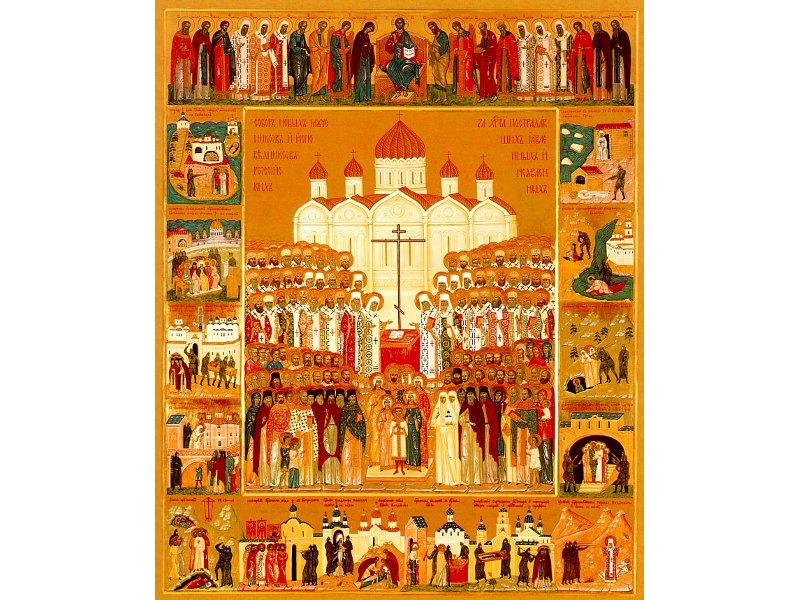
 Icon Cathedral of the Holy New Martyrs and Confessors of Russian
Alexander Sokolov is the son of a priest from the village of Ozerovo of the Tikhvin district of the Novgorod province. In 1915, 22-year-old Alexander Sokolov graduated from the Novgorod Theological Seminary and entered the temple of the village of Ershov, Cherepovets district of the Novgorod province.
In 1916, he was ordained the rank of deacon to the temple of the village of Morotsky, and a year later - in the dignity of a priest to the temple of the village of Ozerov, where his childhood passed, where he took the first skills of church life and piety. In 1924 he was transferred to the temple of the village of Ershova, where he once served as a psalmist.
Immediately, by establishing Soviet power, persecution began on the Russian Orthodox Church. One of the forms in which the persecution was poured was expressed in the demand for the payment of exorbitant taxes and fines, which in the case of Fr. Alexander was so significant that, having no means to pay them, the priest was forced to move with his wife and three young children to another place in 1924, to the Tver region, where he first served in the temples of the Krasno-Kholmsky district, and then in the village of Porechye, Molokovsky district.
Father Alexander gave all his strength and time to his flock. Local authorities forbade prayers in the fields and houses of parishioners to serve, but he, as was adopted before the revolution, regularly went around all the villages of the parish. Seeing his zealous ministry, the flock response to him. Despite the persecution and destruction of the temples, to the fact that the authorities constantly blamed the parish and the priest, the Church in the village of Porechye was repaired whenever the need was. But each time the authorities immediately pursued both the priest and the parishioners.
In 1935, parishioners painted the temple and whitewashed the temple, and sold to the paint remaining from the repair. Immediately after this, the priest and the headman were arrested; The priest was accused of speculation and sentenced to five years of forced labor camps.
In those years, it was sometimes possible if the priest was not accused of a political crime, to prove his innocence. The regional court, where the case fell from the district court, fully justified the priest, and about. Alexander was released. At a time when everything that had any relation to the church was mercilessly destroyed, parishioners about. Alexandra built a new brick fence around the chapel.
At the end of April 1937, the chairman of the village council called to the office of Fr. Alexandra demanded that he pay income tax forward for the next quarter, as well as rent for the land on which the temple and church buildings stood. “Do not waste your strength in vain,” Fr. Alexander, I will not pay, because the term of payments did not fit. ” And having said this, the priest immediately left the village council, not wanting to support an empty and unsafe conversation.
In the summer of 1937, the NKVD employees were notified of the upcoming arrests of the entire clergy and began to collect data about them. Most often, people were called up and confirm anything. One of these told an employee of the NKVD about Fr. Alexandra, as if he doubted the authenticity of the defendants in the open trials, where the accused was too eagerly and smoothly denigrated himself and others, and also that the priest, noting that there were no bread in the district stores, suggested that the local authorities gave excessive figures about productivity, and the central authorities, taking bread in accordance with their needs, decided that they decided that it was bored. The left (in accordance with the numbers) will be enough, and refused the area to supply flour and grain.
There was nothing to blame the priest for, and the informant decided to bring a joke, as if told by the priest: “From one provincial Karelian area, the peasants sent their fellow villager to the chairman of the All -Russian Central Executive Committee Comrade Kalinin to find out why they are now taking accelerated pace in all. At the time when this peasant came to the All -Russian Central Executive Committee with his puzzled issue, Kalinin was very busy, he led the man to one window and, pointing to the tram passing along the street, said: “I saw, and after five years there will be hundreds!” Then he led the man to another window, where the passing car was visible, and said: “You see, and in five years there will be thousands of them!” A man left for the village, and when he began to ask about the results of the trip, he applied exactly the same way of explaining. First I looked out the window, where I saw that they were carrying the deceased on the street, and said: “See, and after five years they will be carried hundreds!” Then, going to the second window, he saw - there was a beggar, and also, turning to those present, said: “See, and after five years there will be thousands of them!”
July 1937 came. Information about the arrests of clergymen began to come. It became clear to his father Alexander that he would be arrested, after which the temple would be subjected to blasphemous plunder. And he folded the spare Eucharistic set in a Camilavka and hid in the attic of the temple. He also laid a trunk cross, a gift -guard and a lice.
On July 27, 1937, the NKVD employees arrested the priest and entered into the Krasnokholm prison. They interrogated in three days. The investigator asked what the priest was doing before and after the revolution. Father Alexander replied that before the revolution he was engaged exclusively with pastoral activities, and after the revolution he had to acquire a small economy. Times were hungry, and the subsidiary farm became help, especially since there was a family in the hands, two sons and a daughter, everyone was born after the revolution, a daughter in 1924. The farm was small: a house, a barn, a barn, a threshed, a bathhouse, one horse, two cows, five acres of land. In 1929, the priest was given an overwhelming task for the delivery of agricultural products, and for non -compliance his economy was described and requisitioned.
The village council, as usual, issued a certificate, which said the need to arrest the priest, since he “attracted a backward population to his side” and without registration at the registry office was a funeral from the dead. “We consider him a socially dangerous person for the local population who deserves expulsions from local limits,” wrote the chairman of the village council.
On August 10, the investigator again interrogated the priest.
- When and what views did you express in connection with the process over the Trotskyists led by Pyatakov?
“I was interested in this process and read about it,” the priest answered. -From what I read, I had some kind of disbelief in his reality, I was surprised by the fact that all the defendants somehow even boasted with their counter-revolutionary actions, and I considered all this unnatural ... these views, as far as I remember, I did not share with anyone, with the exception of my family.
- When and what views did you express in connection with difficulties with bread?
- The difficulties created in our area with bread, since they did not let me go in cooperation, I personally regarded the presence of wrecking in the Soviet regime and the creation of this deliberately leaders. On the other hand, my opinion was folded that peasants are poorly treated with land, and therefore difficulties were created. I did not share my views with anyone.
- Tell us when and to whom you told how the peasant visited the chairman of the All -Russian Central Executive Committee, Comrade Kalinin, and what was their conversation about the pace.
-The year in 1935, and maybe in 1934, I don’t remember exactly, I walked along the village of Porechye and the drunken man who met me near the Kazenka began to tell something about the pace, but I did not listen to him and left, I personally did not tell anyone about the conversations of comrade Kalinin and the peasant.
- What was your initiative in the construction of the fence around the chapel in the village of Stepankovo?
- In the village of Stepankovo, I visited very often, because in this village a church headman lives, to whom I often had to go to church needs, but I did not show initiatives in the construction of a fence at the chapel, on whose initiative the construction of the fence took place, I do not know.
The interrogation was over.
On August 25, the Troika of the NKVD sentenced Fr. Alexander to death.
Priest Alexander Sokolov was shot on August 29, 1937.