
Translated material
The head of the Ruskeala Park - about the season 2020
Due to the pandemic this year, the Ruskeala Mountain Park opened for visitors from June 1. At the same time, the flow of tourists in the summer months was equal to the indicators with the spring-summer seasons of past years.
“Paper” spoke with the general director of the Kolmas company managing park Alexander Artemyev about how Ruskeala coped with the summer flow of tourists, with what problems the park faced immediately after removing restrictions and how the tourist complex will change in the next three years.
Alexander Artemyev
General Director of the Kolmas Management Park company
How the Pandem of Coronavirus influenced the park
- At first, the pandemic greatly influenced morally. We worried that we would not reach the planned indicators, and a financial plan will not be implemented - there will be no development of the park. But nothing.
Ruskeal was closed from March to June 1. The company (we are talking about the managing company of the Kolmas park - approx. “Papers” ), of course, spent a large amount on payments of all wages, payment of electricity, and so on, but from June, when the first stream of tourists went, we realized that, apparently, everything would return to our circles.
There were more guests than we planned. For July and August, the park visited the same number of guests as before it came from May to August. That is, everything was compensated by a large number of visitors at once. But our service suffered from this. It was difficult to work with high quality, because the guests came and demanded services, but we could not provide them.
When the season begins from the end of April, then in May-June it has grown and slowly unwinds a ball of service itself. We collect additional staff, purchase auxiliary equipment, rent transport. And this summer we had nothing of this.
We thought that this year everything would go as it went. But when the park was sharply opened, everything changed within a week and a half - everyone needed everything at once. And we could not fill the infrastructure by either personnel or equipment. And therefore, unfortunately, it did not work out to provide high -quality service. But the plus is that even so for many Russians we discovered part of Karelia.
The absence of foreigners on the flow of tourists did not affect. The only border service that we also have: a cafe, a shopping center (Cafe Kolmas in the border point “Vyartsil-Niyrala”-approx. “Papers” )-is now closed, unfortunately, because there is no one to work for.
How the self -isolation regime affected the economy of the park
- The park has not yet returned the losses from March to June, but we are approaching this. So to say, the critical feature is passed. Now we understand that without consequences we enter the offseason: we can completely pay the salary to employees and plan new services for the next spring.
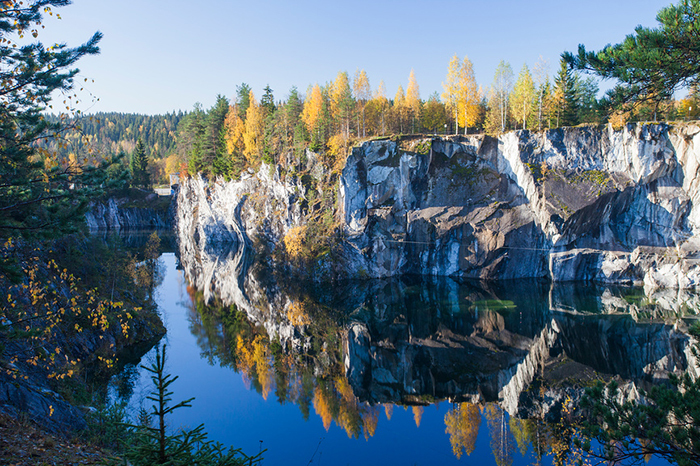
Now a decline in tourists is already felt, a week and a half as guests fewer. But I think that in winter they will go again, as the snow will fall out. The park then looks completely different, we turn on the artistic backlight on the rocks.
It didn’t reach the dismissal, but the situation was shaky. The first month we paid the minimum salary - 12,300 rubles, and I realized that the labor exchange pays the same amount. To keep the workers, we began to pay 21,000 rubles. And thus stopped the departure of professionals. It is a pity to lose people who worked a lot, some for 10-15 years, so we went for additional costs.
All that the authorities promised was paid. We received salary and support loans. I can’t complain about it.
How the Ruskeala Park developed
- I trusted my friend and friend (local historian Andrei Gribushin - approx. "Papers" ) And he believed in the idea of the park. And when we undertook to work out, I realized that this is a great project for a long time. And, perhaps, there will be a return; At least we put the territory in order - already a big plus. And when we cleared everything, made paths, paths and viewing platforms, we got gratitude from people.
Since this deposit, a lot of time was taking specialists and commissions. They checked our plans and opportunities. The most important thing was to obtain permission for work and recognition of the field unsuitable for production. It took more than three years.
The deposit was recognized as unsuitable in 1998. Marble there was mined by a drilling way, which led to the appearance of microcracks in marble blocks and made it impossible to use them. Here we have already connected: we cleaned, showed how this place might look.
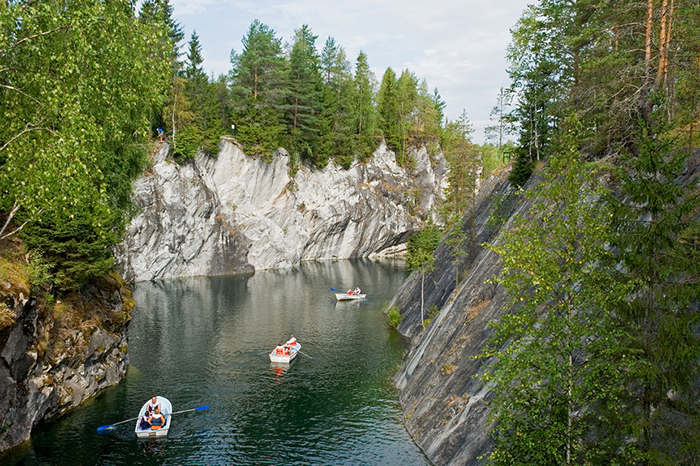
When we cleared the surface, we realized that the flooded quarry was also unusable for the show - there were points with fuel oil, cabin. And what was on the surface, we lifted with cranes and took it to a landfill, and when we started cleaning under water, divers were already connected there - we lifted garbage from the bottom. In parallel with these works, we just received permission, that is, we did everything at our own peril and risk.
The cost of building a park has not yet been recording. We immediately put the received income again back into the park. All our cafes, restaurants and hotels - all profit goes to development. And in the near future it will continue.
In general, the costs are large. Only the Underground Ruskeala project (an underground route through artificial caves created for the extraction of marble - approx. "Papers" ) cost 57 million rubles - cleaning, safety, lighting, pontoral paths. We traveled to other caves and adits (horizontal or slightly inclined underground mining with access to the surface - approx. “Papers”) , watched how they are used abroad. Is it possible to go down there at all.
It took a lot of time and money. We worked on this project along with the Russian Geographical Society. They helped us with equipment and specialists free of charge. Otherwise, the costs would be even more.
How "Ruskeala" will change in the next three years
- Before the New Year, the Museum of Mining is being surrendered. In it we will talk about people working in the extraction of marble, and how they did it.
The plans include the local history museum. Its main theme is the combination of different cultures here in Karelia. For example, at the command of Catherine II, entire villages were forcibly transported here from Siberia to work with the masters of the stone affairs. And they were assimilated. Also, there were constantly wars between Russia, Finland and Sweden. In the museum we will show how it all happened.
We see that there is a need for an educational format, and we will prepare places for training. Thus, there will be educational, tourist and cultural formats. And the most important thing is food. Fish, Karelian pies, gate - we will explain everything to our guests and show. Multifunctional centers will be earned in the park so that people not only plunged into history, but also ate, drink, rest. Such a task is standing for the next three years.