
Translated material
The fifth element of health
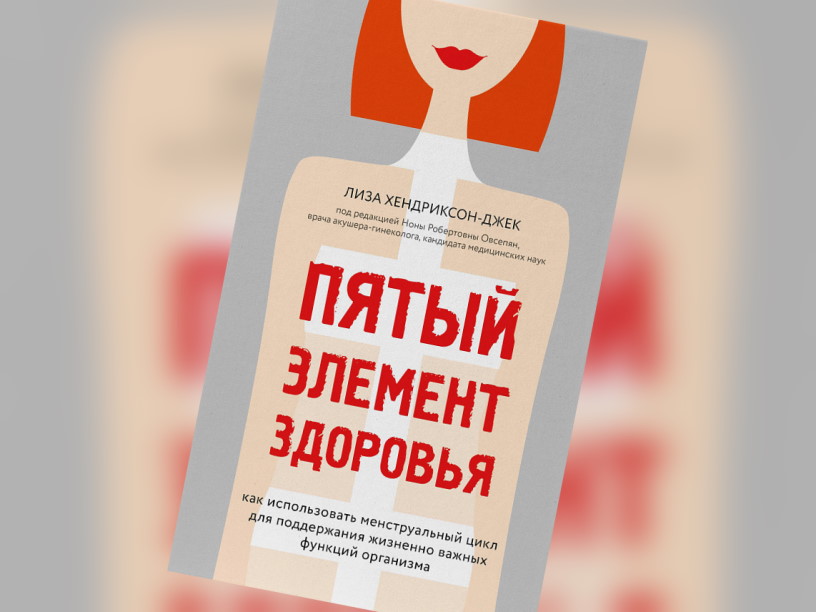
The Bombbor publishing house represents the book of Lisa Hendrickson-Jack “The Fifth Elepe of Health. How to use the menstrual cycle to maintain vital functions of the body ”(translation by D.V. Khakhaleva).
Everyone, even without being a doctor, knows that the pulse, body temperature, breathing and pressure give almost exhaustive information about the state of the body. “Almost” - because women have a fifth health indicator, which, unfortunately, still few people pay attention to - this is the menstrual cycle. Short or long, regular or unpredictable - the cycle can be very different, and each of its parameter, each change serves as an indicator of a particular problem in the body. Many “female” symptoms that are perceived for granted are actually far from normal and may even indicate the presence of chronic diseases.
We offer to read an excerpt from the book.
Have you ever told you that the menstrual cycle is an important health parameter? Exactly the same as a pulse, body temperature, respiratory rate and blood pressure. The cycle is one of the key indicators of how well your body works. If he does not cope, then the cycle fails.
Both the American Academy of Pediatrics (AAR), and the American College of Obstetrics and Gynecology (ACAG) unanimously believe that menstruation is one of the main things that teenage girls should pay attention to. According to the AAR, when the girl begins to menstruation, the assessment of her cycle should become one of the important components during the comprehensive diagnosis. Doctors emphasize that, along with other indicators, menstruation reflect the general state of health.
The menstrual cycle begins on the first day of menstruation and ends on the last day before the start of a new menstruation. Although critical days are often discussed in the media, this is not the main event of the cycle. The most important thing is ovulation, and menstruation can be considered full only after it has taken place.
Ovulation pays special attention when it comes to the reproductive system. However, regular ovulation is possible only if both the endocrine and reproductive systems function properly. The wrong or irregular cycle is the first alarming call signaling some health problem. Have you noticed how sometimes the phone is buggy? Your cycle can also start junk, if there are certain reasons. Problems can be different: delayed ovulation, bloody discharge in the middle of the cycle, pathology of the cervical mucosa, irregular periods or even amenorrhea (in this case, menstruation does not come at all). Therefore, the menstrual cycle (with regular ovulation) is the fifth key indicator of health and fertility.
What is a key indicator of health?
A key indicator of health is a parameter that can be measured to understand how your organs function. The four most famous health indicators are pulse, body temperature, respiratory rate (i.e., inhale-output) and blood pressure.
When doctors measure these indicators, they compare the results obtained with average normal values. High pressure may indicate malfunctions in the work of the cardiovascular system, and an elevated temperature-the presence of infection in the body. When you recover, these data are used to monitor improvements. Having measured these parameters, your therapist receives a full -fledged picture of the state of health. It allows him to see disturbing signs that indicate a problem that has become the root cause of a particular disease.
One of my colleagues, Doctor of Medicine Margarita Duan, said a very correct thing: “Just like doctors learn to read electrocardiograms and experts in the field of female health can draw certain conclusions after the analysis of the menstrual cycle graphics.” An electrocardiogram (ECG) is a study that shows the activity of your heart. It allows you to determine the frequency and rhythm of the heartbeat and find problems. The doctor can say that it’s wrong with your ECG. An experienced women's health specialist can determine anomalies in your cycle after analyzing the corresponding diagram.
In the same way as in the case of four key indicators described above, there is a clear set of parameters that will help to determine if everything is in order with your cycle and whether it falls under the criteria of the norm (see chapter 4). When you begin to study your cycle (according to a special schedule), you can notice even the smallest changes. They occur when you consume certain products, drink alcohol, travel or change sleep mode. If there are serious health problems, you may have significant cycle disorders.
Why do you need to study the fifth health indicator
Many of us have been accustomed to the idea that you can get pregnant on any day of the cycle, because there are no safe days. This is not true. Ovulation occurs only one day, and as soon as the egg is released, it, if it is not fertilized, is destroyed. However, cervical mucus appears before ovulation and stretches this one -day fertile window to six days of the cycle (approximately). This comes from the fact that sperm can live in cervical mucus for up to five days. Outside of this window, pregnancy cannot occur.
The woman’s body produces cervical mucus in the days preceding ovulation. At this time, estrogen level rises. If the amount of estrogen does not grow, little mucus is produced or it is not produced at all (dry days). Analysis of cyclic changes in the production of mucus allows you to develop a base for the most accurate methods for determining the days when it is possible and impossible to get pregnant. If you use this method correctly, it with a probability of 99.4 % will protect you from unwanted pregnancy (see chapter 5). In other words, synthetic hormones are not the only possible way of contraception. To understand the principle of mucus production means to understand the fertility in general, to evaluate the value of ovulation, as well as to predict at the household level when menstruation begins. Many women (including me) experience some anger and disappointment from the fact that they were not told about all this during the period of growing up.
Awareness of fertility (OF) is a general term that describes how well a woman understands her menstrual cycle and knows how to recognize the fertile signs that her body sends. OF applies not only to birth control.
If you use PF to protect yourself from unwanted pregnancy, you need to learn how to notice and fix special fertile signs. There are also certain rules that will help you correctly install a fertile window (chapter 10). When you learn to understand and interpret these signs, a new world will open before you. You can naturally protect yourself from pregnancy, increase the chances of conception, monitor the general state of health and just feel all the benefits that regular ovulation will bring to your body.
I hate love my menstruation
Now I love and appreciate my menstruation. True, in order to come to this, I had to reprogram my brain. Perhaps you grew up with the realization that the days are critical - something bad and dirty. The idea that a woman is made unclean during menstruation is found in many religious teachings. There are still rites in which a woman cannot take part during menstruation, and a place where she cannot go. According to various religious prescriptions, at this time you can not deal with some everyday things, for example, prepare or set on the table.
All this does not pass without a trace. One woman once told me that if she had a magic wand, in an instant she would “be freed from the oppression to be a woman.”
Many doctors do not think that a woman physically needs to have regular menstruation. They suggest that in the society of hunters-gatherers among women, menstruation was less common (possibly due to more frequent pregnancies, a shorter life expectancy and/or more frequent diseases and hunger), and assure that it would also be useful for modern women to have menstruation. However, due to the fact that most modern women do not plan to be in a semi -intake state of pregnancy, these practices lead only to suppressing the menstrual cycle using the constant use of hormonal contraceptives. This model is becoming more and more common, and I am sorry why so many women literally become in line to temporarily “cure themselves” from fertility.
Hormonal contraceptives (Civil Code) became ubiquitous, so most women do not even perceive them as a medicine. I attribute all the ways of hormonal contraception to the category of the Civil Code: tablets, injections, implants, rings, patching and hormonal intrauterine spirals. Although all of the above methods have their differences, the general threat that comes from them is the introduction of artificial hormones into your blood. The Civil Code is mixed with natural sex hormones, which leads to small or large malfunctions in the endocrine system. At the molecular level, hormones in the Civil Code are completely different from estrogen and progesterone that our body produces (see the figure 1–1 and 1–2).
Figure 1–1. Synthetic and natural estrogen.
Estradiol is one of the natural estrogen, which is produced by the body. Compare with ethinyl estradiol, synthetic version of estrogen, so often used in the Civil Code. Pay attention to the difference in the chemical structure (circled)
Figure 1-2. Synthetic and natural progesterone.
Progesterone is a natural hormone that is produced by the body. Levonorgestrel is one of the synthetic versions of progesterone, which is often used in the Civil Code. Pay attention to the differences in the chemical structure (circled)
The Civil Code became the first medicine that was developed with the aim of stopping a completely normal and natural process in your body (see chapter 7). With this approach, fertility is regarded as a disease that needs treatment. The Civil Code allows you to set the time for menstruation, pass them when they fall out for an uncomfortable time, and in some cases completely abandon them. You will never have to think when the periods come, because they will begin strictly at a certain time. Rain or the sun, stress or rest, power impairment, dysfunction of the endocrine system - all this does not matter, your fake menstruation will come in 28 days. For comparison: the natural cycle can vary depending on the month. It depends on stress, diseases and other factors associated with the way of life.
Indeed, monthly menstruation is bored, but this is a normal and natural part of a woman’s life. The idea that they can be suppressed by hormones for years and this will pass without a trace for health is not only false, but also dangerous. It’s not always easy to accept your cycle, especially if it causes inconvenience, but I suggest you look at it as a key indicator - an important health parameter.
Gloria Stein in his essay “If men had menstruation” describes the adultery picture: men have menstruation, and they rejoice at this fact. Here is a little endurance:
“What will happen if suddenly, the men’s, but women do not have a magical way?
The answer is clear - menstruation will immediately become worthy of envy and a great sign of real masculinity.
Men will compare and argue who has a longer and stronger critical days. Boys will celebrate the first menstruation and boast of them. Of course, religious rites will exist in culture specifically for this case. At worst, they will arrange family parties ...
Hygiene products will be financed from the budget and spread free as part of medical insurance ... On TV, they will openly discuss this issue ... as well as in newspapers and films. ”
Agree, it would be wonderful if women also treated their menstruation!
Maybe now you do not like your critical days, but when you finish reading the book, you will understand that you are doing so in vain. In the end, can there be something more natural? Each person on Earth lives here because his or her mother came out of menstrual blood. The role of menstruation is very important, because if women did not have them, there would be no subsequent generations of people.