
Translated material
Non -border about not anyway
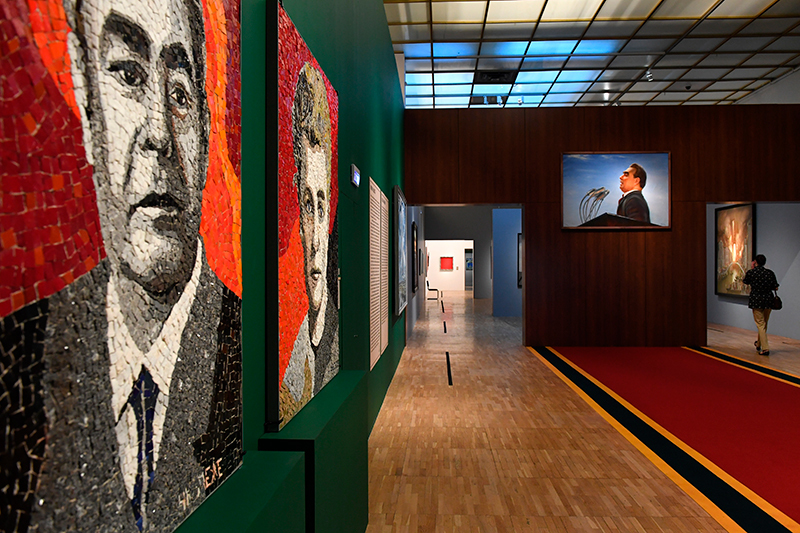
I.
As you know, recently, the International Council of Museums (Icoma) recorded that already accomplished in institutional practice, proposing to reduce the function of the museum, shifting the emphasis “from the objects of the museum as a public institution” . In this regard, it is interesting to return to the issue provoked by the exhibition “Non -Wort” and causing a wide controversy - is it appropriate to exhibit “bad” art in museums.
Of course, the Tretyakov Gallery in its position is fundamentally different from the three -digit number of other Moscow galleries and, opening the way to its halls to one or another artists and works, bears “responsibility to history”. On the other hand, if you move in the designated line and understand the museum as a space not only of the history of art, but also the history of culture, if we are not talking about a constant exposition, but about the exhibition, then the answer is definitely possible to exhibit “bad” art. Moreover, with this kind of problematization, in fact, the curatorial work begins, this differs from work on “distilled” anthology.
However, a positive answer to this preliminary question in itself does not predetermine the success or failure of a particular exhibition (I will not go deeper into the fact that in the history of art failure is not anyway and often it turns into success). I perceive the new Tretyakov Gallery as a pronounced SITE-SPECIC space. Moreover, it is not only about the faceless halls of the Central House of Artists, which are extremely suitable and accustomed to the exposition of the “official” art of the era of stagnation (returning “to the native harbor” on the eve of reconstruction). The specifics of this space are his public and its accumulated associations with the name of the Tretyakov Gallery. So, the conditional visitor of the “complex” exhibitions “Garage” ( AKA Exhibition Lifshits) or VAC ( AKA “General Rehearsal”) has a kind of “vaccination” of eliminated critical perception. At worst, the audience perceives such exhibitions as something experimental, but “Instagram” ( AKA Yoko it). But in the new Tretyakov Gallery, the largest queues are not at all on the “gift of Marat”, but on the “proven classics in the trusted museum” - on Vereshchagin, Repin and Polenov. And specifically these days, visitors to “Non -West” - these are also people who will come to the Russian Tale exhibition with the subtitle “Adventure for the whole family”.
I will assume that a considerable part of the visitors will perceive the art of literally (maybe, having made a small discount on officialdom in the very first, Brezhnevsky, hall). And “bad” they can declare the part of the exhibits that professionals - participants in the unfolding polemic consider “good”. And they literally repeat the ironic question voiced in the FB Batals : "Where is the Maestro Glazunov?" “But only filling it with sincere bewilderment.”
Not a museum at all, but the Tretyakov Gallery has the property of Midas - Duchan: to turn everything exhibited into “good” art. And here a key question arises - the question of commentary. Many can reproach the exhibited work for a lot (probably the meaning of the exhibition), but the exposition as such can be reproached with that it is not enough “imposes the discussion of the party” - so to speak, the “popular front” of the general public. The division in the plot-thematic halls and relatively small wall comments only open the topic, and the necessary discussion is “hidden” in the public program, paid audio guide and hardly very popular excursions after the pandemic.
II.
The issues raised by the exhibition “Nonsense” are valid not only for visual, but, perhaps, for any art of stagnation. Music is no exception, but a vivid example of autonomous coexistence and partial interaction of different conceptual aesthetic fields.
The era of half-life of the Soviet Union in music was characterized by a half-censorship-the works of composers of the famous “Khrennikovskaya seven” (Elena Firsova, Dmitry Smirnov, Alexander Knaifel, Victor Suslin, Vyacheslav Artemov, Sofia Gubaidulin, Edison Denisov) were rather ignored by official culture, but still not total. The orchestral programs of the Gennady Rozhdestvensky, the Moscow Youth Composer Club Grigory Frida, separate concerts of the Moscow Autumn festival, which appeared on the end of the stagnation, visits to Moscow Bouleza and Cage are exceptions that do not refute the rule, but still illustrating the presence of certain “fortels” in it.
One of the most striking examples of the notorious “half-” is the semi-official status in the Moscow Conservatory of Edison Denisov. The founder of the brightest composer school of the turn of the XX - XXI centuries - no - could not have his own official class of composition, but - yes - he was a full -time teacher and led individual tools for instrumentation (where, in fact, he could engage in the composition with all those who wish).
The division of composers of that era into “official socialists” and “avant -garde non -conformists”, despite the quotes and the required clarifications in each of these definitions, is generally quite unconditional. But it is just as unconditional that this division (at least in music) cannot be absolute - there are almost no “pure” cases, especially if we talk about the early periods of creativity. Even the most uncompromising avant -garde, who developed the ideas and principles of the Novovensky school, Nikolai Karetnikov wrote more conventional music under 30 years old and was “officially” recognized (his ballets “Geologists” and “Vanina Vanini” and the oratorio “Julius Fuchik” were put in the Bolshoi Theater). On the other hand, Rodion Shchedrin, who later became a more traditional composer, acted as a completely avant-garde author (the second symphony, the second piano concert in the mid-1960s , and in the first concert he acted almost as the main successor of Stravinsky’s ideas).
There was a “third path” traditional for Russia, equally far from officialdom and avant -garde, presented, for example, in the work of Nikolai Sidelnikov - in particular, in his neo -folklore opuses: “Conversations”, “Russian fairy tales” (there were, however, other versions of the “third path”). Of course, there is also a “special way” of Vladimir Martynov, who proclaimed the end of musical history after Francis Fukuyama-at least in her composer-sentiment format. However, the course of history and the development of composer music so far show the prematureness of these statements, and Fukuyama has already recognized his mistake.
Given all this “flowering complexity”, the ensemble “Studio of New Music”, being an undoubted adherent of the avant- garde of that era, tried to avoid the hard division of music into “TU” and “this” and “this” and focus on gradations in the classroom. We deliberately included those works of “traditionalists” that can be attributed to the number of obvious artistic successes, and those works of composers of the Soviet underground, in which new areas of searches of their authors are planned. Yes, and the tough sounding name “non -border”, in essence, already in itself thematizes swell. The appeal to “traditional” late -Soviet music turned out to be paradoxically innovative for us - some of the composers who entered the program were not performed by the “new music studio” for the 27 years of the existence of the ensemble.
III.
It is hardly many Soviet censors (at least until the late Brezhnev period) thought themselves with the brakes of history-on the contrary, the project of Soviet utopia and the censorship authorities generated by them were very seriously striving for, and then declared the desire for a wonderful future (as the aforementioned ex-Politechnologist Marat Gelman would say, “happiness is not beyond the mountains”-but for some reason all the time all the time all the time. Rushes along with the horizon).
Any times are not anyway . But the principles are eternal. And sometimes those who believe in their progressiveness and a special mission are involuntarily in the actual brake of development. And the point is not that, for example, to almost all arts and the cultural media of the Apshicant type of concert statement about the “Non-West” turned out to be obviously uninteresting (although this is also quite curious, albeit not too amazing, precedent). But the fact that most of the co -products of musicians and artists today find themselves purely external, when the parties sometimes do not want (I would not want to believe that they cannot) understand each other's creative motivations. And partners for interaction are more often chosen not so much on substantive aspects-for which it would be necessary to study the landscape of another type of art in more detail-how much on the principle of a more or less accidental acquaintance. As a result, in many, it seems that interdisciplinary projects there is an imposition of two layers that are not always suitable for each other; However, their diffusion often does not occur.
But the criterion of a successful dialogue is not its formal presence, but still its quality. Today there is a feeling that the culture of discussion has left not only from the parliament, but also from the creative environment that could develop its language. In other words, in fact, we censify ourselves: artists are musicians, and musicians are artists. And all together we are depriving our potential substantive dialogs and truly breakthrough projects. It seems to me that this is a new type of stagnation-intensively seething stagnation inside an intense drill-resistant era.
... As a teacher of criticism at the Moscow Conservatory, I usually tell students that you should not end the article with the words “I want to hope” and “generally”. In general, I would like to hope that this situation is non -border and not outward.