
Translated material
Belarus 2020 and Peru 2000
Around Russia
 Belarus 2020 and Peru 2000
September 25, 2020 Valentin Mikhailov

Countries with an authoritarian regime in their place on the map and cultural traditions can be different, but their fate can be described in the same words. Draw parallels.
PERU. Thirty years ago, in April 1990, in the first round of presidential elections, Peru Alberto Fuhimory, a little -known rector of the Agrarian University, surprised many. He unexpectedly took the second place, losing a bit of Mario to Vargas Llos, the most famous writer of the country, the future Nobel laureate in literature (2010), who in 1975 was elected president of the international Pen club and which the elite of the country simply adored. 1990 was the year of an acute crisis. The Peruvian economy fell into hyperinflation, and the terrorist Maoist organization “The Sudent Way” expanded its control over the rural regions, approaching Lima, the capital of the country. Liasa advocated the radical transformation of the Peruvian economy, for the transition to a free market, to the policy of rigid economy and the speedy privatization of state assets. He could have done for his country what Balcerovich did for Poland. But most of the Peruvians liked the populist slogans of Fuhimory. “The president is the same as you,” he spoke about himself and easily won the second round: 62 versus 37 percent.
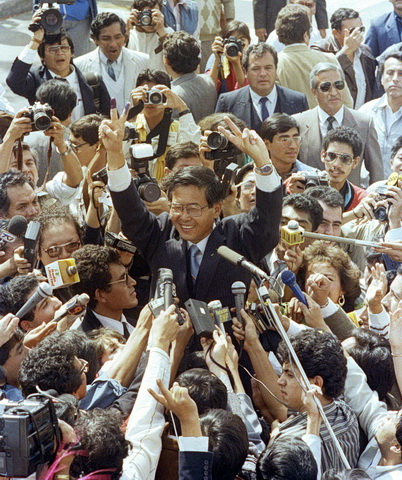
Then Peru was a republic with a multi -party parliament (Congress) and a regularly elected president. Without support in parliament and courts, Fuhimory immediately entered into confrontation with them, began to crush them. Instead of negotiations with the leaders of Congress, he pounced on them with abuse and humiliated them. He began to go around the congress, increasingly resorting to the publication of his decrees instead of adopting laws. The Constitution of Peru was too tough for him and limiting. During the confrontation with the terrorists, Fuhimory made decisions bypassing the courts and was accused by the Association of Judges of "unacceptable anti -democratic authoritarianism." The conflict with Congress deepened, and on April 5, 1992, Fuhimory dismissed the parliament and canceled the constitution.
New elections provided him with the majority of their new party. Fuchimori secured his unlimited power in the new Constitution, adopted at the referendum in October 1993. Despite the usurpation of power by the President and numerous human rights violations, including murders, the people of Peru supported Fuhimory. The basis of its popularity was the rapid growth of the economy, successes in relations with neighboring states and in the fight against Maoists. Their leader Abimael Gusman (peer Fuhimory!) Was arrested and sentenced to life imprisonment.
In 1996, Congress controlled by the President adopted a law that allowed Fuhimory to run for a third term. Reforms began to stretch out, and his rating began to fall. But in 2000, he nominated his candidacy for the third term. On May 28, he won the second round, but the first tour was marked by accusations of unconstitutionality, corruption, inequality of participants and direct falsifications of voting.
The main rival of Fuhimory Alejandro Toledo withdrew his candidacy, protesting against the lack of a reaction to violations of the courts. The inauguration of Fuhimory took place on July 28, but the next months were filled with protest manifestations, exposure to intelligence service, led by Vladimir Montesinos, corruption scandals. In November, Fuhimori lost to the requirements and agreed to hold new elections in 2001. And also pledged not to take part in them. But soon his party lost the majority in Congress, and during an international trip he disappeared, then appearing in Tokyo, where he announced his resignation and asked for citizenship of Japan.
The new speaker of the parliament Valentin Paniagua was appointed acting President Peru, and in May 2001, Alexander Toledo won in the general elections, who stayed for a full time until 2006.
BELARUS. Twenty -six years ago, in June 1994, in the first round of the elections of the President of the Republic of Belarus, the victory was unexpectedly won by Alexander Lukashenko, the director of the Gorodets state farm of the Shklovsky district of the Mogilev region and the active deputy of the Supreme Council of the republic. He received 48.8% of the vote and went to the second round with Prime Minister Vyacheslav Kebich (17.4%).
In January of the same year, the Supreme Council adopted a resolution on the review of the chairman of the Armed Forces Stanislav Shushkevich. The project of this resolution, with the support of the government lobby in parliament, wrote three young deputies: Alexander Lukashenko, Victor Gonchar and Dmitry Bulakhov. Soon, the post of president of the Republic of Belarus was established, and, as expected, Kebich was supposed to win in the upcoming elections. But these expectations could not come true. Lukashenko won a slight victory. In the second round, he gained 80.3 percent of the vote.
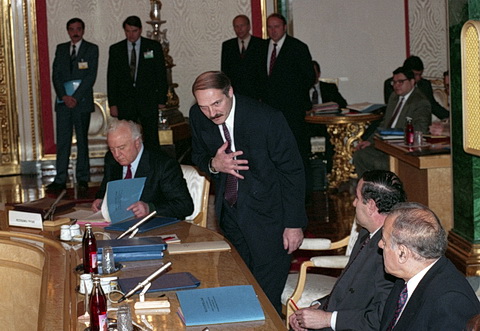
The president of the lower classes, who did not enter the political elite, like Fuhimory began to "tighten the nuts." Censorship intensified. In 1995-1996, a strict confrontation of the Supreme Council and the President was felt. In the first year, the president held a referendum in which the Russian language received the status of the second state language, and the president received the right to dissolve the Sun. The opposition in parliament was still alive in the summer of 1996. 70 deputies spoke out for impeachment of the president. But in a referendum in November of the same year, Lukashenko “rely” his term as president, received more authority, including dissolution of the aircraft. With this right, he immediately took advantage of and dismissed the Armed Forces of the 13th convocation, which worked for only ten months.
The persecution of independent press and famous oppositionists began. After public calls to deal with the opposition in 1999-2002, three oppositionists disappeared, including colleague Lukashenko on the Supreme Council, the former chairman of his election headquarters, chairman of the CEC V. Gonchar, who actively opposed Lukashenko before the 1996 referendum. He refused to recognize the results of the referendum and was replaced by Lydia Ermoshina, who holds the post of chairman of the CEC to the present. She handed Lukashenko at a closed ceremony on September 23, the presidential certificate. The potter was a bright charismatic politician, a professional lawyer, a beautiful person who had many fans. It was he who could become a strong presidential candidate in the 2001 elections.
There are indications that, together with his friend Anatoly Krasovsky, he was abducted and killed by the Sobrom of the internal troops of the Ministry of Internal Affairs. In the same year, Yuri Zakharenko, Major General, former Minister of Internal Affairs of the Republic of Belarus, who went into the opposition to Lukashenko, disappeared.
This time has become a turning point in the political life of the republic. The opposition in parliament has disappeared. Political parties exist, but are practically not represented in parliament. In the five elections of the president after 2001, Lukashenko supposedly received from 76 to 83 percent. Presidential candidates are being erected by insurmountable barriers, some are imprisoned. In 2004, the referendum adopted an amendment to the Constitution, which removes the restriction of the number of presidential terms for one person. The opposition was suppressed physically during the dispersal of rallies and through court sentences. There are typical signs of an authoritarian, dictatorial regime of power.
General. In different countries as Belarus and Peru, it is easy to find a lot in common in the fate and characters of the two authoritarian rulers of Fuhimory and Lukashenko. Both are little -known, far from politics, people shortly before their victory in the elections. The formation of both leaves much to be desired. Both were elected in democratic elections, the results of which were not disputed by anyone. They opposed the candidates who supported the political elite (Llos and Kebich), but the people supported them. Both did not accept the rules of democratic rule and immediately began to put pressure on the courts and parliaments, to make them manual.
Both had critical periods with whom they coped, addressing the people and contrasting themselves with parliament. Both conducted referenda to expand their powers. There is one fuhimory, Lukashenko - as many as three. The deadlines for the establishment of hard authoritarian government in both cases were similar-2-3 years.
Both through referenda extended their terms in power in excess of the constitutions. By the end of their activities, both had a very low rating.
Both are involved in falsification of the elections. Both are accused of destroying rivals - opposition candidates, in the case of Fuhimory, this was proved by the court. The trial of Lukashenko has yet to do.
Miscellaneous. The dictatorship of Fuhimory lasted much less than the dictatorship of Lukashenko. The difference should be sought not in their personal qualities, but in the history of these countries, in the customs and culture of the peoples of these countries, in the rooted of political institutions of democracy.
In 1980, after the twelve -year -old reign of the military junta, the competitive democratic elections of President Peru took place. Before the victory of Fuhimory, the country was ruled by two presidents, the term of the board of each was five years. Then, and later, several political parties took part in all the Peruvian elections of the President and Congress, some with a half -century history. The institutions of democracy were very developed in the country, so Fuhimory, despite all efforts, could not completely subjugate the parliament. The opposition always had its representatives in it.
In the parliament, elected in 1995-during the period of the greatest popularity of Fuhimory-his Kambio 90 party had 67 out of 120 seats, and in 2000, his new Peru 2000 party received 52 out of 120. Then his opponent in the presidential election, Toledo, received 40.2 % of the vote in the first round, which forced the second round. Toledo appeared in politics not as unexpectedly as Fuhimory: he was a presidential candidate and in previous elections. His party “Possible Peru Posible”, founded in 1994, received 29 out of 120 seats in the congress and formed the second largest faction. Toledo actively participated in long protests, which ultimately led to the offset of the president. In the preparation of the transit of power, the parliament played a major role. He appointed acting President and new elections for April 2001. In short, the parliamentary opposition was suppressed in Peru, but never disappeared. For all the tyranny of Fuhimory, there were no such fantastic falsifications in the elections as in Belarus.
The experience of democratic development in Belarus at the arrival of Lukashenko was much more modest, and with his arrival he was completely destroyed. For the past two decades, the power in Belarus had features of a single -party system of the USSR without opposition in parliament, and not an electoral authoritarian system - such as a pen with Fuhimory.

In 2000. In the first round, the ratio was 49.9 (Fuhimory) and 40, 2 (Toledo). In the second - 74.3: 25.7, but there was a very large share of invalid ballots (31.2%). According to Peruvian laws, they are entered into the protocol, but are not taken into account when counting the votes cast for the candidates. Almost a third of the invalid is a consequence of the call of Toledo to spoil the ballots. The turnout of the voters was very high - 81 %.
Lukashenko organized the elections so that they always served as the subject of criticism of international organizations and the Belarusian opposition. In 2020. Falsification in the elections reached, it would seem, impossible, which caused a wave of protests.
A big role is played by the policy of a strong neighbor. Soon after the disputed elections of 2000, in Peru, the organization of American states (OAG) created a “table de Dialogo”, on which 18 participants - ministers of the government, members of the Congress on both sides, representatives of civil society - prepared a plan according to which the opposition could form the Provisional Government. The moderator of the exchange of views was the famous Latin American diplomat Eduardo Latorre. The very working table of negotiations was pressure on Fuhimory. In addition, the plan developed as part of the negotiation table was successfully implemented, and new presidential elections took place in the spring.
In Belarus, a body of a similar table of negotiations has not been created. A strong neighbor, Russia, definitely shows that it is interested in Lukashenko, does not provide support for the Coordinating Council and does not make efforts to organize a negotiation platform between the authorities and the opposition. While unprecedented peaceful mass protests of citizens showed the lack of support from Lukashenko and proved that society should participate in the resolution of the crisis.
Epilogue. Fuchimori, after seven years, appeared before the court of Peru. For orders to conduct illegal searches and confiscation, he was sentenced to six years in prison. In 2009-2011 There were three more processes in which he was charged with participation in the murders and abductions of the “death teams” of people in the years when his government led the struggle with the left partisans, as well as a waste of public funds, bribery. 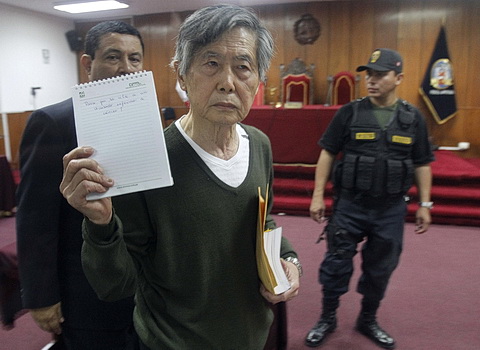
He was found guilty of murder, bodily harm and in two cases of abduction of people. The amount of his prison dates exceeded forty years. Currently, Fuhimory is in the same special prison in which the head of his intelligence of Montesinos and even earlier, according to his order, the leader of the Husman terrorists was enclosed.

The daughter of ex-president Keiko Fuhimory became a famous politician in Peru, ran for the presidency and twice, in 2011 and 2016, went on a second round (in the photo) . She lost to the winners of a share of a percent.
The fate of Lukashenko and the future of the country are still unclear, despite his urgently conducted closed inauguration. Perhaps the departure of the dictator will drag on. Lukashenko has already neglected almost all the restrictions that restrained other authoritarian leaders. He has nothing to lose. He is not interested in the opinion of neighbors in Europe. He does not consider a voluntary rejection of power, like Fuhimory, as a decision for the country's withdrawal from an acute crisis. While the security forces support him, and Russia provides moral and material support, it will delay the knot. But his defeat is inevitable.
The conclusion from the comparison is obvious: the lack of political horizons, a misunderstanding of the general laws of the development of society have ruined many dictators. The problems that they create for their countries are forced to solve the people. In the case of Belarus, this will be difficult, since the country's political space is devastated by repression. The society lacks the skills of political self-organization, over the past years of authoritarian rule, the experience of democracy has been lost, which was in the very least in the country in the first half of the 1990s. But today, Belarusians showed a very high level of spontaneous peaceful protest, they show more and more abilities for self -organization. Protesters won the sympathies of millions of Russians who believe that Lukashenko’s dictatorship came to an end.
Photo: 1. Japanese Descendent Alberto Fujimori, 51, Waves to Supporters After Casting His Vote During Presidential Runoff Famed Mario Vargas Llosa in Lim Sunday, June 10, 1990. (AP Photo/Matias Recart/Tass)
2. 21.10.1994 . Russia. Moscow. On October 21, 1994, the President of Belarus A. Lukashenko (in the center) accepts congratulations in connection with the election of his president of the republic. Georgian President E. Shevardnadze - on the left. Sentsov Alexander, Chumichev Alexander/Photokhronika TASS
3. 04/10/2000. Campana Electoral 2000. Candidato de Peru Posible, Alejandro Toledo, Llegando En Hombros a la Plaza Mayor.foto: Juan Ponce/© El Comercio/Gda Via Zuma Wire/Tass
4.28.11.2013. Alberto Fuhimori is serving 25 years for corruption and support for death squadrons during his authoritarian rule in the 1990s. Photo AP/Karel Navarro/TASS
5. Supporters of presidential candidate Keiko Fuhimory during the election campaign on the outskirts of Lima, Peru on May 10, 2016. Photo AP/Martin Mehiya/TASS