
Translated material
Frank without a passport: the story of the "Islands of cannibals" of the time of the Soviet passport campaign
6 thousand people were deported to Siberia and landed on the island without food, refuge and instruments. In wild conditions, they survived a little more than 2 thousand.
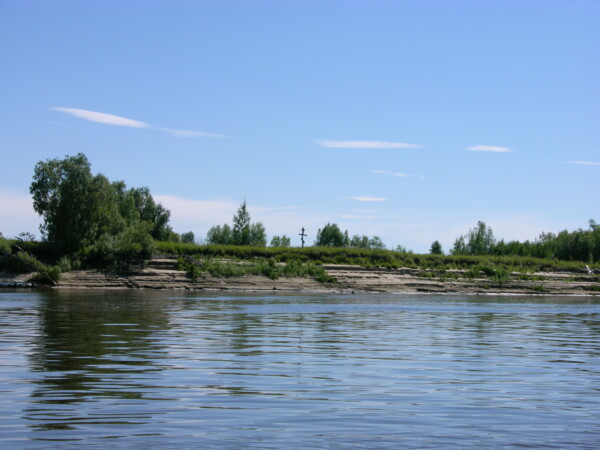
From the 16th century, Siberia served for the authorities of Russia and the USSR a place of exile. Criminal and political criminals were sent there. The exiles were used to settle the undeveloped areas of Siberia, limiting their movement. Since the 19th century, people supposed to the east of the country had to engage in land processing: to conduct fishing or economy. By the beginning of the 20th century, up to 300 thousand people were killed in Siberia, but the number of settlers should have grown in the thirties.
The State Political Administration (GPU) set a goal to increase the population of Siberia by 3-5 million people for five years. Part of this plan was Nazino's immigrants, who were brought to the “naked” island in the middle of the Ob River on two barges. They were landed ashore without giving food, instruments and even warm clothes. This temporary decision stretched for three months and turned out to be 4 thousand dead.
Cities cleaning and link as an anti -crisis measure
After the revolution, the passport system was canceled in Russia, and since 1918 the population did not oblige the personality certificate. People lost their binding to the settlement, place of work or service. The USSR actually became a zone of free mobility - a man could live, where he wanted, and to conduct an economy where he wants. There was no control and accounting, but then collectivization and dispossession passed in the USSR. As a result, the food crisis and hunger began. In search of a better life, people reached out in cities, where the situation was not much better than in villages.
The crisis in the country was only exacerbated, so the USSR authoritiesdecided to go to the introduction of a passport system, which could not only stop migration in the country, but also conduct a census, revealing objectionable ones. Passports were not given nine categories of citizens, among which fists and dispossessed, as well as convicted and simply moved from one city to another for personal needs.
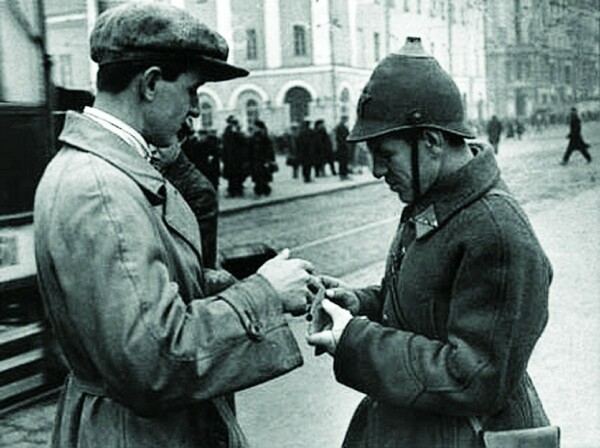
With the introduction of the passport campaign, mass arrests on the streets began almost immediately. Thus, the head of the GPU, Henry, has implemented his plan for the development of Siberia. Passers -bys without a passport were grabbed on the street and sent to Siberia, without even informing the relatives.
"Why did you get here?" - we asked the guy. He replied: “And for nothing. Was a student in Moscow. At the weekend I went to visit Aunt - Muscovite. He reached her door, knocking, but the aunt did not have time to open the door, because they immediately grabbed me. I was arrested as not having a passport with me. ”
Theophilus is the epic
Passport migrants arrested on the streets were mixed with criminals and convicts, and then sent to a correctional labor camp in Siberia, he was Siblag. For all immigrants in the Union, a term was invented - declassed elements. In the spring of 1933, more than 6 thousand such declassed elements were planted on a unusable island near the village of Nazino.
"Let them graze"
No one knows the exact number of Nazinsky island. The Siblag Office in Novosibirsk, according to telegrams , sent two barges with 3 thousand passengers on each to Alexander. The commandant’s office of Alexander officials replied that they could not accept the immigrants, since there are no housing or food for them. In response, Novosibirsk only sent a telegram with the text: “Three thousand were left at your disposal. Meet three more in a week. ”
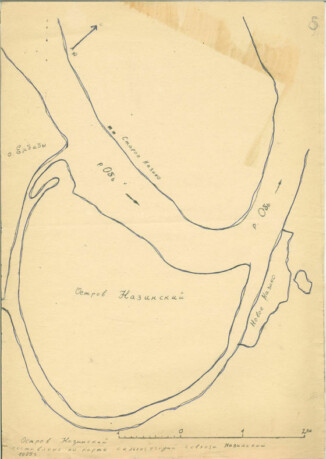
After the meeting, the commandantance of Aleksandrovsky decided to determine the new immigrants on the island in the middle of the Ob River about one and a half kilometers and about 500 meters wide. It was washed by the river, and from the island to the shore on both sides it was at least a kilometer. Thus, it was almost impossible to escape from this island.
Salnikov Kuzma Antonovich from Novokuznetsk worked at the mine. He was married, had two children. Once he went to Novosibirsk, went to the central market. At this time, the market was surrounded, raided and arrested those who did not have documents with them. All, including women and children, were loaded onto the barge and taken to the island of Nazinsky.
Vera Panova
Not everyone could get to the island. The conditions for staying on the barge were not very different from life on a uninhabited island. People were poorly fed, they lacked a place, and due to the fact that the detainees during passport raids were mixed with criminals, a kind of hazing developed on the way. As a result, mortality in the first echelon reached 35-40 people a day.
Witnesses of those events say that on the day when the barge moored to the island was sunny weather. 40 people were dumped on land, but they did not immediately bury them. The graves were allowed to relax, and at this time in a heap of bodies lying in the sun, eight people came to themselves.
The Alexander commandant’s office calculated that not three thousand people arrived in the first barge, as reported in a telegram, but more than five thousand. All weakened and exhausted - for those who felt worse than others, broke four tents, in one of which they placed patients with suspicion of rash typhoid. Another tent was equipped with a power distribution. The daily ration consisted of 500 grams of bread, 32 grams of cereals, 13 grams of sugar and salt. On this, organizational measures on the island ended.
The landing to the island did not do anything - they were not given any tools, landing ashore with the words : "Let them graze." At the same time, the weather was greatly deteriorated: the wind got very cold and rose. This led to the fact that people froze to death or, conversely, trying to warm themselves, received burns incompatible with life. Another consequence of poor nutrition and cold weather was an increase in the number of diseases. As a result, by May 21, 1933 - two days after the landing - another 70 people died on the island. In five of them, the new inhabitants of the island cut the soft parts of the body, pulled out the liver, heart and lungs.
Island of Magnoedov
It is believed that it was the criminals who were the first to try human meat on the island. In the Tomsk Museum "Investigative Prison of the NKVD" there is a restored transcript of the interrogation with one of the "cannibals" caught with red -handed. Andrei Karagodin, who worked on the island, recorded his conversation with a detainee from memory.
- Corners, is it true that you ate human meat?
- No, not true. I ate only the liver and heart.
- Tell us how you did it in detail.
- Very simple. How barbecue is done. He made skewers from willow twigs, cut into pieces, strung into skewers, frying on a bonfire.
- And in which people did you get meat? For the living or the dead?
- Why have the dead. This is a carrion. I chose those who are no longer alive, but also not dead. It can be seen that it comes, in a day or two, it will still give an oak. So it will be easier for him to die ... Now, right away, not to suffer for another two or three days.
The situation began to quickly get out of control. The guards could not do anything with the desperate population of the island and beasts themselves.
I was 5-7 years old. It was on the other side of the Ob. People on the island of the snag will collide into the water and tried to save the soul on it. And then they were shot from the shore. The guard shot others too. One of them himself said: “I aimed ... Bach! Bach ... and three - into the water ... ". The sin to say is war, but here they shot like that ... a lot of people died.
Maria Akhtina
At first, food was given out in order of live queue, but soon this order was violated. People crowded and tried to tear flour. Having panicked, the guards began to randomly shoot in the crowded line. After that, executions on the island became commonplace. The warders said to the death penalty for the slightest misconduct.
Soon the order was changed, and the rapidly reducing population of the island was divided into brigades of 150 people. At the head of each brigade, the elder was prescribed, who took food on everyone and evenly distributed. But most often the criminal became the elder who took this “post” by force. He left all his food to himself without sharing with anyone. Therefore, cases of cannibalism became more frequent, and people no longer waited until their neighbors were in a dying state.
I saw that the old women on the legs were cut off. To my question, she answered: "It was cut to me at death-Ostrov and roasted." All the pulp on the calves was cut off. The legs froze from this, and the woman wrapped them with rags. She moved on her own. She looked an old woman, but in reality she was 40 years old.
Theophilus is the epic
Soon another echelon arrived at the island. People were planted on an island, which, according to the stories of the commandant’s staff, became like an anthill. Mortality only grew up, and the graves did not have time to bury the corpses. Most often, people died from diarrhea.
The dysentery epidemic began, and its scale became larger every day. Only after this healthy and strong began to evacuate. The exiles were again driven to the barge - 200 people each. They were taken about 100 kilometers from the island and landed on the shore to master the taiga.
The evacuation ended in August 1933. 2856 people were able to survive on the island in the middle of the Ob.
Rumors, mass graves, historical heritage
Witnesses of Nazin events say that the locals were calm about what was happening on the island. In the district they knew about the horrors that were being created. Moreover, village party activists caught fugitives from the island, which, with their help, were then delivered back. Periodically, the current arrived to the shores of the corpses, which is why the rumors crawled lower and lower along the river. People told each other about the cases of cannibalism.
After the liquidation of the camp, local residents visited the island to mow hay and collect berries there. They were not frightened even by a cadaveric smell.
Even twenty years after the events, traces of immigrants remained on the island. In 1952, local business executives were sent to mowing to the island. Then people noticed that in some areas the grass does not grow.
I noticed that there is no grass on the area in the form of a semicircle. When they swept the stack, then went to this place. The leg was drowning on it. We realized that there were innocently dead. The Svoror was a believer, cried about ruined people. We did not dig anything.
Theophilus is the epic
In 1989, Tomsk activists entered all possible data on the Nazinsky Island in the register of the Ministry of Culture. Now it is an object of historical heritage.
The letter personally to Stalin
The Nazin tragedy became a precedent, after which the repatriations of the declassed stopped. The campaign for the development of Siberia and other regions of the USSR was stopped at the expense of exiles.
In the fall of 1933, a commission arrived in Siblag, which began the investigation of the incident. All this was the result of a letter from the instructor of the Narymsky external committee of the party Vasily Velichko. He sent him not by mail, but with the man who personally handed the message to Stalin in his hands. The result was a loud scandal. A secrecy vulture was imposed on Nazino documents. Documents became available only during the publicity period.
“I soberly realize that writing such a letter means taking a big responsibility. I admit that a number of points are not stated exactly, may not be confirmed, or confirmed, but not completely, I admit that I just don’t know much - because I used unofficial sources, ”Velichko wrote in a letter.
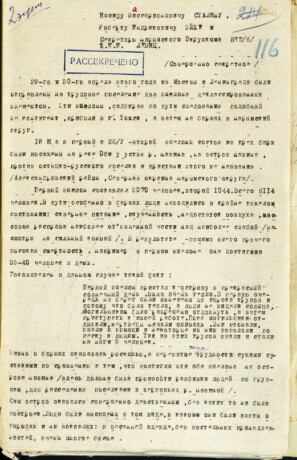
In his message, the party worker pointed to the facts of cannibalism, spoke about rumors that crawl around, reported an epidemic and terrifying mortality. He also wrote about the arbitrariness arranged by the overseers. Commandents and guards beat people and exploited them, despite the plight.
“The shooter Golovachev for the abduction of one fish on the road of the boat beat the labor of the mate and ordered him to wash. When it was done, he ordered to jump from the boat. The worker's labor jumped and drowned. The commandant of Suleimanov beat people when issuing sugar, and also ate him in front of everyone in incredibly large quantities and now, according to his own statement, lost every taste. In addition, he took Grebtsov-Bruskels and rode a boat, ”-from the letter Velichko.
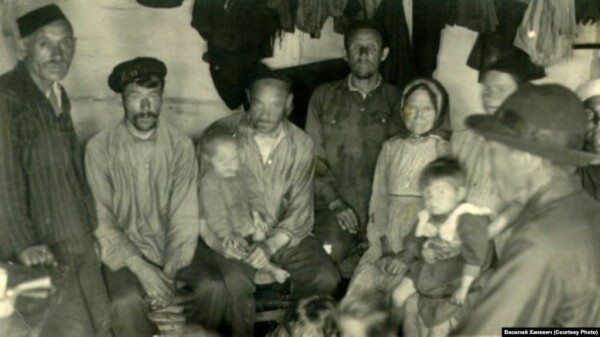
Velichko also wrote that together with the declassified elements, members of the parties fell on the island. They brought party tickets, candidate cards, Komsomol tickets, passports, certificates from factories and other documents that could confirm their identity and injustice in the passport campaign.
Velichko gave as an example a driver who left the house for cigarettes and stumbled upon a patrol; A 23-year-old contemporary girl who went to the store for bread and was arrested, despite the availability of documents; A locksmith who went to Moscow with a ticket for treatment. It is known that relatives of high -ranking party members fell under the detention.
There were all kinds of people there. During certification, they were taken by the police in Tomsk and to the barge. Even himself, this Tomsk prosecutor came. He took two sons from him. People went out without documents, and once - and took the police with a rally. The prosecutor who took his sons from the island.
Alexey Vogulkin
The text of the letter of Vasily Velichko stretched to 11 pages . Most of the facts indicated by him were confirmed during the investigation. At the end of his letter, Velichko wrote on a separate line: "To be worse silent."
There is another detailed story about the Nazin tragedy-on behalf of an employee of the accounting and distribution part of the Alexander Vovakhovsky penal commandant of the Siberian ITL Ivan Uvarov. He found himself among those who took “declassified elements” on the island near Nazino in 1933. Describing the horrors taking place on the island, he completes his story with the words: “But my fault is not in this. The segment of the history of the homeland, which my life has met, is to blame. ”
The article was created by a participant in the authors league. About how she works and how to join there is described in this material .
#stories #USSR #repressions #long -standing