
Translated material
How to steal elections and not go to jail
Russian law is strict to electoral falsifiers in words: Date-study
Over the past 10 years, falsification of elections in Russia has become an integral element of national political culture and served as a rapid growth of the new branch of social sciences - electoral statistics. Thus, according to the most conservative assessment of leading Russian mathematicians and economists (R. Enikolopov and others), published in the referred by the scientific journal (works of the US National Academy of Sciences), in 2011 the result of United Russia due to falsifications - stuffing and rewriting - was overestimated at least 11%. Such an assessment is consistent with the works of famous Russian scientists: Sergey Spilkin, Dmitry Kobak, Maxim Pshenichnikov and others, which were published both in Novaya Gazeta and in the reviewed academic magazines.
In subsequent years, the development of both the methodology of falsifications and the methods of their exposure took place. Thus, the “carousel” in the elections of the Governor of the Moscow Region Vorobyov began to turn into “carnival”: they made a masquerade with dressing up, and observers learned to identify carousels, retrospectively analyzing videos from the sites.
A giant project in its coverage, during which tens of thousands of hours of videos were watched, revealed an overestimation of the Presidential Election in 2018 by five times in sites in a number of regions.
Falsification with ballots and final figures is inextricably linked with violence against public controllers (members of commissions with the right of deliberative vote, journalists and observers): this is pulling out controllers by force from the site, beating, broken hands.
The PEC members in the described criminal offenses play, judging by the same, an active role, while acting plannedly organized: the briefings for the PEC are documented, on which they are explained how to properly throw ballots.
The New Gazeta has repeatedly demanded that the perpetrators of falsifications to criminal liability (for example, as it was in Mytishchi Gate with mass rewriting of protocols in the last elections of the State Duma).
No one, however, sat down for this theft of votes.
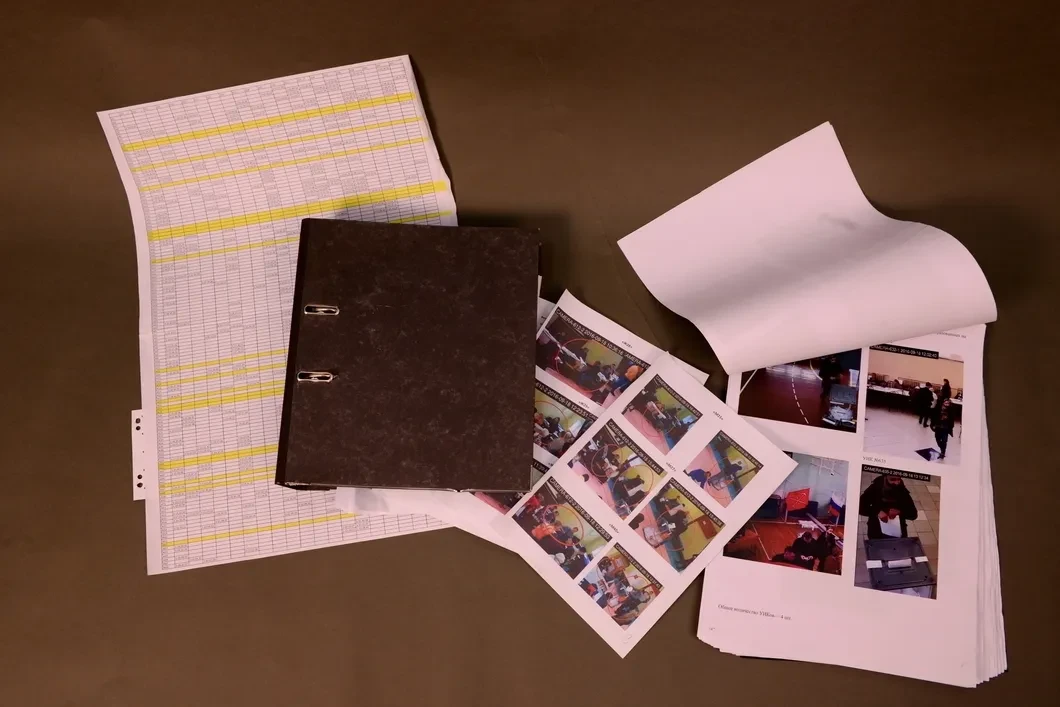
On the falsification of elections in St. Petersburg, New Gazeta gathered a whole photo album and solemnly handed it to the head of the CEC Pamfilova. The trial ended about nothing.
It is extremely difficult to achieve criminal proceedings, even if the observers have direct video evidence of the stuffing or issuing ballots, the police often declare something in the spirit: “And prove that these are ballots, not a pile of cutting paper.”
Strictly speaking, the crimes of the election commission do not begin on the voting day, but earlier it is at the stage of refusal to register opposition candidates and the reception of clearly drawn signatures from spoilers, who subsequently gaining fewer votes than the signatures in the election room. However, criminal cases for obstructing the elections in this sense are not and is not expected, because then, for example, dozens of members of St. Petersburg election commission who sabotage the registration of independent candidates should have been sitting. In the same way, there are no criminal cases against provocateurs who tried to throw false signatures to the opposition.
Therefore, in this study, we limit ourselves to the analysis of crimes that have reached the judicial sentence committed by members of the election commission on the voting day.
The Date of the Department of Novaya Gazeta studied the results of criminal prosecution under four articles of the Criminal Code of the Russian Federation, providing for responsibility for “electoral sins” over the past 10 years.
This is the falsification of elections in the good old sense of the word, as we love it: throwing ballots, incorrect counting of votes, rewriting protocols. Responsibility for these actions is provided for in Article 142.1 of the Criminal Code of the Russian Federation - “Falsification of voting results”.
Other usual actions to distort the election results - “Fents of voters' books, falsification of voter signatures” are punished under Article 142 of the Criminal Code of the Russian Federation - “Falsification of electoral documents ...”.
More exotic corpus delicti are provided for in Article 141 - “Obviating the exercise of electoral rights or the work of election commissions”. For example, actions such as bribing voters, threats to candidates, non -financing elections are held on it.
Finally, more recently, Article 142.2 appeared in the Criminal Code of the Russian Federation - “illegal issuance and receipt of a ballot ballot”. Practice on it is extremely insignificant.
According to all the servers of the district courts that we have automatically unloaded, since 2010 there have been 174 cases of affairs in the first instance for these articles. At the same time, the statistics of GAS “Justice” shows 190 cases of cases that, taking into account the not very careful technical support of local judicial servers (the server flew, and all the old judicial acts disappeared - this happens) even well). Cards on the servers of the district courts, which indicate the “sentence” - about 80.
As we have already written repeatedly, the publisiness of judicial acts often leaves much to be desired even in relatively recent years, even in a technically advanced Moscow City Court. Given the fact that we investigated this time, including quite ancient things, it is even surprising that there were 55 published judicial acts in the cards of the case; We analyzed them.
We calculated the number of judicial acts, not the number of convicts. In all cases we have analyzed, except for one, if it was a question of condemning several people in the same judicial act, they were awarded the punishment of the same type (i.e. or to everyone - fines, or all - conditional imprisonment). In only one case, accomplices received punishments of various types (one - conditional imprisonment, the other - mandatory work).
The most interesting are “classic” falsifications: stuffing with filling books for those who have not lost their elections - it is about them that we most often read in reports from the elections.
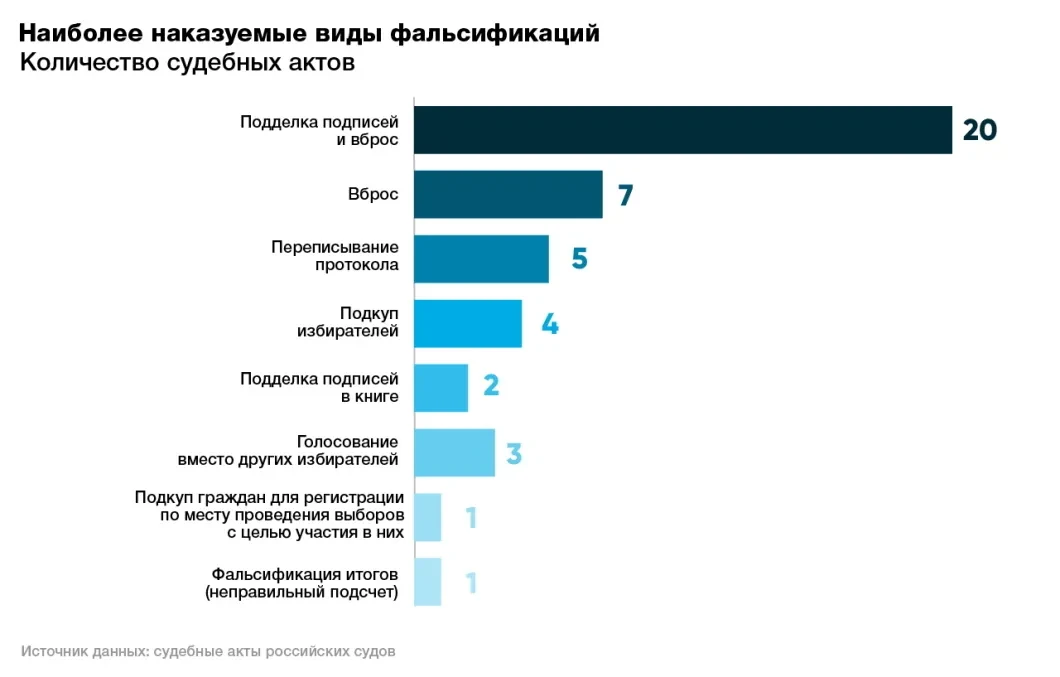
The stuffing with the simultaneous falsification of signatures in the voter lists - such a plot of crime is reflected in 20 judicial acts; In all these cases, the act is qualified under Article 142.1 (“falsification of voting results”),
In 7 of the listed 20 cases, there is also a qualification under Article 142.
In two cases alone, the published form of the judicial act indicates in favor of whom falsification was carried out - in favor of United Russia.
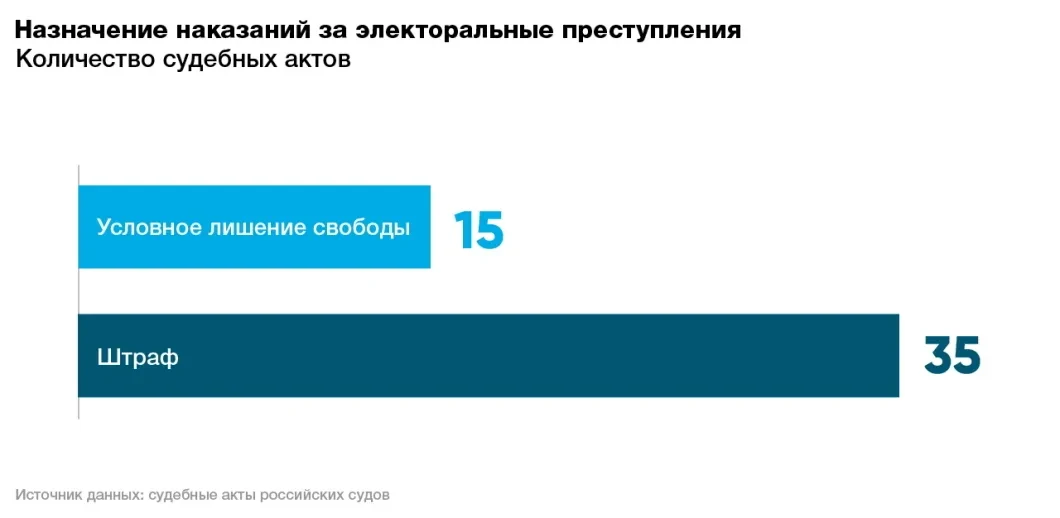
In 7 judicial acts in this category of cases there were sentences to imprisonment. And for all judicial acts, condemnation was conditional.
At the trial, members of the election commission are very ridiculous:
Thus, the accomplices of falsifiers, as was the case in one of the cases considered by the Volga district court of the Samara region, may say that they were given to the carousers "not ballots, but paper leaves."
It’s just that you will cost you much cheaper without fake voter books: you will get off with a fine. We found seven such judicial acts that ended with fines from 50 to 250 thousand rubles.
The courts also imposed a punishment in the form of imprisonment in judicial acts under the above articles of the Criminal Code in the event of a bribery of voters (4 times), falsification of the protocol (1 time), falsification of signatures before the elections (2 times), election non -financing (1 time), and in case of extortion of a bribe for the “necessary” decision of the election commission (1 time). In all cases, it was about conditional terms.
How do soft sentences motivate the courts?
For example, in connection with the failed stuffing in the Belgorod Region in the State Duma elections, the court spoke like this: “Given the totality of circumstances mitigating the punishment of each defendant - Rogozhina, Shcherbak and Miroshnikova, positive characteristics both at the place of residence and at the place of work, the presence of letters for active participation ... of the President of the Russian Federation, deputies of the State Duma, deputies of the State Duma, deputies Belgorod Regional Duma, village collection ... ".
Those. Translating from bureaucratic into Russian: people were exempted from serious responsibility, in particular for helping the “right” result before.
Above, we cited references to the evidence of the centralized nature of stuffing in Novaya Gazeta. However, we did not find a single judicial act where the investigation would unwind the thread at least to the puppeteer of the district level. The journalists of the Novaya here are much more professional in the discovery of Karabas-Barabasov of this theater of puppets.
This is how the court characterizes the motives of the criminal - a teacher of the Children's Art School, the chairman of the PEC in Saransk.
From the court decision
“Shchadova A.F., guided by a personal choice , decided to use her position as a member of the election commission for her criminal purposes aimed at falsification of electoral documents in the interests of the elected political party“ United Russia ”, including one of its candidates running to deputies of the State Duma of the Federal Assembly of the Russian Federation, one of its candidates who ranked to deputies of the State Assembly The Republic of Mordovia, as well as one of the self -nominates, who was elected to the deputies of the Council of Deputies of Saransk, sharing their political views with them, giving them their preference and not informing them of their criminal intentions , thus wanting to significantly change the results of voting on the polling station entrusted to it. ”Seriously? The music teacher went under the criminal, “guided by a personal choice”?
“Sharing” with the candidates “their political views, giving them their preference and not informing them of their criminal intentions”?
The motive reflected in the sentence of the PEC in the city of Yartsevo, Smolensk region, who painted at least 379 votes in favor of “United Russia”: “... from the personal interest of the United Russia political party and, wanting the candidate of this political party to the deputies of the Smolensk Regional Duma of the fifth convocation ...”, is a little more realistic.
As for the selective bribery, different types of this violation reach the court very rarely. It is clear that it is very difficult to ensure the evidence base: it is necessary to fix the transfer of remuneration. In the proper sense of the word, the bribery of voters is established by four judicial acts, in two of them, conditional imprisonment has been chosen as a measure of punishments of the perpetrators, only fines in the other two.
The voter in Russia is cheap:
So in the verdict of the Sosnovoborsky City Court it was established that the votes in the elections to the State Duma of 2011 cost “customers” 300 rubles.
Also, cases of bribery of voters were recorded for their registration on the “right” polling station - approximately the same, apparently, as in our report from the autumn elections of 2020, the “rubber product of the voter”.
Fents of the protocol, rewriting the protocol or incorrect counting of votes, also rarely reaching the courts: we counted only 6. In only two cases, it was indicated that the protoing of the protocol was in favor of United Russia (the punishment in one case was a year and a half conditionally, in the other - a fine of 100 thousand rubles).
Formally, the leaders in the number of judicial acts in our statistics are the Republic of Buryatia, the Moscow Region, the Chelyabinsk Region, the Republic of Komi and the Astrakhan Region (5 or 4 judicial acts each), but this statistics are insignificant, since in a number the same events are about the same events, just criminal cases were allocated into separate proceedings.
It is pointless to appeal to Ms. Pampilova or Mr. Bastrykin.
The only thing that can be opposed to impunity is to close the PEC as tightly as possible with public controllers and not be lazy after the elections to eat the Police of the Police and the Investigative Committee, drowning them in complaints about refusing to initiate criminal cases.