
Translated material
The court in Greece finally defeated the neo -Nazi party "Golden Dawn"
Her members publicly admired Hitler and killed people. This did not interfere with the party to sit in the parliaments of Greece and Europe - and even be friends with Russia
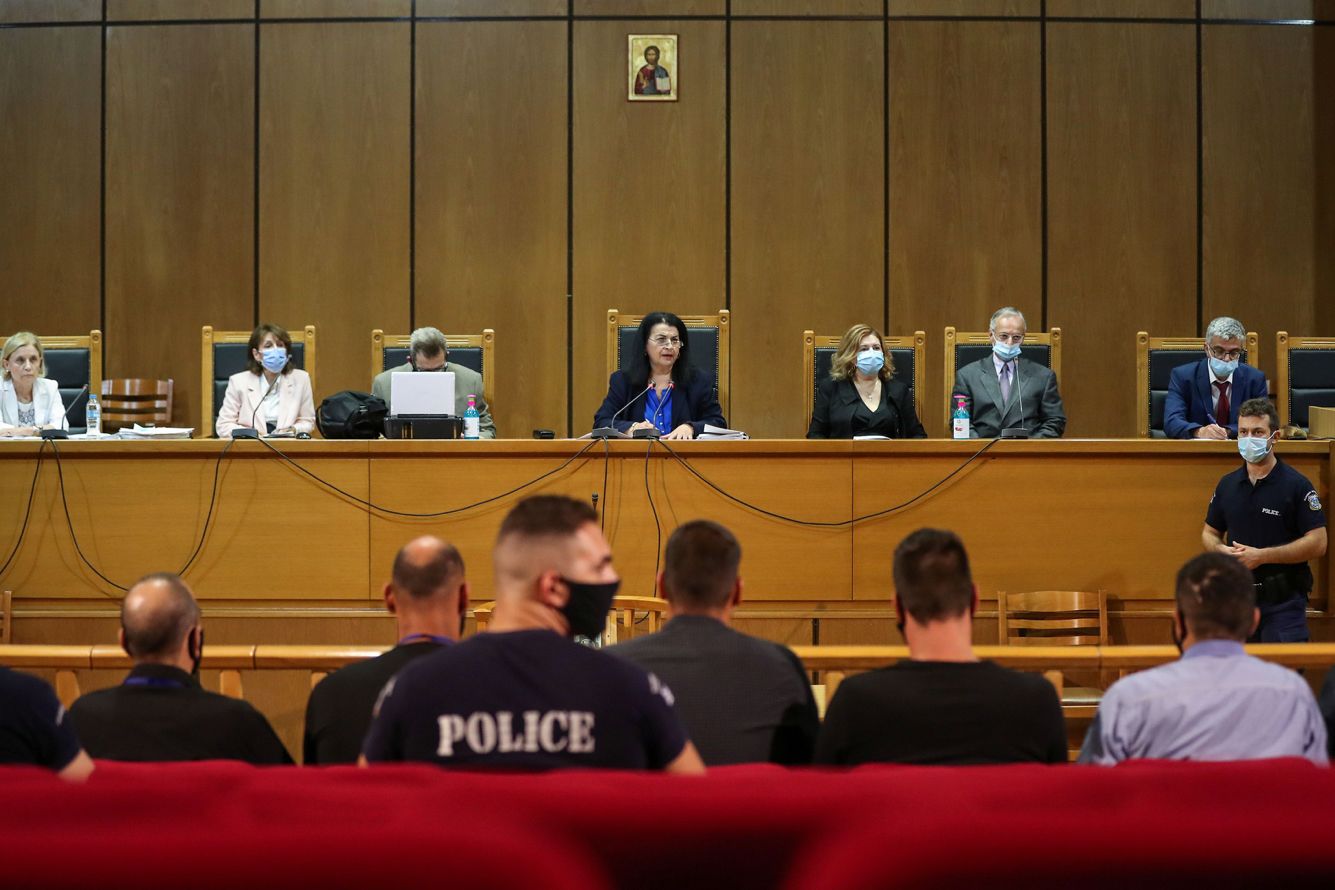
On October 7, 2020, the Athenian court began to make a decision in the case of the neo -Nazi party "Golden Dawn", which lasted five years, since April 2015. The court has already recognized the top of the party, including its leader Nikolaos Mikhaloliakos and a number of members, including the former Golden Dawn deputies in the Greece parliament involved in the creation of a criminal organization. In total, approximately seven dozen people were charged, only a few of them managed to avoid punishment. In addition to the leaders of the party who faces a imprisonment for up to 15 years, up to the lifelong, ordinary members, involved in several high-profile murders of migrants and anti-fascist-rapper Pavlos Fissas, can receive. The prosecution and the Greek media call the case of the Golden Dawn the largest court against the Nazis since the Nuremberg process. However, the defeat of the Golden Dawn does not mean that its support was dissolved, and the electorate simply disappeared: some moved into more respectable parliamentary parties, while others could join the ranks of the police and other Greece specialists.
The judicial verdict in the Golden Dawn case was the last chapter in the history of the most famous ultra-right organization in Greece and one of the most active among the Western right-wing parties and movements that received a new impulse of popularity in the wave of economic crisis of the late 2000s and the migration migration in the mid-2010s.
The Golden Dawn appeared back in the 1980s as a successor of the authoritarian nationalist tradition of the Joannis Metaxas regime, Prime Minister of Greece in the interwar period, and the military junta of the Black Colonels , which ruled the country from 1967 to 1974. The future leader of the Golden Dawn, Nikolai Mikhaloliakos, was in the 1970s in the radical nationalist party “August 4” (named after the Metaxas regime, known as “August 4”-by the date of its creation). In a prison, where Mikhaloliakos got an attack on journalists, he met the leaders of the military junta and received a blessing from them to create a new movement. The Golden Dawn was first called the magazine, which published Mikhaloliakos in the 1980s, and then this name was also received by the movement itself, officially issued in the party in 1993.
However, the Golden Dawn differed from their inspirers, based on the ideology of authoritarian nationalism and anti -communism, but not directly associated with Italian fascism or German Nazism. The new party at the very early stage of its appearance adopted both Nazi aesthetics and many elements of ideology.
The cover of the numbers of the magazine "Golden Dawn" was first decorated with a stylized swastika, and then the real one. In 1987, when the Nazi Reichsinter and Deputy Hitler for NSDAP Rudolf Hess hanged in the Berlin prison of Shpandau, the Golden Dawn placed his portrait on the cover of the Hesse Number, and the activists scattered the leaflets with the inscription “Rudolf Hess Immorta” in Athens. Mikhaloliacos was often photographed against the background of the flag with a swastika and with a hand thrown in a Nazi greeting, and in party documents and proclamations he proclaimed the “principle of leadership” (führerprinzip) and a strict party hierarchy, borrowed from the Nazi - like “blood and honor”. At the same time, the leadership and members of the party - often bore tattoos with the swastika and publicly enthusiastic about Hitler - denied their connection with Nazism, the early neopagan ideology was changed to the support of Greek Orthodoxy, and the swastika in their symbolism changed to a stylized meander - an element of the ancient Greek ornament.
Members of the Golden Dawn always actively participated in street violence: pogroms in Jewish cemeteries, skirmishes of football fans (after in 2004 at a match in the capital of Albania Tirana, the Greek team lost to Albanian with a score of 1: 2, a wave of violence against Albanian immigrants swept, as a result of which at least one person died), as a result of one person) attacks on journalists, representatives of sexual minorities, migrants and left -wing activists. The latter often responded with oncoming violence: the regional headquarters of the Golden Dawn have repeatedly been attacked using Molotov cocktails and explosives.
The peak of street violence involving the members of the Golden Dawn fell on the beginning of the 2010s and coincided with the peak of the party’s political success, as well as a deep, protracted economic crisis in the country. In 2010, the party for the first time achieved success in the elections, choosing its candidate for the City Council of Athens, the leader of the party of Nikolai Mikhaloliakos, who at one of the first meetings of the Council greeted the Nazi gesture colleagues. And in 2012, the Golden Dawn for the first time became a national party, having received almost 7% of the vote in the Greece parliament with 21 deputies-and becoming the third political force in the country, the BBC notes .

In addition, in 2014, Zarya received three places in the European Parliament. During these years, the party activists made the attacks for which they were condemned in 2020: to the house in the suburbs of Athens Peram, in which fishermen from Egypt lived, on members of the PAME communist trade union, the murder of the Pakistani migrant in Athens and others.
But the most famous victim of the Golden Dawn, after which the authorities seriously took up the investigation of the party’s activities and criminal cases against its leadership, was the rapper-antifacer Pavlos Fissas. He died of numerous stab wounds received during a collision with a group of Golden Dawn activists after a football match in the suburbs of Athens in September 2013. The Greek journalist Yannis Granias, who illuminated the activities of the party, in a conversation with Meduza says that the Greek authorities had a lot of reasons to engage in Golden Dawn and before that, but it was already impossible to ignore the murder of Fissas: he was a local resident and killed, unlike previous victims, with numerous witnesses on a busy street. Yorgos Rupakias, a member of the Golden Dawn, was soon arrested for the murder of Fissas.
In September 2013, Nikolaos Mikhaloliakos and several more high -ranking members and ordinary Golden Dawn activists arrested the Greek authorities, charging them of creating a criminal organization, murders, attacks and much more, up to extortion and illegal storage of weapons. When a year and a half later, Mikhaloliakos ended the maximum term of detention before the court, he was released under house arrest, and then, when in April 2015 the trial of the Golden Dawn began on a number of claims united in one case, on a non -place of the periphery (administrative region) of the Attics.
It was the obviously declared “leader principle” later prevented the younger members of the “Golden Dawn” at the trial of the guards of the party leadership in direct orders to commit murders and attacks, said Yannis Granias. Protection lawyers insisted that dawn members, who were attacking migrants and left -wing anti -fascist activists, acted on their own initiative and regardless of the top of the party. The accusation, based on documents seized during searches, proved that the leadership of the Golden Dawn was not only aware of all shares of intimidation, attacks and murders, but also authorized them directly.
Already during the start of the court in the case of the creation of a criminal organization, the party continued to conduct political activities and even establish international ties, including with Russia: the 2015 party program has a point on the formation of economic partnerships primarily with China, Iran and Russia. In March 2015, two representatives of the Golden Dawn, high -ranking retired military, visited the Russian Conservative Forum in St. Petersburg. They did not pass the defendants in the party’s case. But from the hacked hacker group “Shaltai-Boltai”, Georgy Gavrish , who worked in the Athens of an employee of the Russian diplomatic mission in Greece and activist of the “Eurasian movement” Alexander Dugin, is known that the leader of the Italian right-wing party “New Power” and another visitors to the Conservative Forum turned to the comrade-in-arms The “Orthodox oligarch” Konstantin Malofeev Alexei Komov with a request for legal assistance in pre -trial imprisonment to members of the Golden Dawn. Whether this request received a move or not is unknown, but the Golden Dawn, together with other European right -wing parties and movements, actively participated in the pro -Russian coalition of the Euro -deputies and other right -conservative forces at different levels of European countries.
But since the mid-2010s, simultaneously with the start of the trial of the party’s leadership, the political support of the Golden Dawn began to fall steadily. In the subsequent elections, the Zarya lost deputies in the Greece parliament, until she lost all places in 2019, as well as her representatives in the European Parliament. On October 7, 2020, the party was finally destroyed by the judicial verdict and actually ceased to exist - but this does not mean that its voters and ideas simply evaporated, says Medusa, Yannis Granias, says. All factors-high unemployment against the background of the ongoing economic crisis, anti-immigrant sentiments in society and so on-who played a role in the strengthening of the Golden Dawn in the early 2010s, did not disappear in 2020, he notes. The less radical elements of the “dawn” were dissolved in the mainstream right-wing parties: the ruling legalist “New Democracy”, whose leader Kiriakos Mitsakotakis since 2019 is the Prime Minister of Greece, and the opposition Office of the Greek Solution, which appeared recently, in 2016, but already managed to get 10 places in the national parliament and one in one in the national parliament European.
But the most radical members of the Golden Dawn, ready for promotions of violence, are most concerned among the interlocutor of Medusa. There is a danger, Grandia says that they could penetrate the ranks of the police, the army and other law enforcement agencies. The results of several elections are given the reasons to suspect this, in which the support of the Golden Dawn in areas of compact voting of the police was much higher than the average in the country - up to 20 and even higher than 50 percent in some polling stations in which there were police branches. The number of Greek electorate in Greece, which is ready to vote for any, even the most radical ultra -right part, according to Granias, is about half a million people (about 11 million live in the country). And the defeat of the Golden Dawn, he believes, did not affect this figure.
Nevertheless, Greece met the indictment in the Golden Dawn case with many thousands of demonstrations at the courtroom on the day of the verdict. When it became known that the member of the Golden Dawn, Yorgos Rupakias, was called guilty of the murder of Pavlos Fissas, the crowd near the walls of the court met this news by glee and applause. And the rapper’s mother who went to all court sessions went to the journalists with the shouts of “Pavlos, you did it!”.
It is expected that the court may spend a few more days to complete the process and determine the terms for the accused.
Alexey Kovalev