
Translated material
Foil patch
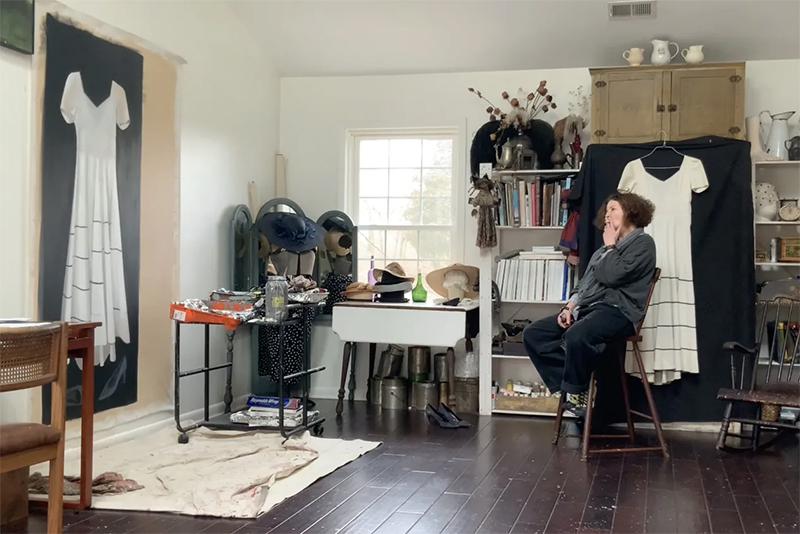
Colta.ru continues to talk about those exhibition events of autumn that tried to force us to forget about the epidemic and at the same time indirectly comprehended the experience of what happened in these months. On October 10, the exhibition “Personal Cosmos” closes in Kaluga (you can watch it by link online).
The curatorial project of Catherine Rozhkova was created for the Kaluga Innovation Cultural Center as part of the VIII program of the Tsiolkovsky festival of contemporary art. The project was attended by nine artists: Ekaterina Rozhkova herself, Lisa Olshanskaya, Katerina Kovaleva, Keiko Kobayashi, Natasha Ivanova, Katya Levental, Vera Khlebnikova, Natalya and Maria Arendt.
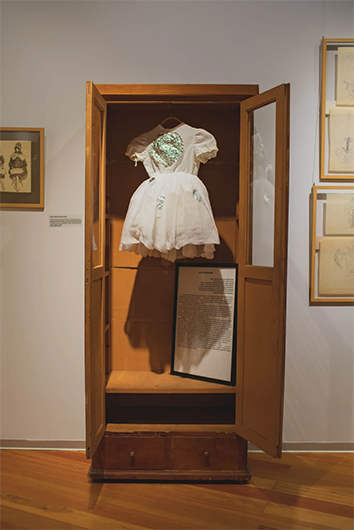 © Gridchinhall Gallery Vera Khlebnikova. Installation for the Personal Cosmos project
The theme of cosmism, fashionable in the 2010s, unexpectedly wrapped like a snail into its own sink: the cosmic was not narrowed to the private, or private was deployed into a colossal cosmic size. The main scheme and metaphor of the space was the dress: children's or wedding, dress-transition, an initiation dress or a doll dress.
The main work, from which, apparently, the whole plan took shape - the installation of the most lacte “holidays”, similar to an old clothing tower. The artist writes that the material was going throughout the country: there are pre -revolutionary baptismal shirts, and medical robes, and dresses of the sixties. Nearby is an exquisite-meditative way to talk about family and childhood: Keiko Kobayashi-a Japanese woman who lived in Russia for many years-mentioned the details of the ornament of the 1940s , taken from the fabric of the kimono, stitched by her grandmother.
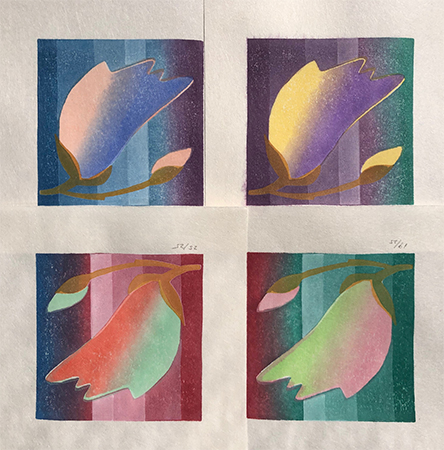 © Raf 18 Keiko Kobayashi. Endless kimono (fragment). From the cycle "Spring Scale"
An attempt at the household level to feel a story, to understand your connection with the events of two hundred years ago, analyzing old things, is a simple task compared to self -awareness near the cosmic scale. In this sense, the project has somewhat depended between the genres. For an ordinary “female” exhibition “on the themes of textiles”, it is too filled with strong and contradictory meanings. At the same time, he certainly does not position himself as feminist. The conversation is conducted in the gender dimension and concerns the personal experience of the artists, but the task of the participants is rather to accumulate and preserve their feelings than to analyze them.
So, the exhibition is collected from close on the topic of memorial capsules. Many of them talk about children (about girls) of the 1960s-1970s , whose dresses were sewn and overwhelmed with a grandmother or mother, and were drawn up by the Soviet government. School uniform or Snowflake costume were tough cells, installation cliches. In rare memorable cases, grains of heat, artisanal dilutions, invisible to an outsider, penetrated into this cell. Apparently, like some knitted pouch that the soldier wears at the heart. But if we have only a pouch in our hands, does it allow him to realize the scale, meaning and purpose of the war? And does the soldier himself think about it?
The main nucleus of the exhibition is most likely not the material objects themselves, but the feeling of a sharp and truly cosmically insurmountable difference from the monumental to intimate, since the late -Soviet culture spilled a whole steak of prohibitions between these spaces. On the monumental shore, everything becomes responsible, formidable, politically significant, even there, even a wedding dress is fabricated from a parachute. On the private shore, life is negligible with all its details: a communal scandal, trough, washing board, rudeness of the teacher, a gauze dress that burned under the iron. Perhaps, to strengthen the contrast, an additional high-rise dominant appeared at the exhibition, like a red star on a spire-a real cosmonaut woman, the first understudy of Tereshkova Irina Solovieva (b. 1937). Despite the records, she never became the first woman in space, she remained a man, not a monument. And before us is her private world - archival photos and a shirt with an embroidered figure of 2000 in honor of two thousand parachute jumps.
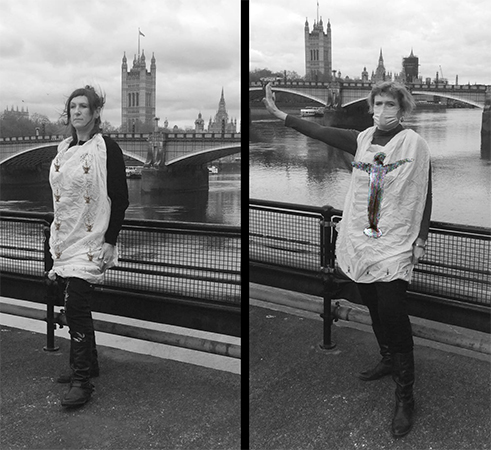 © Gridchinhall Gallery Natalya and Maria Arendt. Photo from the project "Transformer"
How to understand emotions if they take only a monumental form? How to live a rocket, helicopter, truck? What to do if warmth and comfort are perceived as printed words of the 19th century, and to be a girl is either a ridiculous, or an impossible task? Do I need to lose to maintain access to feelings? Some of the artists are looking for a response in family dynasties (Khlebnikov-Miturichi, Redty-Grigoryevs, Sokolov-Levantali). Sisters Arenidt take sculptural poses, claim that they invented a way to “dress in art”, and sew special outfits so that the uniform can still become something unique. A symbol of care for the faith of Khlebnikova was a surematly circle of foil - a patch made by his father. Other participants (Katya Levental, Lisa Olshanskaya, Katya Kovaleva), on the contrary, monumental their memories, create drawings, copies, architectural and picturesque versions of their real home and children's dresses. Well, there is a chance that reinforced concrete can not only perpetuate the experience of motherhood and care, but also make it more real for culture.
Katya Kovaleva works on a paper dress
© Gridchinhall Gallery
Most of the personal stories are told without unnecessary lyrics and sometimes even a little impersonal (“I bought this dress of the 30s at a flea market. For the first time I wrote it many years ago, but the canvas burned with the house”). But the “personal cosmos” ends with an unexpectedly sonorous monumental blow-the film-film Natasha Ivanova. It is no longer Soviet, but modern girls, young nurses in white robes.
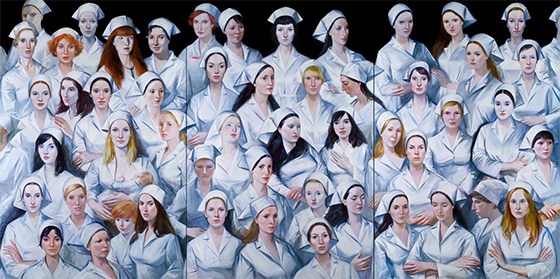 © Gridchinhall Gallery Natasha Ivanova. Nurses
The five -meter panel was supposed to be sent to the workshop portraits of the XVII century, but it was associated, rather, with the youth murals of the seventies. One difference: in modernist compositions there is always gender tension, men and women build a new world, complementing each other. Here is a utopia of sensitivity endlessly and the edge: the army of ideal twenty-year-olds looks at the viewer, like calm Madonna, polite sideli daughters, ready to listen and cure everyone who locked their emotions in a black box. In a sharp light of the space topic, the medical metaphor turned out to be noticeably deeper than many images of the heroes of the pandemic, but the three generations did not meet at the exhibition: it was not possible to bring too much canvas to Kaluga.
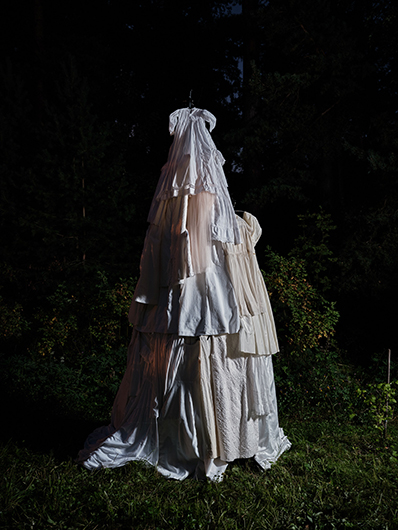 Ekaterina Rozhkova. Holidays