
Translated material
Problem with all unknown
What is happening with the next transition of schools to distance learning
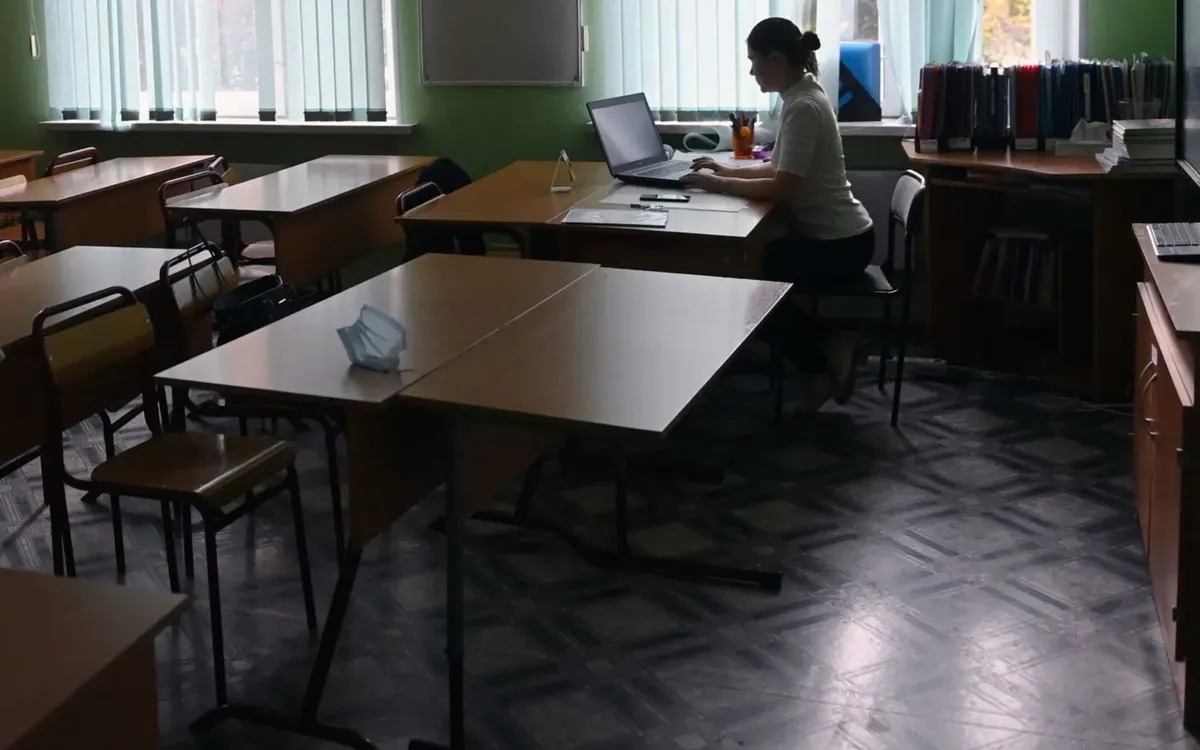
On October 14, Moscow schoolchildren were divided by fiders and correspondence facilities: 1-5th grades were left in full-time education in schools, and the 6–11st was again transferred to the distant. What do schoolchildren and their parents think about this?
There is no single opinion. People are very different, everyone has different living conditions. Some easily cope with the distance, it is categorically not suitable for others.
According to the Superjob portal, only 22% of Muscovites approve of these measures. However, at the same time, 68% of parents of children of grades 1-5 are happy with full-time education. And only 17% of parents of 6-11 grades approve of the transition to distance learning.
All this speaks only about one thing: both parents and children are tired of distance learning and do not believe in its effectiveness.
There are families who benefit from him, but their minority - maybe just about the fifth part.
I interviewed about 200 people - mostly Muscovites, but among my respondents there were still residents of St. Petersburg and the Moscow Region, two regions with a high level of infection with coronavirus. The spectrum of judgments ranges from "madhouse, I am horrified" to "an absolutely reasonable and right decision."
There is no one to work in person
The decision of the Moscow authorities is most supported by those who recently illuminated by Covid or who have my loved ones: “The distant is seen for me by a measure of non -renewal, but inevitable. At the school where I work, many people fell ill in the last month - teachers and children ”( Asya ). “It seems to me that with such statistics, like now, walking or going to school is madness. Distant - of course, is very difficult for everyone. But with the current statistics of the sick, I do not see another way out ”( Anna ). “Four fell ill in my family, my son is hard, her husband’s sister died. I agree to any temporary measures if it protects someone ”( hope ).
Teachers support, especially those who have working groups are affected by an epidemic. A colleague of one of the best Moscow schools writes: “We have a third of the Verbalniki either in the hospital or recovering at home. There is just no one to work in person. ”
The parents of junior students support, because the children themselves cannot cope with the distance. They endlessly pull their parents: help, do something wrong with me.
They cry, get tired, their eyes hurt - and the parents are generally satisfied that they will go to school, and not demand constant psychological and technical support of the house.
I try to breathe deeply
With the fifth grade, everything is not so simple. The fifth grade is already a secondary school. Not everyone understands why the fifth grade is not taken to the distant with the elders. But this, of course, is logic: they just came to high school, have not yet had time to get used to its laws, to the new cabinet system (this year it does not work), for many teachers. It is very useful for them to be at school now. But perhaps the fact is that
Fifth graders are still too small to leave them alone at home. Sixth graders are already eleven to twelve years old - in most countries of the world, children can be left alone from this age.
In Russia, there are no such laws (there is only criminal liability for leaving young people in danger, and everyone is considered to be young up to 14 years), but this decision seems quite logical.
Until you look at him through the eyes of a secondary school teacher, who leads lessons, including in the fifth grade. The remaining classes are on his distance, and the fifth is in person. Russian and literature in the fifth grade, for example, 9 hours, and they are evenly distributed by five days of the week: sometimes this is the third lesson, sometimes the first and second, sometimes the fifth. And before and after - lessons in other classes. And the teacher cannot explode between remote and full -time students - which means that the school will have to equip him with a quiet workplace with a computer, headphones, a microphone and others.
Teachers are gloomily jealous of colleagues who do not work in the fifth grades: we will lead lessons from home (for example, I have 8th and 10th grades, and do not get up to the first lesson an hour earlier-for me a great joy). Directors and business executives have to quickly and quickly come up with new solutions in order to provide the equipment of those who will broadcast from the school. This is
The most unpleasant part of the stories with a distance: all the time you need new technical solutions, and always quickly and quickly.
Parents of two or more children are even less happy if one should go to school in person, while others should sit on the distance. They do not understand what the benefits of the distan is if parents still take the child to school and unanimously carry home an infection.
Many families still do not have enough jobs. “The Internet does not withstand three videos, you have to spend a lot of money on duplication (mobile Internet for everyone and allocation), plus I had to buy new laptops, and this is 80 thousand unplanned expenses” ( Anna ). “It would be better to give children to study tablets who are transported by patients for social monitoring” ( Dina ). And what to do to teachers who are also many children, no one has yet come up with. “I have three children: the elders in the distance, the youngest in the 5th grade in person, I am a teacher in different classes: but in person and a distant. I try to breathe deeply ”( Catherine ).
Read on the topic
How to make a choice when the whole world is in limbo, and what is happening with education. Special project "will take (not) to the future?"
Now I'm crying
In high school - other problems. Some children want to communicate, grumble that “a distant is not studying”, and are torn to school. Others dance and bake buns on the joy that school no longer needs. Parents are concerned that
The Microsoft Teams program, which the entire Moscow distant is rapidly and non -alternatively translated instead of the usual Zuma, does not work, does not load, the classroom hours could not be held, the children could not enter the personal account and cry ...
“Children sob. I, recalling that the average (6th grade ) did not manage to enter the trial lesson, and, imagining that I will have to understand, I also start ”( Oksana ). "Terrible! Moreover, with the transition to Teams, this is again no work, sit and tune everyone: this Teams, the child and yourself ”( Daria ).
General cry "who interfered that we are working in" Zum? " He rises to heaven, but he has no answer. Teachers attach their collective screams to the parental, but the Moscow deposit has not yet heated. However, the Ministry of Crossing, at least, promised to schools that no one would constrain them in the choice of software. Given the total translation of Moscow schools on Microsoft Teams, this is a very timely statement.
There are no more plans
High school students, it would seem, are those people who should benefit from the distant as much as possible. However, parents are most worried about them, especially about 9-11-graders, this year’s graduates: how will they prepare for exams? How will they write the final composition? How will the USE and OGE be handed over?
“How are chemistry lessons possible - without experiments? Physics - without laboratory work? " ( Eugene ).
“Looking at the problem on the scale - the solution is optimal,” Elena thinks philosophically. -Looking at her 8-grader-she will not study. Again, the feasible showdowns: she overslept one lesson, could not connect to another, did not hand over her homework, because I did not understand where to attach ... "
In general, parents do not experience enthusiasm. “I regret the eyes of children. Half a day at the computer, half a day in gadgets, sections and mugs are closed, what will become with their vision? " ( Maria ). “Nothing good. Even to the senior classes, awareness is not included in everyone, what can we say about high school. Thousands of children will sit next to the computer and at best play toys. He will carry others on exploits. From the point of view of education, another year will be lost if it is not for two weeks, but longer ”( Olga ). “Crowds of teenagers stagger around shopping centers, shops, flocks sit in a cafe. Children from the risk group (deuce, poor behavior) did not look at the “zoom” in the spring. And now, when parents also work, they will not appear there at all. And the excellent students studied and study that in the distance, that in person ”( Irina ). All my respondents converge this: the winnings are calm, organized children from wealthy families who are able to pay them tutors and supervision. In loss - children from families where there are not enough resources to study and look after children. And the abyss between them will grow and delve into if you do not come up with something else. But what can you come up with when no one knows what will happen in two weeks?
“Most of all, uncertainty is oppressed,” says Svetlana, the head of the children's art studio. -All these steps for a week or two make their hands down and do not give the opportunity to somehow plan life. I would prefer longer planning segments. For example: guys, we don’t go out before the New Year. All. Everyone masters Tims-Dimens, organize life on the distance. And now: they started - they finished, started - changed for the summer, and so a hundred times in a row. ”