
Translated material
Not so Great AGain. Economist Oleg Itskhoki on the results of Trump's presidency
The Bell represents the special project "who America will choose." On November 3, the United States will receive the 46th president (if the nation elects Joe Biden) or preserve the 45th (if Donald Trump wins). The first material is about the economic results of Trump's reign. The author is Oleg Itskhoki, a professor of economics at the University of California at Los Angeles. Four years ago, Trump promised to make the United States Great Again, and now he talks about Keep Great. What did he achieve?
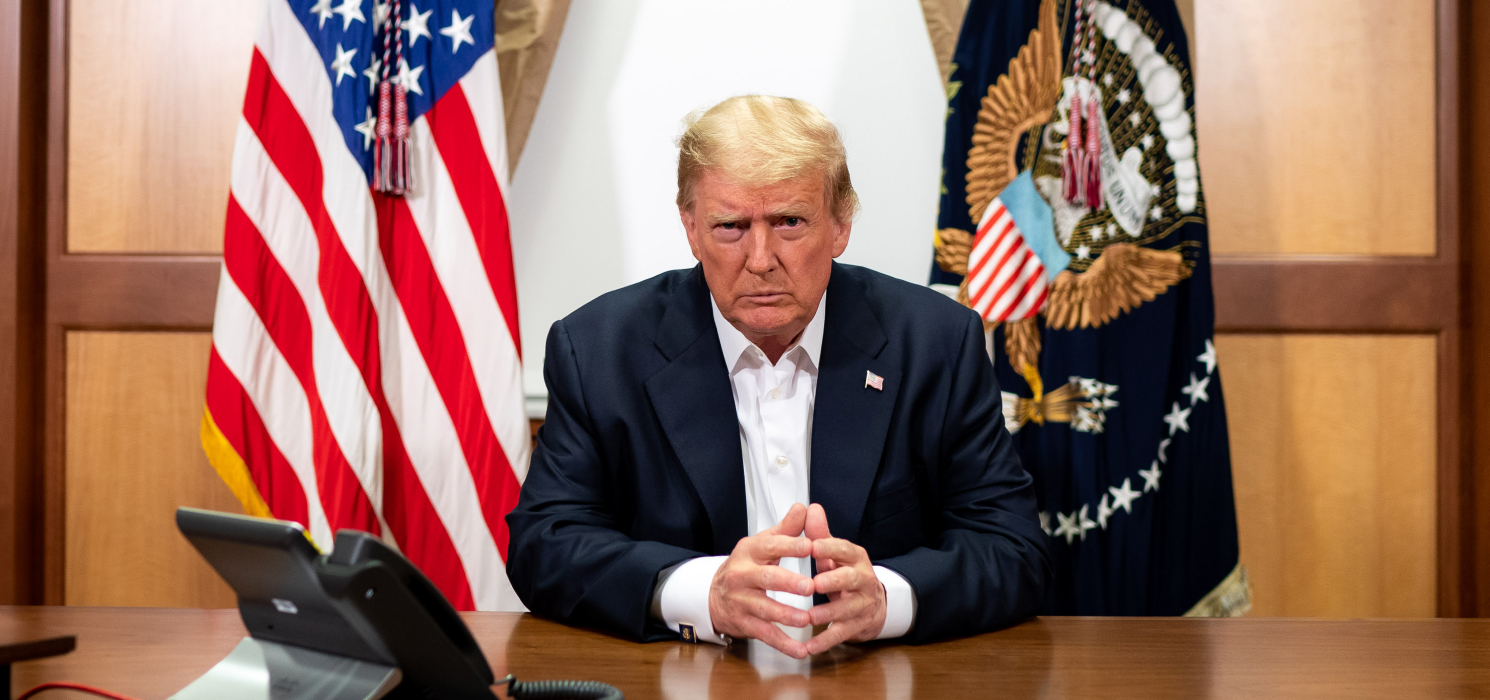
Speaking about the economic results of the presidency of Donald Trump, it must be borne in mind that the role of the state in the American economy is very limited - the president and the ruling party do not have a significant impact on economic development.
Both good and bad economic events in the United States, as a rule, occur regardless of what the government at this moment. A few months ago, SpaceX sent her first manned ship with astronauts to the ISS. It would seem that in space you can’t do without a state. But even in this launch, it played an insignificant role. Yes, it was a state order. But SpaceX is a private company. Her success does not much depend on what the administration is currently in the United States. Other industries depend even less on the state.
But from this rule there are still several important exceptions:
- The American state plays an important role in regulating the economy. An important area is antitrast. If Hillary Clinton won in 2016 and the Democrats received the majority in the lower house of the parliament, the antimonopoly regulation of the high -tech industry would be strengthened. Most likely, this will happen in 2021. The second important area is the regulation of financial markets. Trump dismissed the Consumer Financial Protection Bureau-CFBP bureau, and partially canceled the legislation of the Dodd-franc, created after the crisis of 2008-2009. The third is environmental regulation. The existing system, in particular EPA (Environmental Protection Agency), Trump almost destroyed; The United States announced the exit from the Paris Agreement.
- The state pursues a foreign trade policy, establishing the rules of international trade. What Trump's presidency is remembered for is, of course, trade wars is primarily with China. But with other trading partners - for example, with Mexico, Canada and Europe.
- And one more question in which the state plays an important role is stimulating the way out of serious crises - such as pandemia. The market economy is not adapted to solving such problems, it does not have tools for this. The state’s intervention cannot do here. In the economy, the crisis was not as deep as it could be expected, but in other areas, state policy failed. For example, in America, many schools are still in distance learning.
The pandemic divided Trump's presidency into two segments. Then I will describe what happened to key economic indicators - unemployment, economic growth, trade balance, budget deficit and public debt - on the first segment, which ended in March 2020.
Unemployment
And under Bill Clinton, and under George Bush, unemployment reached very low levels, dropping to 4.5–5%. This level is usually achieved at the end of long expansion .
The presidency of Barack Obama began with the global financial crisis of the 2008-2009 recession - one of the deepest recessions in the American economy. Unemployment in the United States has reached a record 10%. The decrease in unemployment was one of the main goals of Obama’s economic policy from 2008 to 2012. Gradually - however, very slowly - unemployment has decreased. And during the second period she reached its normal level. After that, unemployment continued its decline. And if you look at the schedule below, you will see that the election of Trump has not changed anything: the trend has been preserved.
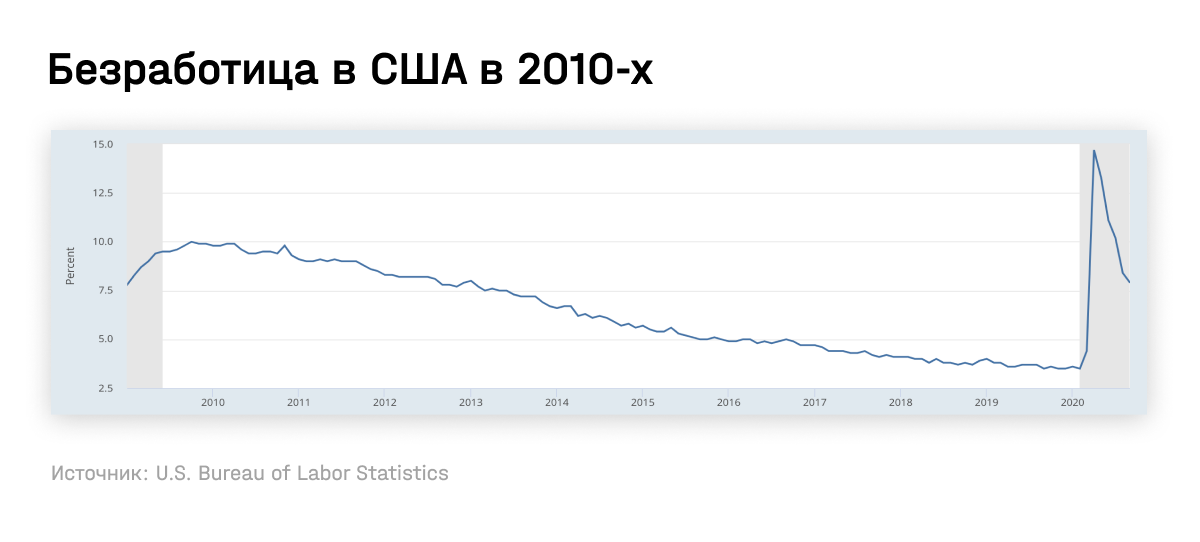
With Trump, the unemployment rate in the United States has reached a record of a low -level of 3.5% - this is the result of one of the longest expansions in the history of America, which began in 2009. During the pandemic, unemployment turned out to be colossally high, about 15% in April 2020 - the result of a unique epidemiological crisis. Nevertheless, neither in a decrease in unemployment to 3.5%, nor in its height to 15%, nor in the next decrease to the current 8%in the first approximation of the Trump administration.
Economic growth
For a long time, the US economy is growing relatively low pace - an average of 2% per year. Developing economies, of course, can and should grow faster, but for a developed economy it is good growth - Europe is growing slower. Has something changed with Trump?
On the graph below (as in the previous one) it is impossible to guess the point at which Trump changed Obama - if you do not know the exact date. And in recent years, Obama growth exceeded 2%, and also with Trump.
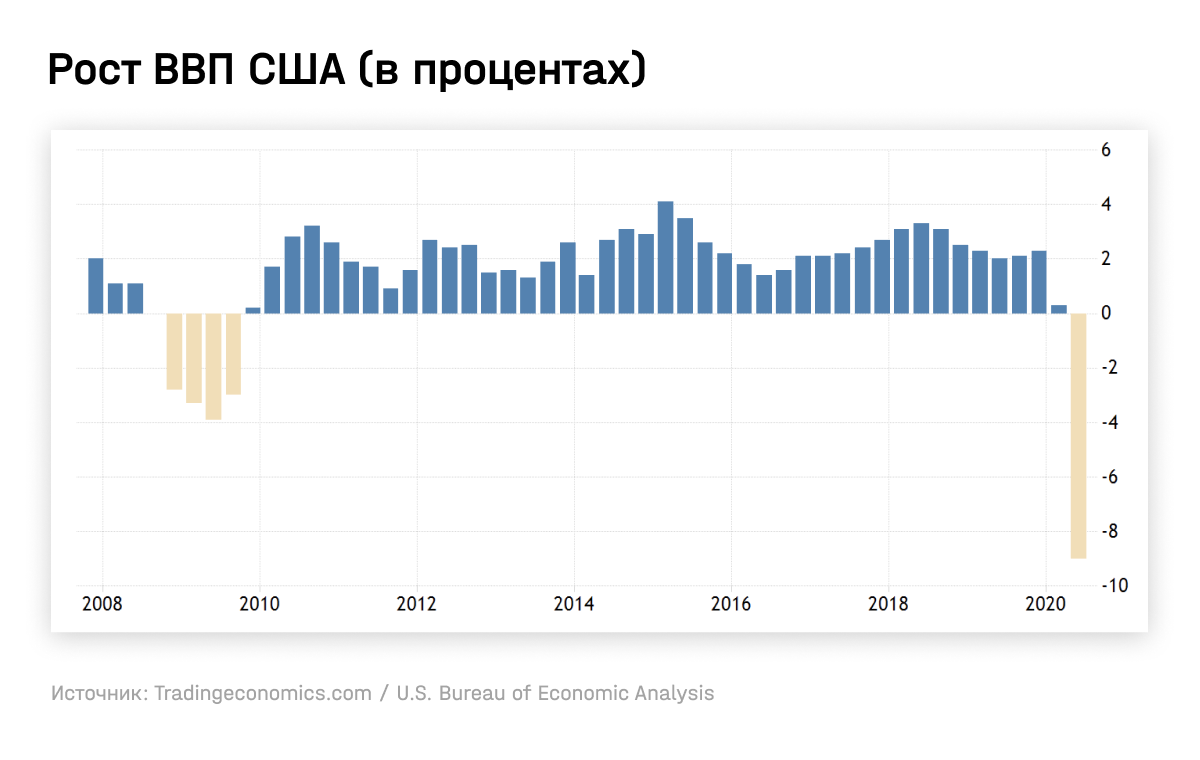
When Trump became president, some economists predicted America to an economic catastrophe. She did not happen. But the miracle did not happen either.
Trade policy
Trump's presidency will be remembered by trade wars. The declared goal was to reduce the deficit of the trade balance. It has increased since the beginning of the 1990s.
Before the crisis of 2008-2009, the deficit reached the largest value: 6% of GDP. First of all, this was caused by the fact that the Americans spent little - the rates were low, so they willingly took loans. At the same time, China, Japan and oil producing countries actively exported capital to America. As a result of the recession, American consumers and businesses began to extinguish loans, began to save more. The deficit has decreased sharply: from 6 to 2% of GDP.
Has something changed with Trump? No. The next schedule shows this - the trade deficit during the presidency of Trump has not changed.
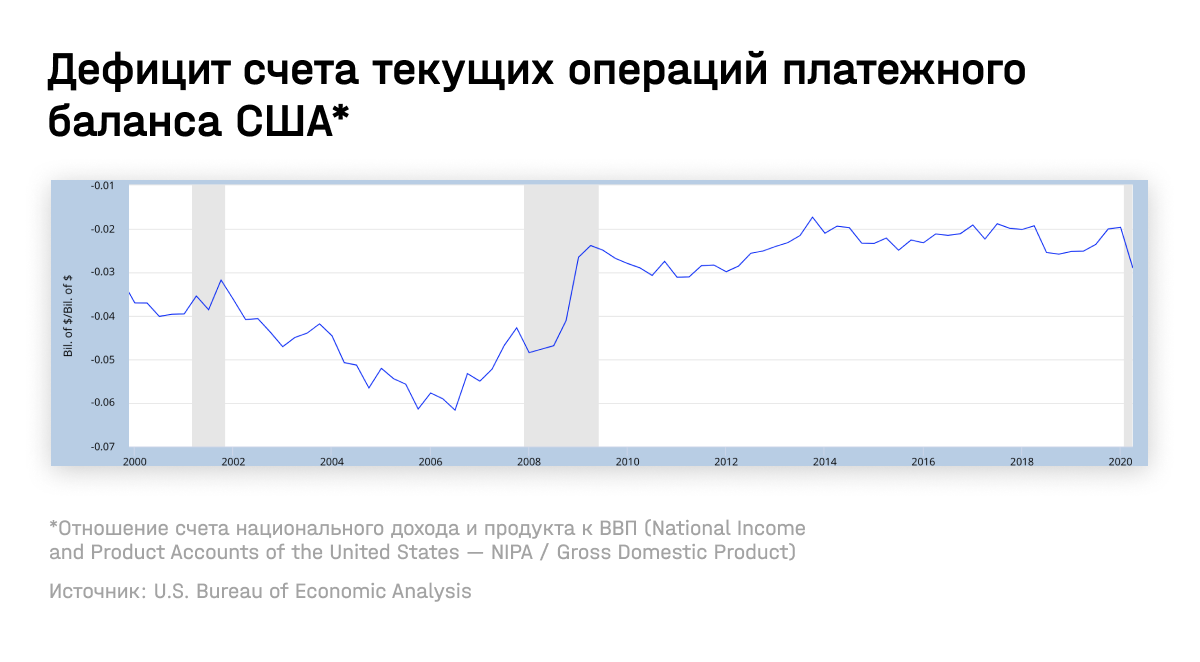
How does a trade balance shortage arise? It is determined not so much by export and import as a balance of savings and investments. If savings are lower than investment, the country should borrow abroad. It is impossible to deal with a shortage of trade balance with the help of a trading war. A trade war can simultaneously reduce both imports and exports. Both are usually bad for the economy in general.
The trade war was rather a political maneuver. During the election campaign, Trump promised to start her - and he kept his promise. The fact that voters voted for this promise suggests that they poorly understand how world trade works.
I must say that there were still grounds for the conflict with China. But they are not associated with a shortage of trade balance. There are problems with theft of intellectual property - this argument lies on the surface. The less obvious argument is that the Chinese market is actually closed to foreign companies. When China was accepted into the WTO, it was assumed that it would give access to its market, provide more or less free competition, but this did not happen. And this is a reason if not for a trade war, then for a serious revision of trade relations, ideally with the participation of Europe, Japan and Korea with the United States. This was not done.
Budget deficit
Trump's most important economic reform is a tax reform adopted in 2017.
Republicans and democrats did not have significant disagreements in the need to reduce income tax - from 35 to 20% or even 15%, that is, to about the level in most developed countries.
The reform was carried out, but it created a new problem: there was a significant budget deficit, since other tax changes did not bring sufficient income to the budget. By the end of the second term of Obama, the budget deficit decreased to about 2% of GDP after the record levels of the 2008-2009 crisis. When Trump's tax reform entered into force (January 1, 2018), the deficit increased sharply. On the schedule below, pay attention to 2019. It was a completely ordinary year, the economy grew. But the budget deficit amounted to 5% of GDP. This is a huge value - as in military or crisis.
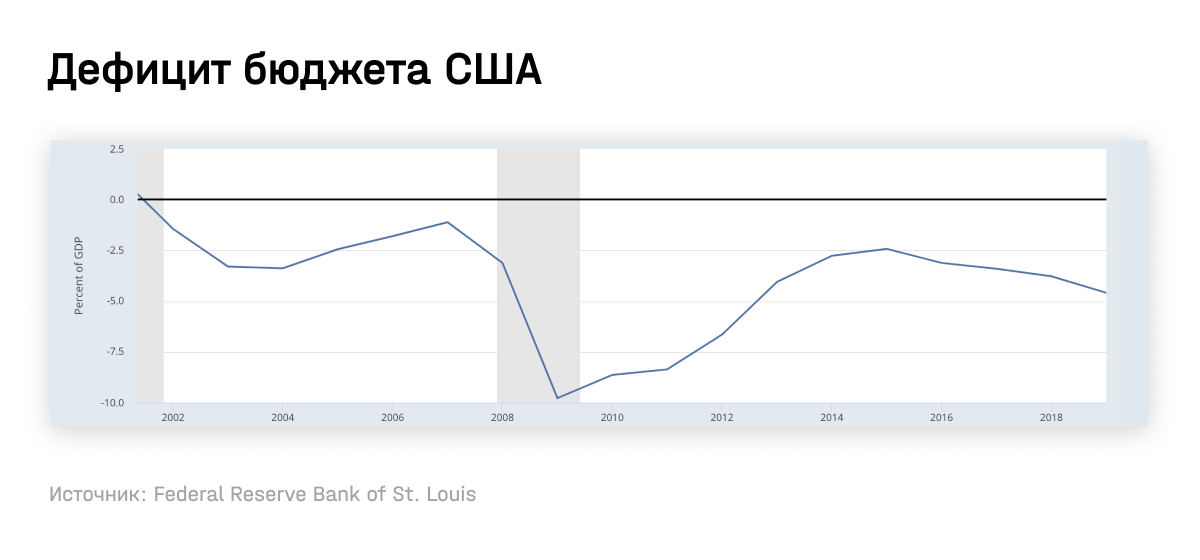
This is not surprising. When the reform was prepared, it was clear that it would lead to a budget deficit. Reducing taxes gives the economy a short -term incentive, but then you have to deal with the deficit: by increasing taxes or reducing government spending.
The tax reform in many respects ensured the economic mini-chudo Trump: in 2018-2019 there were quarters when the economy grew not 2% of the year by 2%, but more than 3%. But the fight against deficiency, in turn, will lead to a drop in growth rate in the future.
State debt
Historically, American public debt was about 60% of GDP. This level is considered safe even for not the most successful European countries, and the most reliable borrowers can afford much more. For comparison, in Japan, public debt exceeds 150% of GDP.
The American public debt grew strongly - to 85–90% - during the crisis of 2008-2009. A new big jump has occurred now-due to state support during the pandemic, and the debt now exceeds 110% of GDP.
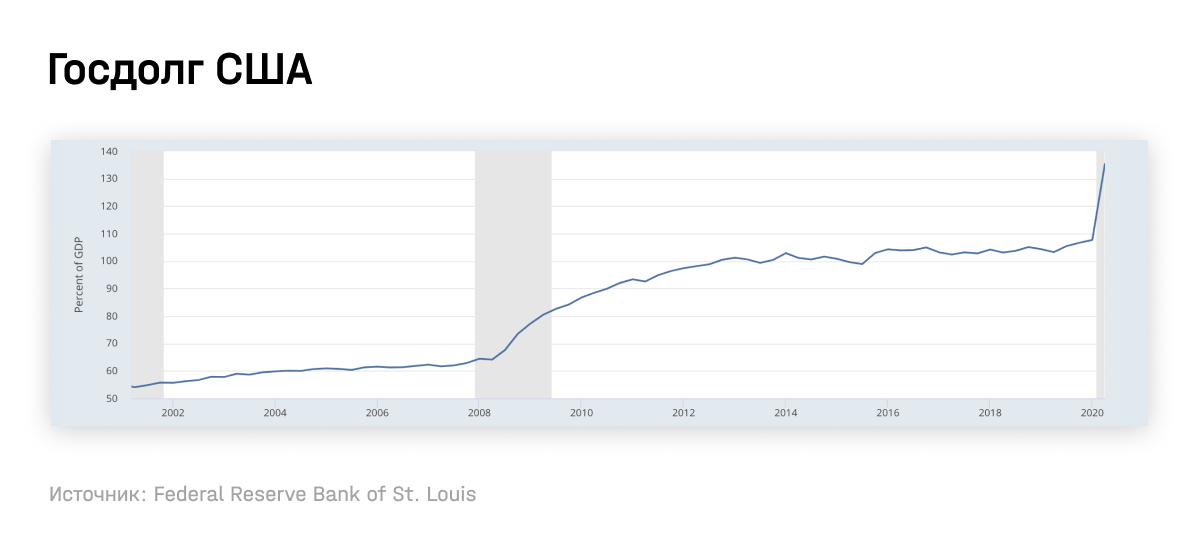
The current level already makes you think about how to reduce it - increase taxes, reduce government costs, etc. This will be a great challenge for the new administration.
It is also interesting here that the Republicans traditionally care about the public debt. When Mitt Romni competed with Barack Obama in 2012, the reduction in the debt was a key theme of the campaign. Another thing is that now, against the backdrop of a pandemic and a new jump in public debt, the problems of 2012 look miniature.
What Trump did not do
Trump fulfilled the majority of election promises (it is another matter that many of them were based on false economic ideas):
- He promised a trade war - and it took place. The political consequences of this war are not obvious, but the economic are obviously negative.
- Another popular election promise is the abolition of the healthcare reform, which was conducted by Obfordable Care Act - ACA, or Obamacare). An attempt to legislative abolition of this reform failed and led to the defeat of the Republicans in the intermediate elections to the lower house of the Senate in 2018, since the Trump administration could not offer an attractive alternative to voters.
- There was a promise to reduce regulation. In particular, in finances and environmental consists. What will be the effect of the abolition of Consumer Financial Protection Bureau (CFBP) is still too early to judge. As for the abolition of a number of environmental norms, then, according to the general opinion, regulation in this area was largely at a dead end. Any new regulation that should appear under the new administration promises to be more effective.
- Trump promised to reduce the number of officials - and reduced. Formally, the state has become less in the economy, but what happened with efficiency is not yet clear.
- In the tax sphere, Trump also did what he was talking about when he was a presidential candidate. It is necessary to make a reservation that this is not a long -term reform. To cope with the budget deficit, it will have to be adjusted.
In fact, Trump did not fulfill only one promise.
In 2016, Republicans and Democrats converged in the fact that the new president would be obliged to conduct ambitious infrastructure reform, invest in roads, bridges, airports, etc.
This topic was not a priority for a very long time - the administration was engaged in other reforms. Obama, for example, made a choice in favor of healthcare reform. She cost him control over parliament - having finished with The Affordable Care Act, he could no longer carry out other reforms. There is some kind of irony that Trump has lost control in parliament when he tried to cancel this reform. Probably, this prevented him from doing the infrastructure.
What voters think about Trump's economic policy
A few weeks before Trump's elections, a record low rating and a short chances of re -election.
But, when voters are asked who is better to cope with the economy, many call Trump. In this aspect, he is not inferior to the candidate from the Democratic Party Joe Biden. At the same time, one must understand: when the president is generally unpopular, this reduces estimates on all points. If there were no pandemia, which hit Trump very much in popularity, there would be even more votes for his economic policy.
Apparently, the point here is that American voters generally associate the Republican Party with a good economy, and the Party of Democrats with the struggle for social justice to the detriment of the economy. Although, as I showed above, there are no real grounds for this: the American economy depends insignificantly on the specific president - at least on the horizon of four years of the presidency.