
Translated material
Philosophy: Women's kind. Diotima
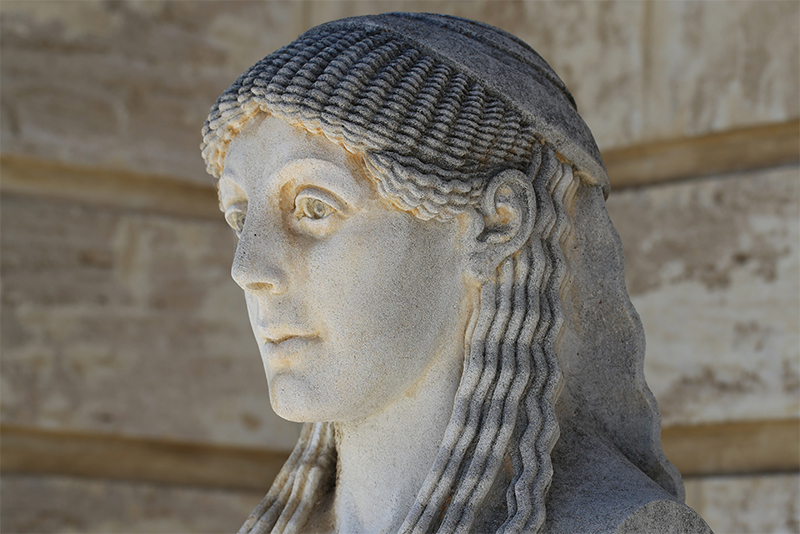
COLTA.RU continues the video book of the section She is an Expert . Today on our air Oksana Gonchako is a candidate of philosophical sciences, a specialist in the history of non -classical logic, ancient and Byzantine philosophy and gender revision of the history of philosophy. She talks about Dyotim - one of the key women in ancient philosophy.
The cycle "Philosophy: Women's Rod" was removed by the founder of the first forum "Women in the film industry", director Julia Andreeva. Administrated the shooting by Anna Zotova.
Dyotim Mantinean ( διοτίμα τὴν μαντίνεια , 440 BC) is a priest of the Elephansian Mysteries, a priest-philosopher who dedicated Socrates “to the mystery of Eros”, at Plato is indicated as a mentor of Socrates in matters of love-is one of the key characters of the Platonian dialogue “Feast”, where in the Pir, where in The retelling of Socrates sets out its concept of “Platonic love” (Eros) - the doctrine of the immortality of the soul, about beauty and good.
Of course, Dyotim is primarily known as the heroine of one of the dialogues of Plato; Along with Aspasia, it is one of only two women who are noted in his dialogs as philosophers and to whom he gives the word, albeit in the Socratic retelling. However, in addition to participating in dialogs, they are quite real historical personalities, which can be discussed with one or another degree of probability (more defined in the case of asphy and less in the case of dyotima). Aspasia actively participated in the public intellectual life of Athens, rhetorically affected many political decisions and on the revaluation of certain historical events (its speech in the Menksen dialogue is subjected to ironic reception at Plato), and also made a significant contribution to the development of sophistry as applied oratory, demonstrating the political potential of public rhetoric rhetoric rhetoric. (for which she was even criticized, believing that she stood behind the unpopular decisions of Perikel, and Plato, including thanks to her rhetorical activity, realized the harm of rhetoric and sophistry as a philosophical direction). In addition to Plato's dialogs, it is twice mentioned by Xenophon, Social Socials have a separate dialogue of Aspasia (not preserved, but mentioned by Plutarch and Cicero), the Aspasy dialogue and a contractik antistenum were also written (several fragments were preserved). Dyotim is mentioned only in Plato, and in this regard, much more questions are connected with its historicity. There are at least four skeptical arguments in the literature against its historicity (see authors such as Rosen, Levinson, Erde, Gold, Friedlander, Anton, Bakhtin, and others). A number of authors also offer quite interesting arguments in favor of its historical existence, based on the difference between her ideas about immortality, the connection of Eros and the Logos and its “concept” of the person from Platonic representations (Weit, Taylor, Kranz).
The figure of dyotima is an interesting reason to talk about the history of female philosophers in terms of studying the issue of mechanisms for the inclusion (or exclusion) of women in the field of discussing general philosophical issues and ideas. Indeed, in the case of dyotim, we can talk about the creation of one of the key concepts of Platonic philosophy - “Platonic” love (“Platonic” eros), or - in a modern Christianized reception - the so -called Platonic feelings. However, if you carefully look at different dialogues of Plato, we can say that this concept is multi -significant and in different dialogs that we are used to calling “Platonic” love, simply is a lot of completely different concepts. In one dialogue, the “feast” can be distinguished at least six different “Platonic” eros, invested in the speech of different speakers, and therefore, to avoid ambiguity, it seems reasonable to introduce various names - “Agafonovsky” Eros, “Aristophanes” Eros, Eros Eriximach, Pausanias, “Socratic” Eros in the “State” dialogue and the “state” dialogue and the state “Dyotimovsky” Eros in the “Feast” dialogue, not even taking into account the historicity or fictionality of the characters setting out their concepts.
However, in the case of the possible historicity of dietimes, such a name seems to be more fair not only from the point of view of clarification of concepts (for example, when we want to personally understand for ourselves, “Socratic” is love or “diotimovskaya”), but also to understand the possible destinies of the “female” word preserved for centuries as their word or reproduced by other authors. The image of diotima and the issues of discussing her historicity can become in a sense a metaphor for the uncertain status of a female think in the history of philosophy at different historical stages of her development in his connection with the history of the philosophy of men, which it is still taught within the majority of academic courses of philosophy.

We make this section together with the She IS an Expert project-the first database of women experts in Russia. The purpose of the project is to make the opinions of women who produce knowledge and are ready to share experience in the public space.
Look for an expert here for your events.
Register and become experts.