
Translated material
Thank you, Donald, or the end of illusions
The permanent author of Coolites - the media analyst Andrei Miroshnichenko will now appear more regularly with us. He begins to lead the monthly column “The Medium and The Message” .
The first text is tied to an event that will not only redraw the political landscape of the world, but will also become a check for some models of the Worldwwide media - with a high probability they will be illusory.
We are talking about the election of the US President, which will be held in a week, November 3. General election layouts were recently explained on our pages by Vladimir Frolov.
Trump dependence of American media
Everyone knows about the crisis of the media. But not everyone knows that some media are flourishing. First of all, the largest American television companies report on profits - unlike their colleagues in other countries. But some American newspapers, such as The New York Times , for example, report the stunning successes of Pavol (paid subscription).
At the end of the second quarter of 2020 , The New York Times scored 4.4 million subscribers to their digital news products. This is a world record. Taking into account the print (about a million subscribers), as well as digital crosswords and culinary applications (so popular that it stands out separately in the report) NYT already has 6.5 million subscribers. The leadership assures that the publication is successfully moving towards the cherished goal of 10 million subscribers.
The most important thing is the income from the numbers in The New York Times this summer for the first time in history exceeded the revenues from the press. Given the scale of the business, we can say that this is the coolest and most long fracture in the press in financial trends in the old media market: the figure finally brings more money than a print.
True, Covid -19 bribed -total income in the second quarter decreased even in The New York Times . The economy in crisis, advertising has fallen, you can understand. Nevertheless, in the indicators of The New York Times and some other leading American media, the entire media market sees a signal: both the market and the public have the impression that a successful business in old media is still possible, that you can survive-you only need to find the right model.
Few people understand that this model is Donald Trump. And not everyone can use it. And even those who were able can lose this "happiness."
Trump-bump
In July 2016, Miki Toliver King reported the Vice-President of Marketing The Washington Post at the Conference of the World Gazeta Publishers about the success of subscribing to her newspaper, linening its dynamics with marketing shares. But if you apply on the same curve the events associated with Trump, then the cause of “marketing success” will become more obvious - and it will be different (ill. 1).
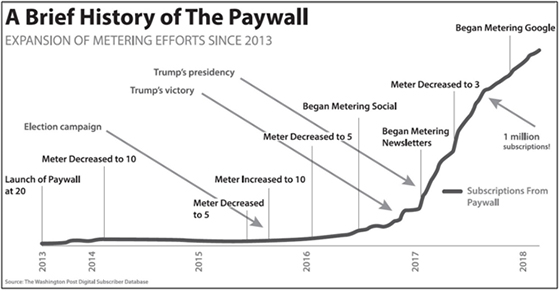 © Source: World News Publishing Focus, Wan-Afra, with the additions of the author Ill. 1. The correlations between the marketing strategy The Washington Post and the dynamics of subscription. Events associated with Trump are added to the graph
It all started in 2016, when the dying media industry was already obviously received a gift in the form of Trump, a candidate-breath who had erased political establishment and returned voters who returned interest in the political process.
Trump turned out to be a good mediator. From the very beginning of the media, Trump paid more attention to Trump - more than any candidate in the history of the presidential election. Not the most generous candidate for advertising, at the preliminary stage, Donald Trump received lighting in the media worth almost two billion dollars in only the first months of the race, if the entire area and the entire air devoted to him is measured at advertisements. He several other candidates (Ill. 2).
 © Sources: Mediaquant, SMG Delta - The New York Times Ill. 2. Paid and free coverage of US presidency candidates by March 2016
What made the leading American media be stuck on Trump? A quick answer to this question was given by the Forest Munvest, the head of the CBS , who announced at the beginning of the presidential race, in February 2016 (now he would not dare to speak out like that): “Maybe this is not very good for America, but this is damn good for CBS . Money flows a river ... this is fun . "
The success of the few leading American media is associated with their ability to monetize the public interest in Trump. More precisely, at first it was interest, then fear. Accordingly, these media first sold interest, then fear ( The Trump Scarae -quite an analogy with The Red Scary , a communist threat, which, according to Herman and Khomsky, was one of the propaganda model filters-the business models of the American media during the Cold War).
The public interest in Trump and his operation in the media turned into media with good ratings, traffic and circulation indicators. In 2016, the period of unprecedented excitement in the leading American media, called the Trump Bump - “surge of Trump” (by analogy with the surge of economic indicators in some sectors after its victory: lifting in the stock market, the growth of the investment expectations, etc.) began.
It was Trump-BAMP that reflected in the traffic and ratings of many media outlets, but some even brought income to some. Thanks to Trump's surge, The New Yorker , The Atlantic and The Washington Post doubled and tripled their signature circulations in the first year of his presidency. It was an unprecedented for them (and for all) a signature dynamics, long forgotten by traditional media.
Of course, the success of The New York Times was the real symbol of Trump-Bump. As we have already said, the “gray lady” shows unprecedented results. At the beginning of the 2016 presidential race , The New York Times had a little more than a million digital subscribers. At the same time, the previous years from the beginning of digital subscription (2014) did not stand out at all. Despite the expected seemingly “low base effect”, the digital subscription curve was gentle until the election began. In the selected year, by the time of the inauguration of Trump, Nyt doubled the digital subscription. And for the entire time of his presidency, she increased four times (ill. 3)! No one in the world could show such dynamics on such volumes (and no longer could).
 © Source: The author’s calculations on the basis of quarterly reports of the publication Ill. 3. Digital subscription to the news products The New York Times (without crosswords and cooking) in thousands
But from Trump-Bump, the most of course won television. 2016 became the most successful in the history of CNN . “ CNN had problems. Donald Trump decided to, ” wrote The New York Times Magazine . TV presenters who focus on Trump received the largest increase in ratings, and therefore advertising in their shows. Steven Kolbert, Jack Tapper, Trevor Noah and Rachel Maddow succeeded most of all; But Tucker Carlson with a conservative Fox News also tasted the general feasts of ratings . The most popular comedy and new program “Saturday Night Live” with Alek Baldwin, very similar to Trump, increased its audience and a half times .
The star hour has come for political reporters and observers. Regular briefings in the White House turned into a starting platform for new journalism stars if they managed to cling to Trump. “This is a great time to be a political journalist if you like to get money and appear on TV,” Buzzfeed News wrote , recalling that a few years ago political journalism was a boring occupation and brought fame only in a narrow circle.
Against the backdrop of such an interest in Trump , a competition for journalism at American universities has grown . And this despite the fact that the industry was considered on the verge of death back in 2015, and now it continues to bend: this fact is simply disguised as a Trump BAMP.
Comedian Michelle Wolf in 2018 at a traditional correspondent dinner at the White House told the assembled journalists: “He helped you sell your newspapers, your books and your television shows. You have helped create this monster and now earn on it. ” Surprisingly, of course, for a speech in the White House, and even to the journalists, who, by tradition, had to honor at dinner on behalf of the president. It remains to add that the president himself was generally absent, probably for the first time in history - he met with supporters in another state. In his residence, he gathered, in fact, opponents, who also listened to the accusation that they led him to power.
In general, Donald Trump made the leading American media again great - the very Great Again that he promised America.
But not related to Trump ceased to be sold.Columbia Journalism Review reported , for example, that even foreign reports and essays have a chance to get into a seal only if Trump is mentioned in them. Media’s fixture on Trump became a problem, in fact, accelerating the destruction of the market outside the few cohort of leading media, which were able to earn on Trump.
Subscribed fatigue
So, the successes of The New York Times and The Washington Post - actively illuminated, of course - created the illusion in the industry that Payvol is working! That a successful transition to a digit is possible - you just need to find the right recipe, as the leaders did. Many began to introduce Pavil at home, but these attempts and especially their results left an oppressive impression.
The fact is that in the digital economy at the same time, the phenomenon of the so -called signature fatigue began to be noted. People are tired of the abundance of subscription services, tired of catching uninvited signature payments every month on their credit cards, tired of marketing tricks when the Internet service first lures “try” for a penny or for free, and then introduces a payment that is not so easy to get rid of. The number of services who want to knock out a subscription out of us is going through. Everyone is trying to switch to this model. Traditional media must be embedded in this competition against the background of increasing users irritation from subscription as a mechanism as a whole.
Intersectoral competition for subscription leads to the fact that in each segment there remains one, a maximum of two services that can achieve subscription and hold it. Video and gaming services, personnel bases, professional services- people agree to pay someone in each category. Naturally, if they are signed, then to the leaders. Subscribed fatigue leads to a concentration of business in every niche and even threatens with monopolization.
The same rule acts in the media: people, for the most part, subscribe to one television package and one media. Those who climbed on Trump win and have already established themselves as Paper of Record -the main source of the media agenda, with which the news is verified, although they are generally recognized anyway in another place-on social networks.
This is the specifics of modern subscription to the press. Newspapers do not sell content, they “authorize” it with their authority as a kind of notaries of public opinion: a modern newspaper - what remains of it - serves as a validator of news than their supplier. In America, readers certify the importance of news in a system of values tied to a political polarization, the main rod in which Trump was a recognized “notary”.
In the American market, the leader of the validation is, of course, first of all, The New York Times . There is some competition from the second number in the cohort - The Washington Post . Business people can also afford The Wall Street Journal - the only newspaper whose success is associated not only with Trump, but also with the validation of news in the adjacent niche - economic.
But in principle, due to the signature fatigue in the market, the rule “The winner receives everything” applies. Consumers have neither a desire nor funds for several subscriptions, as it was before, when households wrote out publications with whole sets (remember that in the Soviet Union the family had from 10 to 20 subscriptions - for each family member of interests).
A few rose, many fell
As a result, the American media is growing between several more or less successful organizations and the rest of the dive market. Analysts began to notice that the subscription of the success of leaders, most likely, cannot be repeated in principle. In 2017, one of the leading mediacritics Matthew Ingram wrote in Columbia Journalism Review that “not all boats caught by Trump will raise all the boats - many will remain in the swamp. There are simply not enough subscribers for everyone. ”
In 2019, Joshua Benton from Niemanlab tried to figure out why Los Angeles Times , clearly entering the cohort of American mega-emails, demonstrates such dull subscription indicators, despite the support of the richest resident of Los Angeles -a millionaire-investor Sun-shyong , who bought the publication in 2018, precisely to Save and give him an impulse. Benton compiled an interesting table, from which it is clear that twenty years ago the newspapers of megacities were generally in the same league. And now they all, in fact, die out, with the exception of two (ill. 4).
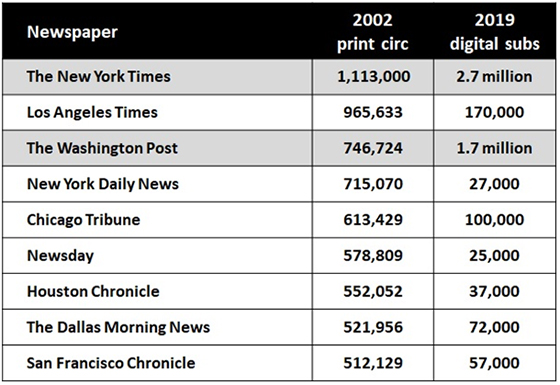 © Source: Niemanlab Ill. 4. Transition of printed subscription to digital, data of some leading American publications
Benton tried to analyze the content and marketing strategy of Los Angeles Times , but the graph shows that this is a global problem. Trump-bump kills local journalism. He focuses on the remaining subscription potential of the audience on the two largest metropolitan media, which are “authorized” by society to validate the news related to Trump.
America was famous for cultural federalism. Unlike Moscow Actric Russia, America could count a dozen megacities, which were centers of regional political, economic and cultural activity, which are superior in intensity and volumes of many countries. The regional media were part of this cultural federalism. Leading newspapers in Boston, Los Angeles , Chicago, Seattle and San Francisco played in the same league as the capital The New York Times and The Washington Post .
This is no longer the case. Local newspapers can no longer sell news, because the news is no longer a product. They also cannot sell Trump, because the signature fatigue left this right only to the two largest newsletters about Trump.
And this still needs to be taken into account the TV that reports Trump faster, better and more emotional. TV as a medium is best suited for news about Trump. And there is also Twitter and other social networks! So the share of many traditional publications remains a very small part of the surplus value of Trump-Bump . The only thing they can distinguish is a more detailed or investigative development of narratives, again associated with Trump. But even this strong side of their strong side is on a new technological barrier - a total reduction in linear reading on the planet.
Yes, Trump-Bump is not for everyone. Trump is an elite product, paradoxically it sounds. Small shops can put it on a window, they can even try to scoop it up with a deadly, but people will buy it only in a large supermarket, where everyone is being cooked. Signatured fatigue led to the ears of the open effect: everyone assures their news agenda in the same place where everyone assures it. Everything is logical, Bandwagon Effect .
It turns out: many media are performing ritual gestures with Trump's exposure, but only units can earn money on this. Trump’s criticism is available to everyone, but Trump’s sale is only for one or two leaders who have already crossed the threshold of the “only signature service” in the industry.
World after Trump: Disaster for the Media
About the end of the 19th century and the whole XX century, advertising brought 70–80% of income in the media industry in countries with a free market. The Internet has taken away advertising from journalism in some 10 years. At the world level, this turn from advertising ended by 2014. Then, for the first time in the present, reader income of publications exceeded their advertising income. More precisely, advertising income fell below readers . Then there was a collapse of advertising income in American publications. In 2013, she collapsed literally “below the plinth” - below the level from which her measurements began in 1950 (ill. 5).
 © Source: Newspaper Association of America Ill. 5. A drop in advertising in American publications
Advertising went to the Internet. And there it was intercepted by the Google duopoly - Facebook , which received 70% of the global digital advertising market. You can understand: the digital platforms offer a massive delivery of an advertising message with such accuracy and cheapness that the old media with their carpet advertising bombing and an insanely ineffective ratio of price and quality simply do in this competition in this competition. The media were forced to look for other sources of income. Against this background, there was a hope that the media will be able to sell content, how they did this before advertising has become a dominant source of financing.
Leading American media created the illusion that the transformation of the media business into the sale of content through digital subscription is possible. But in reality, their success was associated with Trump, and not with the subscription. They did not sell news, but Trump.
Very soon it will manifest: news without Trump is not sold. And Trump can leave-most likely, he will leave-the White House, even if not without a scandal (which will bring the last sob of Trump-Bump for leading publications).
Yes, Trump-Bump will end, most likely, after the elections to the First Tuesday after the first Monday November. After that, the leading American media who earned Trump will have to look for something as outrageous as Trump to maintain a request from subscribers to validate terrifying news.
Для остальных СМИ во всем мире (исключая, пожалуй, немногие нишевые) уход Трампа поставит точку в иллюзиях по поводу подписки. Парадоксально, но с выборами американского президента наступает момент истины для подписной модели в СМИ. Это вдобавок ко всем прочим последствиям, которые несут эти выборы миру.
В тексте использованы материалы из недавней книги Андрея Мирошниченко «Postjournalism and the death of newspapers. The Media After Trump: Manoufacturn Anger and Polarization. "