Date
Author
Катя Бонч-Осмоловская, Артем Щенников
Source

Preserved copy
Translated material
Covid lives for two years
The pandemic in Russia will last until the end of 2021, 6 million people will become infected. This follows from the calculations of the government
With the beginning of the second wave of coronavirus, Russian healthcare authorities and epidemiologists again began to build forecasts: how long the pandemic will last. Most experts believe that the epidemic will not end in 2021, and the incidence will depend on compliance with restrictive measures and will decline only after mass vaccination.
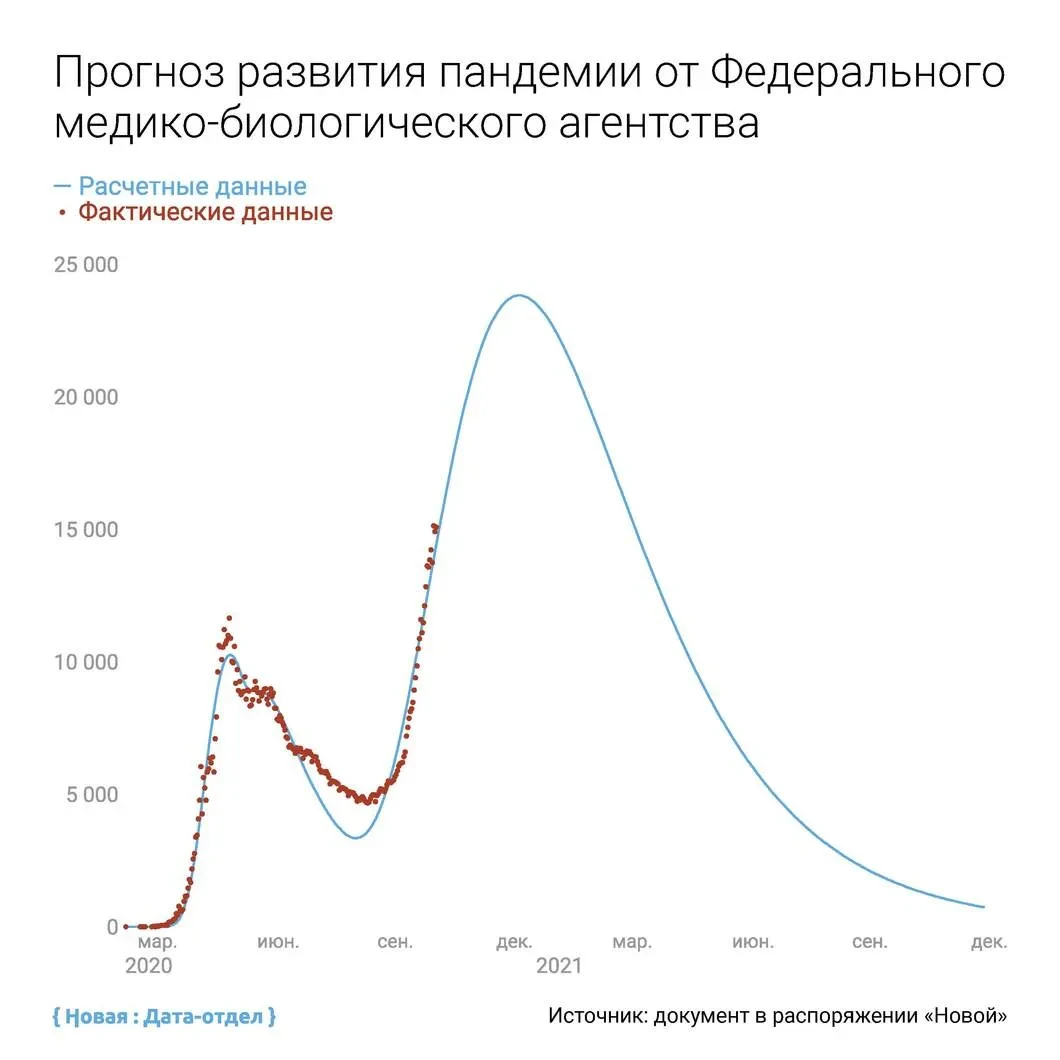
The new coronavirus in Russia, compiled by the Center for Monitoring the Biological Risks of the Federal Medical and Biological Agency (FMBA), was at the disposal of the New ”.
These calculations show that the peak of incidence will fall in mid -December 2020.
The number of cases per day will come to 25 thousand, after which it will smoothly decline until December 2021. The total number of cases will be almost 6 million people, and the number of deaths will exceed 52 thousand.
Such estimates look plausible, but the problem here is in the source data about the incidence that are used to build a model, says Mikhail Tamm, assistant professor of Moscow State University:
“If you take the existing official data and substitute it into some more or less reasonable model, you can get something similar. But in the case of Russia, you need to understand a very simple thing: you take absolutely drawn data that are not related to reality. <...> The main problem of any modeling is that it can be carried out when there is reliable input data. ”
The final number of cases may exceed the estimates of the FMBM, said Boris Ovchinnikov, analyst and director of research by Data Insight. Nevertheless, the epidemic can really last a long time, which will lead to a further increase in mortality:
“The figure of six million [sick] is absolutely conditional, because more than six million people have already become very probable. <...> Of course, the risk that such an intensive phase can last long. And this is a very unpleasant situation, because every new week with our five -digit figures of identified patients brings many thousands of additional deaths daily. ”
The model compiled by the FMM is not published in the public domain - it is probably intended for representatives of the authorities. For example, the Governor of the Kursk Region Roman Starovoit referred to her.
The FMBM did not respond to the request of "New".
Rospotrebnadzor assesses the situation a little more optimistic.
According to the “New” in the department, at the peak of the epidemic, the number of new cases can reach 20 thousand per day, and in mid -November of this year, the incidence will allegedly decline.
Expert commentary
Deputy Director for Clinical and Analytical Work of the Central Research Institute of Epidemiology of Rospotrebnadzor Natalya Pshenichnaya
- The growth rate is quite difficult to evaluate, the infection is unusual, new, there is nothing to compare with. It is possible that the growth will remain until about the first decade of November.
Presumably at the peak we will reach 20 thousand new cases. Further, as we expect, the process of stabilizing the epidemic situation will begin. But it all depends on the consciousness of citizens, on strict adherence to preventive measures by them.
For the epidemic process of the COVID-19 to decline, most of the population should be immune to the COVID-19 either due to antibodies after the disease, either after vaccination, or the “cellular” memory of lymphocytes, which will help to cope with the infection even in the absence of antibodies in some people.
In Rospotrebnadzor, they do not exclude that in the spring the third wave of coronavirus awaits Russia-the incidence can grow again in February-March 2021. The FMBA model does not provide for a new flash.
To make long -term forecasts of the development of an epidemic based on such models is not worth it, Tamm believes. According to him, a lot depends on external factors that are difficult to take into account in advance:
“If you are trying to predict the situation two months in advance, then you will have all models inaccurate. <...> Everything rests on the presence of objective factors. For example, we do not know how people will behave, how they will observe self -isolation, how the weather and change of seasons will affect, what political decisions will be. And therefore, all these forecasts should not be perceived literally. They can give you some guidelines, but in no case should you evaluate them on them. ”
In April, the head of the FMBA Veronika Skvortsova already talked about the model of coronavirus spread in Russia. Then the negative scenario suggested that the epidemic would reach the peak on April 17–20 and end in June: the maximum number of sick people would be 3,500 people a day, and during which time 120 thousand Russians will be ill with coronavirus.
Russia broke these figures at the beginning of May, and against the background of the current increase in the incidence of a “negative” forecast from the FMBM, composed only six months ago, looks excessively optimistic.
Models can become more accurate as the epidemic develops and accumulation of incidence data. However, this still does not make it possible to make long-term forecasts, says Mikhail Tamm:
“This is a common problem in modeling: you can always reproduce what happened before, but this does not guarantee that you can accurately predict the situation. The task of predicting the future two months in advance has no solution. ”
With the participation of Anna Titova
Editor: Arnold Khachaturov