
Translated material
In Russia, 27 streets of Stalin!
Names should be returned not only to people, but also by the streets and squares affected by Soviet power
Shortly before the day of memory of the victims of political repressions, the administration of the provincial Tarusa decided to return the historical names to the central streets, which so far be the names of the figures of the communist revolution. The Vice-President of the Return Foundation Daniil Petrov tells about the return of historical memory, deliverance from the names of the organizers of the Stalinist terror in our toponyms
Expert card
Daniil Viktorovich Petrov-lawyer, candidate of legal sciences, vice-president of the Return Foundation.The organization unites many members of different political and ideological views - journalists, historians, sociologists, writers - united by the conviction that the Soviet government made a huge mistake, destroying many monuments and historical names that could remind Russia of Russia about its centuries -old history.
- Daniil Viktorovich, tell us about your society. What are his goals?
-With our task, we see the return of historical and cultural values lost in the Soviet period. The names are in the first place, since it is easiest to return them. In 1918, the first wave of renaming the Soviet power of streets, squares and cities began. The Communists understood that this was almost free.
And today we understand that
Contrary to the rooted bureaucratic myths, the cost of renaming today is almost equal to the cost of a sheet of paper, on which the official puts his signature.
This must be justified, of course. We need an understanding that the historical name has its value. Among us are people of liberal views, people who rely in memory of the departed tsarist empire, monarchists.
- The White Guards?
- You can say so. The White Guard mainly relied on the idea that nothing was a foregone conclusion: she associated the fate of her homeland with the decisions of the future Constituent Assembly. Given that in the white movement there was pluralism in the highest sense, we can agree that our fund is close to its ideas.
The movement without registration arose in 2008, the fund was registered in 2010. We have very few active members, about a dozen. Although the initiators are Moscow and St. Petersburg, we have supporters throughout Russia. For example, we are actively supported in Nizhny Novgorod, in Tutaev, former Romanov-Borisoglebsk (the city of the 13th century in the Yaroslavl region), there is a struggle for the return of the historical name.
- You start work not from scratch, the mass return of historical toponyms took place during the time of Yeltsin. Are you successors?
-For the first time, the Communists themselves carried out the return of lost historical names for ideological reasons. In the difficult period of the Great Patriotic War, they appealed to the patriotic memory of the people and returned the military officers and epaulets to the military, churches - legitimacy, introduced orders with the names of the tsarist commanders. In 1943, during the blockade, the head of the Leningrad regional committee of the CPSU (b) Zhdanov, following this party line, enlisted Stalin’s approval and renamed twenty central streets and squares.
The renaming was the initiative of the chief architect of the besieged Leningrad Nikolai Bartholomeevich Baranov. It is amazing that he is a descendant of the builder of the Kazan Cathedral, the great architect Voronikhin.
Baranov himself created in the style of Stalinist classicism, but believed that the city should return the historical toponymic appearance.
Now many do not know that in memory of the Bolshevik coup, Nevsky Prospekt was named Avenue on October 25. Even those who were not in St. Petersburg know that there is Palace Square on which there is a winter palace with the Hermitage. It was called Uritsky Square in honor of the head of the Petrograd Cheka from the Left Socialist Revolutionaries.
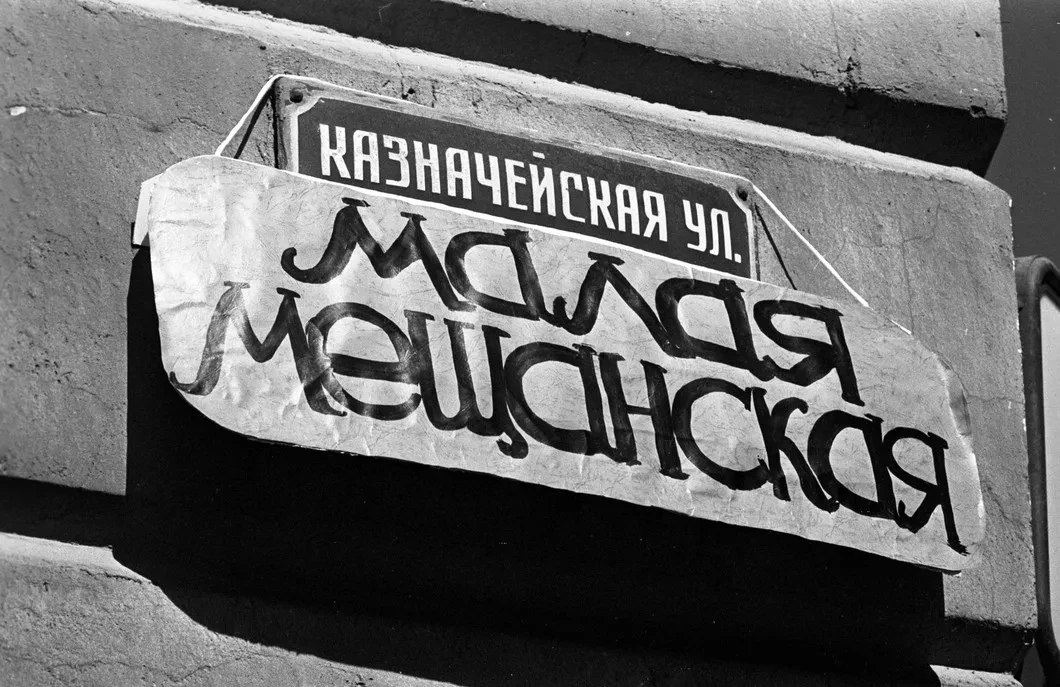
Sadovaya was a street on July 3. Who will say today, what kind of date is this? And this is the date of the first coup, failed by the Bolsheviks in 1917. It would seem that the very proletarian name of the largest prospectus - Liteiny - did not fit the Communists, he was renamed Volodarsky. The field sung by Pushkin Mars was called the Square of the Victims of the Revolution.
On January 5, 1944, a resolution of the city party committee on the return of historical names to the twenty streets of Leningrad was issued under the head of the “secret”. It ended with an amazing phrase: "To entrust the Leningrad Council of People's Deputies to issue this decision in the Soviet manner." This is to the question of who was power in the USSR. That short period ended with the famous Leningrad business, when all the leaders of the besieged Leningrad were shot, who made this decision to rename. Only the architect of Baranov survived, he went into exile in Central Asia.
- What is your and your colleagues a position on the issue of historical continuity, continuity of the process? Where is the line that separates those who should disappear from the names, and the people who were the glory of our science, technology and culture, who were members of the highest party bodies due to circumstances?
- In no case should the Soviet period of history be forgotten. On the contrary, it must be studied deeper, open archives and preserved not only in museums, but also in toponymy. Here you can recommend Moscow experience. Next to the tablets of the returned names there hung explanations about how and why these streets were called in the USSR.
Museums should have appropriate expositions. The filmed names should find everyone there. In Leningrad, there were entire toponymic ensembles: October since July we met at the intersection of Street on July 3 with Avenue on October 25.
Let's define in terminology: there is renaming and there is a return of names. The return of names is, in fact, the abolition of historically erroneous renaming.
Therefore, the first task is to revise the renaming of the Soviet regime, to understand in what cases it was a mistake, the destruction of the ancient historical name.
With the separation of the return of names and renaming, future toponymic commissions should begin, which will entrust this. Are there any cases when the old Soviet names should be changed? Such cases are undoubted for me, although I am in this way with many specialists.
- What criteria are you guided by?
-I consider the Commission of St. Petersburg the best toponymic commission of Russia. The majority of it is very restrained in the idea of renaming Soviet names. We are talking about new streets built in the USSR. In our city, it is believed that they must be left. But there are cases when even the very first Soviet names should change.
Often in the USSR the streets were given the names of people who were terrorists from modern positions. They frightened people, were ready to sacrifice any number of lives in the name of their ideas, often fantastic. Khalturin blew up part of the Winter Palace in 1880, Emperor Alexander II, who destroyed serfdom, which carried out judicial and zemstvo reforms, was not injured. But in the explosion plan, the death of eleven veterans of the Russo-Turkish war from honorary guard was in the inevitable need for the inevitable need. Today, at least 170 streets are named after terrorist Khalturin. In my hometown, Khalturin Street, the historical name Millionnaya was returned.
The terrorists from the Soviet pantheon (they themselves called themselves) - Kalyaev, Zhelyabov and Perovskaya - dedicated many places.
The killed Grand Duke Sergei Alexandrovich, the Moscow Governor General, Kalyaev is mentioned today in the names of 40 streets, Perovskaya-77.
In St. Petersburg, the names of Zhelyabov, Kalyaev, Khalturin and Perovskaya in toponymy are abolished, but in Russia - not yet.
In addition, the names of people involved in the organization and execution of state terror cannot be left in the names. And there are a huge number of those in the names of the country. And in the Soviet years, documents on such the role of Lenin during the civil war were not particularly hidden. And even after the collapse of the USSR, from the documents of the Russian state heading of political history (former archive of the Institute of Marxism-Leninism), it became completely clear. His name is worn by 10,136 toponymic objects.
The Stalin Politburo cannot be circumvented: Molotov, Kaganovich, Kalinin, Voroshilov and others. A huge number of lists signed by them for executions of our fellow citizens and standards for destruction were declassified and published. Destroyed in that era in two ways: by personal lists and regulations launched from above in the region and regions, indicating how many local authorities and the NKVD need to find people of the 1st (execution) and the 2nd (sending to the Gulag) categories.
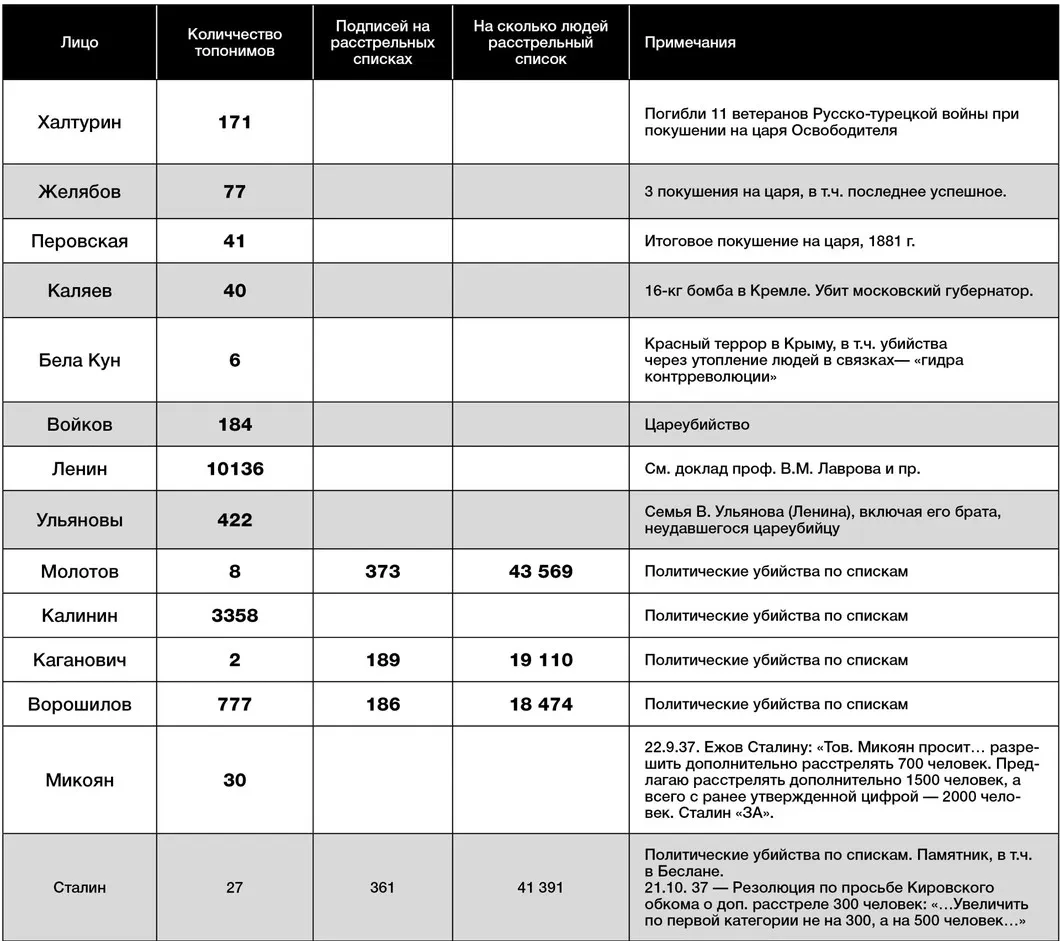
According to my observations, the signature of Kalinin is most often on these lists. According to the Federal Tax Service, this name is found in the toponyms of Russia 3358 times. There are only two streets today, Voroshilov - 777, Molotov - 8, Kirov - 2958. This is not counting parks, stadiums, ships and clubs.
In September 1937, Stalin came from Yezhov such a note: “Comrade Mikoyan asks to additionally shoot 700 people. I propose to additionally shoot 1,500 people, and in total with a previously approved figure - 2000 people. ” Stalin's resolution - "pros." Mikoyan streets today have 30 pieces today.
Stalin's streets in Russia are concentrated in the Caucasus, there are 27 to today.
Finally, you will have to rename the streets that reflect a specific ideology, since this is directly prohibited by our constitution. In my opinion as a lawyer, the name of the streets: Proletarian dictatorship, III International, Communist, Socialist, and so on, meet this criterion. How many fellow citizens know what Mopra Street is ( international organization of assistance to the fighters of the revolution . - V. Sh .)?
Cases of this kind can be called borderline. Of course, such problems can be solved by a population survey that almost does not know either Soviet or pre -revolutionary history. And the habit of name is not related to education at all, it is a matter of psychology. Therefore, when we ask people: "Are you for renaming?" - They respond more often.
It is worth changing the wording: "Are you for the return of the historical name?" - And the answer becomes more positive.
Therefore, it is more correct to create toponymic commissions, as is done in many cities. There are included in the head of the philological faculties, local historians and historians. We do not ask citizens when we decide on the restoration of the architectural monument - there are professional opinions. But the final decision is made by state bodies.
- You happened to participate in the process of returning the historical names of six railway stations in the Urals in 2010. Signed Vladimir Putin. What problems, according to your experience, will have to face those who decide to follow the example of Tarusa? For small cities in Russia, which are counting on the influx of tourists, it may be attractive.
- In its opposition to such an update, the bureaucratic apparatus consistently indicates three problems. 1. It is necessary to change all documents, this is a heavy load on citizens and businessmen. 2. We betray our memory of the Soviet period, because this is also our history. 3. The whole process requires a lot of money.
As a citizen and lawyer under civil law, which has gone through this procedure, I personally can give such a comment.
First. Documents about the place of residence or ownership of real estate do not change when the name is changed in the address, but only when an individual or legal entity moves to another place. Even if the illiterate manager of Rosreestr will require replacement of documents, this will be illegal action, and it is easy to challenge him. In St. Petersburg, many elderly people live with passports and documents in which the streets of Zhelyabova or Kalyaev appear, the city of Trotsk (Gatchina) is indicated in the birth of some. They do not need to change anything.
About the oblivion of the Soviet past. The number of streets and cities built after 1917 is extremely large, it is impossible and not necessary to eliminate this toponymic fund. The Soviet past in the names and visible signs will remain with our descendants forever.
We are talking about the return of historical items in the number of relatively small, concentrated almost always in limited historical centers of cities.
From the historical point of view, the Communists made grandiose mistakes, renaming the streets and cities, which are 500-700 years old.
Still, Russia is more than 1000 years, not 70, as it might seem if you look at the architectural plans of our cities.
About value. It comes down to the maximum to replace the signs. The average cost of one in Russia is 1050 rubles. Many public organizations are ready to take on these expenses. And on large campaigns there are always sponsors. As far as I know the situation in Tarusa, several public organizations announced their readiness to pay the costs of returning historical names.
But there is an even simpler way out. Few people think that the tablets themselves are regularly replaced without any renaming, they simply wear out. In St. Petersburg, this happens every seven years. And when Valentina Ivanovna Matvienko in response to our petitions indicated expenses, we simply offered to change them in a couple of years, when the planned replacement was suitable.
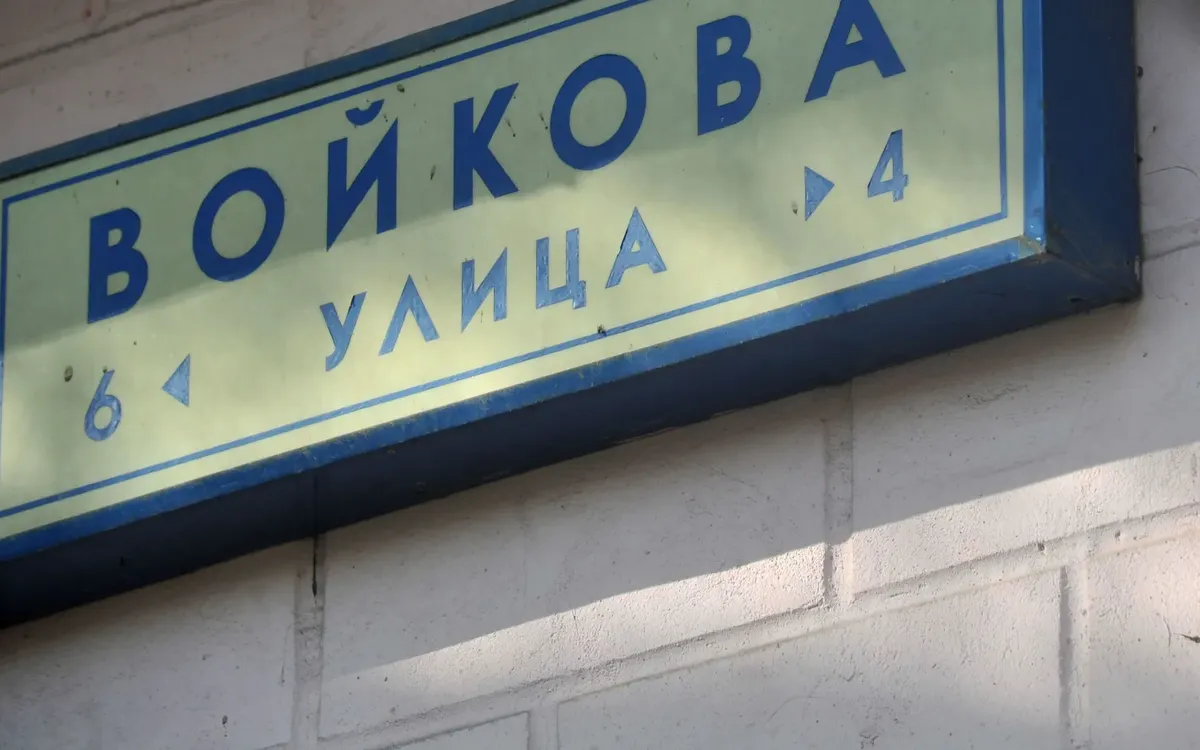
There are a lot of cunning in these arguments: when in Moscow they renamed the Karacharovo station to Nizhny Novgorod, no one remembered the cost. But discussing the renaming of the Voikovskaya metro station (named after the killer of the royal family), the officials publicly grabbed their heads - they saw so much trouble and expenses. In fact, there would be less expenses than when renaming Karacharovo.
Just in St. Petersburg, the Novokrestovskaya metro station was renamed Zenit. All cards in wagons changed in a month! And no one talked about expenses, because these schemes are regularly and often change. In the decision of the Leningrad City Council of January 1944 there is a point on the release of sheet iron on the streets. But the blockade has not yet been removed. I think this example closes all the objections of a material nature.
- Do you feel the unspoken attitude of officials to such initiatives?
- Most often, the appeal to budgetary savings and bureaucratic problems is just covering.
Firstly, officials are really afraid of the socially active part of society, which believes in communist ideals and aggressively opposes all changes related to the memory of the USSR. They can go out without clutching on the street with posters, throw the managerial apparatus with collective and private letters, complaints. They are easy to climb, they are not difficult to write a statement to the prosecutor's office.
Secondly, local officials are not enough education and political skill, I'm not talking about authority. They do not know how to speak with such an element.
Thirdly, many senior officials publicly nostalgic for the Soviet period, and this is an important signal to the places: even provincial patriots and local historians among county bureaucracy are afraid to show disrespect for unequivocally expressed sympathies of leadership.
- Do you hope for the continuation of the process of returning historical names to the streets and squares of Russia?
- It cannot be denied that the appearance of the object, its content are always associated with the name. Horse sculptures on the Anichkovo bridge in St. Petersburg could not be created on the avenue on October 25. The constructivist cinema "Drummer" in Moscow could not be built on Cathedral Square.
And the historical appearance of small cities should be treated especially carefully. Local historical toponyms play even more important role there than in large cities: in small areas, the mismatch of the toponymic ensemble of the architectural simply cuts the eyes. And thank God that Tarusa, known in the XIII century as the city of Prince Mikhail Chernigov, again gained Bogolyubskaya, Voskresenskaya and Brick streets, thus deciding the issue of tourist attractiveness. The tourist business paradoxically stimulates respect for local history and wider - self -esteem.