
Translated material
From the bottom of the heart
Conduct an experimental operation is not the most difficult for a doctor
Who was the last will be the first. This is a biblical saying for everyone. But in this case, we will not talk about the moral-religious connotation of this saying, but about the development of science, which, it would seem, should be the positivist postulates and support on irrefutable evidence based on experiments. It will not be about the deaf Middle Ages, but about the near past - the twentieth century. The location of the post -war (after the First World War) Germany is a civilized country, the cradle of many modern sciences, including medicine.
The fate of the outstanding German doctor, the founder of endovascular surgery, is in the spotlight and the fate of the outstanding German doctor. It is to him that we owe that stenting of heart today has become an almost routine operation that saves millions of people from heart attacks and strokes.
However, the life and fate of this doctor is dramatic, his path in medicine was not dotted with roses. His name Werner Theodore Otto Forsman was born in Berlin in the family of lawyer Julius Forsman and Emmy (Gindenberg) Forsman. He received primary education at the Berlin Askani gymnasium. In 1916, when Mosman was 12 years old, his father - the captain of the German army - died in the Battle of Galicia. In 1922, Forsman became a student of the medical faculty of Berlin University. The economic situation in the country after the war was such that Forceman was forced to enter the bank in search of funds in a temporary job. Nevertheless, he passed preliminary medical exams, and two years later, internships, in 1928, and state exams. A year later, after the defense of the dissertation on the effect of medical nutrition on the content of serum cholesterol and the amount of red blood cells in the blood, he was assigned a medical degree of Berlin University.
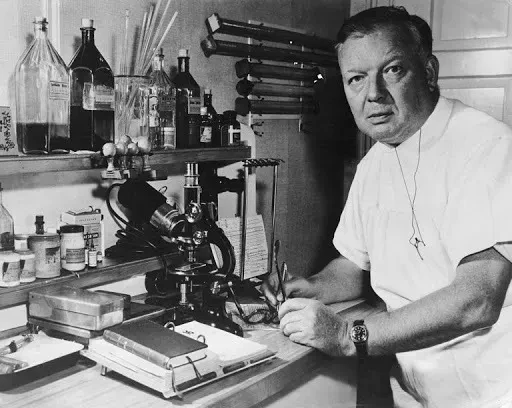
In 1929, Forsman entered the Eberswald surgical clinic near Berlin, where he began a series of experiments aimed at demonstrating the anatomical and functional features of the human heart in his diseases with the help of catheterization. This method is that a catheter is introduced into the heart through a vein. Before the experiments of Forsman in this area, very little had been done by that time. In 1861, two French physiologists conducted a catheterization of the heart in experimental animals.
Later, in 1912, German doctors tried to introduce a catheter into the abdominal aorta (part of the aorta, the main vessel of the arterial system located in the abdominal cavity) of women suffering from postpartum sepsis (complication of postpartum infection), with the aim of more effective drug therapy. Women did not experience any harmful consequences from this procedure. In 1928, an Italian researcher introduced a catheter into the heart of experimental animals and corpses of people. In 1929, having tested such experiments on corpses with the introduction of a catheter into the right departments of the heart, Forceman set himself the goal of prove the safety of this method in clinical practice. He persuaded one of the employees of the Eberswald surgical clinic to help him conduct this procedure in the experiment on himself. The colleague managed to introduce a catheter (a tube with a length of about 65 cm and a diameter of 1 mm) into the elbow vein of Forsman. Starting to promote the catheter towards the heart, he, frightened that this could be too dangerous, stopped experience.
A week later, having not received permission and not even informing his leader about it, Forsman independently carried out the catheterization of the heart.
In the presence of only a medical sister, Forsman conducted a local anesthesia, made a cut, exposed Vienna, introduced a catheter and advanced it about 60 centimeters until he entered the right atrium.
In the X -ray department with the help of a sister who held the mirror, Forsman, looking at the screen of the X -ray apparatus, was convinced that the tip of the catheter reached the heart. Subsequently, he did several more similar experiments, bringing their total number to nine. In two cases, he introduced a contrast medium into the blood, which allowed him to take much more detailed X -ray images of the heart than with ordinary radiography.
At the end of this series of experiments, Forsman published the article “Probing the Right Heart”, in which he described the catheterization methodology and examined its potential for studying the anatomical and functional features of the cardiovascular system under normal conditions and in its diseases. Trying to improve his method, Forsman began a series of experiments using laboratory animals, but the lack of funds in the clinic forced him to stop the experiments.
Forsman announced the results of his research at the XXV conference of the German surgical society in April 1931. However, the authorities of German medicine did not take into account the importance of his experiments. A year later, he was admitted to the service of Ferdinand Zauerbruch in the Berlin hospital for the poor. Soon, however, when one of the Berlin newspapers published a sensational message about his research in the Eberswald clinic, a whole flurry of criticism from his colleagues fell on Forsman.
The Zauerbruch came to the point that he called him a charlatan and fired him from work. Forsman was so offended by what had happened that he decided to interrupt his research.
It can be seen that it was not for nothing that the outstanding physicist N. Bor once remarked: “In order to win new ideas in physics, it is necessary that old physicists die.”
We do not wish anyone evil. And especially in the conditions of the pandemic we wish you all health: both elderly and young people, regardless of their professional classes. But there is a share of truth in this sinister statement.
A similar story that happened already on our domestic soil recalls Yuri Rost. Sinclite Academicians conducted a consultation, discussing the strategy and tactics of treatment of an unusual boy. It was the grandson of one of the members of the Central Committee of the CPSU A.Ya. Pelsche. Cautious academicians proposed conservative methods of treatment, which inevitably had to lead to death. The consultation was attended by a young cardiosurge of E.N. Meshalkin, who knew how to save the boy. He had already taken a step forward, but was stopped by Academician V.I. Frantsev:
“If you express your proposal now,” Fransev whispered, “you will cause jealousy, resentment and aggression of the elderly. And then your method will be buried for many decades. Yes, this boy will die, but you can successfully treat thousands of children! ”
Strictly speaking, we will not recognize anything new. But were the life and professional fate of Fedorov and Elizarov built differently? In any field of culture, art, education, finally, the management of everything new with great difficulty breaks his way.
But on the other hand, maybe the path-through thorns to the stars-is not only logical in its own way, but also justified? Judge for yourself. Bernard was the first in the world to transplant his heart and became a celebrity. Having become a public person, he was forced to work on his image. But, as the poet said, "the service of muses does not tolerate fuss." The muse of science, Urania, is no exception. As a practitioner, Bernard ceased to exist.
Yes, it is scary to be the first, but even worse, being in the last rows, to become a brake of development in the area in which you work.