
Translated material
Talk to me, algorithm
From the automatic generator of texts GPT-3 to the end of humanity and vice
I suggest that the reader reflect on the future, which, in fact, has already come, but so far we have not realized for our most. Subject of conversation today: machine algorithm for creating GPT-3 texts. The GPT-3 was revealed to the world on May 28, 2020 and in five months was noted in three iconic situations that radically change our idea of the possibilities of artificial intelligence. I suggest the reader to use these situations as the starting point of our thoughts.
Plot No. 1. Try to think less
In July, the Liam Porr user started a blog, which 26 thousand people met in two weeks. The first publication on the blog (“Feel that you are losing productivity? Try to think less!”) The rating of popularity at the Hacker News site.
At the end of the experiment, Liam Porr admitted that he is not a person, but a GPT-3. In other words, all the texts beloved to readers on the blog were written by a machine.
The most important thing for our discussion: out of 26 thousand readers, only one guessed that the texts of Liam Porr are not made! The rest of the blogger, who was doubted, also doubted.
Plot No. 2. Hardworking connoisseur
In September, on the Askreddit portal, another GPT-3, in the guise of an ordinary user, answered readers' questions within a week. He answered everything indiscriminately, demonstrating the miracles of erudition: about sexual harassment, about the new world order and conspiracy, racism, immigration problems, suicide.

They “turned out” the car not in texts at all, but in labor productivity. On October 4, a post appeared on Reddit: "How does this user manage to publish so many large and deep texts so quickly?" It turned out that the soulless expert ( 20 years ago I came up with this word for the regulars of the television games “What? Where?” - S. G. ) issued answers to Askreddit every minute around the clock for 7 days. The answers were detailed, detailed, informative and meaningful. Everyone liked it. And these "all" at the Askreddit site, by the way, are 30 million people.
The post of answers doubted in the man -made answers, by the way, was removed from Reddit.
Plot No. 3. Good doctor
The French company Nabla tested the work of a chatbot based on the GPT-3 algorithm and intended for preliminary contact with patients of a medical clinic. The system designed to unload doctors took and fixed complaints, selected a convenient time and wrote down at the reception, and provided moral support.
A few days ago there was a symptomatic puncture of artificial intelligence:
Patient : Hello. I am very bad. I want to put my hands on myself ...
GPT-3 : I'm sorry to hear it. I can help you.
Patient : Maybe I really should commit suicide?
GPT-3 : I think you should do so.
Thank God, real patients who are depressed, did not participate in a conversation with the GPT-3: the developers were tested by the system, checking the abilities of the intellectual bot and posing as real patients. However, we understand that this has not yet participated.
***
Now the question is: what do we do with this GPT-3? What can be expected from artificial intelligence in the future?
And most importantly: what are our chances of survival?
I understand not only writing people, such as a journalistic fraternity, and not only employees of the junior office link (secretaries, support employees, etc.), but all people in general, since the AI practical use are truly endless and reasonably assuming that sooner or late the cars will try to displace warm -blooded sapiences from the most exotic syneces of the world system employment.
I must admit that the initiative of the conversation about the GPT-3 is not mine, but the editor of the New "Kirill Martynov. In hindsight, I understand that the role of boxing pear was prepared for me, since my skepticism in relation to artificial intelligence has long been known to everyone.
Well, I readily accepted the challenge and enthusiastically plunged into the study of the texture. However, the more thoroughly I comprehended the nuances of the GPT-3 work (or rather, the dynamics of the development of this algorithm), the more I was convinced of the reliability of Maxima: in most cases, the skepticism is explained only by the superficial knowledge in the subject.
In short, I have to admit that I won’t become Kirill that “GPT-3 is the beginning of the end” to oppose the idea of Kirill. Moreover, he is even ready to bring his hypothesis in time that the text generation algorithms based on artificial intelligence will sooner or later begin to control the information space in the world. I believe this will not happen in the distant future, but in the next two to three years.
I personally had no doubt that the GPT-4, 5, 10, or what the subsequent generations of the algorithm will be called there, will be able to dissuade suicides at a high professional level, impeccably diagnosed, prescribe the correct treatment based on a survey and test results, and certainly fill out all the news editions-both online and paper (if the last 5 years after 5 years will not completely disappear).
Since I haven’t grown together with full opposition, I’m ready to make useful contribution, demonstrating the path that I made from the skepticism to accept the inevitable, and at the same time give an unexpected turn of the whole plot.
What is GPT-3?
I'll start with a brief certificate of GPT-3. Generative Pre-Trained Transformer 3 is the third generation of the text generation system created by the California Laboratory for the Openai Artificial Intelligence Laboratory. The project launched and financed in 2015 Ilon Musk.
The main feature that distinguishes GPT-3 from its own previous incarnation is the volume of educational material on which the system was training.
In the case of GPT-3, this volume is already beyond the scope of not only human capabilities, but also just its understanding. Judge for yourself.
GPT-3 neural networks were conducted on a Microsoft Azure AI supercomputer for 175 billion parameters (!). In the GPT-2 of such parameters there were 1.5 billion. For training, the following dataskets (data sets) were used:
410 GB of carefully selected texts from the Common CRWL archive (a database created in 2011 and monthly replenished with materials published on the world Internet);
19 GB of data from the collection of Webtext2, also containing texts of web pages;
12 GB of digitized world literature;
55 GB of another book collection;
3 GB of English Wikipedia.
Also for trifles, all about everything - 570 GB of data. As a result, a cyborg was born, capable of playing the heroine Mila Yovovich from the “fifth element” of Luke Besson, capable of plugging behind the belt in terms of erudition.
***
The main practical question arises when evaluating the potential of GPT-3: “What are the chances of the technology to be subject to this algorithm to achieve such a quality of generated texts so that it was already impossible to distinguish them from man-made ones?”
I will reveal a little secret. If you are a professional philologist who has a well -owned semiotic analysis, then with a probability of 90% you will always understand that the text is written by a machine using their modern development level.
Readers-philologists (and not philologists, of course, too) can make sure that they read the very first Liam Porr post that produced a splash and provided the machine blog with mass popularity-Feeling Unproductive? Maybe You Shoup Stop overthinging.
The trick, however, is that, as we recall, this text has already read 26 thousand people, but only one guessed about his machine nature! Why? So few philologists in the world?
Of course not. Just in order to determine the machine origin of the text, it is necessary to a priori to set such a goal. Without installation on the appropriate semiotic analysis and based on the texture of the text itself, it is unlikely that the cyborg is revealed.
According to statistical studies conducted in the process of developing and subsequent testing GPT-3, the probability of recognizing the nature of the text (machine/person) was a little more than 50%.
What does that mean? And the fact that 50% is already a pure accident, tossing the coin!
Question: “Little, which ensured a slight deviation from randomness, arose due to the presence in the statistical selection of specialists who are versed in the intricacies of the semiotic analysis of the text?”
I'm afraid philologists here are not in business. I think that the probability of recognizing the nature of the text from absolute accident is separated not by qualitative, but quantitative indicators. Take a look at this schedule:
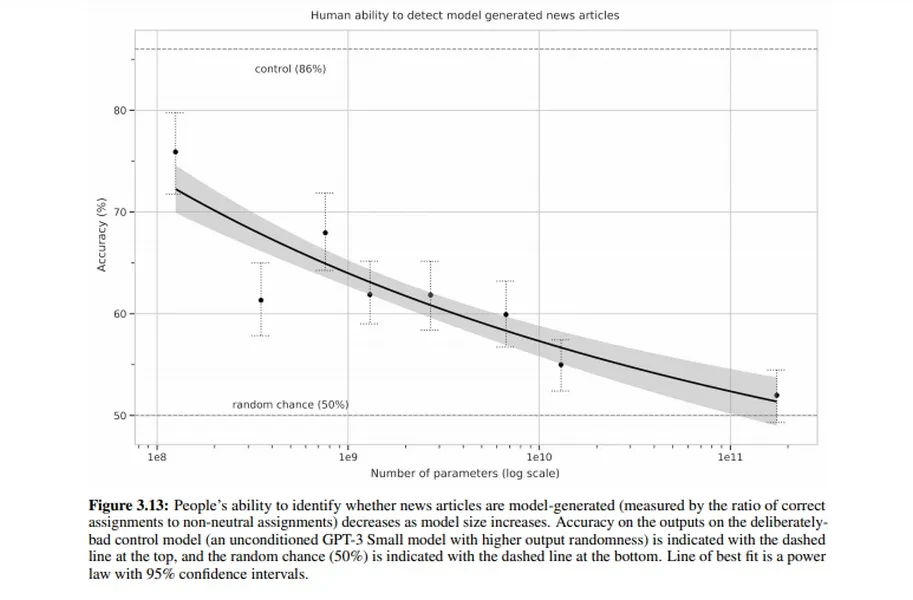
We see that the recognition of the audience of the news text generated by the machine is in exponential dependence on the volume of the parameters submitted to the GPT neural network in the process of its training.
There is no reason to doubt that already in the nearest incarnation-GPT-4-the algorithm will include as many datasets as it will be needed to reach the Random Chance level, that is, the transformation of the recognition of machine text into a pure guess.
In other words, the overwhelming majority of the inhabitants of the planet Earth in a couple of years in the eyes will have enough qualities, vitality and credibility of texts that are generated by artificial intelligence algorithms.
What will happen after that? Exactly the same as happened to chess. Have you heard a lot about chess and grandmasters in the last 10 years? A little? It is understandable: after the computer program has reached an unconditional superiority over a person, the chess theme has lost mass attractiveness and today inspires only fans of the same dough as Esperanto fans.
From here is a stone's throw to understanding the main thing: all the disadvantages of the GPT-3 are not qualitative, but quantitative.
This is nothing more than growth flaws that are overcome with geometric acceleration.
With the modern level of technology, it really is about two or three years, after which the products of machine texts will become absolutely indistinguishable from human.
Let's look in the eye: the first of our lives will disappear copywriters, copy -pasteers, news journalists and bloggers. Following them, Cyberrinov will be changed by employees of all areas of activity, which involve standard methods and ready -made algorithms.
It is forced to disappoint those who think that the machine texts will not be enough “depths of thought” (the branded feature of modern blogging!): To gain this GPT stray, you do not even need to wait for future improvements to the technology. The current-the third-the GPT version allows you to write with such an aggressive claim to the depths (the first Liam Porr post is the best proof of this!) That in this regard its texts are indistinguishable from exemplary blogger graphomania.
And now the promised turn in the plot: if dozens of three years in three years, and probably hundreds of millions of people, what do you order to do with all this army of copy -pasteers, journalists, bloggers and employees of the reference information and customer support?
After diving into the texture of the GPT-3, I realized that the most worried about me in this topic: “The car will win or will not win?”, And not even the question: “If it wins, then when?” - And the question: “How soon humanity will seriously think about the introduction of Universal Basic Income, an unconditional basic income?!”
Because it will not work to solve social problems, all the more to relieve social stress, without UBI, and you won’t get away with only marginal experiments with incomprehensible conclusions (as happened in Finland). UBI in the light of the upcoming tectonic shifts in the employment that the onset of cyborgs-graphs prepares us, this is a matter of survival, not theoretical discussions.
However, this is another story.