
Translated material
Medical values
From November 12 to 19 in St. Petersburg , the LGBT Festival “BOC ON BOK” will be held, part of the program of which this year can be watched online on a special platform. All discussions and meetings with guests will also be broadcast on the Internet. The program includes a film about the street art artist Kitte Harring, the dock about the life of lesbians in the GDR, produced by Netflix “Expanding” about the representation of transgender people in American cinema and on television, festival hits from Denmark, Germany and Argentina. We talk about the two best game paintings by the festival - the drama "You and I" with Barbara Zukova and the winner of Berlinal "No offense."
"You and me"
Nina and Madeleine are middle -aged neighbors living in a small French town. Their apartments are located on one floor opposite each other, and almost all the time the heroines spend together. Not only friendship is connected by them: Nina and Madeline are partners, mistresses, their novel lasts many years. Others are not aware of this. Adult children Madlen are sure that the mother was faithful to their father all her life. The heroines dream of selling separate housing and moving to Rome - a city with which they have special memories. But for this, Madeleine needs to tell your son and daughter about everything. She cannot decide on such a step.
When another attempt to recognize with a bang falls out, Nina is lost, and the result of the quarrel of the two women is their separation. It is easy to guess the trailer about what exactly causes her, but if you have such an opportunity, be patient and do not watch it: believe me, it will be much more interesting.
This picture is a hundred percent audience favorite, the organizers “side oh side” not in vain put her on the opening of the festival. The Italian director Filippo Menhegetti, who settled in France, for whom the film became a debut in a big movie, in an interview (you can read it here ) says that in childhood it was a witness to a similar story, but immediately stipulates: in reality the situation was tougher and worse. Of the obvious cinematic allusions here, of course, it is worth mentioning the “love” of Michael Haneke - the Meneghetti tape could well borrow the same name. But if the cold-blooded Austrian, which was killed by the gray-blooded Austrian, was interested in leaving life, then the 40-year-old Italian is about how to linger in it.
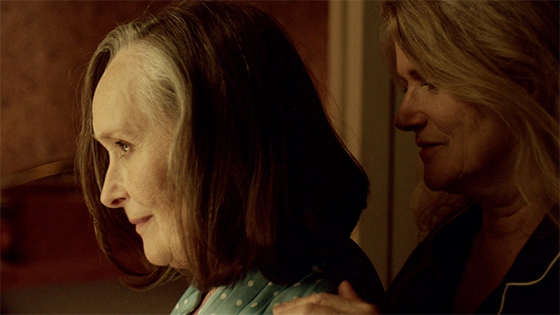 © "BOCO ON BOC" Frame from the movie "You and Me"
The purpose of the study is also different. He studies the double invisibility of his heroines. The first is connected with their age. Women over 60 years old, as a rule, exist on the screen only in the images of someone’s wives, grandmothers or just neighbors. They are deprived of subjectivity, they have no their own life in isolation from the family or society. The second applies to (homo) sexuality . This youth can afford to be open, and people of a more mature age often continue to live in captivity of the old norms that order them to be “serious” and “sedate” (no matter what it means). In the "You and I" one of the first scenes is erotic: the heroines demonstrate that the passion from their relationship has not gone anywhere.
Meneghetti took two great actresses to the main roles. Madeline plays Grand Dama Comedy Frances, Martin Shevalier, Nina-the amazing Barbara Zukova. In the middle of the film, Nina comes to the fore, so the picture can be considered the benefit of the German actress, who in recent years in the cinema has only spectacular episodes have been in the cinema. This is an incredible performance - especially considering the general stinginess of the script. Instead of long dialogues, close -ups are working here, highlighting every wrinkle: it seems that on the screen no one has long been enchanted by a mature female face without makeup and surgical interventions.
Gradually, the melodrama turns into a thriller. After a meaningful and not directly related to the plot of the prologue, the action of which unfolds in the park, Meneghetti in Khikhkokovsky blocks the audience air and locks it in four walls. The apartments of the heroines become prisons for them, the lie accumulated over the years of silence is literally strangled by their joint happiness. But there is no need to be afraid of the final. The film is also destroyed by stereotypes: its authors are convinced that love is eternal, and the word “old age” is not equal to the word “death”.
"No offense"
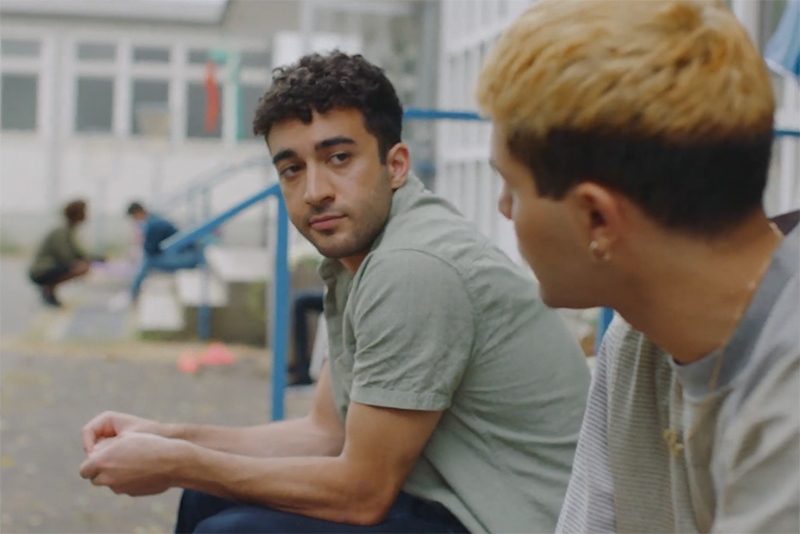
The debut picture of the 26-year-old director Faraz Shariah in February this year received the Teddy Award of the Berlin Film Festival. The film is arranged, at first glance, quite simple. This migration drama is one of the most popular genres of modern German cinema. The protagonist Parvis, the son of Iranian immigrants, is forced to work out a watch in the center for refugees after a store theft. There he meets Amon and Banafsha - his brother and sister who fled from Iran to Germany to start a new life in Europe. Parvis is simply friends with Banafsha, but with Amon he begins a novel. At the same time, no one in the center can guarantee that the brother and sister will provide asylum: their documents are still under consideration.
The distance between the author and the character is minimal. Parvis is actually an alter of the ego director. He was born and raised in Germany, German - his main language, he speaks Farsi with mistakes and accent (in the film this is a separate reason for jokes). And he is Out and Proud , his homosexuality is not a secret for the family - loving parents have long understood and accepted everything. The main role of Benny Radhaipur (by the way, an excellent theater actor, which is in the troupe of Munich Kammerspiele ), even outwardly very similar to Sharia.
 © "BOK ONTH" "Frame from the movie" No offense "
One of the first noticeable films, shot on the topic of migration not by ethnic Germans, but directly directors with migration experience, was called "40 square meters of Germany." He talked about the Turkish wife, whom the conservative husband brought from his native village to Hamburg and locked in a small city apartment.
Now his title looks symbolic for other reasons. Mymgram directories and directors who grew up in the families of immigrants, in recent decades, slowly expanded the space of their presence in German cinema-from 40 square meters to infinity. In the new film adaptation of the modernist novel by Alfred Dyublin “Berlin, Alexanderplaz”, whose action was transferred from the Weimar Republic to neon modernity, the main character, a black refugee from Africa, openly proclaims: “Ich Bin Deutschland” (“I am Germany”). Burkhan Kurbani, the son of political emigrants from Afghanistan, set a picture.
Someone, of course, will see here cultural expansion, but we are talking first of all about the protest against the cinematic ghetto, in which it was customary to stuff films about the roots and the crisis of identity for years. For many directors of the new European cinema, the question "Who am I?" - The most important, fundamental, and they are looking for new visual images in return for the prevailing cliches. This movie is emotionally charged, impudent, at times impudent, always extremely personal-not for the sake of some illusory "agenda" or festival selection. It’s just more important topics for its creators really do not exist, and their sincerity cannot but act on the audience.
The closest relative is “no offense” - now going at the Russian box office “Where are you from?” In it, the British actor and musician of Pakistani descent Riz Ahmed plays a rapper, almost all the texts of which are devoted to self -identification. At some point, the hero brings his own body: it literally destroys from his inner conflict with himself.
The German lovers of Parvis ask him the same question: "Where are you from?" And the answer “from Germany” does not suit them: “No, but in fact where?” The plot “No offense”, like the plot of his British twin film, also rotates around the family and body-the closest to any person of things. In the picture of Sharia, they will directly rhyme: while Parvis makes love with Amon on the top floor of the parental house, his mother tells Banafsha about moving from Iran to Germany. The original name - “Futur Drei” - refers to the two forms of future tense forms in German: Futur I and Futur II . There is no third form, director Shariah came up with it himself, and this is his personal and creative manifesto: stop playing by other people's rules, it's time to install his own.