
Translated material
"Brusfest now dock"
Dmitry Brusnikin's memory festival shows how important a direct conversation with people is important

In Moscow, the second festival of the Brusfest Documentary Theater is in memory of the theater director and teacher Dmitry Brusnikin. In the poster there are crossings of plastic, musical, puppet and dramatic theaters, mocking and verbatim, reading documentaries, as well as master classes from leading theater teachers.
The director of Brusfest and Brusnikin's Workshop Ekaterina Troepolskaya told the “new” about how she sees the role of a documentary theater, how performances are created in this genre and why acting education is not always necessary in the modern theater.

- What is the documentary for you?
- I can answer from different points of view: as a spectator, as the director of the documentary theater festival or as a playwright. For some, “the whole world is the theater”, and for me the whole world is a documentary theater, it occupies all my attention now. And speaking distant: a documentary theater is one of the most effective ways to know the world. There are many methods, but they all lead to a direct, honest conversation with the viewer.
- Who needs a documentary theater?
- It seems to me, everyone. I was born in Lugansk, and I had a skeptical attitude to the theater. I did not understand why it was needed - after all, there is a movie. But now, of course, I realize that the theater is a unique collective experience that you can’t replace. Documentary conversation is a special tool, if you approach it, you can no longer stop.
The dock exists so that the theater is not covered with dust, so that it is on the tip and is interesting for those who are young and looking for answers to questions.
-Within the framework of Brusfest, a large scientific and practical conference dedicated to acting is held: “Upgrade. Teachers - teachers. " It turns out that future actors must go through the doctarator?
-“Brusfest” arose in memory of Dmitry Vladimirovich Brusnikin, a teacher of the Moscow Art Theater School with forty years of experience. He was one of the first to drag verbatim into the educational system. Verbatim is the basis of the documentary theater, when human speech becomes a fabric of the performance, not artistic fiction. With his course, Dmitry Brusnikin made the famous performance “This is also me” - a set of people's monologues (in the documentary theater they are called donors), whom students found in various places, talked with them. In this technique, you need to talk a person and thus create a story, then to realize it on stage. This performance is still in the Practice Theater with Angels. When stories cease to be interesting, the actors go to take new verbatics finding relevant heroes for today's statement. Since then, all the courses of Dmitry Vladimirovich released performances-vertim. Within the framework of the festival, the performance “CCPR” will be released, dedicated to the disappearing and future professions, the so -called fourth industrial revolution. This is the work of the second-year school-studio of the Moscow Art Theater, the growing workshop of Brusnikin. The course is guided by Marina Brusnikina and Sergey Shchedrin, the directors of the performance are Anastasia Great and Yuri Kvyatkovsky. All of us - the circle of students, associates and close people of Dmitry Vladimirovich, try not to let him down. Actors act as interviewers, create their own role, and then perform it. Therefore, yes, I believe that a documentary theater is one of the key components of acting education. It is very important for us to introduce teachers who do not live in Moscow. Show them what a documentary theater is and how different it can be, and they, in turn, will introduce students to him.
- Is the text of Verbatima prescribed, or each performance - improvisation?
- There are already ready -made studies created with the help of an interview. First, the actors themselves work with them, then playwrights help them. The best and live work are selected, of course. The actor, of course, has a little opportunity for improvisation, in fact, there is this place inside each role. But you need to keep the role anyway: if you begin to speak with your text, and not the text of the sixty -year -old man from whom you interviewed, then you will fall out of the role, and all this will notice.
- In the play “Osumbez”, students of your poetic studio play at the Center for Voznesensky - they do not have acting education. Does the documentary allow the participation of unprofessional actors?
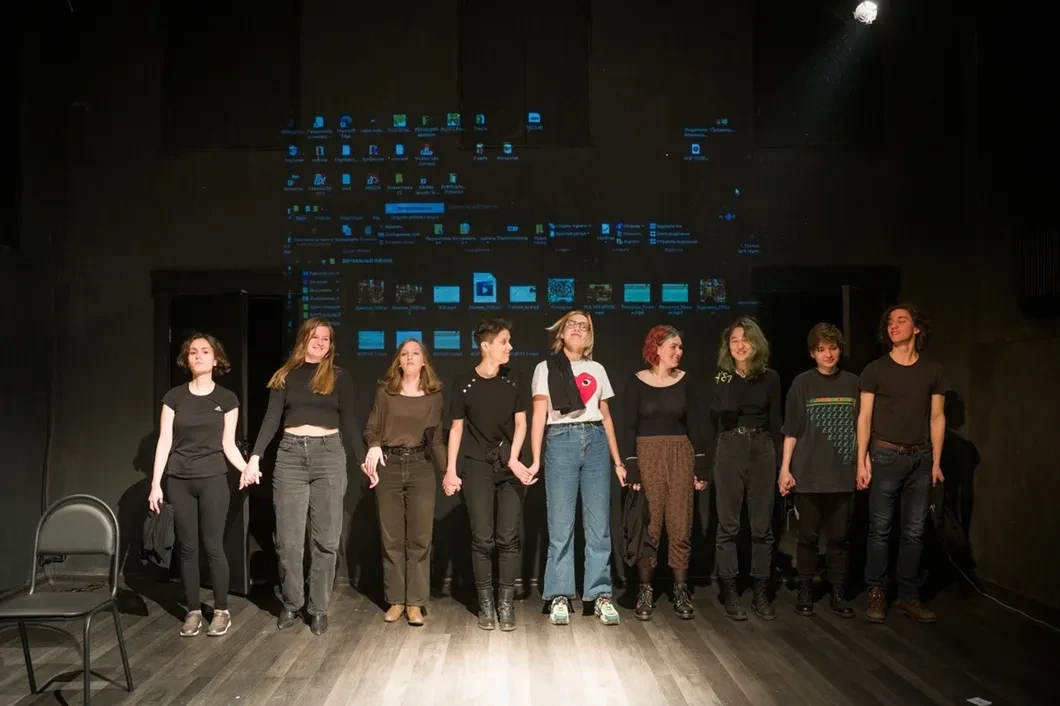
- In my opinion, acting education is not necessary for the entire modern theater. And if we talk about the dock directly, then there is another type of theater - witness. When on the stage there are not actors broadcasting someone's stories, but the carriers of these stories. Our last festival was opened by the Finnish performance "Death at Work." There, real ministers of the church, Morge's workers talked about their views on death, and despite the gloomy name, turned out to be a very delicate and cheerful performance. They talked about whether it was possible to use the coffin for a second time, how much funeral ceremonies should cost. “Osumbez” is, of course, not a witness theater. Our students are really involved there, Andrei Rodionov and I are leading a poetic studio, and he was just entering the poetic community of Osumbez. One of our students - Rina Denisova was very inspired by this topic and dedicated her exchange rate to her. She scored so many interviews that we decided to use the collected materials to create a collective documentary theater action.
- In the play “Future.doc” you act as an actress. How do you feel in this territory?
- Yes, but there are also not quite artists. Rather, I am myself, putting on a role function. This performance uses the Headphone Verbatim London technique, when performers in real time reproduce interview fragments that sound in headphones. In this performance, a teenage topic rises, it largely arose as a reaction to the series “School”, which thundered several years ago. To protect the teenager from direct exit, adult actors are needed. And the bearer of the story itself is quite difficult to be on stage. This is the first time I will come out in this performance, and so far I can not evaluate it on myself.
- As from the whole variety that exists, performances for the festival were selected?
- We have a rather harsh art council. We all collect offers in a common boiler. They often enter openly - they write to us, and we are considering all the proposals. There is a need to support the domestic theater landscape, to help out projects that cannot do this for a number of economic reasons. Such an example is the creative association “Theater of mutual actions” with the play “The University of Birds”, which would not be released without the collective support of the Union of Theater Workers, Festivals Territory and Brusfest.
- Are the premieres presented on Brusfest?
- Not really. We wanted to bring many foreign work, but in connection with restrictions, it was not possible to do this. We could not even get to us from Belarus, for unknown reasons they could not cross the border, although they had all the permits. But there really are a lot of premieres. For example, the play “Breathing” is a performance where the document itself is the document. Especially breathing these days, which is significant. There is an amazing work “Black Sky” - this is a monospace of Alexei Narutto; He interviewed the inhabitants of Krasnoyarsk, asked what they constantly live under this Black sky. Another special story is Esther's Black Book - a collaboration of Brusnikin's workshop with the Russian Jewish Congress and the “Bureau of Artistic Design”. At the heart - a book of crimes of Nazism against humanity, which was prohibited in the Soviet Union. The director (she is very drowning for feminity) Zhenya Berkovich tied it all with the Jewish tradition of an insanely cheerful theatrical action. Therefore, it’s scary to say, but it will be a fun documentary about the Holocaust. And this is an absolute premiere, we ourselves have not seen him yet.
- Mayakovsky has a well -known statement: "Theater is not a displaying mirror, but a magnifying glass." We can assume that the documentary theater is a mirror?
- It is possible, but in our society there are so many mirrors, and we are used to giving birth when we look at them. And in the mirror we see one thing, and people from the outside see another. Honestly, when we came up with this festival, we did not dare to make it documentary until the last, we thought that the second festival would be devoted to another phenomenon. But the first festival created a very strange effect even for ourselves. Having looked at our own festival, we realized that the documentary theater is an accurate statement. And very necessary. It would seem that the audience expects some fun from the theater, but this is not always the case. The audience is used to watching a reality show on TV-it is interesting to watch real people. Therefore, a documentary theater is not a punishment, not torture, but an attempt to an honest conversation.
But the documentary theater, like documentary cinema, can deceive, so it will not always be a mirror. Here, the viewer should already distinguish the truth from lies.
- That is, the doctarator from now on your festival format?
- Yes, we stopped at this. We decided to include here and postdock, rock the framework of a documentary theater to the anti-documentary-theater that is experiencing its documentary and turns into something else. In order for the phenomenon to develop, it is necessary to constantly throw new ideas - for this the festival exists.
- There is where to develop the phenomenon?
- So far there are people who are developing - the phenomenon is developing. There is life in the documentary theater, that's for sure. For the second year, our community of people has been growing, to whom this direct conversation is important. The documentary theater was the first to respond to questions of ecology, unemployment, politics. This is the most responsive tool that turns face to urgent problems.
Talked by Ekaterina Tararak - especially for "New"