
Original Material
Caucasus power broker
Hello! This week our top story is about Russia’s role in negotiating a peace agreement between Armenia and Azerbaijan, ending over 40 days of bloody fighting. We also look at why state-owned bank Sber is on the verge of losing yet another major tech partner, and the soccer player whose masturbation video caused a national scandal.
What does the ceasefire in Nagorno-Karabakh mean for Russia?
A bloody two-month military conflict between Armenia and Azerbaijan over the contested region of Nagorno-Karabakh ended this week as abruptly as it began. Russia, traditionally an ally of Armenia, brokered a peace agreement between the warring parties that is highly disadvantageous to Yerevan. It’s a victory for Russian diplomacy, and a triumph for Azerbaijan.
What happened?
The presidents of Azerbaijan and Russia, and the prime minister of Armenia, signed a ceasefire Monday ending hostilities in Nagorno-Karabakh, an ethnic Armenian enclave in Azerbaijan. It stipulated that a ceasefire was to begin Tuesday; that the warring parties will remain in the positions they currently occupy; and mandated a prisoner of war exchange.
This means big territorial gains for Azerbaijan, which had gained the upper hand in the military struggle. Baku will take over several areas previously under Armenian control, including the strategically important city of Shusha overlooking Stepanakert, the capital of Nagorno Karabakh.
In addition, Russia will deploy 2,000 peacekeepers along the line of the new border, as well as the corridor of land that connects Armenia and Nagorno-Karabakh. They will be in place for five years, with the possibility of an extension if needed.
What does it mean for Azerbaijan and Armenia?
For Azerbaijan’s president Ilham Aliyev this is a clear victory, and ensures power will remain in the hands of his clan. Revanchist sentiment in Azeri society has not faded since the early 1990s when control over Nagorno-Karabakh was ceded to Armenia amid bitter fighting.
Aliyev may gain further popularity points because he was able to persuade Turkey to take his side. He even claimed that Turkish peacekeepers will serve in Nagorno-Karabakh — though this is not confirmed by the text of the agreement. Others see Aliyev as having little agency, arguing he is merely being used as a pawn by Ankara in its growing foreign policy ambitions.
The truce prevented a humanitarian catastrophe in Nagorno-Karabakh, and a likely Armenian military collapse. But for Armenian Prime Minister Nikol Pashinyan, it’s hard to see this as anything other than surrender. Pashinyan became prime minister in 2018 following the country’s ‘Velvet Revolution’, which toppled then-President Serzh Sargasyan. A recurring criticism of Sargasyan was that corruption left the army under-funded and vulnerable.
Apparently nothing has changed in the past two years, and when the conflict flared in late September, Armenia quickly found itself on the back foot. Now, Pashinyan is facing a storm of criticism. Yerevan has been rocked by mass protests, and on the night the agreement was signed demonstrators trashed Pashinyan’s residence and broke into the parliament building.
What was Russia’s role?
Many observers expected Russia to back Armenia in the conflict as the two countries are bound by a mutual assistance agreement via the Moscow-led Collective Security Treaty Organization. But Russia kept its distance, and the peace deal hands Azerbaijan a clear win.
Does that mean that Russia suffered a diplomatic reverse? On the contrary. Firstly, Russia has managed — at least partially — to implement the so-called Lavrov Plan, which dates from 2016 when Russia tried to persuade Armenia to withdraw its forces from Nagorno- Karabakh and replace them with Russian peacekeepers (Russia has denied the existence of such a plan). This approach was never backed by the U.S., France and other European countries, which wanted an international peace treaty. In other words, Russia has stolen a march on the West.
Secondly, it has given Russia a chance to double down on one of it’s favorite refrains: how so-called color revolutions in post-Soviet countries always end in tears. State-owned media outlets in Russia have been framing Armenia’s defeat in this context.
Why the world should care No-one believes this is a permanent resolution to the Nagorno-Karabakh ‘problem’. Even with an agreement, the conflict is far from over. Most analysts see the current situation as a temporary fix, and point out that the agreement says nothing about the status of Nagorno-Karabakh. In addition, refugees are now likely to return to the territories retaken by Azerbaijan and it is far from clear how they will live alongside the Armenian population.
Sber looks set to lose yet another tech partner
It’s just a few months since Sber’s dramatic divorce with internet giant Yandex, but the state-owned bank has already run into more problems in the digital services market. The Financial Times reported Thursday that Sber and Mail.Ru Group, which owns Russia’s largest social media outlet, may soon go their separate ways in a JV that includes taxi services and food delivery. The Bell’s sources confirmed the simmering dispute. The reasons are the same as with Yandex: both parties control 45 percent of the JV and cannot agree who is in charge.
- Sberbank is unhappy that its acquisition of a 36 percent stake in Mail.Ru Group’s management structure (equivalent to about 20 percent in the company itself) does not give the bank sufficient control. The JV between Sber and Yandex was structured in the same way before it fell apart.
- The major bone of contention is the partnership’s structure. According to Mail.Ru, Russia’s biggest social network, Vkontakte, should be the basis of their joint platform, while Sber wants its financial network to play this role, according to the FT.
- Sber and Mail.Ru Group announced the creation of a JV called O2O-Holding in July last year, at the height of Sber’s conflict with Yandex. The bank planned to use this to break into the e-commerce market. The object of the collaboration was Mail.Ru’s Citimobil taxi service and its Delivery Club food app. The partners invested 71 billion rubles ($915 million), with Sber putting in over half. And there were plans to invest a further 18 billion rubles ($226 million). In 2019, not one of the companies involved in the JV made a profit, despite all of them posting revenue increases.
- If the JV does indeed collapse, it will be the third failed tech partnership involving Sber. The bank was unsuccessful in its attempt to partner with Chinese e-commerce giant Alibaba to work in the Russian market, then, over the course of two years, it established and dismantled a JV with Yandex. In all three cases, the problem appears to be that Sberbank wanted full control over management.
Why the world should care Russia’s tech sector – and to a lesser extent its financial sector – are the most competitive and progressive areas of the economy. We have long been prepared for a ‘battle of ecosystems’, with Sber, Yandex, Mail.Ru and Tinkoff Bank as the key protagonists — but it appears this battle is still some way off. First, the various factions need to establish their alliances and attack plans.
Soccer star disgraced in explicit video furore
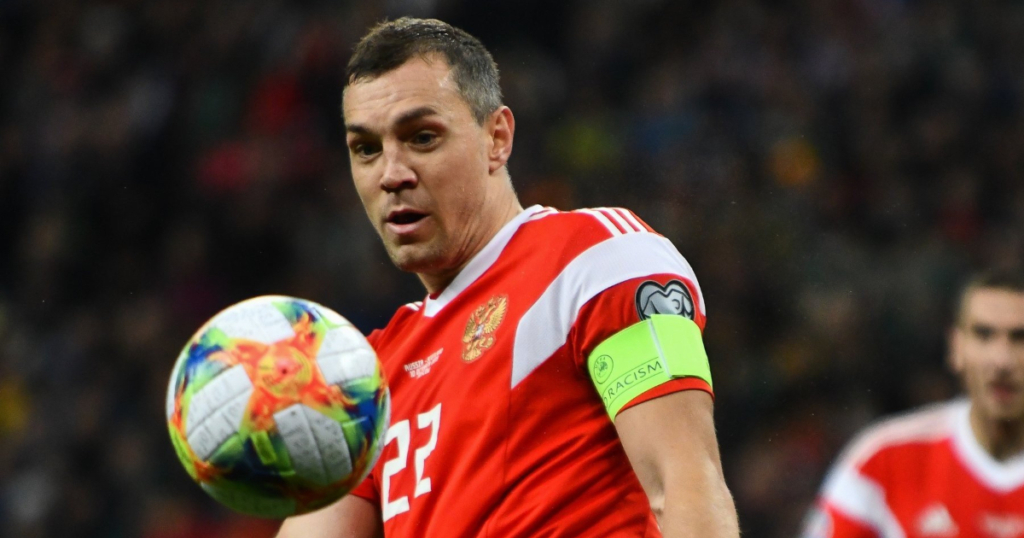
Despite a peace treaty in the Southern Caucasus, a government reshuffle and spiking coronavirus cases, this week’s most discussed topic in Russia was masturbation. When an explicit video emerged of Artyom Dzyuba, one of the country’s most famous soccer players, it dominated newspaper headlines and talk show line-ups for days. The 32-year-old saw his career fall apart overnight — he was dropped from Russia’s national squad and stripped of the captaincy of his club. But the big question is not so much whether he can stage a comeback to frontline soccer, as why the video provoked such a strong reaction.
- Things escalated quickly. The intimate video of Dzyuba, apparently recorded by the player himself over a year ago, appeared on social media Saturday. He was immediately removed from the Russian national squad and dropped from the line-up for Thursday’s game against Moldova and next week’s clashes with Turkey and Serbia. The official explanation for the decision was to “avoid negativity affecting him and the team” because “both on and off the field, everyone must live up to the standards expected of a representative of the national side.”
- Dzyuba was also stripped of the captaincy of his club team, Zenit, for its match against Krasnodar. However, he played the full 90 minutes and scored the winning goal. During the game, he was jeered and abused by many of the fans.
- At the same time, dozens of Russian celebrities — from famous singers to ex-presidential candidate Ksenia Sobchak — spoke out in support of Dzyuba. They argued the footballer had done nothing illegal and, as a responsible adult, should be allowed to do whatever he likes as long as it does not offend others. The offense, they said, was caused by whoever distributed the video.
- There was also high level support from pilots at national carrier Aeroflot’s budget airline, Pobeda, who traced out a giant penis over a central Russian city. “We don’t know exactly what was implied by the flightpath of our aircraft, but it’s possible the captains were expressing their support for Dzyuba,” a spokesperson for the airline told journalists.
- It’s not clear exactly how Dzyuba’s video appeared online. According to media outlet Baza, the footballer’s phone was hacked a few weeks earlier. St. Petersburg news site Fontanka quoted sources that said the player was being blackmailed to the tune of 5 million rubles (about $65,000). For context, Dzyuba’s annual salary at Zenit is estimated to be around 3.7 million euros ($4.4 million) including bonuses.
Why the world should care The concept of a ‘public reputation’ is still at a formative stage in Russia, and is riddled with double standards. Public figures very rarely face backlashes following inappropriate words or behavior — only a week ago, teacher and TV star Mikhail Skipsky returned to the nation’s screens despite credible accusations that he molested schoolgirls.The case provoked a wave of disapproval online, but not a single formal sanction. It’s possible Russian society remains deeply patriarchal, meaning sexual harassment is seen as ‘manly’ and acceptable — whereas masturbation is not. Or it could just be that there are no clear rules yet.