
Translated material
"The security forces seemed to be crazy." Elena Borovskaya - about the march of the memory of Roman Bondarenko
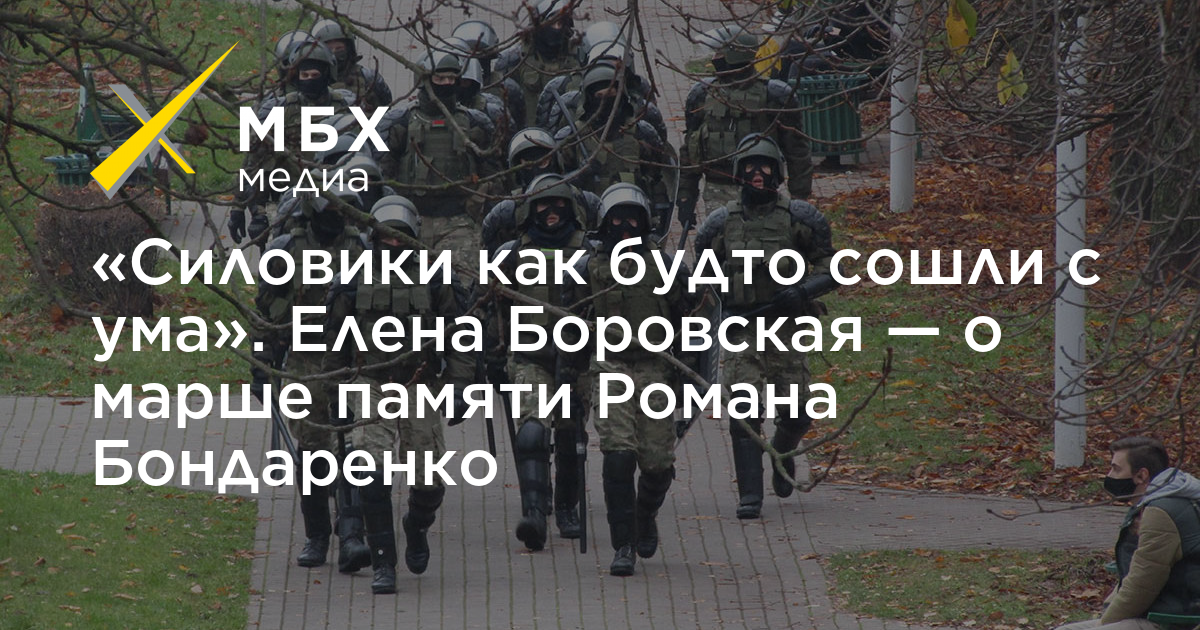
The tightening power of the political confrontation in Belarus, growing from the beginning of this month, could not but lead to someone else's death. The opposition march in Minsk on November 15, dedicated to the memory of the murdered Roman Bondarenko, became a record in the number of detainees - about 1300 people. Having dispersed it, Alexander Lukashenko showed the protesters what level he was ready to conduct a dialogue with society. About Sunday events, their causes and consequences - in the column of Elena Borovskaya.
The death of Roman Bondarenko


On the evening of November 11, unknowners arrived in civilian clothes in the courtyard of Chervykova Street, known as the area of change, in order to cut off red and white ribbons hung by local residents on fences. Visiters were notified in the courtyard chat. People went out to protect their yard, and one of the released was 31-year-old Roman Bondarenko. The uninvited guests behaved aggressively, arranged a brawl, beat Bondarenko and dragged them into their minibus. A few hours later, the novel from the RUVD of the Central District was taken to the hospital with a traumatic brain injury in critical condition. Doctors tried to save him, an operation was performed, but in less than a day the novel died.
Who killed Roman Bondarenko? It is not known whether Bondarenko was beaten into the RUVD. Those who came to the yard cut the ribbons, first took for the “Tikhars” - employees of law enforcement agencies in civilian clothes. However, journalists found that a person who has beaten the novel in the Square is similar to an influential athlete, ex-boxer Dmitry Shakutu. The real Shakuta is connected with Dmitry Baskov, the head of the Hockey Federation and the coach of the Minsk team Bastion, in which the sons of Alexander Lukashenko play. Shakuta is an attacker in the team. They saw people similar to Baskov and Shakut not only during the incident on November 11, but also in other yards earlier, where they also were engaged in the destruction of protest symbols. According to the Ministry of Internal Affairs, Bondarenko had a conflict with "caring citizens."
Bondarenko was not a professional revolutionary or political activist - he was an artist and taught children to draw, worked as the director of the store. Several years ago, he served as a draft at the military unit No. 3214 - a division of internal troops, which in recent months has "become famous" with particularly active participation and cruelty in the acceleration of peaceful actions of the presidential opponents.
The murder was stirred up by Belarusian society. On the day of the death of Bondarenko, thousands of people brought flowers to the area of changes, where a spontaneous memorial arose. For its protection from destruction, round -the -clock duty was organized.
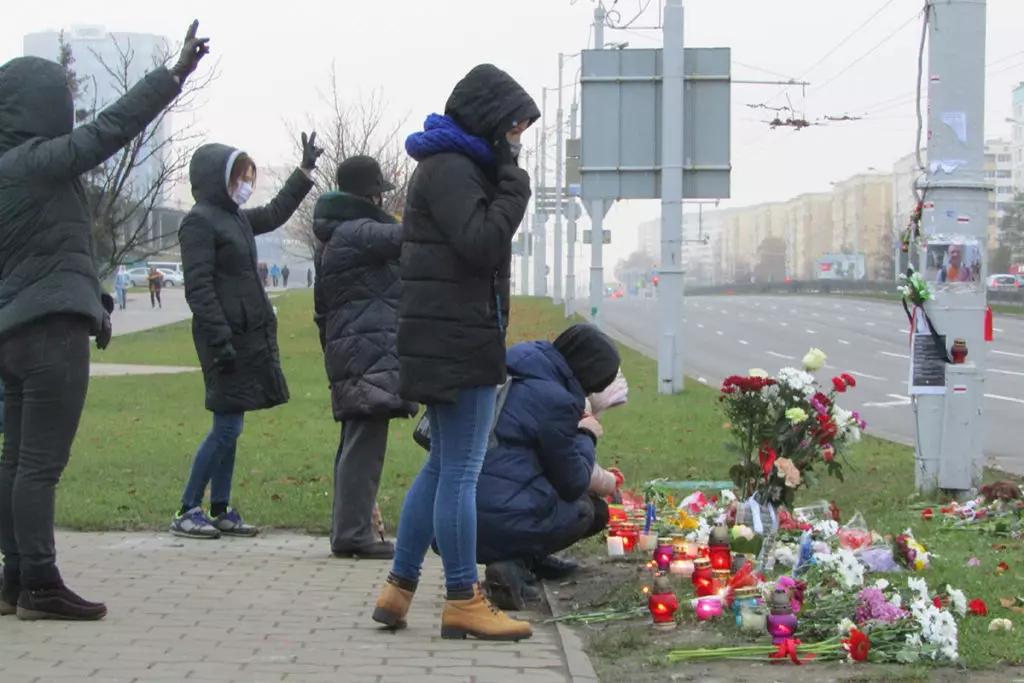
The death of Bondarenko, unambiguous in his circumstances and preventing any non-political interpretations, forced Alexander Lukashenko to respond. He expressed concern and condolences to relatives and stated that he was taking an investigation under his personal control. However, according to him, Bondarenko was drunk (this is refuted by the final diagnosis of doctors) and he had a conflict with one of the recently created squads that walked and cut off the “collaborationist pro -fascist flags”.
Lukashenko announced the creation of the squad on the day of the appointment of Ivan Kubrakov, the new Minister of the Ministry of Internal Affairs: “We need not formal to do the work of folk squads. They began to work, but still did not turn out in full force ”and suggested attracting former military personnel in them and arming them.
Memory march
The traditional Sunday march of the opposition in Minsk on November 15 was dedicated to the memory of Roman Bondarenko. The place of gathering on Pushkinskaya Square - where in August the special forces shot the peaceful demonstration Alexander Taraykovsky - was announced on the morning of the promotion in the morning. Half an hour before the event, there were already internal troops, riot police and special equipment. Despite opposition, several thousand people gathered in the square. Gas and light -school grenades were used against them (several people were injured), one man knocked the minibus of security forces. The main detentions occurred there (about 1300 people were detained on Sunday). Those who did not get to the car zaki went along the avenue in the direction of the area of change. At about three o’clock in the afternoon, riot police continued to scatter people on Pushkinskaya, adjacent courtyards combed the internal troops.
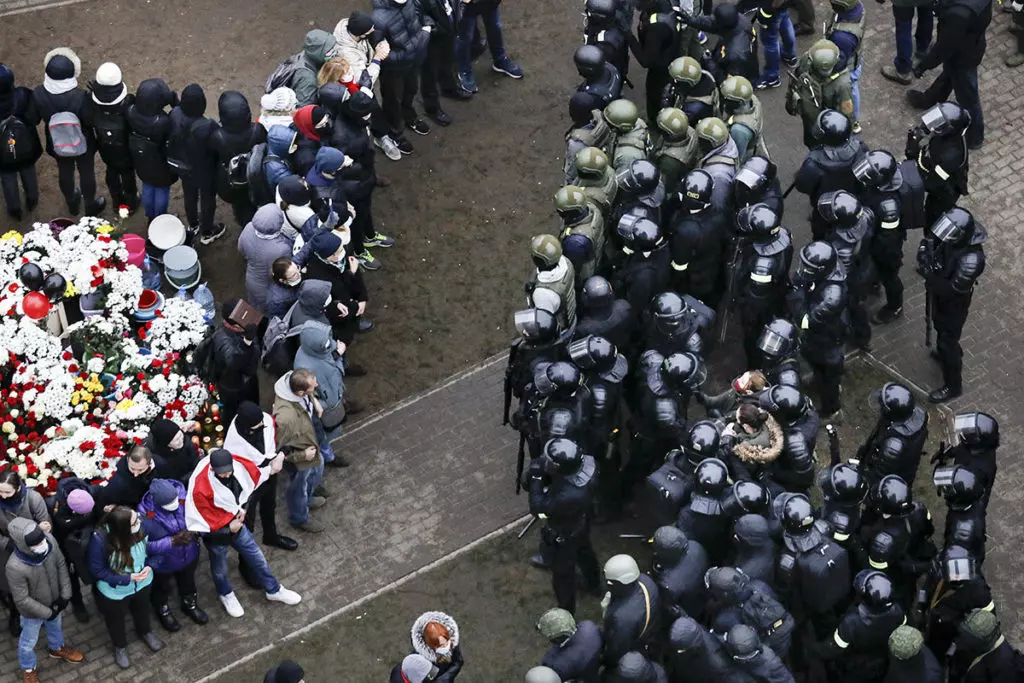
Meanwhile, protesters gathered in the area of changes around the Bondarenko memorial, motorists blocked the neighboring streets and buzzed. Here the police did not dare to immediate acceleration, but waited for reinforcements from Pushkinskaya Square - all the resources of the security forces were transferred to the small courtyard on Chervyakov Street. By that time, many had already dispersed, someone grabbed in the neighborhood, someone was able to escape, and about five hundred people had left the memorial. The area of change was completely blocked by internal troops. The detentions began, riot police burst into shops and entrances, went around the apartments, listening to the voices of the doors. The captured did not have time to load in the autozaks, the lines formed. During the detention, people were beaten, many of the police departments were then taken away by ambulance vehicles.
Natural death
The death of Bondarenko became the natural result of the new tactics of the Ministry of Internal Affairs regarding protests - after the shift Alexander Lukashenko, the head of the department on October 29, the security forces seemed to be crazy. Not only students, but also doctors, artists, women, accelerated any meetings began to be enough on the streets - only pensioners and disabled people have not yet touched. Repressive mechanisms were earned at high speeds: people were taken from the houses and arrested for participating in old promotions. Since November 1, against the detainees on the marches, including journalists, they began to initiate criminal cases for the “organization and preparation of actions that were grossly violating public order” - in addition to the usual administrations. On November 8 and 15, on Sunday protest marches, there was a marginal number of security forces and technology, tried to dissipate the slightest accumulations of people, purposefully beaten into the blood, broke the bones. These marches became record -in -law in the number of detainees.
According to the former castle commander of the special forces of the Almaz Ministry of Internal Affairs, Igor Makar, Lukashenko is configured to complete speedy suppression of protests, and the fewer people will go out onto the streets, the more intensively the opposition will be. One of the reasons is the significant fatigue of the security forces who have been working in daily combat mode for several months with meager salaries, without any special surcharges. At the same time, the security forces understand that they have committed many crimes. The basic principle on which the status quo is held is a guarantee of impunity of security forces. If we hold accountable for death, infliction of bodily harm, mockery of civilians - the system will break. Understanding that Lukashenko eventually “throws them”, the security forces are already for themselves, and everyone who went outside is an enemy for them, because there is no road back. “Go away! We will live in this country, not you! ”, The riot police said as the women, driving them away from the Taraikovsky memorial on Pushkinskaya Square last Sunday.
With this level of confrontation of the murder of people are inevitable. But the return surge of rage in society is also inevitable. Despite the fact that the last marches turned out to be less large -scale than the previous ones, a decrease in protest activity is an illusion. The moods of people are tightened, emotionality is growing - on the streets you hear not half -heard and innocent statements to the authorities, but very evil and suffered words.
The tragedy of Roman Bondarenko could besiege power and reduce the level of police violence, but this did not happen. On the contrary, the demonstrative destruction of memorials (not only in the area of changes, but throughout Minsk), neglect of the memory of the dead and human grief shows how easily Alexander Lukashenko is ready to follow corpses. But it is also obvious that the Belarusian people will really not forget anything and forgive.