
Translated material
Leonello d'Este: Humanist on the throne
In mid -autumn, the Word/Slovo publishing house published the book of Pavel Aleshin, The D'Este Dynasty. Politics of splendor. Renaissance in Ferrara. " The author-a specialist in the Italian revival, a candidate of art history, a poet and translator, an employee of the scientific and editorial department of the museums of the Moscow Kremlin-tells the story of the famous North Italian dynasty, which are associated with the names of such artists and poets, Francesco Del Kossa, Ludovico Ariosto or Torkvato Tasso. The achievement of the dynasty was the interaction of philanthropy and politics, which the humanists of the 15th century called the "policy of magnificence." Colta.ru publishes a fragment from the book.
The text is published in the source.
 © Word/Slovo
 Are the Golden times the times of Saturn came here, wars
Where are only those that we read in books rumble?
Where the people are constantly cheerful, the people of the round dance,
Music where endlessly, where palaces shine with beauty,
Where is the abundance of a horn and is not needed, the earth where is rich?
Both are happy: the lord of the people, and the people are the Vladyka.
Jan Pannonius.
Panegyrin Guarino Veronsky
The lines of the Hungarian poet of the 15th century, Yana Pannoniy from the Hungarian poet from Guarino dedicated to Veron, the poems of Panegirik Guarino, the Ferrara of the reign of the Marquis Leonello d'Este (1441–1450) . The poem is a poetic evidence of an extraordinary cultural upsurge, which experienced a Ferrara state in these years. The transformation of Ferrara into an important artistic center is a vivid example of the development and spread of the Renaissance culture in northern Italy, closely associated with the heyday of Signoria.
In Italy, the XV - XVI centuries, divided into small states, it was the Signors who were able to actively engage in philanthropy and even necessary for the patronage of culture, regardless of personal interest, since the culture, thanks to humanism, acquired more and more importance in politics. It should be noted that the figure of the philanthropist and the collector in the modern sense appeared precisely in the Renaissance, when a new perception of culture was formed as an independent world with its laws. This process was not simultaneously, therefore, the institution of philanthropy developed gradually.
In the case of Ferrara, where the sole rule of one dynasty was established, in the hands of which all the fullness of power concentrated, the philanthropy of the rulers - representatives of the family of d'Este - in the Renaissance era became a fundamental factor that determined the vector of cultural development.
The beginning of the Renaissance in Ferrara is associated with the rule of Leonello d'Este: it is he who was the first of d'Este to provide the widest, most conscious, constant patronage of the emerging Renaissance culture.
Throughout the second half of the XIII - XIV century, the development of culture was not among the main tasks of the Signor d'Este, preoccupied primarily by the consolidation of their political victory and the creation of the state. During this period, the only step that played a huge role in the development of culture was the receipt of the Marquis Alberto V d'Este to the foundation in Ferrara of the University. The right was given by Pope Bonifacius IX and confirmed by the Papal Bull dated March 4, 1391, which allowed the university’s establishment and the teaching of civil and church law, arts, medicine and theology in it. For this, grateful subjects set the statue of the Marquis on the facade of the Cathedral of Ferrara.
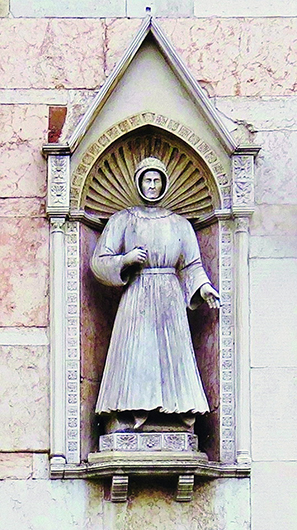 © Cathedral of St. George Alberto V d'Este. 1390s. Marble
However, although 1391 is considered the traditional date of the founding of Ferrara University, it began to function on an ongoing basis only after a re -opening in 1442 during the reign of Leonello.
Initially, the university was opened on October 18, 1391, when classes on civil law began, but already in 1393 the classes ceased. In 1418, the heir to Alberto V, the Marquis Niccolo III d'Est, tried to open it again, but unsuccessfully due to financial problems. The creation of the university was not a personal whim of the marques d'Este, but was a reflection of important sociocultures of the processes that took place in Italy: in addition to Ferrara, in the second half of the XIV - the first half of the XV century, a number of new universities appear in Italy: in Pisa (1343), Florence (1348), Pavia (1361), Turin (1411-1413) , Turin, Turin, Turin,, Katania (1445).
For his long rule (1393–1440), Niccolo III, Father Leonello, did a lot to strengthen the power of the dynasty: with him new laws were adopted, active urban construction was carried out, and drainage work so necessary in the marshy areas were carried out. The Marquis himself was a warlike, cruel person, alien to the ideas of humanism, but, a visionary ruler, he realized the increasing significance of culture in politics. That is why he tried to re -open the university, and also invited in 1429 to educate his son and heir to Leonello the famous humanist and teacher Guarino da Verona, who opened his own school. All Ferrars could visit it, regardless of the social status, which contributed to the widespread spread of a new humanistic culture. Similar schools were opened in other cities of Italy: so earlier, in 1423, the humanist Vittorino da Feltre created a school in Mantua with the patronage of the Marquis of Dzhanfranscho Gonzag.
 © London, British Museum Medal Guarino da Verona (Avers). About 1446. Bronze; diameter 9.5
Thanks to Guarino, Leonello d'Este received an excellent education and became a passionate fan of ancient culture, so that, being in power, he showed a lively example of a real “humanist on the throne”. He knew the story well and was well versed in Latin literature, played several musical instruments, loved art, wrote speeches in Latin and poems in Italian. Two of his sonnets in the spirit of Petrarch was preserved:
* * *
Hit the horse to the top of Gelicon
Hoof - and the source instantly made his way,
And the one who washed him with water,
Free from love spell of polonon.
And I, who got into the Cupid network,
He rushed to the water of that miraculous.
Well - funny: he appeared here
And the wanderer suddenly came out from the slope.
While I was reaching for the water,
He quietly poured the poison of torment
In the wave, having made it poisonous.
I searched in the cherished moisture I have saved,
but only the Flame was incurred by passions
With a sip, all my new waters are drunk.
* * *
Because of love, when I just blinded
Love sent me on the road
On purpose alone, telling me strictly:
"Now go, you who boasted so much."
I felt the strength in myself because
He went, hoping for help.
But soon he could not defeat the alarm
After all, where I was, I did not understand at all.
Then love, mocking more and more,
Repeating my obscure speeches
I enhanced the flour many times.
And I listened to a whisper, without understanding
Not a word, but in response to say:
"At least indicate the path to me back."
Around Leonello formed a circle of scientists and poets, which included Guarino da Verona, the Brothers Niccolo and Tito Vespasiano Strozzi, Feltrino Boyardo, Francesco Ariosto and others and in which the problems of philosophy, philology, ethics, history and art were discussed. The conversations that were conducted in it are known from the treatise on elegant literature ( De Politia Litteraria) of the Milan humanist Angelo Deschelo, who also studied with Guarino da Verona. This circle is a characteristic phenomenon of the era, such arose in Renaissance Italy everywhere; The most striking example of such communities is the Platonic Academy in Florence.
 © Ariosta Frontispiece Library to the publication of the treatise "On Extraordinary Literature" ("De Politia Litteraria") Angela Deschelo. 1540. Engraving
Guarino paid serious attention to the ethical education of his ward and, inspiring him with examples from ancient history, sought to cultivate the ideal ruler endowed with all the virtues interpreted in the spirit of Nikomakh’s ethics of Aristotle. In particular, in letters to Leonello, the scientist urges him to take care of cultural dignity, which manifests itself due to such virtue as splendor, which implies active patronage of culture. The splendor, according to Aristotle, implies expenses, “which we consider honorary, for example, the costs of [veneration] of the gods, dedicated gifts, buildings and sacrifices, just like everything that is associated with the deity, as well as everything that is willingly made of ambition for the common good, for example, when they think it is brilliantly equipped with a choir or trier or arrange a feast for everything cities ". Although this virtue can manifest itself not only in general affairs, but also in private ones: “So, such a person is magnificent mainly and the splendor [manifests itself] in such expenses that were said: after all, they are the most magnificent and honorable. In private matters, it is excellent what happens once, for example, a wedding or something else, as well as what the whole city or high-ranking [citizens] bothers [citizens]; In addition, there are great meetings and wires of foreign guests, gifts and gifting. The magnificent spends, of course, not on himself, but on common affairs, and gifts are somewhat similar to dedication to the gods. The decoration of the house, appropriate for wealth, is also a sign of the magnificent (after all, this house also serves as a kind of decoration of the city). ” Leonello's philanthropic activity fully corresponded to this definition: he generously spent money on culture.
Due to the fact that an important component of the policy of the Italian sovereigns of the Renaissance was a rivalry in the field of culture, when each of them sought to surround themselves with outstanding scientists, writers, artists and musicians, discussions about splendor gained importance in the humanistic environment in the middle of the 15th century. Gradually, they switched from the sphere of ethical thought into the sphere of the thought of political, and the Ferrara humanists in the second half of the 15th century secured this concept - Magnificientia - as a definition of the cultural policy of the d'Este family.
This fact is notable in the history of the Renaissance. The definition of the “magnificent” was a common appeal, applied to the high persons, outstanding, influential people who necessarily implying active patronage of culture: humanist Timofooo Maffei wrote a treatise on the magnificence of Kozimo Medici (c. 1454), and the grandson of Kozimo, Lorenzo Medici, forever went down as Lorenzo magnificent. However, only behind the cultural policy of the d'Este family in historiography, the name “Politic Policy” was assigned. This testifies, on the one hand, the meaning that this concept was given by d'Este themselves, and on the other, that their cultural policy was characterized by constant continuity, despite the individual characteristics of each of the representatives of the dynasty, which one or another affected his philanthropist activity. The basic principles of this policy remained unchanged, and its essence was the widespread use of culture as a means of state propaganda in order to exalt the power of the dynasty, strengthen its authority and confirm its legitimacy, which was expressed in purposeful creation with the help of the culture of the state “myth of d'Ast”.
As already noted, the peculiarity of this myth was to emphasize the knightly traditions of the D'Este clan. The game of chivalry in Italy in the XV and less in the XVI century is a characteristic phenomenon not only for the aristocracy, but also for the bourgeoisie, a striking example of that is the famous knightly tournament arranged by Medici in Florence in 1475 and a resent in the Angelo Polytsino poem for a tournament . But in the case of d'Est, the knightly ideal served not just a kind of beautiful surroundings, but was a factor that had a real influence on politics.
Leonello retained the features characteristic of medieval Signors, and the concepts of knightly honor were not something conditional for him: before he was given to education to Guarino, Leonello studied military art and spent several years on campaigns under the leadership of Condoter Brachchio and Monton. A similar practice of compulsory training of heirs to military art will be preserved in the D'Est family throughout the Renaissance. The features of medieval aristocracy laid out a certain imprint on the activity of the Marquis as a philanthropist: this will affect his taste as a collector, as well as the fact that the works ordered by him will appeal to the anti -medieval and medieval heritage, contributing to close interaction and synthesis of humanism and the ideals of the late mediocrity of the court culture within Ferrarar Revival.
However, Leonello, unlike his father, was an example of the already Renaissance ruler and largely corresponded to the image of an ideal sovereign created by humanists of the 15th century. He learned the lessons of Guarino, who called on the student to devote himself to the concerns of the prosperity of the people, so the time of his reign was marked by relative social well -being (under him Ferrara did not participate in wars) and an unprecedented heyday of cultural life. Wide and constant patronage provided by Leonello to various fields of culture laid the foundations of the “splendor policy” of the d'Este family, and his philanthropic activity became an example for the following rulers of Ferrara.
It is significant that one of the first decisions made by the Marquis after coming to power is the decision to open the university. Leonello became the ruler in December 1441, and already in January 1442 he discussed this issue with the city commune, who agreed to take on most of the expenses, although the Marquis himself helped the university financially. If in 1391–1393 the classes were conducted only by civil law, then starting in Fergrar's university a variety of disciplines began to teach, for which scientists and humanists from all over Italy were invited, among whom were the Theodor and Giovanni Aurisp (Greek), Angeo Delia Ubaldi (civil law), Lodizio Krielly and Francesco Akkolti d'Arerso (canonical law), Giovanni Manardi (philosophy), Giovanni Byankini and Domenico Maria Novara (astronomy). Guarino da Verona, who read the speech at the opening of the university on October 18, became a teacher of rhetoric. Ferrar University, which did not have scholastic traditions, immediately became one of the advanced centers of humanistic education, where students from all over Europe came to study.
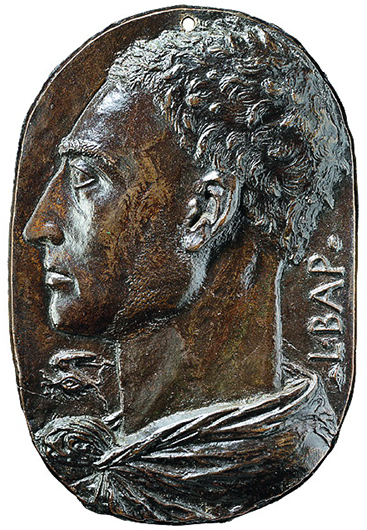 © Washington, National Gallery Leon Battista Alberti. Self -portrait (Avers). About 1435. Bronze; 20.1 × 13.6 (wrong oval)
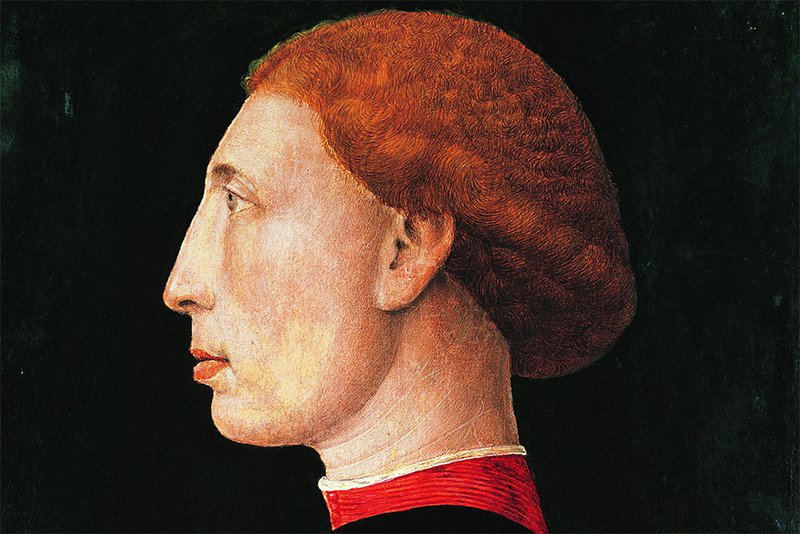
The bright event of the cultural life of Ferrara, which occurred in 1441, during the life of Niccolo III, was the competition of artists - Pisanello and Jacopo Bellini. In Ferrara, there was no tradition to arrange such competitions, and its holding is associated with the influence on the artistic life of the Ferrara court of Leon Battista Alberti. Both painters had to write a portrait of Leonello. The portrait performed by Pisanello has been preserved.
 © Bergamo, Academy of Carrara Pisanello. Portrait of Leonello d'Este. 1441. Wood, temperature; 26 × 18
Inspired by ancient medals, he portrayed Leonello in profile. The figure depicted on the shoulders occupies almost the entire space of the picture, clearly standing out with a minted silhouette on a dark neutral background decorated with shoots of wild roses. True Pisanello truthfully conveys the face of the marquis with its high forehead, a thin long nose, a slightly outstanding lower lip, a sharp chin. With extraordinary skill and thoroughness, Leonello's clothes were written out: thanks to different ways of applying strokes, the artist skillfully conveyed various textures of fabrics. The work of Bellini was not preserved, however, in the Louvre his later picture of Madonna with a baby and the worshiping Leonello d'Estes , who can give some idea of how the marquise was depicted on the portrait is stored.
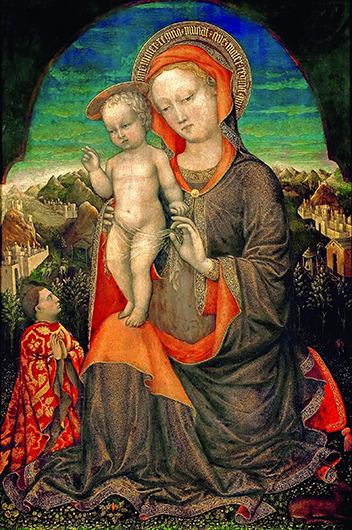 © Paris, Louvre Jacopo Bellini. Madonna with a baby and worshiping Leonello d'Este. About 1450. Wood, temperature; 60 × 40
Niccolo III chose the winner of the Venetian artist, about which the poetic testimony of the poet Ulysses Aleotti was preserved:
When to compete with Pisanello
With nature, the image in color also decided
show, like a real one, on the portrait
The marquise of young Leonello,
when for six months it flew by
labor and he thought about parity,
Then Fortune is angry that the nets
weaves, since someone opens her boldly,
I did it that from the other edge
The master of the marquise is excellent for the father of the Marquis,
Bellini, suddenly arrived, new Fidiy,
And what, between two portraits, choosing
father is a second portrait, so noble,
He considered the best and Bellini - Darovtiya.
Leonello himself probably liked the portrait of the Pisanello brush, whom he and his inner circle were considered one of the best artists of his time. It is known that the master gave Guarino and Veron a picture with the image of St. Jerome, and he in response devoted an enthusiastic poem to the artist. Elegy, in which a certain collective image of the art of Pisanello was given, was also written by the Ferrara poet Tito Vespasiano Strozzi, a friend of Leonello, another student of Guarino da Verona. It was reflected in the reflection of the motives characteristic of such works of the Renaissance - the motive for the equality of art with nature and the motive of the superiority of the contemporary artist over the ancients.
 © London, National Pisanello Gallery. The vision of St. Eustathius. About 1438-1442. Wood, tempera; 54.8 × 65.5
Pisanello, an outstanding artist
Who, Pisanello, will be able to glorify with dignity and with honor
Твой выдающийся гений, в работе умелую руку?
Ни Апеллес, ни Зевксис не сравнятся в искусстве с тобою,
Нарисовать если ты пожелаешь людей иль животных.
Как рассказать мне о птицах живых и о реках текущих
С их берегами, о глади безбрежной могучего моря?
Кажется мне, что я слышу тот звучный поток, когда рыбы
Стаей чешуйчатой воды лазурные вдруг прорывают.
Слышу, лягушка как квакает в илистой темной пучине.
Ты укрываешь медведей в горах, кабанов на равнинах,
Ты окружаешь источники чистые нежно садами,
Их украшая цветами. И травы вокруг зеленеют.
Видим мы, нимфы в лесах как тенистых, охотясь, блуждают,
Сети несет на плечах одна, острые стрелы — другая.
Видим мы в месте другом: выбегают из зарослей серны,
С лаем собаки зверей загоняют в расщелину диких.
Так вот умбрийская гончая зайцу погибель готовит.
Ржет и кусает узду свою конь, бьет копытом о землю.
Не восхитится кто позам мужей и телам безупречным
Тех, никогда про которых не скажешь: они не живые?
Изображенному лику Юпитера не поклонится
Кто, полагая, что лик настоящего бога представлен?
Что бы ты ни рисовал, доказательство то, что с природой
Может всевластной сравниться божественный ум человека.
И не одна тебя живопись дивная так прославляет,
И не один этот дар твой дает тебе славное имя,
Но также то, что в искусстве другом Поликлета ты выше,
Фидия что и Лисиппа работы твоим уступают.
Славу великую ты заслужил, по заслугам молвою
Славится имя твое безупречной на всем белом свете.
Счастлив же будь! Тебе Лахесис мудрая в том пусть послужит.
С нами же вместе хвалою ты музу почти Каллиопу!
Художник еще не раз впоследствии портретировал Леонелло: сохранилось несколько великолепных медалей, сделанных им в 1441–1444 годах . Эти произведения, ориентированные на классическую традицию, безусловно, нравились маркизу, поклоннику античной культуры и страстному коллекционеру античных медалей и монет.
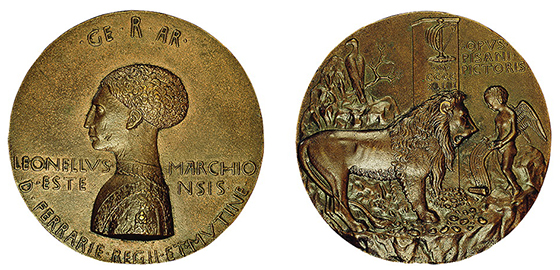 © Вашингтон, Национальная галерея Пизанелло. Медаль в ознаменование второго бракосочетания Леонелло д'Эсте (аверс и реверс). 1441–1444. Bronze; диаметр 10,08
Деятельность Пизанелло оказала большое влияние на искусство портрета в Ферраре и на портретную иконографию семьи д'Эсте: на созданные им портреты Леонелло ориентировались впоследствии мастера, которым другие представители семьи д'Эсте заказывали свои портреты, причем эта ориентация была продуманным волеизъявлением заказчиков и сохранялась не только в медалях.
Утверждение собственного могущества через обращение к античности стало важной составляющей культурной политики д'Эсте. Хотя во второй половине XV века живописный портрет претерпевает значительные изменения (постепенно все более распространным становится изображение модели в трехчетвертном повороте), традиция профильного портрета сохраняет значение при дворе д'Эсте. В частности ее продолжал придворный художник герцогов Борсо и Эрколе I — Бальдассаре д'Эсте, с именем которого связано создание Генеалогии д'Эсте (1474–1479) — иллюстрированного кодекса с портретами, в основном профильными, многочисленных представителей династии. И даже Леонардо да Винчи нарисовал графический портрет Изабеллы д'Эсте профильным, и, скорее всего, это было именно ее пожелание — быть изображенной all'antica и одновременно согласно уже устоявшейся портретной иконографии д'Эсте.
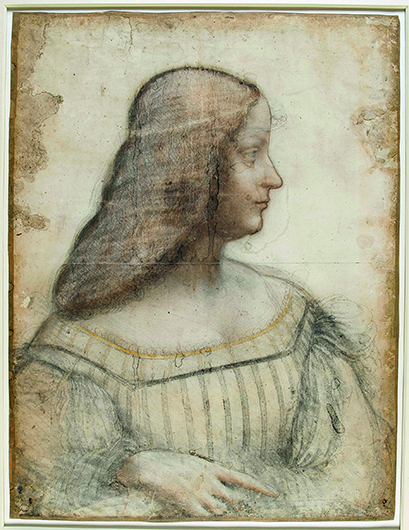 © Париж, Лувр Леонардо да Винчи. Портрет Изабеллы д'Эсте. 1499–1500. Грунтованная белая бумага, черный мел, древесный уголь, сангина, растушевка, пастель; 61×46,5
Совсем недавно был найден и живописный портрет, созданный мастером или его учениками после 1504 года на основе этого рисунка.