
Translated material
Reading space
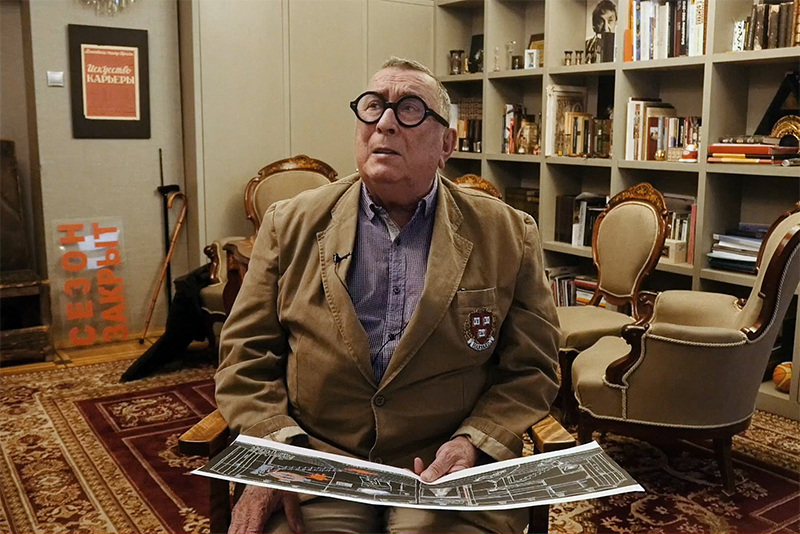
It is necessary to represent Sergei Barkhin for a long time-if you still imagine. The almost permanent scenographer of Kama Ginkas and Henrietta Yanovskaya from the first years of their work in the Moscow Youth Theater. In Soviet times, he collaborated with Yuri Lyubimov, Oleg Efremov, Roman Viktyuk and Valery Fokin, designed dozens of performances in the regions. Creator of the Faculty of Scenography in GITIS. In the nineties - the main artist of the Bolshoi Theater. Since the beginning of the tenth - ally of Mindaugas Karbauskis in the updated theater. Mayakovsky. And also - an illustrator, writer and playwright.
Barkhin was born in a family of famous architects. His grandfather and father built a constructivist building of the newspaper Izvestia on Pushkinskaya Square (the scenographer quoted this project in several performances). He also received a family specialty, but he worked a little on it - since the mid -sixties, the theater has become its main business. It is logical to wait for the functional scenery from the artist with the architectural background, which directed and reveal the actor, mainly his movements, and in themselves report a little: Meyerhold called such a scenography. But Barkhina's applied tasks occupied last. His space almost always contained a finished thought - and in the director with the artist it often needed less than they - in it.
In the conceptual decisions of Barkhin there was more from installation than from architecture - although the artist loved to use the architectural motifs of different eras (like ancient Egyptian columns in the "dog heart" of Yanovskaya). Barkhin was a master of narrative scenography - one of the very few in the country. His work had to be read.
For Medei, Ginkas, the artist came up with a pavilion, trimmed with a blue tiles. In some places there were not enough tiles, water stood on the floor, as if a pipe broke in the house. At first glance at the stage, the audience understood that the Colchis Princess was burdened by a family life and yearned for sea travels with argonauts. The pavilion was shared by a stepped rock that looked like a frozen stream of lava - as alien and wild as Medea herself. In one of his last performances, the “Oblomov” of Karbauskis, Barkhin alternated three household scenery, which did not differ almost nothing: the same layout, the same headset - only the colors are different. It turned out a self -sufficient visual story about a hero, unable to start a new life.
His work had to be read.
The artist turned to the cultural experience of the viewer, endlessly referring to painting, architecture, literature. In the “Notes of the Madman” (Ginkas), Barkhin settled Poprishchina in the Yellow House, hoping that they know what the dyshusquarters for the mentally ill were called in the hall. In the “Rothschild violin” according to Chekhov (also Ginkas), a landscape from the Rublevskaya “Trinity” was hidden behind the wardrobes-cupboards: waking up from the routine for the first time in many years, the old coffin returned from the material world to the spiritual. In a relatively new performance , “Elephant” according to the forgotten satire of Alexander Kopkov (Yanovskaya), Soviet peasants lived in a hut, similar to a Rodchenko working club.
Barkhin was a man of the theater in everything - in character, in work, in everyday life, in clothes. Ginkas recalls how the artist met guests in Hamlet's costume at a personal exhibition, and on the plane before the landing itself, he changed his mind in chavarys and Fesku to beautifully go down the ladder. In the sixties and seventies, when the advanced theater was fond of mean, harsh paints and rough natural textures - iron, wood, wool - Barkhin was the only one was not afraid of color, artificiality, frivolity. The decoration for Tartufu Lyubimov - the early work of 1967 in collaboration with Mikhail Anikst - did not at all resemble the brutal scenography of David Borovsky, who soon began to determine the familiar visual style of the Taganka: large gilded frames with dolls of the cardinal and officer hung around the edges, and a variegated gallery of old portraits from them stretched between them. slots for heads and hands. The main domestic scenography researcher Viktor Berezkin called Barkhin the first artist-postmodern artist on the Soviet stage-for irony, deliberate theatricality, craving for quotes and mixed technology.
In the Universe of the Barkhin-artist, there was no more important and more voluminous concept than the theater. The theater building was not just a platform for him, but a complex, multi -digit symbol. In the “Talents and Fans” of Karbauskis, the scenographer exposed a turning circle - he was alive, like a large norious beast, and only the artist Negina obeyed. Barkhin thought of Ginkas to play the “black monk” and “lady with a dog” on the balcony so that the black failure of the stalls worked as the background. The decisions were similar in form, but in fact: in the “Black Monk” the spacious theater hall embodied the megalomanian ambitions of Kovrin, in the “lady with a dog” - sea distance and freedom lost by heroes.
The famous "thunderstorm" of the Yanovskaya spectators looked right on the stage, surrounded by an undisguised machinery. Inspired by all mythology at once, the artist turned the stage into a model of the universe. The thin Volga flowed down the gutter behind the mirror door, connecting the country of the living with the country of the dead. On the shore of the stream, the world tree was growing, hung with Easter eggs. And at the technical gallery, real tiny lightning sparkled. The director and scenographer saw in the “thunderstorm” not a household drama, but a tragedy, and a tragedy in the ancient sense, when the hero sides not only with surrounding people, but primarily with the sky. The space of the tragedy is always space, and not some individual house.
Barkhin was a rare theater artist who really possessed this dying genre - although he rarely worked with him. No wonder he loved the Shakespearean “Globus”, an ideal tragic space, where the borders between the hall and the stage were not as such, and a canophine embroidered under the starry sky soared over the artists. In the early nineties, Barkhin even dreamed of building a wooden replica of the Globe in Moscow so that only Shakespeare's plays play there. It didn't work out.