
Translated material
Ericsson Mobility Report: Using mobile devices and mobile traffic in the world
On November 30, Ericsson published a report that has already become a traditional report on the use of mobile devices and mobile traffic in the world - Ericsson Mobility Report . In it, one of the leaders in the field of telecommunication equipment talks about the state of the industry, its successes and challenges, as well as about global trends.
Key data
2020 will go down in history as a year of global shocks that significantly influenced everyday life. And at the same time, this is the year when the world community has rethought the role of technology and made a giant leap on the path to digitalization. The need for good connection turned out to be fundamental, therefore the capacity and distribution of cellular networks, as well as the even more rapid and large -scale development of 5G technology, is inevitable. So, by the end of 2020, more than 1 billion people (15% of the population of the globe) will live in 5G coating areas. In 2026, there will already be 3.5 billion (40% of all cell traffic in the world).
Now the dominant cellular network is LTE: By the end of the year, it will increase the number of users to 4.5 billion, this is 57% of all subscribers in the world. But by the end of 2021, LTE will reach the peak of its distribution (4.8 billion subscribers), after which users will gradually switch to 5G.
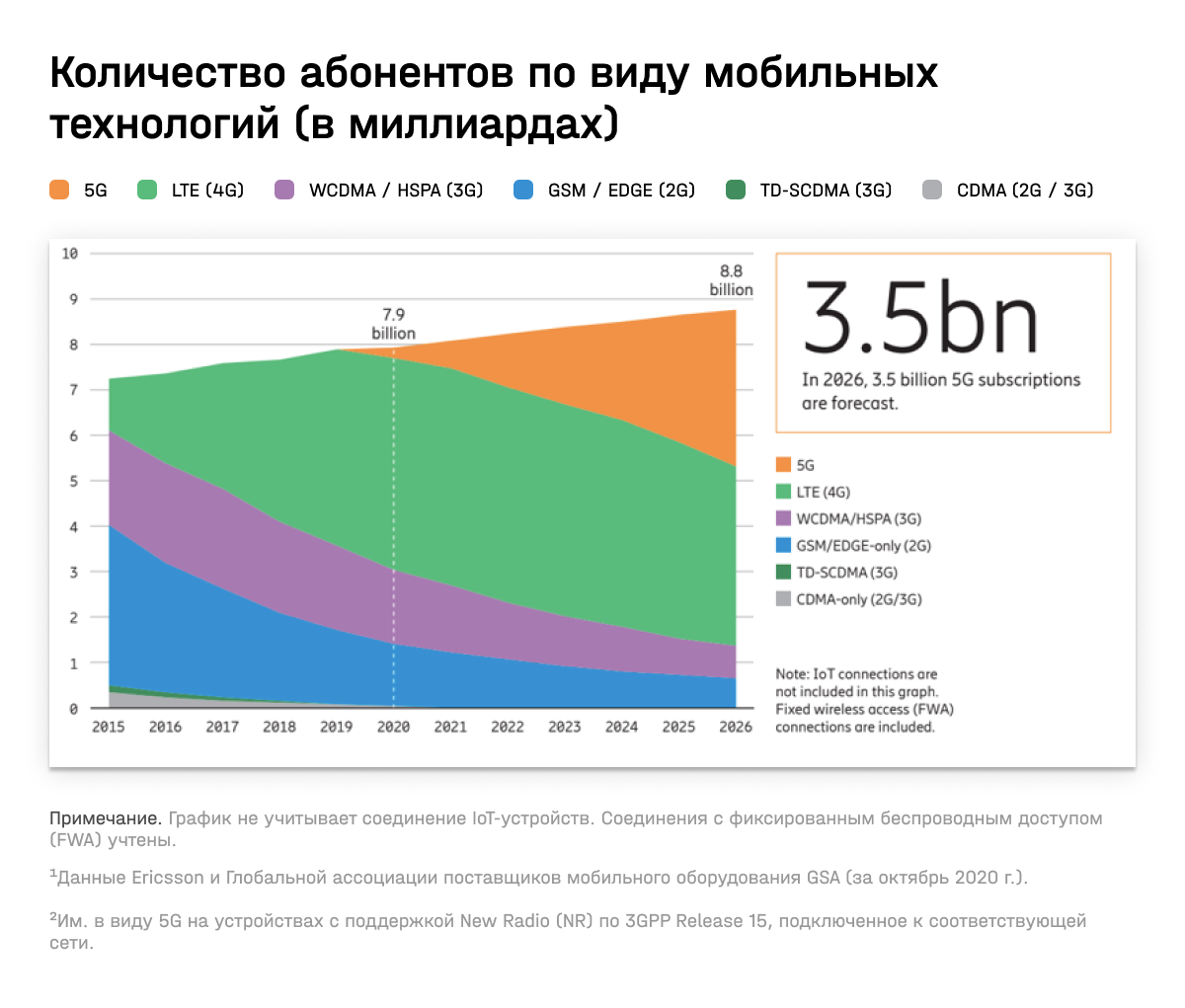
According to the authors of Ericsson Mobility Report, by the end of 2026, 91% of subscribers in the world will already have access to broadband mobile communications: it is 6.4 billion of unique subscribers and 8.8 billion subscriptions in total (despite the fact that the population of the Earth by this time will be about 8.2 billion, according to approximate estimates ). 85% of them (7.5 billion) will account for smartphones - against 75%, or 6.1 billion today.
The main increase in the distribution of 5G will be on China, where the development of technology occurs even faster than expected. The distribution of 5G in the country is part of the national digitalization program. The development is facilitated by the acute competition of providers, and also - the ubiquitous reduction in mobile devices. Today, North-East Asia as a whole is a region with the highest degree of penetration of fifth-generation networks. However, by 2026, according to Ericsson experts, the leadership will intercept North America, the share of the use of technology there will exceed 80%. At the same time, experts predict that “addiction” to 5G will be much faster than to 4G (LTE) after its launch in 2009.
New technologies bring the fourth industrial revolution closer
The improvement of communications, including the widespread distribution of 5G, is one of the elements of the so -called industry 4.0, it is also the fourth industrial revolution. Industry 4.0 implies an unprecedented level of automation, the use of industrial Internet of things (IIOT), supplemented reality (AR) and data analysis (for example, predicted maintenance).
It is not only about smart operations at the plant level, but also about all “invisible” and virtualized processes in logistics and supply. New generation communication technologies help small and medium -sized enterprises become more noticeable, entering global markets, increasing export, increasing their positions in the value of the cost of cost, and ultimately increase the level of national GDP.
Ericsson has its own solution - Ericsson Manuapacturing and Supply, it helps small and medium -sized businesses to deploy a smart production process - by connecting suppliers to a single ecosystem. In fact, Ericsson Manuapacturing and Supply makes it possible to control the availability of goods in real time, monitor distribution and sales. This significantly reduces production risks (for example, protects the cash register), helps to more efficiently manage resources, respond faster to economic changes and new requirements of customers, allows you to quickly introduce their products and deliver them to end customers, thereby increasing their loyalty.
Mobile networks, safety
2020 showed that cellular networks are a critical infrastructure. An example of this is not only the operational deployment of high-tech hospitals for patients with COVID-19, but, for example, forest fires in Australia (fire helped to track special mobile sensors in patrolling aircraft).
According to Ericsson, in the first six months of the Covid-19 pandemic, which is difficult to call otherwise, except for the emergency, the redistribution of mobile traffic has changed a lot. Of the offices and public places, he moved to the household (in the states alone, 60% of employees completely switched to remote work). People also compensate for the lack of personal communication with mobile communications - voice mobile traffic grew by 40%. All this creates an additional load on home networks and requires the deployment of technological solutions with greater bandwidth.
Even when the epidemic is over, technology will still be needed. So, high -quality communication is one of the cornerstones of telemedicine. Connected ambulances can in real time receive data on road traffic, choose the optimal route, share the status of a patient with doctors in the hospital. New communication capacities are needed for the widespread introduction of drones. For example, drones-policemen can provide an actual overview of the situation in criminal areas. Drones with temperature sensors can effectively detect new fires and help extinguish fires even before they grow.
The widespread deployment of fifth -generation networks will help to more effectively interact with quick response services - law enforcement agencies, employees of the Ministry of Emergencies, and doctors. Today they are still forced to rely on disparate and primitive radio systems, poorly integrated with each other. But high -speed mobile traffic networks should improve the situation.
The future is behind mobile games
The first game streaming services appeared not so long ago and were originally oriented towards consoles and PCs. Today, with the development of 5G and game cloud services, more and more people play smartphones and tablets. Mobile games already account for about 50% of the income of the world gaming industry, about 2.4 billion people play. Moreover, the most “mobile players” in Asia. Now it is the world's largest mobile games market in terms of revenue, its volume is $ 41 billion.
At the same time, by 2026, the market for mobile games will expect even more explosive growth. Firstly, the distribution of 5G technologies will increase by then by then, this will provoke the development of immersive games that require more throughput. Streaming games as a whole consume several times more data than a video stream of equivalent quality. This is due to the need for more speed coding of the video and data transfer speed (after all, no one loves when the game “hangs”). Reliable capacity for cloud games on mobile devices, according to the providers of the games, is about 10 Mbps per second.
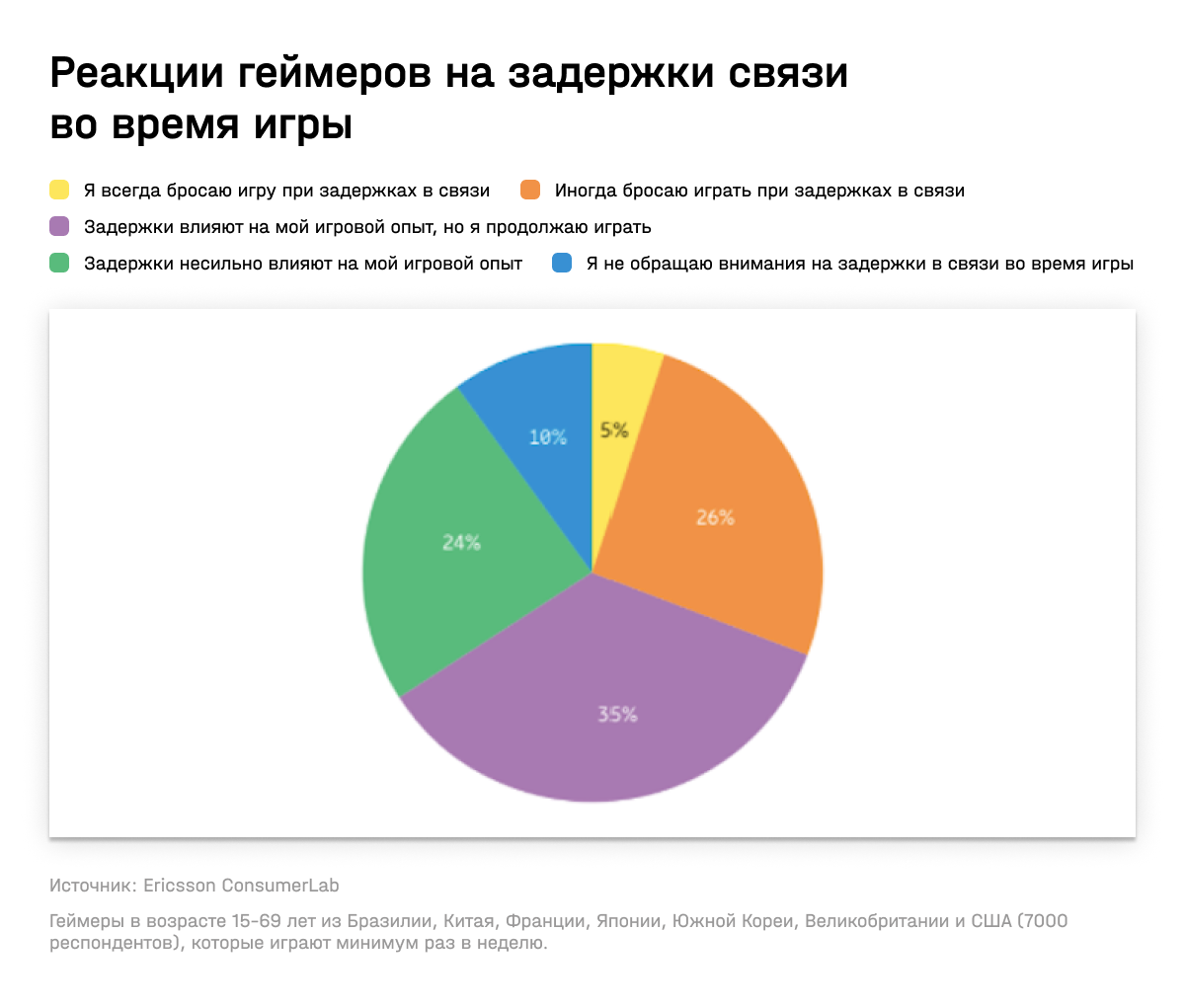
So, in 2019, Ericsson Consumerlab conducted a survey of 7000 players from the USA, China, Japan, South Korea and the three most “playing” countries of the world. It turned out that more than a third of them tend to throw an online group if the network begins to slow down. This is especially critical for those who prefer shooters and sports online games.
Secondly, the data centers providing the services of cloud storages, by 2026, will also obviously become more powerful. And in general, mobile devices in the world by that time will become more. All this will affect the growth of the market for mobile streaming games.
A good example of the development of the industry is South Korea. This country has a strong game culture, and professional gamers from Korea often lead in international e -sports competitions. The country has one of the highest performance of smartphones per capita, they became the most popular gaming devices. 44% of Koreans who play games on smartphones do this every day, while the average game time exceeds an hour and a half on weekdays and two hours on weekends. It is not surprising that three leading South Korean mobile providers united with large international gaming companies and now they offer cloud services for streaming games in subscription. In total, 19 of 22 Korean service providers have already been used by the subscription model for mobile games. It is expected that in the future operators will even begin to release their own mobile games in order to attract and hold new users.
What the providers should do to succeed in the market
Having analyzed the work of 300 service providers of high-quality services from 121 countries, Ericsson identified three main development scenarios that the market players follow. The first (19%) are leaders in the field oriented to quality strategy (Quality-LED Strategy). They seek to maintain leadership in terms of network covering, use the latest technologies to provide the highest quality and most uninterrupted service. Already 69% of such providers provide 5G technology for use on smartphones. Most of these companies in Western Europe, as well as in the Middle East.
The second group (28%)-ambitious players seeking to seize leadership by offering customers innovative services that the market had not yet seen (offering-led Strategy). They use modern technologies, such as AI, as well as an omnican client service, effectively combining universal offers with targeting distribution. In other words, it is important for them to promote the performance of their network among specific areas, for example, in the field of streaming video. 5G technology uses approximately 31% of such providers, while most of them in Central and South America, as well as in the African region.
The third group (38%) can be called followers-this is the backbone of the market that does not strive for leadership and at the same time supports a stable, but not high-class level of communication quality (Industry-LED). This group of providers usually adapt the innovations of more ambitious players to offer customers (usually people with a lower income level) products in their suitable price and quality ratio. Such a strategy is the most popular among providers of Central and Eastern Europe. The remaining 15% of the market, according to Ericsson, occupy weaker players.
And what about Russia?
According to Ericsson experts, the 2020 Russian telecom model can be called quite competitive: the penetration of mobile Internet is more than 90%, while the cost of services is relatively low, and the transition to a mobile broadband relationship is quite quickly. Thanks to the successful deployment of mobile networks in Russia, a strong ICT industry appeared, including the creation of high-tech services (for example, from Yandex and VKontakte), the rapid development of mobile banking and electronic commerce. However, this competitiveness can only be maintained due to the development of 5G. For this industry, you will have to overcome several barriers (spectrum distribution, technological neutrality in existing bands), ensure constant healthy competition and maintain global cooperation in the field of high technologies. This year, Ericsson set its own record for the deployment of fifth-generation networks: it launched 70 5G networks in 36 countries and concluded 116 commercial agreements in the field of 5G. In addition, Ericsson is constantly testing new technical solutions together with Russian operators.