
Translated material
The unmanned war of Yandex and Sberus, Tsuckerberg - Supergraduate and a new Apple hit on Qualcomm for chips
The topic of release is the unmanned war of Yandex and Sberbank.

Yandex has been working on an unmanned car for almost five years, Sberbank for about a year. Can he catch up with a competitor? We tell you what Russian developers have already achieved, in which they are inferior to American and Chinese, what tasks to solve and what is in the way.
The full text of this story can be read here .
Problems with the law
On April 1, Vladimir Putin instructed the government to develop a plan that would allow the roads to the roads without engineers in the cabin. The assignment is important, but it has not yet been fulfilled, although the term was until May 31.
The reason - the disagreement of the Ministry of Transport and the Ministry of Industry and Trade, was told by the two sources familiar with the situation, and confirmed the federal official. Putin was reported to Putin in a letter (he was seen by The Bell and two market participants) was reported by the first deputy prime minister Andrei Belousov. That, according to our sources, the ministries did not share:
- The Ministry of Industry and Trade wants to convey the role of the regulator of the emerging market for the Autonet working group of the National Technological Initiative (NTI, they said that this is not so). NTI is a state program for technology support, Autonet Group includes representatives of the industry, and they are headed by an official from the Ministry of Industry and Trade and the President of the Glonass NP.
- The Ministry of Transport opens against. According to The Bell, the ministry sees this in the role of a regulator of himself.
- The market participants do not like the idea of reducing the status of the topic that is inevitable when transferring curators from the government to the structure subordinate to the Ministry of Industry and Trade.
Most of all, the developers of drones are waiting for permission to remove test engineers from cars. Nobody is thinking about earnings on commercial trips now. It is much more important to gain experience and get answers to many small questions. How to sit in an unmanned taxi? What to do with the steering wheel - to put the castle? And with a driver’s place - to plant a doll on it? How to act if the passenger in the cabin felt uncomfortable? Now there are no answers to these and other similar questions.
In the April order of Vladimir Putin, it was said that the government should develop a plan with business participation. And the business has already presented its position: Yandex, Sberbank, KAMAZ, GAZ Group and Gazpromneft united in the group and at the end of April showed their plan to the government - it has not yet been approved.
Who is who in Russia
On the Russian market, only two major players, whom American companies consider as potential competitors. This is Yandex and Sberbank. The second title of competitor received an advance, thanks to his resources and readiness to invest in development.
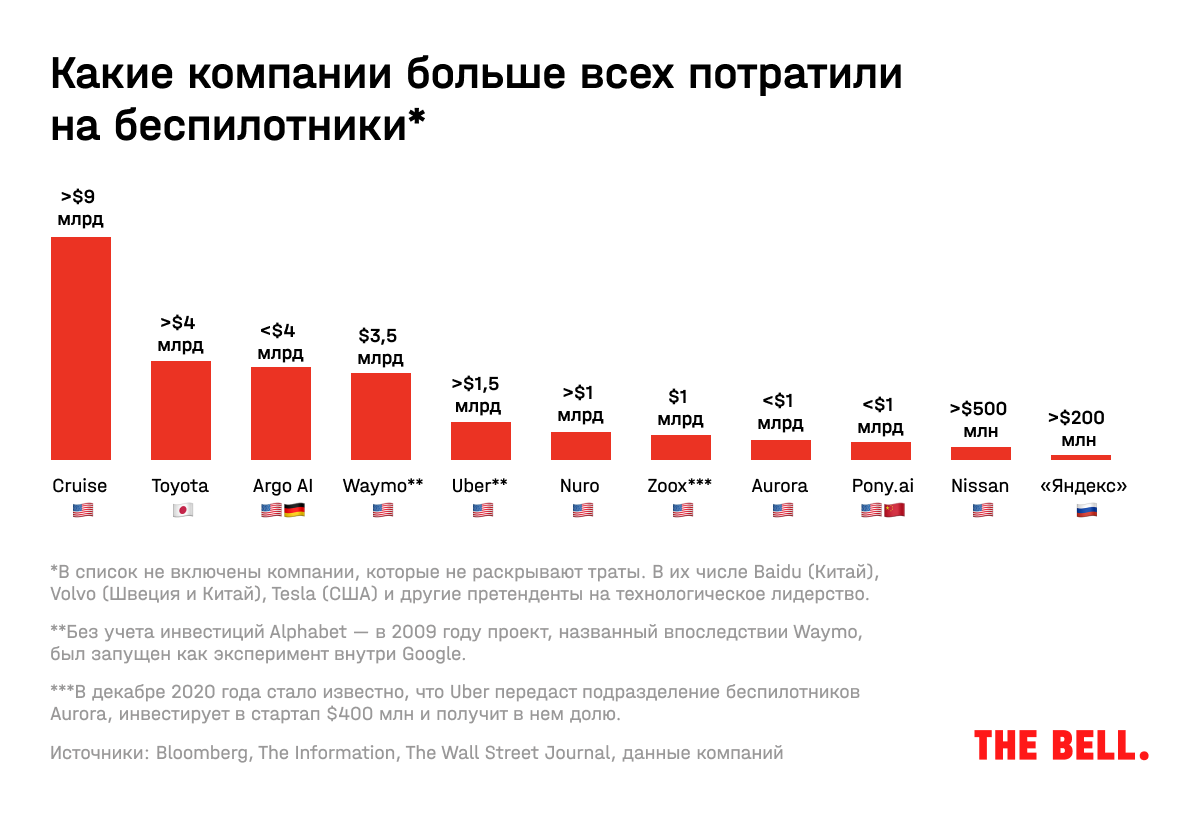
- Yandex has been developing drones since 2016, since 2017 he has been testing them on the roads. The park has 160 cars. In total, they drove 9 million kilometers in Russia, Israel and the USA - along with the American competitor Waymo owned by Google. In September, Yandex allocated drones in a separate company Yandex Self-Driving Group. The company has invested $ 150 million in this business. Now 73% of the shares belong to Yandex, 19% - Uber, the remaining - managers.
- Sber on the creation of SBERUTOTECH for drones just two hours after the announcement of Yandex about the creation of Yandex Self-Driving Group. The project is only a year. The Gosbank promised to show the first car at the end of 2020, but now this will happen in February. Recently, a video of the Sberban drone appeared on the Web. This is a KIA Optima car, on which very expensive equipment is installed: two 128 ray lidars. Yandex uses 32 ray lidars. In addition, the bank hired about 150 programmers and the head from Yandex.Avto Andrei Vasilevsky.
- Both companies (as, indeed, the leaders of the American market like Waymo) make completely autonomous drones based on optical sensors. There are other approaches, explains the founder of the Basetrack startup Andrei Vavilin: for example, Basetrack himself does not use optical sensors, and uses geoinformation data for positioning - but here we are not talking about a completely unmanned car.
- Another player is KamAZ. He also develops a drone based on computer vision. But its project is different: the KamAZ unmanned truck requires a constant connection to the network-by industrial Wi-Fi, 4G or a special VHF band (in emergency cases). So far, KamAZ has a concept , but no one saw the real tests of its drone, although the company has already spent more than 10 billion rubles on it, and at least part of them are state subsidies.
- The GAZ GARS itself does not make drones, but it provides its electric minivans for tests for startups: a group from MSTU named after N.E. Bauman and Basetrack.
- Gazpromneft also does not swing the drones itself, but is preparing to become a buyer of cars for its deposits. The company is already testing one of the Gazelle, as well as the KamAZ drone. “But here is also such a Russian history: companies should go to Khanty -Mansi Autonomous Okrug at their own expense, take its prototypes without TK and potential orders there. We have everything at the level of demonstrations, ”says Bavilin from Basetrack.
Who is who in the world
In addition to Russia, only the United States and China are seriously engaged in drones. Israel, where it would be possible to wait for the appearance of bright startups, is late with regulation, explains one of The Bell's interlocutors on the market. The main local developer of Mobileye was already threatening to leave for the United States if the situation is not resolved.
USA. This is an indisputable leader. Most companies testing their developments at a more or less serious level are based there. Originally from the United States and the most advanced and experienced player: Waymo. He has 600 cars. His story began back in 2009. Then it was a research project inside Google. Now Waymo is a separate company in the Alphabet structure. She attracted about $ 3.5 billion investments. Google and Alphabet for all the time invested about $ 10 billion in the project.
China. Not much is known about his successes. In China, a kind of approach, says the author of the YouTube channel about drones from California Mikhail Bakunin.
- The state makes a public infrastructure that supports drones: the car is driving, and city devices tell you when there is a red light, where the accident, etc. This system is called City Furniture, and it requires dozens, or even hundreds of billions of dollars of investment. China is ready to invest this money, but drones will turn out “on crutches”. Whether this will be able to work effectively, we do not know yet.
- China authorities easily adapt regulation to the needs of local startups. For example, they suddenly gave the go -ahead to travel without a driver. At first, the Chinese Autox allowed to carry their employees and VIP guests in Shanghai, then the same was allowed by Baidu. “In the USA, you need to test, provide data, prove that you will not kill anyone. China gives risk, ”says Bakunin.
Russia. Lagging behind the United States for at least 3-5 years, says Bakunin. “To make the car go independently, you need resources and three to six months of development, then you have an euphoria: an unmanned taxi is about to appear,” the expert formulates. - Waymo had such an euphoria in 2009. But after this the company took another ten years to solve the problem of the “long tail”. It is clear how the car behaves in 99% of cases. But with the remaining 1% you have to deal with a very long time. ”
- It is impossible to compare Yandex with the same Waymo by objective metrics. The developers of drones in the United States are required to report on the number of Disengagements - cases when the engineer in the cabin had to intervene in the management in order to avoid accidents. In Russia, such data is not disclosed.
- But even American companies are hard to compare among themselves, says the interlocutor of The Bell in one of the large companies in the valley. In California, reports on the number of Disengagements for a mile, but under Disengagements different companies can understand different things. In addition, some companies are tested by drones in urban areas with skyscrapers and large traffic, others in the suburbs. Comparison of their metrics will give little.
The problem with the auto industry
The big question that is now facing all the players is who will make cars for their unmanned driving systems. You can make drones from ordinary cars, manually - this is exactly what the market participants do now. But this is very expensive, says Bakunin: you need to redo half the car, and it can cost more than $ 100,000 per car. If conveyor production is not established, the company will never be able to earn it.
- Most of the startups designing drones, for this, sold shares of auto giants. For example, General Motors belongs to control in Cruise, Volkswagen invested in the American Argo AI, Mercedes-Benz makes drones along with Nvidia.
- Some of the companies did not sell a share, but concluded long -term agreements with large companies. The same Waymo has agreed several years ago with Chrysler , Jaguar , Volvo , Renault-Nissan . For some, the volumes of purchases are named - we are talking about tens of thousands of cars.
- Yandex also has an agreement - but of a different order. The company agreed with the “daughter” of Hyundai, the company Mobis on the development of a system of unmanned driving. So far, there is no talk of car supplies here - and this is a problem for Yandex, Bakunin believes.
- A large auto industry may not want to conclude agreements with Yandex due to geopolitical risks associated with Russia. And you can’t put such a drone on the VAZ - they have an obsolete control platform, and very advanced technologies are required here. It is quite possible to put a drone on a Japanese, Korean or Chinese car, but these automakers already have their own lines from startups from the valley - and Yandex can be difficult to compete with them. Sberbank will have exactly the same problems, Bakunin explains.
What's next
Now everyone is already clear that there will be no massive use of robotaxi as quickly, the interlocutor of The Bell in a large American company says: “Five years ago, we were sure that by 2020 drones would be everywhere, and now we do not understand how easy it is to scale this technology. Is it possible to transfer successful experience to San Francisco to another city? For example, in Pittsburgh, according to the rules, a car that stands at a traffic light and turns left, can go first, without missing the stream. A person reads this quickly, the robot needs to be explained for a long time and hard. ”
Monopolies
How Zuckerberg became a doctor of evil and a thunderstorm of competition
The US Federal Trade Commission (FTC), along with the authorities of 48 states this week, filed a long -awaited antimonopoly claim against Facebook - and its requirements were extremely gestured. The regulators asked the court to oblige Facebook to sell Instagram and WhatsApp, and in the future to request the approval of such transactions. Also, plaintiffs demand to prohibit Facebook to create anti -competitive conditions for developers. The social network was also called the social network in the American Congress: there they came to the conclusion that Facebook is a monopolist in the online advertising sector and in the social networks market. In the USA, the social network occupies 60.5% of the market in the number of users.
Special claims were caused by the purchase of Instagram (for $ 1 billion) in 2012. The congressmen admitted that this was a way to eliminate a dangerous competitor, and not save a promising startup. Now this is also said in the FTC lawsuit, and the expressions are used there are the most radical. In the case file, Mark Zuckerberg appears as a vile and predatory scandalist, a kind of “godfather” of the valley, literally vowing to destroy his competitors. That is, an entrepreneur from his beloved American startup has already turned into an avid villain not only in the eyes of radical members of Congress-and this is unlikely to mean something good for the social network.
Microcircuits
Newcomm
Apple is preparing to make its own modem for the iPhone to replace Qualcomm chips, Bloomberg said on Friday. Qualcomm shares due to this collapsed by 6.3%. The news should have expected: in 2019, Apple bought part of the Intel modem business for $ 1 billion, which helped the corporation to assemble a team of hardware and software engineers for their own developments. When Apple plans to introduce its own modems into cellular devices is still unknown. The latest iPhone with 5G modems also use Qualcomm chips. Two companies have a stormy history of relations with an extensive patent war, which can be read in detail here . The last licensed agreement between Apple and Qualcomm, acting until 2025, is considered the last victory: Apple pledged to purchase it for smartphones from 5G, but did not stop making plans for its own production. In November, she first presented new Mac computers with processors of her own production-ARM processors M1-instead of Intel products.
Read Later
- A few more stories about drones in the USA: how the Waymo unmanned taxi service works and why, although everything works quite well, it makes only 100 trips a week.
- How drum delivery can change our houses and cities and when landing sites for drones and mailboxes on roofs appear.
- How Huawei develops a technology for recognizing persons with the function of Uyghur anxiety, which can warn the Chinese police that Uyghur was walking along the street.