
Translated material
The thief must steer in the country
Why does corruption do not threaten the regime, but lies at its basis
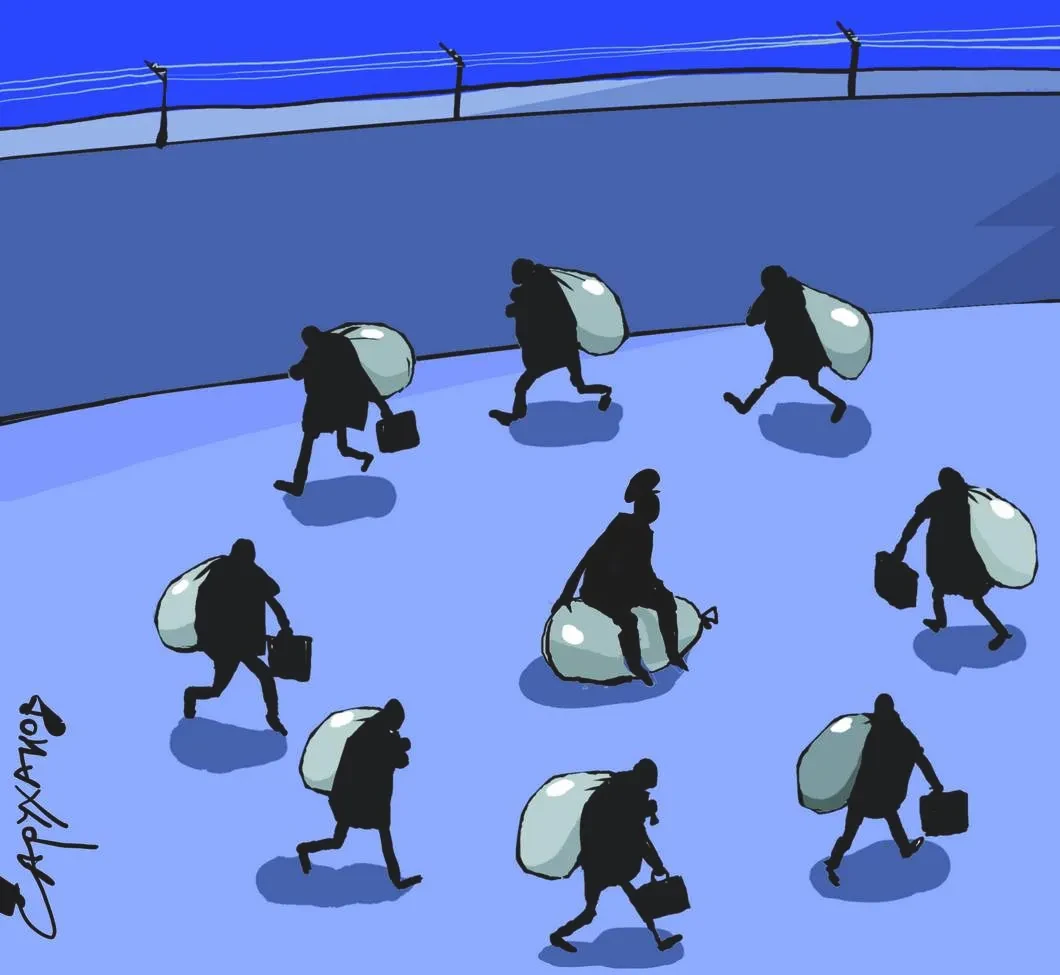
Every year, bosses report on the fight against corruption and their successes in this difficult matter. There is no doubt that during the hybrid press conference of President Putin on December 17, it will also be again about this. Why does the struggle not end in any way, and the level of corruption in Russia does not decrease? Let's try to figure it out.
The usual luxury
The rating of Transparency International-2019 puts the Russian Federation in 137th-between Paraguay and Papua Nova Guinea. However, the Russian “anti-corruption legislation”, that is, formal rules, where it is spelled out that the “bribe-byak” is not inferior to the same legislation in countries in which there is almost no corruption. And officials submit the declarations everything, and the law on public procurement will regulate every sneeze, everywhere there are commissions, checks, prosecutors ... How will you steal? But go - you can not count the stolen money for billions, but tons of large bills.
Another thing is interesting. Public passions regarding the stained officials, in theory, are designed not so much to punish corrupt officials as to prevent corruption in the future. But the arrests and courts do not affect the desire of the successors of the exposed twists to slow down their enrichment.
Demonstrative arrests and searches officials are treated as a “professional risk”. It happens that nothing can be done.
The wolf dragged - dragged the wolf.
At the same time, it cannot be said that the palaces on Rublevka, ocean yachts, automobile parks, harems from top models and a collection of watches are somehow especially hiding. Well, how can you hide the acquired?
The consumption of several thousand Russian ruling families is sometimes estimated at an astronomical amount of two hundred billion dollars per year - this is a little less than the expenditure of the state budget. But if it is necessary to explain the origin of this money-the bosses are doing this-here is the grandmother-businesswoman, here is the grandson-investor, here the daughter won the lottery, here my grandfather accumulated a pension, but I myself accidentally bought a package of shares, for money from the handled bottles. The scale of the luxury in which the Russian elite bathes is so large that they are no longer perceived as something unusual.
Effective corruption
Supporters of the version that Russian problems are a derivative of bossy theft are proceeding from the representation according to which the prevalence of bribes means the degradation of state institutions. An ineffective “chopping official” is opposed to an effective “honest official”. In this logic, the spread of corruption indicates the collapse of the state - it shows that the institutions that control officials do not meet the relevant requirements, which entails the destruction of state structures and makes the system weak and ineffective.

Why would you get this, the political scientist Keith Dardden (Yale University), the author of the study “The integrity of corrupt states: bribery as an informal institution” (The Integrity of Corrupt States: Graft as an informal state)? There are many countries “where the widespread corruption and stability of the state apparatus are combined. And there is no empirical evidence that bribery and state effectiveness negatively correlate. ”
That is, theft of officials is not an obstacle to the exercise of power. This thesis of Keith Darden proves simply and spectacularly.
How should the effectiveness of the state apparatus should not be evaluated in words, but in practice? Measuring and objective indicators of the efficiency of the power apparatus are the ability to collect taxes and the percentage share of general state expenses in GDP. Indeed, taxation is a very accurate indicator, because it allows us to measure the state’s ability to take away from you and spend in our own interests. “Without going into a discussion of the issue of what task the state should solve first of all,” Darden emphasizes.
The last addition is extremely important, because we are used to calling the “caring” state “effective” - which will cure patients, warm the frozen, protect the weak and feed the hungry. Yes, nothing of the kind, political scientists grin, do not confuse the effectiveness of power with goal -setting and motivation. The authorities can choose “care for people” with its goal, but is not obliged to do it.
And voting for a “strong state”, a person first of all votes for a boot that can step on his face if they order.
Having analyzed the level of tax collection and comparing it with the level of corruption in different countries, Darden discovered that the countries with the transcendental, by the standards of Transparency International, such as Nicaragua, Zimbabwe, Papua New Gueny, Kenya and the Russian Federation, are quite cope with the state task people of money and turning it into something important for the authorities. Another thing is that in Papua or Zimbabwe there is especially nothing to take away. But, Darden emphasizes, even the corrupt state squeezes these crumbs quite effectively.
Corruptions guarding the state
It turns out that corruption does not threaten the state? In principle, no, Darden will answer, it depends on what kind of corruption we are talking about. There is bribery, “weakening power”, there is bribery, “not threatening power”, and there is bribery, “strengthening power”! How does this work?
Where the institutions are legal, and administrative teams are given within the framework of the law, bribes may indicate the collapse of the administrative hierarchy. The problem here is not that the official will do what he was paid for, but that he will stop observing the laws.

Where the institutions of the authorities do not correlate with bribery, there is a "non -hazardous" corruption. These are the same “chocolate bottles” received by the official for the work that he had to do without an additional incentive. But, “if everyone admits that it is necessary to give a bribe to stimulate the official’s proper work, and everyone gives bribes (and everyone can afford it), a state of this type permeated with corruption differs from the work of the bureaucracy that does not take bribes by the method of distribution of private goods (from citizens to officials)”, Darden comments.
How does corruption work “fastening” the hierarchy? There are two mechanisms with which corruption replaces official legal institutions. The first time that the bribe is the “second salary”. In the framework of such an agreement, “income from bribery is in exchange for the effective implementation of the instructions of the center and the deduction of a share from these income.” Such an agreement compromises the principle of the rule of law, Darden explains, but "does not affect the administrative hierarchy and the ability of the state to act in a consented manner with the orders of the official leadership." The second mechanism is more important. “Breeding gives leaders new opportunities in the provision of unofficial pressure on their formal subordinates. The use of bribery as a widespread method of unofficial payments may not weaken, but to strengthen the control of the center ... "
Such coercion “through blackmail” can be more effective than coercion “according to the law”, explained Princess University Princess John Waterbury in an article with the characteristic name Endemic and Planned Corruption in A Monarchical Regime (“spontaneous and planned corruption in monarchical regime”). In a non -corrupted system, an official who refused to comply with the order risks, in extreme cases, a career and future income, but retains earned earlier.
In the corrupt system, disobedience will lead to a more serious punishment - the acquired will be taken away and not only.
If something is wrong, you will sit, says the senior chief of the younger, according to the law on the fight against corruption, hehe.
Where the society is split and divided, the laws are confused and contradictory, and the bureaucracy is not controlled by people, “widespread violations of the law may indicate the presence of reliable informal institutions, and not the collapse of the administrative hierarchy,” Darden emphasizes.
In a corruption impasse
Yes, that's right, the Russian sociologist Simon Cordonsky could supplement these words. “Russia after 1991 is an estate state. Unlike classes (groups that arise in the conditions of a market economy “naturally”), classes are groups created by the state “from above”. They differ in access to resources and benefits ... In the resource organization of state life, the rollback norm is a functional analogue of the price of money in a market economy. Without a rollback, “nothing would stand” and did not move. Another thing is that the price of money is set centrally, and the rollback rate is not set centrally. It is regulated by the scale and severity of repressions for the fact that the rollback exceeds certain never certain sizes. ”

In other words, “the stability of the managerial structure is achieved by a combination of incentives and restrictions arising from the controlled, monitored and systematic use of bribery”, Darden adds.
What do we get at the exit? The “strong state”, in the foundation of which is laid by corruption, can effectively collect taxes, organize construction sites, guard the boundaries, control people and crush political activity. Another thing is that it has no motives for economic growth and increase the welfare of society, because it poses a threat to him. The growth of people's income will undermine their dependence on the corrupt hierarchy.
In the meantime, Keith Darden states, “if the prevalence of corruption practices testified to the collapse of political power, then political leaders would have clear incentives to combat them.
But if bribery plays an important role in informal institutions of public administration and political domination, then the country's leadership has all the incentives for its maintenance. ”
And you say - the fight against corruption.