
Translated material
"They wanted to spit on the farmer." Why the import substitution program failed

The policy of import substitution, consider it, has failed, the report of the National Rating Agency, published in December, has failed: it was not possible to fulfill the plan according to key indicators, and the sanctions “prohibitory” still falls on the shelves. Russian manufacturers were not able to fully close consumer demand: somewhere the quality of products, somewhere-volumes. The correspondent of the North. Reali talked with farmers and sellers and found out what went wrong.

The Russian authorities announced the course of accelerated import substitution in 2014 in response to the sanctions of the United States and the European Union, introduced after the annexation of Crimea. Lesturing measures concerned officials, defense enterprises, support for Russian projects, as well as the export of goods, services and technologies to the Crimea. In response, Russia banned the supply of meat, fish, dairy products, cheeses, vegetables, fruits from the EU and the USA. A year later, Albania, Liechtenstein, Iceland and Montenegro were added to the lists, then the turn came to Ukraine. The authorities decided to reimburse the losses at the expense of Russian goods, especially since the course on import substitution was already assumed as part of the "State Program for the Development of Agriculture for 2013–2020".
After the sanctions, the program was expanded, plus in 2015 a government import substitution commission was created. In the north-west, the government has opened the center for import substitution and localization. The latest news on his website dates from July 2019.
In December 2020 , the national rating agency , which is part of the register of credit rating agencies of the Bank of Russia, decided to evaluate the results of the import substitution program in December 2020. The results of the study turned out to be disappointing: the volume of import of dairy products by the end of 2020 was to be reduced by 30%, but it turned out by only 20%. The import of fruit and vegetable products was to decrease by 20%, but fell only by 11%. The delivery of imported vegetables was reduced by 27%instead of the declared 70%. Only the meat industry was able to get to planned numbers: there imports were reduced by 65%.

According to the customs service, in January - September 2020 in the Pskov region, the import of food goods amounted to 12.8%. Most often, products are imported from the Republic of Belarus (23.5%), Germany (17.5%) and Latvia (9.1%).
“Let them stuff their program in the ass,” commented the successes of import substitution, farmer Alexander Konashenkov . He has his own KFH, he is a doctor of agricultural sciences, deputy of the Gdovsky District Assembly and President of the Pskov farmer association. The import substitution program, in his opinion, was written by a person far from agriculture, who "does not understand how it is built."
Sober calculation
“This could not have happened in five years,” says Dmitry Matveev , General Director of the Import substitution program, the general director of the Kabosh Group of Companies. - For comparison, a cow, like a woman, is pregnant for 9 months and, as a rule, wears one calf. At best, we can get milk after 2.5 years. The cows are not a pig, they cannot flide after 4.5 months in 12-14 calves.
The Kabosh agricultural holding, located in the Velikoluksky district of the Pskov region, turned out to be ready for import substitution policy. Shortly before the war in the southeast of Ukraine, the plant launched a fully automated line for the production of cheese.

-I understood that the state would once wake up and begin to think about how to protect the domestic manufacturer, and understood that there is a market in which you can earn. This is a sober calculation that was justified, ”says Matveev. -But the state did not act to protect the domestic market, but does it because of the political situation. Therefore, how quickly it was introduced, so quickly it will be removed. And now my company is preparing for the fact that the sanctions will be canceled. Any manufacturer does not want competition, but I think this is a good. Because any competition makes you stronger.
You liked some cheese, but the next day you came, bought the same brand in the same store, and there is already different cheese
Kabosh specializes precisely in the production of cheese, because before the sanctions the market was 50% filled with imports. He was replaced by a domestic "cheese product", but Dmitry Matveev intends to prove that "in Russia, cheese may not be just worse, but even better."
- Naturally, many Russian manufacturers began to make palm oil cheese, from anything, add any fats to reduce the cost of the product. What just fired the entire category. The second problem is the packagers. For them, the main thing is the price, they did not attach importance to quality. If you buy from the packages, today you can find Belarusian cheese on the shelf, tomorrow is cheese from Latin America, the day after tomorrow is some other. You liked some cheese, but the next day you came, bought the same brand in the same store, and there is another cheese, ”explains Cabosh CEO.

There are other objective causes of failure indicators, for example, the lack of raw materials and the market. Unlike other countries, the system of rural cooperatives does not work in Russia, and with each manufacturer of milk, plants have to conclude an agreement directly. Raw -wiring milk in Russia, according to Matveev, produces single enterprises: "Not because they cannot produce, but because, unfortunately, there are no bets on this from the state."
Even Russian mineral fertilizers are sold strictly depending on the course
In addition, the possibilities of import substitution paradoxically restraining the dollar.
- We take, for example, the production of milk. The technique that we buy, it is all imported. The equipment that we buy is all imported. The seed than we inseminate cows, drugs are all imported. Even Russian mineral fertilizers are sold strictly depending on the course, because their largest manufacturers are exported. And exactly the same situation in the processing of milk. We were horrified! Therefore, the growth of the currency is very destructive to us, ”says Matveev.
"We are bourgeois in their eyes"
Individual entrepreneur Anna Perova produces products under the brand "Cheese outpost". It all began in 2015 with cheese in a ten -liter pan for itself, "for neighbors", and now the cheese has a separate room. In 2019, Perova issued a loan in the Fund for Guarantees and Development of Entrepreneurship of the Pskov Region: more than a million rubles were needed to invest in the workshop and equipment. About 50 thousand rubles took to certify (a multi -level state audit, which includes a declaration of conformity, GOSTs, etc.), and so far each batch of cheese goes for tests to the laboratory - they cost about five thousand rubles. Anna expected to recapture the investments this year: she had agreements with restaurants and small St. Petersburg stores that specialize in wine and cheese, there was a department for trading in Pskov. But already in March, sales fell: all plans were shot down by the Pandemia of Coronavirus.
We, farmers, did not fall under state support measures, we are bourgeois in their eyes
-Of course, some are opening now, restaurants began to cooperate with us, which work in windows and delivery, but they have very small orders. They want to make a premium product, but there are not enough revolutions to buy expensive cheese. And under the measures of state support, we farmers did not fall, we are bourgeois in their eyes, ”says Perova. - After all, our milk does not stop pouring, the animals are alive. The "guarantee fund" gave a delay for six months, but this was not enough.
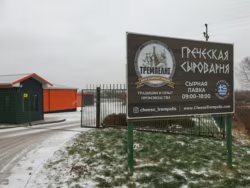
Svetlana Klimova and Stavros Trempelis moved from Greece to Pskovshchina a couple of years ago - “they chose Russia and brought their business here” - and in the summer of 2020 they risked opening the Greek cheese rhinar Trempelis in the Vaulino village. Representatives of the administration proudly called them an investor who "helped to come" from Greece to the Pskov region and gave a loan of five million rubles from the guarantees and development of entrepreneurship.
Those Pskovs who used to buy cheeses in the Baltic states came to us, tried and said that they did not need a "green card" more
- We believe that a project of import substitution was 100% successful for us, we process milk of the Pskov region. Those Pskovs who used to buy cheeses in the Baltic states came to us, tried and said that they did not need a “green card” more - they will buy our cheese. And we did not receive any support from the state, even there is no leasing program from the Ministry of Agriculture. We can’t buy a car, do not buy equipment. Here, as I understand it, there is no interest, ”says Svetlana Klimova, Director General of the Greek Syrovarn.
She says that in Greece farmers are always offered support programs. Cheese are especially appreciated by the one that offers assistance to companies purchasing milk.

- And in Russia at the moment we are not lending to banks, because we are a new enterprise, we do not have a large revenue. You are lending if the revenue is 2.5 million per quarter. And in order to get to her, you need money, ”explains Klimova. - And here is just a stick about the two ends. And we cannot take a loan for milk at 1%, but take a total of 13% in a commercial bank. And in Greece there are loans at the bank for rural business at 3%. Here we were offered a lot of things, and that’s it. Further point.
So that a small or medium enterprise can make a breakthrough, three components are needed: land, equipment and human resources
The chairman of the Council of the Pskov farmer association, the owner of the Manor of the Tits, Julia Roshchina was a successful trainer with her own fitness room in St. Petersburg, but in 2015 moved to Palkinsky district and began to restore abandoned apple orchards.
- With investment projects, we are far from as good as they say in the media. It is almost impossible to get a loan. For sums from 300 million and above, apparently, some of their own relations with banks are needed. Investments are a great difficulty. In order for a small or medium enterprise to make a jerk, three components are needed: land, equipment and human resources. But all this is tied either on a commercial loan or on investmentkredit, and small and medium forms of the economy almost cannot get them, ”says Roshchin.

Import substitution could have been successful if the grown fruits and vegetables were where to store. Each region should have a distribution center where it would be possible to rent products, and there they would be stored and distributed by shops, farmers say.
- This is a large project with very significant investments. So far, no one has decided on him, but he is necessary. Firstly, he will help to understand and calculate the real reserves that the region possesses-how much we can provide for ourselves. Secondly, this is a short shoulder from a farmer to the first buyer, who will be a distribution center. Perhaps he will be able to gather a cooperative around himself, ”Roshchin argues.
"It makes no sense to sell for nothing"
None of the North -Real Correspondent of the Severia of the Farmers is presented in federal and local retail chains. The arguments "against" are different for everyone, but the general message alone is unprofitable.
- I carefully read the contract with the Imperial shopping center and realized that if I accidentally hit at least one fine, I could not cover my expenses. There are very large amounts. The fine is issued, for example, for not putting the right amount of cheese. And it depends on how much milk will give animals, which are influenced by many factors, up to the sun today. And also food, for example, bought the wrong ones, and the animals fell ill, ”says Anna Perova.
Straighten payments for products for products are also prescribed in the contracts. For a small farmer, this is almost impossible
According to her, there are no large dairy farms, which, in which case, can “insure milk”, in the region, all their deliveries are painted to factories.
- Large networks immediately prescribe in the contracts delayed payments for products. For a small farmer, this is almost impossible, because we have a turn, we need to constantly spin. If there are no working capital, we will not be able to work further, which the pandemic showed - we reduced production to a minimum, - Perova admits.

She explains that there are farming cheeses for endurance, but there are young and fresh ones that give working capital. But the latter almost stopped buying.
-They need them to buy a piece of small, 150-200 grams of cheese, put in the refrigerator and at a small piece of spruce for a long, long time. And this is possible only with cheeses of long -term storage, ”the owner of the“ cheese outpost ”clarifies.
It is more convenient for me to work with small -optical supplies to small institutions and shops
Julia Roshchina, too, "nothing has reached retail": the residents of the region take everyone "and hide in the basements."
- "Pyaterochka", "Magnit" - definitely not. There are high requirements, large volumes are needed, and there is the most impossible point for me - year -round deliveries. It is more convenient for me to work with small -optical supplies to small institutions and shops. My main consumer is private customers who want to eat quality products and have the opportunity to store it in houses in small batches, says Roshchin.
Greek cheese from the Pskov district notes that access to federal retail chains can turn into a forced price reduction for them and, therefore, profit.

- Our buyer from the segment is an average plus. We are not presented on federal networks at all. And in principle, we don’t want to go there or go. Because it makes no sense to compete with synthetic cheeses of 600 rubles per kilogram. Our product is out of competition: this is a unique cheese on Greek technology. Now it makes no sense for us to sell our cheese for nothing, and they want to bring us to some price. But we will not reduce the cost, our higher quality, ”says Svetlana Klimova.
Director of the Kabosh Group of Companies Dmitry Matveev also relies not on federal, but on regional networks and independent retail.
-Firstly, it is easier to work with them, they are less capricious than federal networks. Second, we want to be more seriously represented. But we have products for restaurants, and this is the category with which we worked and will work, ”Matveev notes.
The director of the Pskov hypermarket "Imperial" Nikolai Rassadin in response to criticism replies that he cannot leave the shelf empty and, of course, will prefer the supplier that guarantees the desired volume of goods.

- Do not confuse Oleg's conditional farmer orphan and mass production. He has a single farmer product, he can build cheese residents and can provide it with 0.01 percent of the population of Russia. And there is the concept of a mass product. We do not take large volumes from farmers, we perfectly understand that we will not sell them. This product is more expensive, and it is new for the consumer, ”says Rassadin.
Trading points are forced to adapt to the crisis behavior of customers who are now choosing a product in a smaller volume and for a lower price, he explains.
- The higher the exchange rate, the greater the price of the goods delivered to Russia. Accordingly, the demand for imported goods is reduced, and the consumer will reorient himself, a family for domestic goods, ”said Rassadin. - Today we are actually not dependent on the external pork market. What was 6-10 years ago was heaven and earth. We stopped importing the chicken. Sometimes we buy a bunch for the production of cat, dog feed, because almost everywhere (excluding the border with China and the northern regions) they eat their own.
And the state wanted to spit on some farmer in the Gdovsky district
He advises farmers to unite in associations and more actively use social networks as a sales sites. He does not believe in help from the state.
- A farmer is a microbusiness that our state, sorry, has not rested in one place. Although for all economic theories, a developed state is more dependent on small and medium -sized businesses, but not in Russia. Here, the whole economy rests on state corporations. And the state wanted to spit on some farmer in the Gdovsky district. Yes, who needs it. He will survive so survived, but if he does not pay taxes, then he will be rendered on him, - Sorssin is convinced.
Interplanetary cooperative
Farmer Alexander Konashenkov believes that with the unification of peasant farms, everything is not so simple. Since 2015, he has been heading the farm association and doubled the number of its participants, but "it turns out slowly."

- This is all different from cooperatives in Europe and the USA, which are 200 years old. It is not so easy to create a cooperative from the association: trust is needed between people and adequate distances. We have a vegetable breeder lives 200 kilometers - well, what kind of cooperative I am in the area of the Cooperative if there are no farmers density? In some areas, we have not a single farmer at all! You can, of course, create interplanetary, - Konashenkov is ironic. He knows in the Pskov region only two truly large manufacturers of vegetables. - They periodically work with networks, but others, smaller ones, cannot. Networks need constancy, the price is cheap and it is still not clear what. Небольшим хозяйствам это не под силу, вот мы и продаем сами.
А у нас идиотское государство: нефть в два раза понизилась, а соляра повысилась!
Государство, с одной стороны, выделяет какие-то деньги кооперативам, но с другой стороны, сначала кооператив должен организоваться и продемонстрировать работу. Издержки не стоят возможной выгоды, отмечает Конашенков.
– Стало хуже работать, хуже с продажами, хуже с ценами, дороже составляющая крестьянского труда – запчасти, ГСМ, семена. Потому что доллар растет! А у нас идиотское государство: нефть в два раза понизилась, а соляра повысилась! – ругается фермер.

Он уверен, что "ни один "Кабош", ни один крупный свинокомплекс сельские территории не разовьет правильно".
– Спасут их небольшие фермерские хозяйства, которые будут заполнять пространство людьми. Если у тех будет возможность зарабатывать, то на первых порах они обойдутся даже без больниц и детских садов. А для того, чтобы была возможность заработать, нужны готовые построенные фермы и земля, на которых на конкурсной основе будут работать люди, – считает фермер Конашенков.
Норвежско-русский лосось
Еще одним результатом политики импортозамещения стал реэкспорт. Национальное рейтинговое агентство в своем исследовании отмечает, что поставки норвежской рыбы в Россию сократились – их заменили товары из Чили и с Фарерских островов – но параллельно втрое выросли поставки из Норвегии в Чили. Также на российском рынке увеличился объем китайских овощей, это совпало с трехкратным ростом поставок из ЕС в Китай.
– Я допускаю возможность, что у меня в магазине лежит норвежский лосось, который куплен и расфасован корейцами. Это общемировая практика. И египтяне могут купить норвежского лосося, расфасовать его и поставить как египетского. Цена при этом обязательно изменится, дешевле было купить у норвежцев, – говорит Рассадин.
Государство ведет непредсказуемую политику, в которой нет жизни долгосрочным проектам
Лосось этот может быть даже не норвежским, а российским. Просто наше государство не хочет вкладываться в переработку рыбы, объясняет Николай Рассадин:
– Это длинные деньги, в которые никто не вкладывается, потому что государство ведет непредсказуемую политику, в которой нет жизни долгосрочным проектам. Поэтому мы вылавливаем рыбу, продаем корейцам, японцам, тем же самым норвежцам, англичанам. А потом вынуждены покупать нашу же рыбу у корейцев.

Дмитрий Матвеев информацией о реэкспорте тоже не удивлен. Ключевой страной называет Беларусь:
– Я всегда говорил, что, если не закроем границу с Белоруссией, то будем потреблять те же самые продукты, просто в другом виде и немного в другом количестве. Недавно я делал в Сочи доклад о сырах и, когда готовился, взял статистику Беларуси. What did I see there? Производство сыра у них выросло на 40% с копейками. А производство молока на 8% процентов. А теперь скажите, как можно увеличить производство сыра на 40% и увеличить производство молока на 8%? Я в 2015–2016 году объезжал заводы в Польше и практически на каждом видел белорусские грузовики с молоком.
Впрочем, пример реэкспорта с Чили – не самый удачный, считает Матвеев. Более показательна ситуации с Арменией, которая вдруг начала в большом количестве производить горгонзолу и другие твердые сыры. "Я думаю, что это украинские сыры, которые поставляются в Армению, а там переклеивают этикетки", – говорит он.