
Translated material
Another present
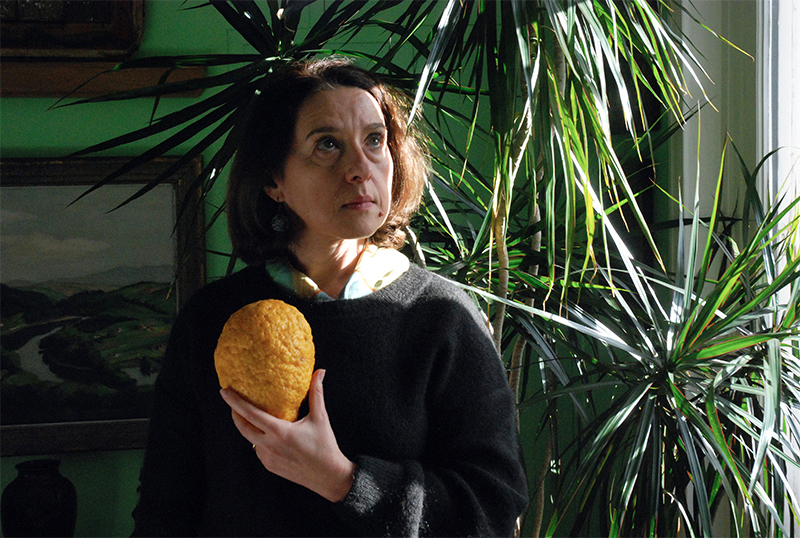
A novel in three in no way connected, in no way (seems to be) stories that do not send each other? Does this happen? Hm.
(That is, it is already clear what happens; it remains to find out the meaning of such an enterprise, which we will do.)
Yes, the three components of the book are self -sufficient and, moreover, difference. Before us are plots from European life at three of its arbitrarily taken points, far spilled in time. There are no clear dating here (which, one must think, is fundamentally; a little later we will return to this consideration), but it is easily guessed that it is, respectively, the early revival (the author’s afterword, along with the annotation, is attributed to the first of the stories of the book, about Princess Ivonne, to the Middle Ages, but Italy in which Ivonna comes across undoubtedly discovers undeniable Renaissance features), the 18th century (the history of the widow of Berto, the owner of the publishing house in the French province) and the blurry borderlands of the 19th-20th centuries - probably the beginning of the XX , because, already in the afterword, the hero said that he was born "at the end of the nineteenth century" (the history of the Polish anti-anti-native of Pavel Nekhevsky). These stories are presented to the reader, however, in a chronological sequence, which already reduces the degree of accident. The geographical points to which what is tied is grouped in Europe, almost exclusively Western and Romano -speaking. Italy, France, again Italy (and before - a little Britain and perhaps very little Poland, where the father of the hero of the last part of Pavel Nekrevsky came from, but this country, Pavel, is never seen, gave him, however, not in sensations, but in other people's nostalgic memories and much more fantastic than real. The mother of Paul is a French woman, and therefore a little France).
The life of the French widow of the 18th century in the second part and the Polish philologist, the London native and the Roman resident-a European pre-war citizen, to the First World War, Victorian-founding world-in the third are told carefully recreated both at the lexical and intonational levels of the typical language of the literature of the corresponding time, more precisely, the language of its qualitative Russian translations. We read as if (recognizable!) Translations of the unwritten one - however, one that could well be written and created from a substance of the same that many works, safely written, published, read, compiled background and inner rumble of time and sunk into oblivion. In these two cases, we are dealing entirely with the art of possible.
But there is an exception, and it is especially interesting. This is the story of Princess Ivonna, by the will of the fate of illiterate and at first perceiving everything that is happening with her, completely besides the literary conventions of any time and place. “They knocked and entered, as always, without waiting for an answer. She did not know, she never knew whether she had to answer. No one explained to her. But since they always entered, without waiting for an answer, she decided that it was not necessary to answer, but maybe even not allowed. The three of them entered, but only the main one spoke. The other two stood behind him somewhat at a distance. So she saw only half of the head and body of the left and right leg and the Kuaf of the right. ” She (at the beginning of the chapter dedicated to her; then is more complicated) lives exclusively by sensual impressions, the nature of which stands behind which does not know and does not play: “The doctor raised her hand, then another. He watched everywhere and said that with his elbow where she has any distinctive features and moles. She did not move. It was impossible. I looked right in front of me, where there was nothing and nobody. Even when she was bathed, it was impossible to look into the water for reflection. It was forbidden. Of course, she could quickly, quietly look, but there was no need. I liked to drive secretly on your teeth more. There were several more pieces that she learned to do secretly. ”
True, this line is a well-read and sophisticated author, strictly, does not fully stand it, nevertheless succumbing to the philological temptation to supplant the almost documentary speech of the simple-minded speech of the literary speech, with all its characteristic for time, carefully modeled features, with all the abundant, complex cultural memory (and thereby unforeseen-and is it so motivated? heroine).
This is how the events of the life of Ivonna are described at the very end, after ... oh, there are no: no spoilers! - In general, at a new stage of its development: “After portrait, she went to the studiolo to engage in science. Benedetto was waiting for her there. He took out speculum, and she looked at him for a long time, and he explained to her about her with a dad’s deceased likeness. Then he showed her various entertaining wonders and miravilles, like an unear or mummy. He took out the crystal vessel certainly, explained in detail what is portrayed on it. And about the triumph, and about the slave, and about Memento Mori. And if he inaccurately told or changed something in the details, then she corrected him and angry, because she already understood this story for a forces. So, having studied with Benedetto science, she he herself took out of the chest of precious matter velvet, embroidered with grenade apples. Stroking it, she inaudibly recalled to herself that there was a longitudinal thread, and there was a transverse one. And that one without the other it is impossible to compose matter in any way, and was happy about this knowledge of the things deep, invisible, and the word thread, and the word matter. ” (Here, by the way, it was very curious, as a simple-minded consciousness-if there was a translation before us, its original would, of course, be written in vulgar Latin-gradually seizes an education sitting on it, thereby revealing that the consciousness was not so simple-minded-it was simply not known about it. So when the author calls Ivonnu “Princess-Durochka”, this It suggests that sometimes the authors are unfair to their own heroes.)
Or, or rather, here from some considerations unknown to the reader - but it will never hurt to guess in guessing and speculation - they compete two narrative modes: extraovitative and literary, and this latter eventually wins.
Of course, because the first is actually also literary.
In fairness, I must say that the other two chapters are much more solid in stylistic terms.
Of course, each of these stories, quite standing on its own legs, could be told separately. But, being reduced together, they, without a doubt, begin to shine through each other: only the fact of including these stories in a common sequence, the proposal to perceive them together changes the angle of the look at each of them and turn them into a whole. No, not on the principle of “thesis-antitisis-synthesis” and, perhaps, not even on the principle of consistent development-from part to part to part-some idea or a combination of intuitions (although, perhaps, the reader will feel something like that and to look out for these intuitions-and has the right to succumb to it). Here the matter is clearly deeper and more complicated.
Of course, all these stories are interconnected. First of all, as islands belonging to the same array, holding on the same geological plate invisible under the waters. But, moreover, even - that as if not obvious - common heroes and a common type of plot, its common scheme. We can briefly designate this scheme as the acquisition of the unforeseen; General heroes - love in a) its possibilities and impossibility; b) the variety of her appearance, attachment not only to a person of the other sex-the story with the traditional female-Muzhsky mutual attraction here is generally only one, and this only emphasizes how much it is a private and non-prevailing case. And yes, immortality.
This is a romance of vengeance to other lives, in different sensitivity systems, in different types of views. Strictly speaking, it has long been known that this is precisely this literature is usually engaged in; But here all this happens emphasized, concentrated, and other tasks, no less legal and traditional for elegant literature, are such as stylization, parody, philological experiments and subtle philological games for understanding - are in service roles and work on the main task.
As for the genre of this text that is not deprived of the mystery of the text, I will undertake to attribute it to the fact that with the light hand of Evgeny Vodolazkin, developing and clarifying the once ironically, almost jokingly the concept he proposed, can be called a “non -sistortical novel”. This is, that is, such a narrative about the past, even with a thorough reconstruction of it will accept it, in which it is important, however, not a story (and even more not its big processes and trends) and not the past at all, no matter how diligently and accurately it is recreated. And it is important here is another present . Life is important in her momentary - “different” except in relation to other details and conventions unusual for us, from which it is cast and on the material of which it lives.
By the way, it's time to recall the fundamental absence of accurate dating, which we paid attention to at the very beginning. This absence, on the one hand, can rightfully be considered as one of the forms (developing) games with the reader: everyone has the opportunity, calling for help their erudition and reference literature, zeal in a more accurate localization of what is happening on the time scale - thereby expanding their own horizons. Well, for example: the word “Kuaf”, which flickered on the very first page, was called, as the 1997 Encyclopedia of Fashion, a male headdress, reported (there was a female version, worn in the IX - XIV centuries , but our kuaph is clearly decorated with a male head), which was a “type of hood with a long tail, it descending it, it was descending it, it was descending it. Wore in bad weather. " The answer to the question “when” becomes, thus, noticeably clearer ... But if it were really important - believe me, the author, reaching in his meticulousness, sometimes almost up to boring, would have said so. The fact of the matter is that the exact dating is not required: the characters whose horizons (and not our with you) will reconstruct the author, and so well know their own when . No one constantly holds in the head, in which year he lives: we all know this background knowledge . And the heroes of Medvedkova is no exception. The reader is immersed here in no history, but in another, with all the immediacy of the present.
By the way. As fundamentally as dating, there are no comments in the book - explanations of abundantly mentioned historical realities. No wonder: for heroes they belong to the horizon of evidence that they do not need interpretations.
And by the way. As a legitimate, meaningful part of the novel text, the afterword should also be considered, in which the author explains why and obeying what motives it was written - and thereby handing us (another) the key to the triple door constructed by it.
In the postparties, Olga Medvedkova, the French writer and art historian of Russian origin (some features of her biography are also revealed to us here), leads the reader, it seems, a little to the side of his true intentions (that’s right - otherwise it will be uninteresting), explaining what is happening in the book as follows: “In the non -worship of circumstances and events, all three are looking for love and immortality.”
Let me. But they are not so looking for all named - whoever turns out to be (no matter how it turns out) the subject of love and no matter what is understood by immortality.
Neither Ivonna, nor the heroine of the second story of Tuanette, the widow of Berto, are not looking for love for sure: the first does not have about her for the time being the slightest performance, the second, struck by love suddenly, even resists her (the other question is unsuccessfully), and both of them are caught by her completely by surprise. In fairness, we note that Ivonna invents his version of immortality - but, however, he is not so much looking for him as he actually finds ready. But Tuanette, it seems, immortality does not care at all, it is captured by much more earthly things. As for Paul, his relationship with different girls, located on the periphery of the narrative, obviously does not form the main semantic line: true love of Pavlova life in a sense with him from the very beginning; The earthly variety of immortality - the villa on the Anti hill in Rome - he creates his own hands.
Yes, immortality, immortality ... In it is the whole thing, and in search of it, it seems, the author himself is primarily (a)-sending heroes to reconnaissance as their agents.
And, most importantly, she certainly takes on the desired!
Igor Gulin in his recent review of “Three characters ...” wrote that all three stories - about the miracle of human transformation, the awakening of each of the heroes to the true one. This is fair - at the end of each of them the hero really turns out to be at all what he entered her. But the fact of writing a book is the story of the transformation of its author! With Olga Medvedkova herself, exactly with her heroes, something, according to her recognition, also happened, the opposite of all expectations. Living in France for thirty years, all this time she wrote in French -both scientific works and art prose, and "mostly about Russia or Russians." This is her second book (and the first artistic), written in her native language (preceded her last year a biographical study on Leo Bakst “Portrait of an artist in the image of a Jew”) - and we will not find a single Russian here.
Immortality is the implementation of what before did not suspect its possibility.
By the way ... In the book, at least in one of the cases - Pavel Nekrevsky - looking into a parallel history occurs. It is largely similar to ours, however ... It is not strange that our temporary stream, for example, remained unknown to such an outstanding literary monument as “Song of the Death of Adalbertova”, “The Great Poem of the Slavic Middle Ages”, of which Pavel Nekhevsky became? ..
Then the reader guesses: what if the matter is not (only) is that here the author plays with the story of “Words about Igor’s Regiment”, with which “Song ...” discovers suspiciously many common features? What if we have a different world before us - with a different culture, otherwise organized by memory? (And did the previous stories have not happened in it either?) Maybe that the world did not happen in that world, and everything that followed it? And how to get there? ..
In any case, (happily gained in the book) immortality is the opportunity to live other lives as their own - here and now, the equality of the former and unprecedented in ontological status. And is it not precisely - the development (this minute of the resident) of immortality - the literature has been engaged in time for centuries?
Olga Medvedkova. Three characters in search of love and immortality. - M.: New Literary Review, 2021. 288 p. (Art series)